
You’re bouncing your leg under the desk. Again. Or clicking a pen. Or humming without realizing it until someone gives you a look. If you have ADHD, there’s a decent chance you’ve been doing some version of this your entire life without knowing it had a name.
Stimming is one of those things that makes perfect sense once you understand what’s actually happening in your brain. It’s not a nervous habit. It’s not a lack of self-control. It’s your executive function system doing what it can with the resources it has.
This article breaks down what stimming is, why ADHD brains do it, how it connects to executive function, and what to do when your stims are working for you versus when they’re getting in the way.
TL;DR: ADHD Stimming at a Glance
- ADHD stimming is repetitive movement, sound, or sensation that helps regulate focus, emotion, or energy. It’s short for self-stimulatory behavior.
- Common examples include leg bouncing, pen clicking, hair twirling, humming, skin picking, and doomscrolling.
- Stimming serves a real purpose. Research from the UC Davis MIND Institute found that fidgeting actually helps children with ADHD perform better on complex tasks.
- The executive function connection is central: when working memory, attention, or emotional regulation is taxed, stimming compensates by providing sensory input the brain needs to stay engaged.
- ADHD stimming and autism stimming overlap but tend to serve different primary functions. ADHD stimming is more often about increasing stimulation. Autism stimming is more often about managing overstimulation.
- Stimming is only a concern when it causes physical harm or significantly disrupts daily life. For most people, it’s a functional tool worth understanding rather than eliminating.
This article is educational, not a substitute for professional evaluation. If stimming is causing you distress or you’re unsure whether what you’re experiencing is stimming, a tic, or something else, a qualified professional can help sort that out.
What Is ADHD Stimming, Really?
Stimming is short for self-stimulatory behavior. It covers any repetitive action, movement, or sound that a person uses to regulate their internal state. Tapping, rocking, humming, chewing, picking at skin, clicking a pen, bouncing a leg. These all count.
Most people stim to some degree. Drumming fingers during a boring meeting or twirling a pen while thinking are common enough that nobody blinks. The difference when you have ADHD is frequency, intensity, and function. When you have ADHD, stimming isn’t incidental. It’s doing something your brain genuinely needs.
That’s the part most articles miss, and it matters.
They list the types. They tell you when to worry and suggest you “try alternatives.” But the question worth asking is: why does your brain reach for this in the first place? The answer has everything to do with how executive function works, and where it runs short.
Common ADHD Stimming Examples
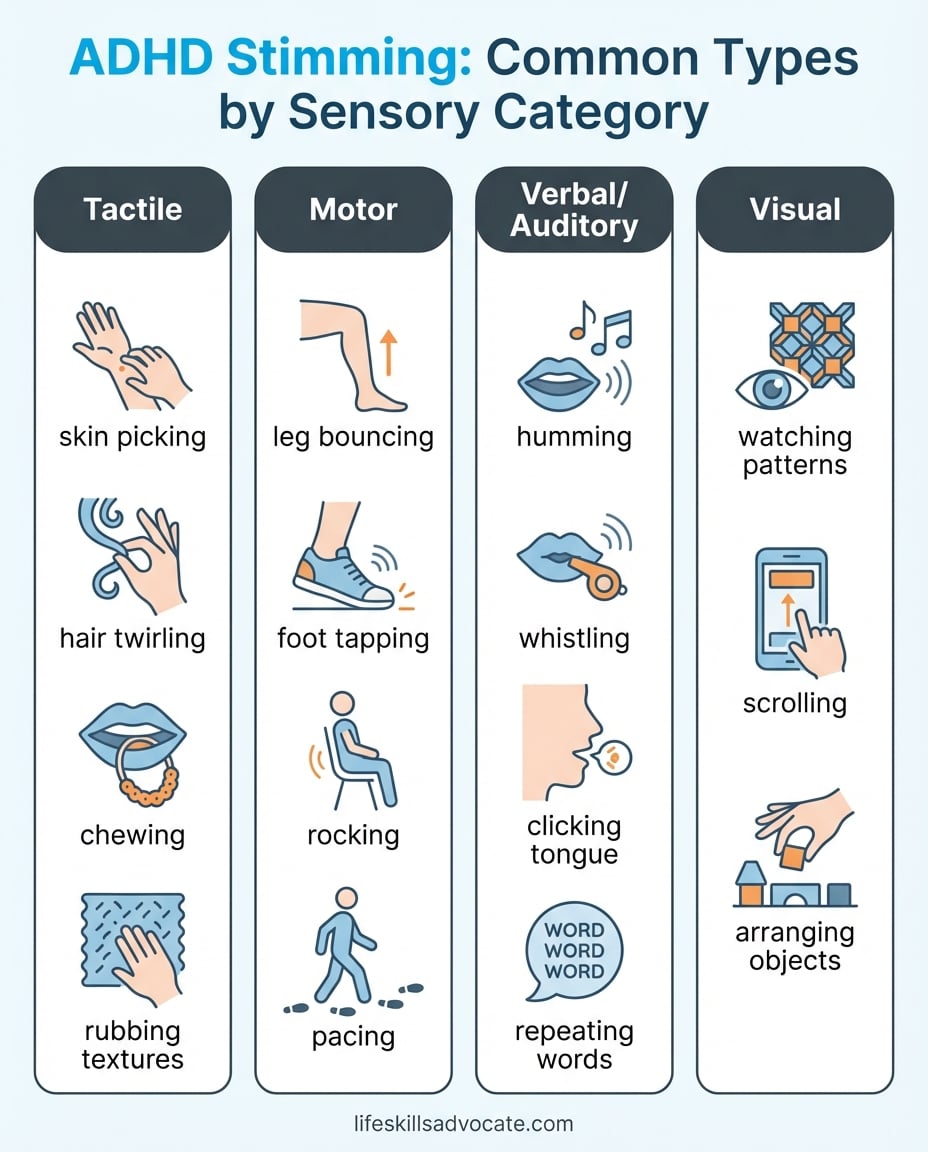
Stimming shows up across every sensory channel. Here’s what the most common examples actually look like, organized by type.
Tactile (Touch)
This is the biggest category for most adults with ADHD. Skin picking around the fingernails. Rubbing a textured surface. Chewing on pen caps or the inside of your cheek (some people redirect this to a chew necklace designed for sensory needs). Hair twirling or pulling. Running your thumb along the edge of your phone case. These are the stims most people try hardest to hide, partly because some of them leave visible marks.
Motor (Movement)
Leg bouncing. Foot tapping. Rocking in a chair. Pacing while on the phone. Shifting position constantly. If you’ve ever been told to “sit still” and felt like they were asking you to hold your breath, that’s motor stimming doing its job.
Verbal and Auditory
Humming. Whistling. Repeating a word or phrase under your breath. Clicking your tongue. Making little sounds while working. Vocal stims tend to draw the most attention in shared spaces, which makes them the ones adults suppress first. That suppression comes at a cost, which we’ll get to.
Visual
Watching repetitive patterns. Scrolling through content without really absorbing it (yes, doomscrolling can be a stim). Arranging objects on a desk. Flipping pages. Staring at a flickering candle. Visual stims are easy to mistake for zoning out, but they’re often the brain reaching for input.
Why ADHD Brains Stim: The Executive Function Connection
Here’s where the conversation usually stops at “boredom” or “anxiety.” Those aren’t wrong, but they’re surface-level. Stimming is a self-regulation response, and self-regulation runs on executive function.
Working Memory and Sustained Attention
Working memory is your brain’s ability to hold information while using it. When working memory is taxed, which happens faster and more often with ADHD, the brain looks for ways to stay engaged. Stimming provides a low-level sensory input that keeps the system from dropping offline entirely.
Researchers at the UC Davis MIND Institute found something that confirms what a lot of ADHD adults already know: fidgeting actually helped children with ADHD perform better on complex working memory tasks. The movement wasn’t a distraction. It was a workaround. (Working memory load, by the way, is the thing that kills most “just try harder” approaches to attention.)
Emotional Regulation
When emotions spike, whether from frustration, excitement, or the particular brand of dread that comes with opening your email after three days of avoidance, stimming acts as a pressure valve. The repetitive motion or sound gives your nervous system something to do with the energy that would otherwise sit in your chest or your jaw or your fists.
A study on executive functioning and emotion regulation in ADHD found that stronger working memory predicted better emotional regulation. When working memory is depleted, emotional regulation gets harder, and stimming fills the gap. It’s not a lack of control. It’s a compensatory mechanism.
The Dopamine Factor
ADHD involves differences in how the brain processes dopamine.
The short version: baseline dopamine tends to run lower, which means the brain is frequently looking for stimulation to close the gap. ADDitude Magazine explains this well: the ADHD brain is “wired for novelty,” which makes routine tasks feel almost physically uncomfortable.
Stimming provides a small, controllable hit of sensory input. It doesn’t replace dopamine, but it gives the system just enough to keep going. That’s why stimming increases when you’re bored, understimulated, or stuck on something monotonous. Your brain isn’t misbehaving. It’s doing its job with limited resources.
| Fact | Detail | Source |
|---|---|---|
| Stimming is common in ADHD | Self-stimulatory behavior serves attention regulation and emotional management in ADHD | ADDA |
| Fidgeting improves ADHD task performance | UC Davis MIND Institute research found movement helps children with ADHD complete complex working memory tasks | CHADD |
| ADHD and autism stimming differ in function | ADHD stimming is primarily motor-focused and linked to maintaining focus; autism stimming is more varied and manages sensory overload | Oroian et al. (2024) |
| Executive function connects to self-regulation | Intact executive functions are required for effective self-regulation; deficits explain why stimming compensates | Russell Barkley |
| Working memory predicts emotional regulation | Stronger working memory is associated with better emotion regulation and fewer ADHD symptoms | PMC (2022) |
Is Stimming ADHD or Autism? Both, and Here’s the Difference
This is one of the most searched questions around stimming, and it deserves a clear answer. Stimming happens in both ADHD and autism. It’s not exclusive to either.
A 2024 comparative analysis published in European Psychiatry (Oroian et al.) looked at self-stimulatory behaviors across both conditions.
The key finding: both groups stim, but the patterns differ. In autism, stimming tends to be more frequent and varied, often serving to manage sensory overload. In ADHD, stimming is typically motor-focused and linked to maintaining focus or releasing excess energy.
It’s not either/or.
The simplified version:
- ADHD stimming is more often about increasing stimulation when understimulated. Your brain needs more input, so it creates some.
- Autism stimming is more often about managing overstimulation. The brain has too much input and uses repetitive behavior to regulate it.
But it’s not always that clean. Many people have both ADHD and autism (sometimes called AuDHD), and their stimming patterns reflect both functions. If you’re unsure which is driving your stims, that’s normal. The distinction matters less than understanding what your stims are doing for you.
What Triggers ADHD Stimming?
ADHD stimming doesn’t happen randomly. It tends to show up in predictable contexts once you know what to look for.
Understimulation and boredom. This is the most common trigger. Waiting rooms, long meetings, tasks that feel repetitive. When the environment isn’t providing enough input, your brain supplies its own. I can personally confirm that no meeting has ever been improved by my inability to stop clicking a pen, but my brain disagrees.
Sensory overload. Loud spaces, bright lights, crowds, overlapping conversations. When input exceeds what your system can process, stimming narrows your focus to one controllable sensation. It’s a way to anchor when everything else is too much.
Emotional activation. Anxiety, excitement, frustration, shame. Strong emotions create physiological energy that needs somewhere to go. Stimming channels it into something rhythmic and manageable.
Complex tasks that tax executive functioning skills like working memory, planning, or task switching can also drive stimming. This is why it often increases when you’re concentrating hardest, not when you’re slacking off.
And some stims become so automatic that they happen outside of any specific trigger. They’re just part of how you sit, work, or think. Not every stim needs a deep explanation. Sometimes a leg bounce is just a leg bounce.
Stimming vs Tics: How to Tell the Difference
People sometimes confuse ADHD stimming with tics, especially when the behaviors overlap (throat clearing, facial movements, vocal sounds). They’re different things.
Stimming is generally voluntary and serves a function. You might not always be aware you’re doing it, but you can usually stop if you choose to, and it’s providing some kind of regulation. Tics are involuntary. They happen on their own, often with an urge that builds until the tic releases it. Tics don’t serve a regulatory purpose.
Both can occur in ADHD. Psychology Today notes that ADHD and tic disorders frequently coexist, so it’s not uncommon to have both stimming and tics. If you’re unsure which you’re experiencing, especially if the behavior feels involuntary or distressing, a neuropsychologist or psychiatrist can help differentiate.
Working With Your Stims, Not Against Them
The instinct for a lot of adults is to suppress ADHD stimming. Especially at work. Especially in meetings. Especially around people who don’t understand. But suppression has a real cost: it redirects energy toward monitoring and controlling the behavior, which means less energy for the thing you were trying to focus on in the first place.
There’s a better approach.
Understand what each stim is doing for you, and make decisions from there.
Notice your stims without judging them. Spend a week just paying attention. When do they show up? What’s happening right before? You might find patterns you hadn’t noticed: a specific stim that always shows up during certain types of tasks, or one that increases when you’re dehydrated or under-slept.
Keep the ones that work. If bouncing your leg helps you focus during a lecture, and it’s not disrupting anyone, there’s no reason to stop. Stimming that serves a purpose and doesn’t cause harm is doing exactly what it should.
Swap the ones that cause problems. Some stims leave marks (skin picking), draw unwanted attention (loud pen clicking in a quiet office), or interfere with what you’re trying to do. For these, a fidget tool designed for regulation can provide the same sensory input without the downsides. The goal isn’t to stop stimming. It’s to redirect it.
If sensory overload drives your most disruptive stims, adjusting your environment helps. Noise-filtering earplugs or noise-canceling headphones. Softer lighting. A workspace setup that supports your sensory needs rather than fighting them. You can’t always control the environment, but when you can, it makes a measurable difference.
It also helps to talk to the people around you. Partners, coworkers, family members who understand that your fidgeting isn’t restlessness or rudeness are less likely to create shame about it. A short, matter-of-fact explanation goes further than you’d expect.
FAQ
Is it normal for adults with ADHD to stim?
Yes. It doesn’t go away in adulthood. Adults tend to develop more subtle stims over time, partly because of social pressure to look still and attentive. Leg bouncing, pen clicking, skin picking, and humming are all common.
Can you have ADHD stimming without being autistic?
Absolutely. Research from Oroian et al. (2024) confirms that self-stimulatory behavior is a distinct feature of ADHD, not just autism. The difference is primarily in function: ADHD stimming tends to increase stimulation, while autism stimming tends to manage overload. Having both ADHD and autism is also possible, and in that case stimming serves both purposes.
Should I try to stop stimming?
That depends entirely on what the stim is doing. If it helps you focus and doesn’t cause harm, stopping it would remove a tool your brain is actively using. If it’s causing physical damage (like skin picking that leads to infection) or creating significant problems at work or in relationships, redirecting to a less disruptive alternative makes sense. The goal isn’t elimination. It’s understanding what works.
What are the most common ADHD stims in adults?
Leg bouncing, pen clicking, hair twirling, skin picking, humming, tapping fingers, chewing on objects, rocking, and doomscrolling.
Does ADHD stimming get worse with stress?
It often increases, yes. Stress depletes executive function resources, particularly working memory and emotional regulation, which means your brain has less capacity for self-regulation and leans harder on stimming to compensate. Whether that’s “worse” depends on perspective. The stimming is doing more work because there’s more to regulate. It might be more visible, but it’s also more necessary. Research on arousal dysregulation in ADHD suggests that stress disrupts the already fragile balance between understimulation and overstimulation. When that balance tips, stimming acts as a stabilizer. If stress-related stimming is creating physical damage or significant distress, that’s worth exploring with a provider. But the stimming itself isn’t the problem. The stress load is. Reducing the source of stress and giving yourself permission to stim when you need to are more productive than trying to suppress it.
Next Steps
- Take the free executive functioning assessment to see where your specific EF strengths and challenges are. If stimming is your brain’s way of compensating for EF gaps, knowing exactly where those gaps are gives you better options.
- Pay attention to your stims for one week. No judgment, no changes. Just notice when they happen, what triggers them, and which ones help. That data is more useful than any generic list of tips.
- Read more about the executive function skills involved: emotional regulation and ADHD and why fidgeting happens both connect directly to what drives stimming.
- If you want structured support in building systems that work with your brain, executive function coaching with LSA focuses on practical skill-building rather than just understanding the label.
Further Reading
- Stimming and Fidgeting Helps Some People with ADHD to Pay Attention – CHADD
- Comparative Analysis of Self-Stimulatory Behaviors in ASD and ADHD – European Psychiatry (Oroian et al., 2024)
- Executive Functioning and Emotion Regulation in Children with and without ADHD – PMC
- Brain Stimulation and ADHD: Cravings and Regulation – ADDitude Magazine
- What You Need to Know About ADHD Tic and Stimming Behaviors – Psychology Today
- Arousal Dysregulation and Executive Dysfunction in ADHD – Frontiers in Psychiatry (2023)
- The Important Role of Executive Functioning and Self-Regulation in ADHD – Russell Barkley
- 11 Executive Functioning Skills – Life Skills Advocate
- AuDHD: Executive Function in Daily Life – Life Skills Advocate
- Fidget Tools for Regulation – Life Skills Advocate
- How to Create a Sensory-Friendly Environment at Home – Life Skills Advocate
- Emotional Regulation and ADHD – Life Skills Advocate
- Why Do I Fidget So Much? – Life Skills Advocate
- Free Executive Functioning Assessment – Life Skills Advocate
- Executive Function Coaching – Life Skills Advocate
- ARK Krypto-Bite Chew Necklace – Amazon
- Loop Quiet 2 Earplugs – Amazon