
If you are hearing people talk about “executive functioning skills” and are not sure what that actually means, you are in the right place.
Maybe a teacher mentioned executive function in a meeting, or a report said your child has “executive function deficits.” Maybe you are an adult who can handle complex ideas at work but still feels stuck starting dishes, emails, or homework with your kids. It can be confusing and frustrating to want to do things and still feel like your brain is hitting a wall.
Executive functioning skills are the brain’s self-management tools. They help you plan, start tasks, stay organized, manage emotions, and follow through on the things that matter to you. When these skills are stretched or underdeveloped, everyday life can feel harder than it looks from the outside.
Most guides on this topic define executive function in a few hundred words, frame it around young children, and never name a usable list of skills. This one is different. It names all 11 skills we use at Life Skills Advocate, shows what each looks like in real life for teens and adults, and points you toward the supports that fit your actual brain.
TL;DR: The 11 Executive Functioning Skills
Most people searching for executive functioning skills want three things at once: a plain definition, the full list, and what to do about the one skill that keeps tripping them up. In short:
- Executive function is the set of mental skills that let you plan, start, organize, remember, switch gears, and manage emotions so you can get things done.
- We work from 11 skills: planning, time management, task initiation, organization, problem-solving, cognitive flexibility, working memory, emotional control, impulse control, attentional control, and self-monitoring. Other models count 3, 7, or 12, and we explain why below.
- These skills keep developing into the mid-20s and are shaped by sleep, stress, and environment, so struggling with them is not laziness or a character flaw.
- They can be strengthened with the right supports, and the fastest wins usually come from making the invisible visible, not from trying harder.
This article is educational, not a diagnosis or a substitute for working with a professional. Coaching builds everyday skills; it is not therapy or medical treatment.
What Are Executive Functioning Skills?
Executive functioning skills are the set of mental abilities that help you manage yourself so you can get things done in daily life.
A quick definition
When people talk about executive functioning skills, they are usually talking about how your brain helps you plan, start, and finish tasks, even when they are boring, complicated, or emotionally hard. These skills include paying attention, remembering what you are doing, managing emotions, shifting plans when something changes, and checking in with yourself as you go.
Researchers often describe three core processes at the heart of executive function: working memory (holding information in mind), inhibitory control (pausing before acting), and cognitive flexibility (shifting your thinking or strategy when needed). Everyday skills like time management, organization, task initiation, and self-monitoring grow out of these foundations, which is why you see different lists of executive functioning skills in different places.
If you would like a science-focused overview of these ideas, the Executive Function and Self-Regulation guide from the Center on the Developing Child at Harvard University explains how these skills show up across development.
Executive function vs executive functioning skills
The terms sound almost identical, so it helps to separate them clearly. Executive function usually refers to the overall system in the brain that coordinates attention, planning, problem solving, and self-control. Executive functioning skills are the everyday abilities people notice, like using a planner, starting homework without a huge delay, or pausing before saying something you might regret.
Different researchers and practitioners group these skills in slightly different ways. The exact labels matter less than being able to name what is actually hard in daily life. That is the whole point of having a list: it turns a vague “I’m bad at adulting” into something specific you can support.
How Many Executive Functioning Skills Are There? (3, 7, 11, or 12)
One reason these lists feel confusing is that experts genuinely do not agree on a single number. Researcher Adele Diamond describes three “core” executive functions: inhibition, working memory, and cognitive flexibility. Everything else, like planning and problem-solving, builds on top of those three.
Other frameworks split the same territory more finely. Russell Barkley’s model names about seven. Some popular guides list twelve. The set we use is 11, adapted from the framework in Smart but Scattered by Peg Dawson and Richard Guare. None of these is the “official” list, because there is not one.
What matters more than the count is being able to name the specific skill that keeps tripping you up. “I struggle with executive function” is hard to act on. “I struggle with task initiation and time management” points straight at the supports that help.
The 11 skills in this guide are adapted from this book’s framework, which gives each executive function skill a clear name and a step-by-step plan for building the ones that get in the way most.
Best for: Parents, adults, and educators who want the full framework behind the 11 skills and concrete plans for the shakiest ones. Its examples lean toward kids and teens, so adults will adapt some of them to their own routines.
Why executive functioning skills matter for neurodivergent brains
For many neurodivergent people, executive functioning skills are a big part of why life can feel “all or nothing.” A college student with ADHD might write a brilliant paper in one intense late-night sprint, yet struggle for weeks to start basic reading, email a professor, or keep laundry from piling up. An autistic teen might understand the homework content but feel stuck when the routine changes or instructions are unclear.
When executive functioning skills are stretched, it often looks from the outside like someone is careless, unmotivated, or defiant. On the inside, it usually feels very different. People describe wanting to act, knowing exactly what needs to happen, and still feeling like their body and brain are frozen or scattered. Understanding executive functioning skills gives parents, adults, and educators a more accurate way to name what is going on and to choose supports that reduce shame instead of increasing it.
If you prefer to explore this topic in more depth, our Executive Functioning 101 Resource Hub gathers many of our articles and tools that use the same skill language you will see in the rest of this guide.
The 11 Core Executive Functioning Skills
Executive functioning skills become much easier to work with when you can name them clearly and see how they show up in everyday life.
Different researchers use different lists, but in our work at Life Skills Advocate we focus on 11 core executive functioning skills. Together, they describe how someone plans, starts tasks, stays on track, manages emotions, and reflects on what is working. Each one below links to a deeper guide if you want to work on it specifically.
| Skill | What it means | Everyday signs of struggle |
|---|---|---|
| Planning | Setting a goal and deciding on the steps to reach it. | Starts assignments or chores without a clear plan and gets stuck partway through. |
| Time management | Estimating how long tasks will take and using time on purpose. | Underestimates how long work will take, runs late, or misses deadlines. |
| Task initiation | Getting started on tasks, especially ones that feel boring or hard. | Sits near the task, thinks about it, but cannot quite begin. |
| Organization | Keeping belongings, information, and spaces in a usable order. | Backpack, desk, bedroom, or digital files are cluttered and hard to sort through. |
| Problem-solving | Figuring out what to do when things do not go as planned. | Gets stuck when there is a small roadblock and may give up quickly. |
| Cognitive flexibility | Shifting plans, rules, or expectations when something changes. | Feels very distressed by changes in schedule, routine, or instructions. |
| Working memory | Holding and using information in mind for a short time. | Forgets multi-step directions or loses track of what they were doing. |
| Emotional control | Managing strong feelings so they do not take over behavior. | Melts down, shuts down, or snaps at others over seemingly small triggers. |
| Impulse control | Pausing before acting or speaking. | Interrupts, blurts, or acts quickly in ways that lead to regret. |
| Attentional control | Focusing on what matters and ignoring distractions. | Drifts off in class or meetings, or jumps between tabs and tasks. |
| Self-monitoring | Noticing how you are doing and adjusting in real time. | Does not notice mistakes, tone, or impact until someone points them out. |
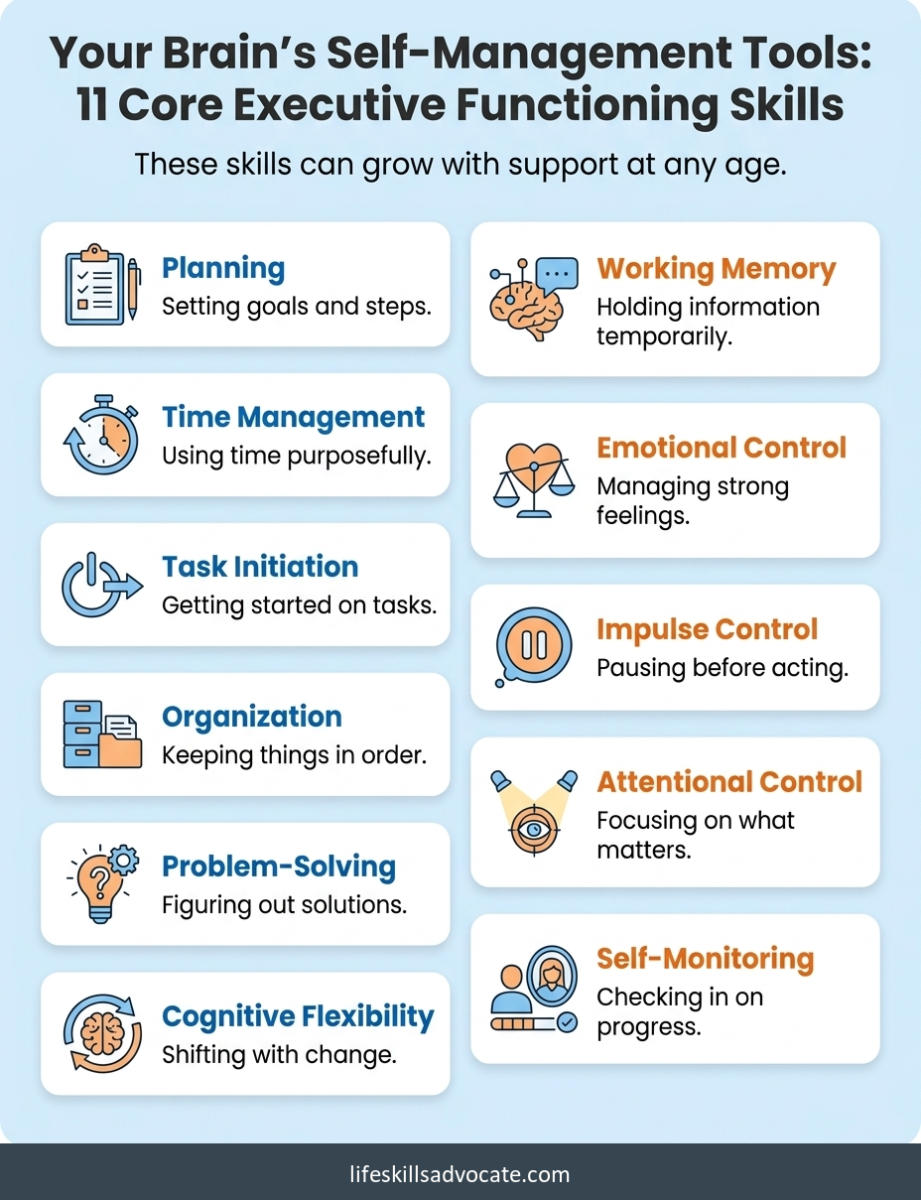
1. Planning
Planning is the skill that helps you decide what needs to happen and in what order. A student uses planning when they map out the steps for a history project instead of just opening a blank document and hoping for the best. If this is a sticky spot, our guide to the basics of planning breaks it down further.
- Without planning support, tasks often start late or stall in the middle.
- Tools like backward planning, simple checklists, or a whiteboard overview can make the steps visible.
2. Time Management
Time management is about estimating how long tasks will take and using that time on purpose. Someone with shaky time management might always think “this will only take ten minutes” and then be surprised when an hour passes.
- Using timers, visual schedules, or “time blocking” can give time a clearer shape.
- Practicing time estimates and then comparing them to reality helps this skill grow. Our free Time Estimation Worksheet gives you a simple way to do exactly that.
3. Task Initiation
Task initiation is the ability to start, especially when a task feels boring, overwhelming, or emotionally loaded. Many neurodivergent folks know exactly what they need to do yet feel stuck on the couch or scrolling their phone. If starting is the hardest part for you, our guide to the basics of task initiation goes deeper.
- Breaking tasks into very small starting steps (“open the document,” “put one dish in the sink”) lowers the barrier.
- Body doubling, where someone sits nearby while you work, can also make starting easier.
4. Organization
Organization is how you arrange your space, materials, and information so you can actually find and use them. A disorganized student might have important papers crumpled at the bottom of a backpack or a digital folder full of “final_final2.docx.” For practical systems, see our list of organization skills to teach a teen.
- Simple bins, color coding, or “one home for each item” systems can help.
- Regular short “reset” sessions often work better than rare big cleanups.
5. Problem-Solving
Problem-solving is deciding what to do when something gets in the way. It includes noticing the problem, considering a few options, and choosing a next step. Our walkthrough of problem-solving as an EF skill offers more structure if this is a weak spot.
- People who struggle with problem-solving may freeze, ask for constant help, or give up quickly.
- Practicing “if this happens, then I will try…” scripts can build confidence.
6. Cognitive Flexibility
Cognitive flexibility helps you shift when plans, rules, or expectations change. For some people, even small changes like a substitute teacher or a new seating chart can feel like a big shock. We collected cognitive flexibility strategies you can experiment with one at a time.
- Previewing changes and offering choices can soften the impact.
- Having backup plans (“plan B” and “plan C”) makes change less scary.
7. Working Memory
Working memory is the short-term “scratch pad” that lets you hold and use information. It is what you use to remember multi-step directions or keep track of what you were doing when someone interrupts. If this is your bottleneck, here are effective ways to boost working memory.
- Signs of working memory strain include losing your place, forgetting instructions, or rereading the same paragraph many times.
- External supports like written directions, sticky notes, or checklists reduce the load on working memory.
8. Emotional Control
Emotional control means feeling feelings without letting them completely take over your behavior. It does not mean shutting feelings down or pretending you are fine when you are not. Our guide to the basics of emotional control has more on this.
- When emotional control is stretched, small setbacks can trigger big reactions or long shutdowns.
- Strategies like naming feelings, using “cool down” options, or practicing coping plans can help.
9. Impulse Control
Impulse control is the ability to pause before acting or speaking. It is the split second between feeling an urge and deciding what to do with it. For longer-term approaches, see our piece on longer-term impulse control supports.
- People with impulse control challenges might interrupt a lot, overshare, or act quickly in ways that create later stress.
- Visual cues, simple pause phrases, and clear boundaries can give the brain extra time to choose.
10. Attentional Control
Attentional control is how you decide what to focus on and what to ignore. It includes shifting attention on purpose instead of staying “stuck” on one thing. If focus is the struggle, our guide on helping a teen with paying attention has practical activities.
- Signs of difficulty include zoning out during important tasks or getting pulled into every distraction around you.
- Short work blocks with planned breaks, noise management, and supportive tools can make focus more possible.
11. Self-Monitoring
Self-monitoring (sometimes called metacognition) is the built-in feedback system that lets you notice how things are going and adjust. It helps you catch mistakes, notice tone of voice, and recognize when you need a break.
- Without strong self-monitoring, someone may repeat the same mistake without realizing it or be surprised by others’ reactions.
- Checklists, rubrics, or simple reflection questions at the end of a task can strengthen this skill over time.
As you read through these 11 skills, you might notice that some feel solid and others feel shaky. That pattern is normal. If you want structured ways to work on specific skills, our Real-Life Executive Functioning Workbook offers exercises and real-world activities that match this framework.
How the Brain Supports Executive Functioning Skills
Executive functioning skills rely on a network of brain regions that help you pay attention, plan ahead, manage emotions, and adjust your behavior as you go.
Brain regions involved in executive functioning
A lot of executive functioning happens in the frontal lobes, especially the prefrontal cortex. This part of the brain helps you weigh options, think about the future, and pause before acting. It works together with deeper structures like the basal ganglia and thalamus, which help with movement, attention, and sending information between different brain areas.
Medical and neuroscience sources, such as the Children’s Hospital of Philadelphia overview of executive function and the Cleveland Clinic guide to executive function, describe executive function as a “control center” that coordinates many other skills rather than one single spot in the brain.
How these skills develop across childhood and young adulthood
The prefrontal cortex is one of the last brain regions to fully mature, and research summaries from the National Institute of Mental Health’s overview of teen brain development describe executive functioning skills continuing to develop into the mid-20s. The Center on the Developing Child at Harvard University explains that children build these skills gradually through practice, play, and supportive relationships, not overnight.
This is one reason teens and college students can seem very capable in some areas and still struggle with planning, time management, or self-control. Their brains are still wiring up the systems that support those skills. If you want to see how executive functioning skills often show up at different ages, our executive function skills by age guide walks through common patterns from childhood through young adulthood.
Why stress, sleep, and environment matter
Even in adults, these skills are sensitive to stress, sleep, and overall health. When someone is exhausted, overwhelmed, in pain, or dealing with chronic stress, the brain has less capacity for planning and flexible thinking. That is why a person might handle tasks well during a calm week and feel completely stuck during exam season, major life changes, or burnout.
Seeing executive functioning as a brain-based system that can be stretched by life circumstances makes it easier to adjust expectations, change the environment, and look for support, instead of blaming yourself or your child for “not trying hard enough.”
What Is Executive Dysfunction (Executive Function Disorder)?
Executive dysfunction is a way of describing ongoing difficulty using executive functioning skills in daily life, especially when the demands are high and the support is low.
Executive dysfunction in plain terms
When someone has executive dysfunction, it means skills like planning, time management, working memory, emotional control, and task initiation are not working as smoothly as they need to for everyday tasks. This might look like always being late, starting projects at the last minute, feeling stuck on simple chores, or melting down when routines change, even when the person genuinely cares and is trying.
Health and psychology sources, including clinical overviews from organizations like the Cleveland Clinic and the Children’s Hospital of Philadelphia, note that executive function challenges are common in conditions such as ADHD, autism, learning disabilities, mood disorders, and some neurological conditions, although every person’s profile looks different.
Executive dysfunction vs “laziness”
From the outside, executive dysfunction can look like laziness, carelessness, or poor motivation. From the inside, it usually feels very different. Many neurodivergent people describe wanting to act, knowing exactly what they “should” do, and still feeling frozen, overwhelmed, or pulled toward easier distractions. That gap between intention and action is a core sign that executive functioning skills are under strain, not proof that someone does not care.
Clinicians sometimes describe this as a kind of “friction” in ADHD rather than a lack of effort, which is explored in a Psychology Today explainer on ADHD and perceived laziness.
Understanding this difference matters for parents, adults, and educators. If you treat executive dysfunction as a motivation problem, you are likely to lean on lectures, consequences, or pressure. If you see it as a skills-and-supports problem, you are more likely to adjust expectations, change the environment, and teach specific skills, which is where real progress tends to happen.
Is executive dysfunction a diagnosis?
In many reports and articles, you might see phrases like “executive function disorder” alongside “executive dysfunction.” These terms are often used descriptively rather than as a formal stand-alone diagnosis. Clinicians usually look at executive functioning as part of a bigger picture that can include ADHD, autism, learning disabilities, mood or anxiety conditions, brain injury, or other factors.
If executive dysfunction is causing major stress at home, school, or work, it is worth talking with a qualified professional such as a psychologist, neuropsychologist, or physician. They can help sort out what is going on, rule out other concerns, and suggest supports that fit your situation.
How Executive Functioning Challenges Show Up in Real Life
Executive functioning challenges rarely arrive with a neat label. They usually show up as everyday struggles that keep getting in the way, even when someone is smart, caring, and trying hard.
For kids and tweens
In younger children, executive function challenges often look like “behavior problems” or “not listening,” even though the real issue is skill-based. A child might forget multi-step directions, lose track of what they were doing, or melt down when a routine changes. Teachers might see missing homework, messy desks, and big reactions to small setbacks.
- Homework is left at school or never makes it out of the backpack.
- Simple routines like getting dressed, brushing teeth, and packing a bag take much longer than expected.
- Transitions, such as leaving the playground or switching subjects, spark resistance or tears.
Families often feel torn between understanding and frustration. Seeing these patterns as executive functioning challenges opens the door to supports like visual schedules, checklists, and more patient step-by-step teaching instead of assuming the child simply “does not care.”
For teens and college students
For teens and college students, executive functioning challenges can be easy to miss because they often blend in with typical stress. A high school student might understand the material but never quite get assignments turned in. A college student might pull off brilliant work at the very last minute yet feel unable to start smaller, boring tasks like reading or emailing professors.
- Assignments are started late, finished in a rush, or abandoned halfway through.
- Important tasks like scholarship applications, housing forms, or disability paperwork keep getting pushed off.
- Sleep, meals, and self-care become irregular because planning and follow-through are draining.
For parents who want a deeper map of these patterns, Smart but Scattered by Peg Dawson and Richard Guare is the most widely recommended starting point and uses a similar 11-skill framework to the one in this article. These students are often told they “have so much potential” but feel like they are constantly letting others down. Naming executive functioning as part of the picture can reduce shame and help everyone focus on supports that actually fit.
For adults
In adults, executive functioning challenges may show up as chronic overwhelm rather than report cards. Someone might be excellent in meetings and completely stuck on email, or strong in crisis but unable to keep up with dishes, bills, and appointments when life is “calm.”
- Bills are paid late, even when money is available, because opening mail and logging in feels like a mountain.
- Household tasks pile up until they feel impossible to start.
- Work projects are completed only under extreme pressure, leading to burnout cycles.
Many neurodivergent adults describe feeling like they are always a few steps behind everyone else, even when they work twice as hard. Understanding executive functioning gives a more accurate explanation than laziness or failure.
What executive dysfunction feels like from the inside
From the inside, executive dysfunction often feels like wanting to act and not being able to bridge the gap. People describe staring at a sink full of dishes, a blank document, or a long to-do list and feeling frozen, foggy, or pulled toward anything easier. This freeze has a name and a map: our guide to ADHD paralysis and its three types walks through why the brain stalls and how to get unstuck, and our piece on task paralysis digs into the specific can’t-start version.
Self-talk can become harsh in these moments, which usually makes starting even harder. Adults who recognize themselves in this description often find Driven to Distraction by Edward Hallowell and John Ratey a useful next read for understanding why the gap between intention and action shows up the way it does.
Recognizing that this “stuck” feeling is related to executive functioning skills, not your worth or effort, is a powerful first step. It shifts the focus from “Why can’t I just do it?” to “What support, skill, or change in environment would make this doable for my brain?”
What Causes Executive Functioning Challenges?
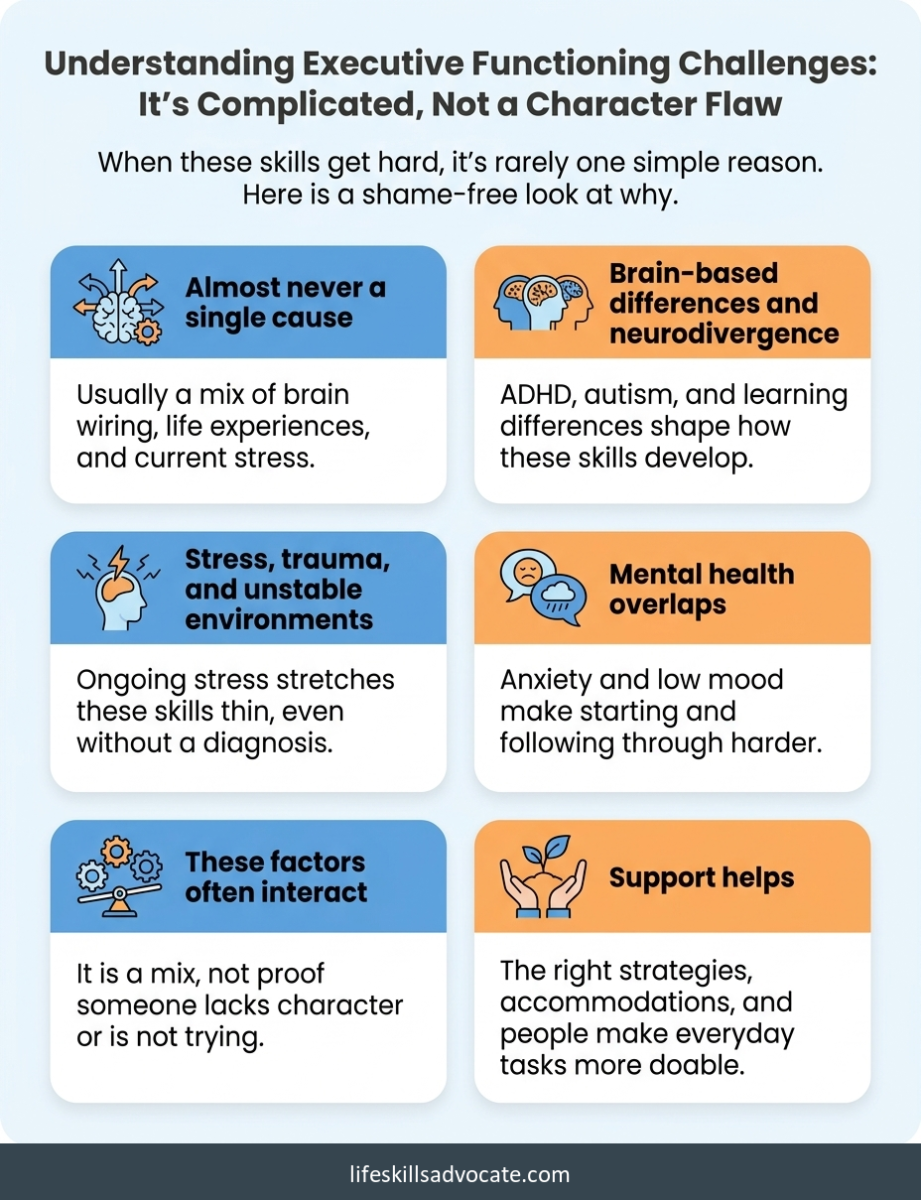
Executive functioning challenges almost never have a single cause. They usually come from a mix of brain differences, life experiences, and current stress levels.
Brain-based differences and neurodivergence
Research shows that executive function skills are closely linked to how the prefrontal cortex and related brain networks develop. For some people, these networks work differently from early childhood. That is especially common in conditions such as ADHD, autism, learning disabilities, and some genetic or neurological conditions.
In these cases, executive functioning challenges are not a sign of low effort. They are part of how the person’s brain processes information, handles attention, and manages action.
Medical and neurology sources like the Cleveland Clinic guide to executive function, the Children’s Hospital of Philadelphia overview of executive function, and the UCSF Memory and Aging Center executive functions overview all note that these patterns are common across many conditions and can show up in different ways for different people. When ADHD and autism overlap, the picture gets its own texture, which we cover in our guide to AuDHD and executive function in daily life.
Stress, trauma, and environment
Even without a formal diagnosis, chronic stress and difficult experiences can stretch executive functioning skills. Growing up without predictable routines, facing ongoing financial or family stress, or experiencing trauma can make it harder for the brain to develop and use planning, emotional control, and flexibility skills.
The Center on the Developing Child at Harvard University points out that supportive relationships and stable environments help executive function grow, while ongoing stress can make these skills harder to access. This is one reason a child might do fairly well at school but fall apart at home, or the other way around, depending on which setting feels safer and more structured.
When executive function challenges overlap with mental health
Executive functioning challenges also overlap with mental health. Anxiety can make it difficult to start tasks or make decisions. Depression can drain energy and motivation, which makes planning and follow-through much harder. Conditions like OCD, PTSD, and bipolar disorder can also affect how reliably someone can use their executive functioning skills.
If executive functioning challenges are causing major problems with safety, daily life, or relationships, it makes sense to reach out to a qualified professional such as a psychologist, neuropsychologist, or physician. They can help sort out what is happening and suggest options, such as therapy or medical treatment, that sit alongside practical supports and skill-building.
How Do I Know If I (or My Child) Have Executive Functioning Challenges?
Executive functioning challenges show up as patterns over time, not one bad day. The goal is not to label every tough moment, but to notice when certain struggles keep repeating and are getting in the way of daily life.
Common signs in children and teens
For children and teens, executive functioning challenges often look like school, home, and social struggles that do not match their effort or intelligence. You might notice that your child can talk about what they need to do, yet still cannot get started or follow through without a lot of support.
- Frequently loses homework, forgets to turn it in, or leaves materials at school.
- Has a hard time following multi-step directions unless they are broken down or written out.
- Needs many reminders to start routines like getting ready in the morning or for bed.
- Becomes very upset when plans change or when transitions happen without warning.
- Struggles to notice their own impact on others or to see when a strategy is not working.
Common signs of poor executive functioning in adults
In college and adulthood, the signs of poor executive functioning often shift from report cards to life logistics. Many neurodivergent adults describe feeling capable in bursts, then wiped out or stuck for long periods, especially with boring or emotionally loaded tasks.
- Regularly pays bills late, misses appointments, or avoids important paperwork until there is a crisis.
- Feels paralyzed by long to-do lists and spends a lot of time deciding where to start.
- Relies heavily on last-minute adrenaline to finish work or school tasks.
- Lives in cycles of “get everything together” followed by burnout and shutdown.
Screening, assessment, and next questions
If these patterns feel familiar, it can help to pause and gather more information rather than jumping straight to self-blame. One option is to start with a non-clinical reflection tool that helps you notice strengths and challenges across different executive functioning skills. Our free executive functioning assessment is designed for that purpose and can be a useful conversation starter for families, adults, and educators.
For a deeper dive into how executive function is measured, you can read our article on how to measure executive function and our overview of executive function assessment tools. These resources explain the difference between rating scales, testing, and real-life observation.
If challenges are causing significant stress at school, work, or home, or you are worried about safety, consider talking with a qualified professional such as a psychologist, neuropsychologist, or physician. They can look at the full picture, weigh possible explanations, and suggest supports that fit your specific situation.
How to Support and Strengthen Executive Functioning Skills
Supporting executive functioning skills works best when you focus on changing the environment, teaching specific skills, and building in gentle accountability, not on telling yourself or your child to “just try harder.” If you are weighing a structured program to teach them, our comparison of executive functioning curriculum options lays out how the main programs and books differ.
Start with compassion and reasonable expectations
It is very common to feel frustrated when executive functioning challenges keep getting in the way of school, work, or home life. At the same time, shame and criticism usually make initiation, planning, and emotional control even harder. A more useful starting point is, “Given how this brain works and what life looks like right now, what would make this task a little easier?”
For kids and teens, this might mean breaking homework into smaller parts and accepting that they may need more coaching than peers. For adults, it might mean acknowledging that energy is limited and choosing a short, specific list instead of trying to do everything in one day.
Change the environment to make tasks more doable
Environmental supports reduce how much any one brain has to hold at once. This does not “baby” kids or adults, it simply removes friction so skills can grow.
- Use visual schedules and simple checklists for repeat routines like mornings, after school, and bedtime.
- Set up “launch pads” by the door with keys, backpacks, or work bags in one spot.
- Reduce visual clutter in the main work area so the brain has fewer distractions to filter.
- Use alarms, timers, or calendar reminders to bring tasks back into awareness.
Resources like the Executive Function and Self-Regulation guide from the Center on the Developing Child at Harvard University highlight how routines, visual cues, and predictable environments give kids and teens daily practice with these skills.
Teach skills in real-life context
These skills grow best when they are practiced inside real tasks, not only through worksheets or apps. Instead of only telling a student to “be more organized,” you might sit with them once a week to sort papers, update a planner, and talk through how they decided what to keep or toss.
- Use real assignments, chores, or job tasks as practice for planning, breaking tasks into steps, and self-monitoring.
- Model your own thinking out loud: “First I am going to open the calendar, then I will choose a day, then I will set a reminder.”
- Ask simple reflection questions afterward, such as “What helped?” and “What would you change next time?”
Research reviews on executive function suggest that when practice is tied to meaningful activities, gains are more likely to carry over into daily life than when skills are practiced only in artificial exercises. That said, the evidence on how far any one strategy transfers is still mixed, so it is worth treating new tools as experiments rather than guarantees.
Use tools that match the person’s brain
No single planner, app, or system works for everyone. The best tools are the ones a person can actually remember to use on a typical week, not on a perfect day.
- Some people prefer analog planners or whiteboards they can see at a glance. Others like digital calendars with alerts and color coding.
- Timers, including visual countdown timers, can help with both starting and stopping tasks.
- Task management apps can be helpful if they are simple and checked regularly, not overloaded with categories.
It usually makes sense to start with one or two tools, test them for a couple of weeks, and then adjust rather than switching systems every few days. For adults building these systems from scratch, our guide on how to improve executive function in adults has more grown-up examples.
When executive function coaching can help
Sometimes it is hard to build new patterns without structured support. Executive function coaching focuses on everyday skills such as planning, time management, task initiation, organization, and self-advocacy. It is educational and skills-based, not therapy or medical treatment.
In coaching, a person works with a coach to set realistic goals, break them into steps, experiment with tools, and review what is working between sessions. If you would like a deeper overview of what this looks like, you can read our ultimate guide to executive function coaching or learn more about our executive function coaching for adults.
For people who want structured activities they can use on their own or with support, the Real-Life Executive Functioning Workbook offers exercises that match the 11 skills described in this article and can be used at home, in school settings, or in coaching.
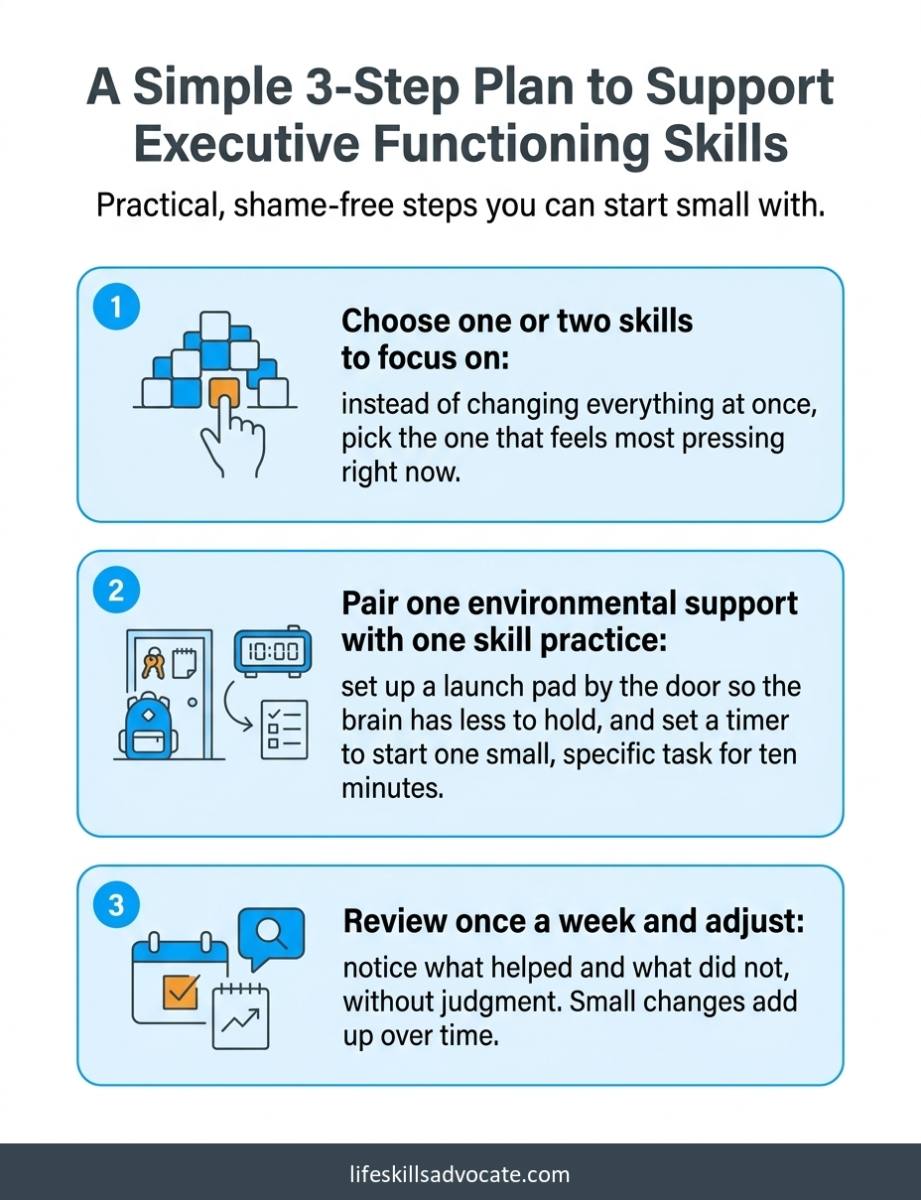
A simple three-step starting plan
If you are feeling overwhelmed, it can help to start very small instead of trying to overhaul everything at once.
- Pick one or two skills to focus on. For example, you might choose time management and task initiation for the next month.
- Choose one environmental support and one skill practice. You might add a visual schedule for homework time and practice using a five-minute timer to get started.
- Review once a week. Spend a few minutes looking at what helped, what did not, and what small adjustment you want to try next.
Executive Functioning Skills at a Glance: What the Research Says
If you want to quote or cite the core facts behind executive functioning, here is a compact reference drawn from the primary research.
| Finding | What it means | Source |
|---|---|---|
| Researchers describe three “core” executive functions: inhibition, working memory, and cognitive flexibility. | The 11 skills people use day to day build on these three. It is why lists range from 3 to 12 depending on how finely you split them. | Diamond, Annual Review of Psychology (2013) |
| In a study of about 1,000 people followed from birth to age 32, childhood self-control predicted adult health, finances, and other outcomes. | Executive function is not a “nice to have.” Supporting it early and across life has real payoff. | Moffitt et al., PNAS (2011) |
| The prefrontal cortex, the brain’s executive function hub, keeps maturing into the mid-20s. | A 19-year-old’s planning and impulse control are still coming online. Expecting “adult” follow-through too early sets people up to feel like they are failing. | NIMH, The Teen Brain (2023) |
| Executive functions are weakened by stress, poor sleep, and low support, and they improve with practice and the right scaffolds. | Executive functioning skills are trainable, not fixed traits. The environment around a person changes how well their executive function works. | Center on the Developing Child, Harvard (2024) |
Frequently Asked Questions
What are the 11 executive functioning skills?
The 11 executive functioning skills we use at Life Skills Advocate are planning, time management, task initiation, organization, problem-solving, cognitive flexibility, working memory, emotional control, impulse control, attentional control, and self-monitoring. Together they describe how you decide what to do, get started, stay on track, manage your feelings, and adjust as you go. Other models name 3, 7, or 12 skills, so this is one useful list rather than the only correct one.
What are the signs of poor executive functioning?
Common signs of poor executive functioning include chronic lateness, trouble starting tasks you actually care about, losing track of belongings or directions, missing deadlines, and feeling swamped by ordinary to-do lists. The clearest signal is a pattern that repeats over time and gets in the way of daily life, not one rough day.
Are there 7, 11, or 12 executive functioning skills?
It depends on the framework. Some researchers boil executive function down to three core processes: inhibition, working memory, and cognitive flexibility. Russell Barkley’s model names around seven. Many educators and clinicians, including us, work from a more detailed list of about 11, and a few popular guides stretch to 12.
There is no single official count. The honest answer is that all of these can be “right,” depending on how finely someone chooses to split the skills.
Is executive dysfunction the same as ADHD or autism?
No. Executive dysfunction is common in ADHD and autism but is not the same as either one. It can also appear with learning disabilities, anxiety, depression, trauma, or no diagnosis at all, especially under high stress.
Can adults strengthen their executive functioning skills?
Yes. Executive functioning skills can grow at any age, especially when the environment changes and the skills are practiced inside real-life tasks rather than abstract exercises.
Adults often benefit from supports such as planners, digital reminders, body doubling, clear routines, and structured help from partners, friends, or professionals. Understanding your own neurodivergence also helps, because it lets you choose approaches that match how your brain actually works instead of fighting it. Progress tends to be uneven, with some skills improving faster than others, and that is normal rather than a sign you are doing it wrong.
The goal is not to “fix” anything. It is to build skills and supports that carry more of the load, so daily life feels less like a constant uphill push.
At what age do executive functioning skills fully develop?
Executive functioning skills develop throughout childhood and adolescence and often keep maturing into the mid-20s, because the prefrontal cortex is one of the last brain areas to finish developing. That means teens and young adults are still building these abilities rather than being “behind,” and adults can continue to strengthen them with practice and support.
Next Steps: Putting This Guide Into Practice
Reading about executive functioning skills is a helpful start, but real change happens in small, repeatable steps that fit your actual life. You do not need to tackle all 11 skills at once.
- Pick one or two skills to focus on. Look back at the list of 11 skills and circle the ones that cause the most stress right now, such as time management or task initiation.
- Choose one tiny change in your environment. Add a visual checklist for the morning routine, set one reminder on your phone, or create a “launch pad” by the door.
- Practice in real tasks, not just in theory. Try your new support with a real assignment, chore, or work task so your brain can connect the strategy to something that matters.
- Check in once a week. Ask “What helped?” and “What did not?” and adjust. Our free executive functioning assessment can give you a structured way to notice changes over time.
Further Reading
- Executive Function and Self-Regulation – Center on the Developing Child at Harvard University
- Executive Functions (the three core processes) – Adele Diamond, Annual Review of Psychology
- Childhood self-control predicts adult outcomes – Moffitt et al., PNAS
- The Teen Brain: 7 Things to Know – National Institute of Mental Health
- Executive Function: What It Is and How to Improve It – Cleveland Clinic
- Executive Function – Children’s Hospital of Philadelphia
- Executive Functions – UCSF Memory and Aging Center
- ADHD Is Not Laziness, It’s Friction – Psychology Today
- Smart but Scattered – Peg Dawson and Richard Guare
- Driven to Distraction – Edward Hallowell and John Ratey
- Executive Functioning 101 Resource Hub – Life Skills Advocate
- Executive Function Skills by Age – Life Skills Advocate
- Executive Dysfunction Signs and Strategies – Life Skills Advocate
- ADHD Paralysis: The 3 Types and How to Get Unstuck – Life Skills Advocate
- What Is Task Paralysis – Life Skills Advocate
- The Basics of Planning – Life Skills Advocate
- The Basics of Time Management – Life Skills Advocate
- The Basics of Task Initiation – Life Skills Advocate
- Problem-Solving as an EF Skill – Life Skills Advocate
- 7 Cognitive Flexibility Strategies – Life Skills Advocate
- 5 Ways to Boost Working Memory – Life Skills Advocate
- The Basics of Emotional Control – Life Skills Advocate
- Impulse Control Strategies and Supports – Life Skills Advocate
- Helping a Teen With Paying Attention – Life Skills Advocate
- 7 Organization Skills to Teach Your Teen – Life Skills Advocate
- AuDHD and Executive Function in Daily Life – Life Skills Advocate
- Improve Executive Function in Adults – Life Skills Advocate
- ADHD and Executive Age – Life Skills Advocate
- How to Measure Executive Function – Life Skills Advocate
- Executive Function Assessment Tools – Life Skills Advocate
- ADHD vs ADD: The Difference – Life Skills Advocate
- When a Teen Seems Unmotivated – Life Skills Advocate
- Infodumping – Life Skills Advocate
- ADHD or Trauma – Life Skills Advocate
- Best Executive Function Training Programs for Adults – Life Skills Advocate
- The Ultimate Guide to Executive Function Coaching – Life Skills Advocate
- Time Estimation Worksheet (free) – Life Skills Advocate
- Free Executive Functioning Assessment – Life Skills Advocate
- Real-Life Executive Functioning Workbook – Life Skills Advocate
- Executive Function Coaching for Adults – Life Skills Advocate