
The message lands on a Friday afternoon. Can you take this on? And you have already typed “Of course, happy to help” before any part of you has checked whether you can, or want to, or have the room.
The drop comes about ninety seconds later.
That gap between the yes and the sinking feeling is what people mean by the fawn response. When something registers as a threat, some nervous systems fight, some run, some go still, and some go straight to keeping the other person happy.
For a lot of ADHD and autistic adults it is so well practiced that it stops feeling like a response and starts feeling like personality. The nine below are written as ordinary moments, because they are easiest to miss exactly when they look like being helpful. The harder question comes after: telling fawning apart from people-pleasing, from masking, and from executive dysfunction.
TL;DR
Fawning is the survival response that looks most like a personality trait, which is why it usually gets named late and by somebody else:
- Nine everyday versions of the fawn response: the reflexive yes, the mood-tracking, the apology that was never yours, the missing preference, the pre-softened message, the swallowed disagreement, the over-delivering, the downplaying at appointments, and the cost that lands hours later
- Why “is this just people-pleasing?” is a fair question, and the one tell that separates them
- How fawning differs from neurodivergent masking, and how both differ from executive dysfunction, since the three get treated as one thing and respond to different tools
- What to say in the few seconds before an automatic yes
This is educational writing from an executive function coach, not a professional evaluation. If you are working on this with a therapist or another provider, treat it as something to bring to that conversation rather than something to replace it.
What the Fawn Response Is
The fawn response is a threat response that moves toward the threat. Fight raises the volume. Flight leaves the room. Fawn hands the other person what they seem to want, so the situation stops being dangerous.
“Fawn” is not an official term, and that is worth knowing before you decide how much weight to give it. It came from psychotherapist Pete Walker, whose book Complex PTSD: From Surviving to Thriving sets out the four-response framing. It spread because it named something people recognized. One caveat before you pick it up: that book is written for trauma recovery specifically, which is a narrower starting point than this article assumes.
Researchers who study threat responses use other words, and they disagree about the boundaries. A 2023 paper in the European Journal of Psychotraumatology proposes “appeasement” for the survival strategy of settling a dangerous person, and separates that from fawning, which those authors describe as people-pleasing used to defuse conflict and earn approval.
A 2026 review in Current Addiction Reports puts the fawn response alongside fight, flight and freeze, and says the concept is still underdeveloped and understudied.
So the term is useful, and the term is contested. Both are true at once.
The machinery underneath is less in dispute. Under threat, fast survival circuits take over, which is why this reads as instinct rather than choice.
9 Ways the Fawn Response Shows Up in Everyday Life
The fawn response is easier to spot against a situation than against a description. “Chronic self-abandonment” is accurate and nearly impossible to match yourself to, because nobody experiences their Tuesday that way. So each of the nine below comes with an ordinary moment attached.
1. The Yes Arrives Before You Do
A colleague messages at 4:40 on a Friday. You reply “no problem, I’ll sort it,” and only afterwards notice you have nowhere to put it.
The tell is the ordering. You did not weigh it and land on yes. The yes went first, and the weighing showed up later as dread.
2. Someone’s Mood Shifts and You Are Already Adjusting
A tone changes by a few degrees and you clock it instantly. Then you start managing: lightening things, filling a silence, steering away from whatever set it off. A family visit where you track who is annoyed with whom all afternoon.
It reads as being attentive. From inside it is closer to weather-watching, and it does not switch off when the room is fine.
3. Sorry Comes Out for Things That Were Never Yours
Someone bumps into your cart in a shop and you say sorry. A meeting runs long and you apologize for taking up time you were asked to take up.
Used this way, sorry is not really an apology. It is a small offering that says: I am not going to be a problem for you.
4. Asked What You Want, You Find Nothing There
Where do you want to eat? And there is a blank where the preference should be, so you say “whatever works” and mean it, because you cannot locate an answer.
That reads as easygoing. It is often a preference that got outvoted so consistently it stopped being generated. Our free What Do I Need Reminder Worksheet is a low-stakes way to practice finding the answer before somebody asks.
5. The Two-Line Message Takes Eleven Minutes
You keep adding cushioning. “Sorry to bug you.” “No rush at all.” “Totally fine if not!” At some point you stopped writing the message and started pre-managing the reaction to it.
If there is a braced, physical quality to waiting for the reply, the signs of rejection sensitive dysphoria are worth a look. It runs alongside this pattern often enough to be worth naming.
6. You Go Along in the Room and Argue in the Shower
In the meeting, you nod. Three hours later you are delivering the objection you did not make, out loud, to nobody, and phrasing it much better than you would have at the time.
The disagreement was there. It could not get out while a person was in front of you.
7. Somebody Sounds Off, So You Over-Deliver
A housemate seems irritated about the dishes, so you clean the whole kitchen. A manager sounds clipped in one message, so you turn in more than was asked for, early, with extra options nobody wanted.
The size of the response is the signal. It is sized to somebody’s mood, not to the request.
8. You Downplay It at the Appointment
The doctor asks how bad the pain is and you hear yourself say it is not that bad. The support call is going nowhere and you thank them warmly and hang up unresolved.
Appointments are where this gets expensive, because the person opposite is making decisions out of what you tell them.
9. You Feel It Afterwards, Not During
During is often fine. Smooth, even. It arrives that evening as a flatness you cannot account for, or on Sunday as a wall you cannot climb.
The cost is separated from the moment by hours or weeks, so it rarely gets traced back to the fifteen small accommodations that produced it.
Fawning or People-Pleasing? What Separates Them
This is the question that comes up most, and it deserves a straight answer rather than a tidy one. Is the fawn response genuinely different from people-pleasing, or is it the same behavior with a bigger name?
Plenty of thoughtful people think it is the same thing renamed, and their case is not silly. Both grow out of similar environments. Both look identical from the outside. Neither has a test that settles it.
The distinction that survives contact with real life turns on one thing: how much of you was present for the decision.
People-pleasing tends to be something you catch yourself doing while it happens. There is a moment, however brief, where you clock the choice and make it anyway.
Fawning tends to be recognized afterwards. Sometimes hours later. Sometimes years later, in the shape of a burnout nobody could explain at the time.
So treat it as a spectrum, not two boxes. The usable tell is a question: could you have described what you were doing while you were doing it?
If yes, you have a decision to work with. If no, then boundary advice is arriving after the moment it was meant to help with, which is a large part of why it keeps not working.
Masking and Fawning Overlap, but They Are Not the Same
Readers who live with both run into this one hard. Masking and fawning share a surface, they often run at the same time, and the two words get swapped often enough to be genuinely confusing.
Three questions separate them.
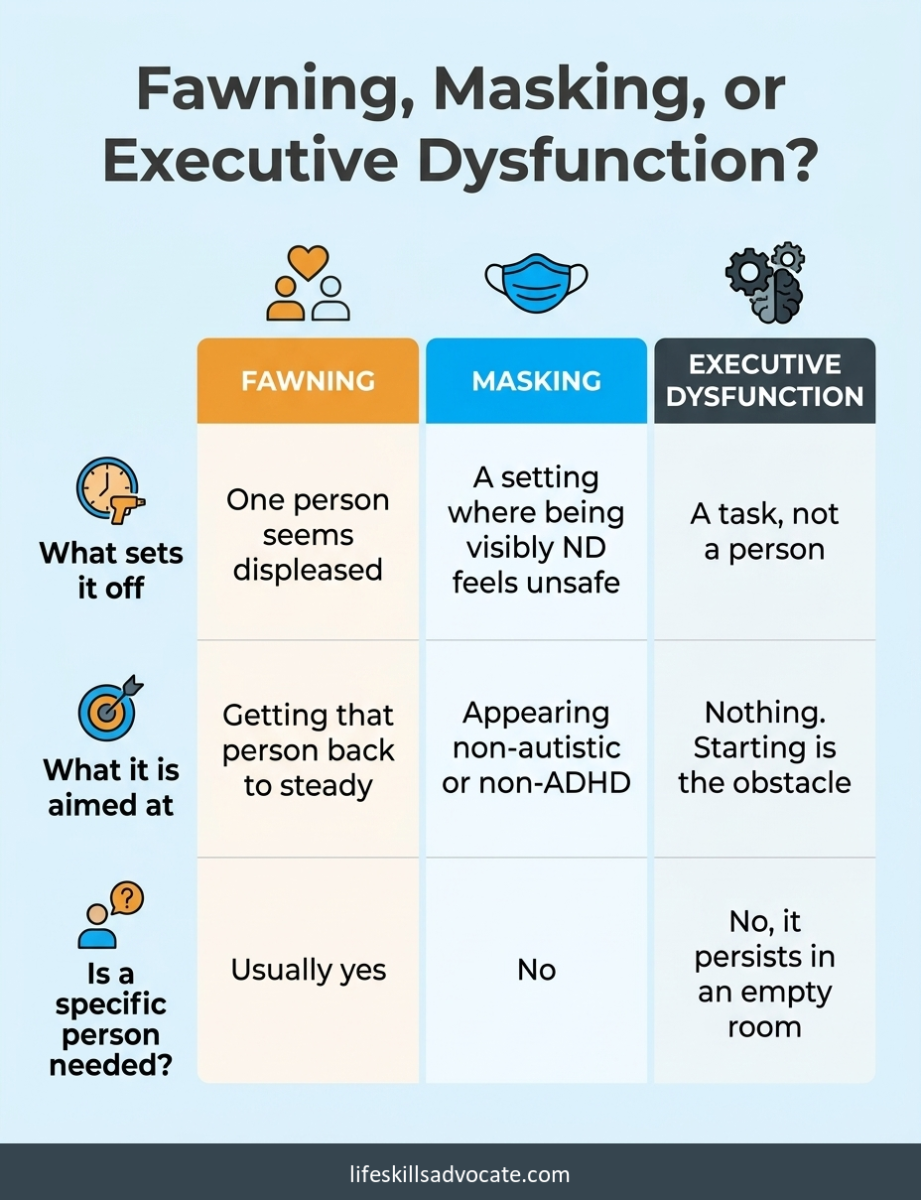
| Question | Masking | Fawn response |
|---|---|---|
| What sets it off? | Being somewhere that visibly autistic or ADHD behavior feels unsafe or costly | A specific person reading as displeased, disappointed, or about to be |
| What is it aimed at? | Appearing non-autistic or non-ADHD: suppressing stims, scripting small talk, holding eye contact | Getting one person back to steady, by agreeing, soothing, conceding, or over-giving |
| Does a specific person need to be there? | No. It runs in a room of strangers, or an empty office you might be seen in | Usually yes. It is organized around somebody in particular |
The overlap is real. You can mask your way through a work meeting while fawning at the one person in it whose approval feels load-bearing, inside the same forty minutes. Which is why sorting them out by feel does not work well.
Masking has its own long answer, and it is not this article’s. For the ADHD version, what ADHD masking costs and what helps covers it. For the autistic version, twelve everyday examples of autistic masking is the closer match.
When It Looks Like Fawning but It’s Executive Dysfunction
Fawning, freezing, and executive dysfunction can produce the same outcome: the thing does not get said, or does not get done. In the moment they are hard to tell apart.
The practical tell is what the moment is organized around.
A fawn moment is organized around a person. It tracks somebody’s mood, it costs you something to protect their comfort, and it eases when they seem satisfied. Take that person out of the room and the pressure drops with them.
An executive dysfunction moment is organized around a task. It carries on with nobody in the room at all. The email is still unsent at 11pm in an empty house.
They want opposite things from you. An executive dysfunction wall responds to making the task smaller and the first step more concrete. A fawn moment does not, because the task was never the obstacle.
There is a third possibility, a freeze response, where the body goes still and neither approach lands. That one has its own article: seven signs you are in dorsal vagal shutdown covers what it is and how it differs from burnout.
My read, as an executive function coach rather than a therapist: this distinction is worth more than the labels are. Knowing whether the obstacle in front of you is person-shaped or task-shaped is what decides which tools are worth reaching for.
The appeasement paper describes what happens under genuine life threat, where survival circuits take over and interfere with executive functioning. A Friday work message is a long way from a hostage situation, so read that as the mechanism at full volume. The direction still holds. The more threatening something registers as, the less deliberate machinery you have available.
The Cost of Fawning Over Time
Any single instance of fawning is cheap, which is what makes the long-run cost hard to see. One accommodation nobody asked for is nothing. Several thousand of them is a different matter.
The chain that shows up over and over is fawn, then mask, then burnout.
Research does not use the word fawn, but it is clear about the neighboring pieces. A 2021 study in Molecular Autism found camouflaging associated with higher generalized anxiety, depression and social anxiety among autistic adults, beyond what autistic traits and age accounted for. The design was cross-sectional, so it cannot tell us which came first.
A 2019 study in Lancet Psychiatry found that compensating below the behavioral surface can delay identification for years, and that the effort is taxing and often does not work anyway.
The US study that first defined autistic burnout traced it to chronic life stress and a mismatch between expectations and abilities without adequate support. Its authors flagged the risks of teaching autistic people to mask.
A 2023 study in the journal Autism interviewed 22 autistic adults about their experiences of interpersonal violence. Asked what had made them vulnerable, they named going along with people to please them, and described it as something shaped by repeatedly being told their thoughts and behavior were wrong, rather than as a trait they showed up with.
If that chain sounds like where you already are, nine signs of neurodivergent burnout and what recovery looks like is the more useful next read.
How to Interrupt an Automatic Yes
You cannot decide your way out of the fawn response, because it completes before the deciding starts. What you can do is put something small and pre-written in the gap, so the automatic yes has an obstacle to hit.
This is a stall. You are buying enough seconds for the deliberate part of your thinking to come back online, and that is the whole job.
Copy these somewhere you can reach in a hurry, a notes app or the back of a card:
- “Let me check and come back to you.”
- “I need to look at my week before I answer that.”
- “Can I tell you tomorrow?”
- “I want to say yes. Give me until this afternoon to make sure I can.”
- “That might work. Let me confirm.”
None of those requires you to know your answer yet, and none of them is a no. That second part matters, because a stall that feels like a refusal does not get used.
Two things make the stall easier to reach for. Noticing the body signal that runs just ahead of the yes buys you a fraction more warning, which is what our How My Body Pays Attention Exercise is built for. And when the blank shows up where a preference should be, the Feel Wheel Exercise hands you vocabulary instead of a shrug.
If the moment has already tipped past stalling into full activation, that is a different problem, and how to regulate your nervous system covers it properly.
Research on the Fawn Response and Masking
Five findings worth quoting, with the sources attached.
| Finding | What it means | Source |
|---|---|---|
| Under genuine life threat, survival circuits take over and interfere with executive functioning | The deliberate part of your thinking is not in charge during a threat response | Bailey et al., 2023, European Journal of Psychotraumatology |
| The fawn response sits alongside fight, flight and freeze, but remains underdeveloped and understudied | The four-response model is widely used; the fawn part has the least research behind it | Algarin et al., 2026, Current Addiction Reports |
| Camouflaging is associated with higher generalized anxiety, depression and social anxiety in autistic adults, beyond autistic traits and age | Hiding the response carries a measurable association with mental health, though the study cannot show direction | Hull et al., 2021, Molecular Autism |
| Compensating for social difficulties can delay identification and is taxing to sustain | Being good at appearing fine is part of why some adults are identified late | Livingston et al., 2019, Lancet Psychiatry |
| Autistic burnout follows chronic life stress and a mismatch of expectations and abilities without adequate support (US interview study, 2020) | The cost builds from ongoing load rather than one event | Raymaker et al., 2020, Autism in Adulthood |
Frequently Asked Questions
Is the fawn response a real thing, or just a popular term?
Both, in a way worth being precise about. The behavior it points at is well documented. People do appease and go along under threat, and that shows up across species, not only in humans.
The label is the softer part. “Fawn” came out of one psychotherapist’s writing rather than a research program. Researchers studying threat responses use other words for overlapping ideas, and a 2023 paper draws a firm line between appeasement and fawning rather than treating them as one thing. A 2026 review calls the concept understudied.
So it is a useful handle for something real, and it is not settled terminology. If the word helps you notice the pattern, that is reason enough to use it. If it leaves you feeling like you have been handed a condition, drop the word and keep the observation.
Is fawning a narcissistic trait?
No. It runs the other way. Fawning gives up your own position to protect somebody else’s comfort. The confusion comes from both involving close attention to other people.
Can you fawn without a trauma history?
Yes, and it is worth saying plainly, because most writing on this topic assumes otherwise. The four-response model is a threat model rather than a trauma-history model.
Chronic ordinary stress trains the same reflex. A job where one person’s mood set the weather. A household where disagreement was expensive.
If you are working out whether what you are dealing with is trauma-shaped or ADHD-shaped, the daily-life differences between ADHD and trauma goes through it properly.
What is the freeze response, and how is it different from the fawn response?
Freeze is the one where the body goes still. You cannot move, cannot speak, cannot start.
The fawn response does the opposite. It moves toward the other person and starts managing them. The two can also run in sequence, which is part of why they so often get confused with each other.
How do I stop fawning?
Slowly, and probably not completely, which is a more useful answer than the alternative. A response that fast is not something you talk yourself out of by deciding to.
What moves first is recognition. You catch it afterwards, then closer to the moment, then occasionally while it is happening. That progression is the actual work, and it runs in months rather than weeks.
The second thing that moves is having a stall ready before you need one. If the pattern is tangled up with wider executive function demands, that is the kind of thing executive function coaching can support directly.
Next Steps
Recognition on its own does not change the pattern, but it has to come first, because you cannot interrupt something you cannot see happening. These are ordered by how little they ask of you.
- Run one week of noticing, with no attempt to change anything. Each time you catch a yes that arrived before you did, note the situation and who was in the room. A week of that usually shows the pattern is concentrated in two or three relationships.
- Write your stall down. Pick two sentences from the list above, put them in your own words, and keep them somewhere you can reach in a hurry. A stall you have to compose on the spot will not be there when you need it.
- Practice on something that does not matter. Use it on a delivery driver or a low-stakes work request. The point is to get the sentence out of your mouth once, so it is not brand new the first time it counts.
- If this is one thread in a wider set of executive function demands, executive function coaching is built for that kind of work. It is educational and skills-focused rather than therapy. Patterns rooted in trauma are worth taking to a therapist, and the two sit alongside each other.
Further Reading
- Appeasement: Replacing Stockholm Syndrome as a Definition of a Survival Strategy – Bailey, Dugard, Smith and Porges, European Journal of Psychotraumatology (2023)
- Fight, Flight, Fawn, Freeze: Rethinking Substance Use Through a Stress Response Lens – Algarin, Lee and Zhan, Current Addiction Reports (2026)
- Is Social Camouflaging Associated With Anxiety and Depression in Autistic Adults? – Hull and colleagues, Molecular Autism (2021)
- Compensatory Strategies Below the Behavioural Surface in Autism – Livingston, Shah and Happe, Lancet Psychiatry (2019)
- Defining Autistic Burnout – Raymaker and colleagues, Autism in Adulthood (2020)
- Maybe We Just Seem Like Easy Targets: Autistic Adults’ Experiences of Interpersonal Violence – Gibbs and Pellicano, Autism (2023)
- Complex PTSD: From Surviving to Thriving – Pete Walker (2013)
- ADHD Masking: What It Is, What It Costs, and What Helps – Life Skills Advocate
- 12 Examples of Autistic Masking in Everyday Life – Life Skills Advocate
- 7 Signs You’re in Dorsal Vagal Shutdown (Not Just ADHD Burnout) – Life Skills Advocate
- 9 Clear Signs of Neurodivergent Burnout and Practical Ways to Recover – Life Skills Advocate
- 11 Signs of Rejection Sensitive Dysphoria in Adults – Life Skills Advocate
- ADHD or Trauma: The Daily-Life Differences – Life Skills Advocate
- How to Regulate Your Nervous System When Calm Won’t Come – Life Skills Advocate
- Executive Function Coaching for Adults – Life Skills Advocate
- What Do I Need Reminder Worksheet – Life Skills Advocate
- Feel Wheel Exercise – Life Skills Advocate
- How My Body Pays Attention Exercise – Life Skills Advocate