
Have you ever walked away from a high-stakes conversation thinking, “Ugh, I wish I had said that differently”? Maybe your tone came out sharper than you meant. Maybe you stayed quiet even though you did have something to say. Or maybe your brain went completely blank, and the moment passed before you could process what was happening.
If that sounds familiar, there is a good reason for it.
Situations that call for assertive communication can be overwhelming for all of us. Our tone changes when we are stressed. Our words get jumbled. Some of us replay the whole conversation hours later, still wishing we knew the “right” thing to say.
Assertive communication is a skill, not a personality trait. Like any skill, you can learn it, practice it, and get better at it over time. What follows are real assertive communication examples you can borrow, starting with why speaking up feels so loaded in the first place.
TL;DR
Assertive communication is the calm, clear middle ground between staying silent and blowing up, and it is a skill you can build. Here is what it sounds like in real life:
- Assertive is direct without being harsh: “I wasn’t finished yet. I’d like to finish my point.”
- It sits between passive (quiet, apologetic) and aggressive (sharp, overpowering). Same boundary, very different delivery.
- A simple 3-part message builds it: describe what happened, say how it affects you (“I feel…”), and state what you need.
- You get real assertive communication examples and ready-to-use scripts for asking for help, saying no, needing more time, and handling crossed boundaries.
- It can feel awkward at first, and people may push back when you start using your voice. That is normal, and it gets easier with practice.
This article is educational, not medical or mental health advice. If you are working with a professional on communication, use these examples as a supplement to that work.
Why Assertive Communication Feels So Hard (Especially for Neurodivergent Brains)
One reason assertive communication can feel so hard for a neurodivergent brain is that most of us were handed mixed messages about it. We were told what “being assertive” should look like, and when it is and is not socially acceptable, and the messages often contradicted each other.
The Mixed Messages You’ve Been Given About “Speaking Up”
Many of us grew up hearing things like:
- “Don’t make a big deal about it.”
- “Just be polite.”
- “You’re overreacting.”
- “Use your inside voice.”
If those sound familiar, you may have learned that speaking up is something to avoid, and that keeping your needs small keeps other people comfortable. Over time, it can start to feel safer to stay quiet, avoid conflict, or let things slide, even when something really matters to you.
On the flip side, some neurodivergent people get told their tone sounds “too intense,” “too blunt,” or “too much,” even when they are simply trying to be clear. That is part of what the double empathy problem describes: the mismatch runs in both directions, but the neurodivergent person is usually the one told to change.
It can make speaking up feel like walking through a minefield. Will this sound rude, too direct, or not direct enough?
No wonder assertive communication feels confusing. You have been trained to keep your voice in a narrow, almost impossible middle zone, one that is not always realistic or even the best choice.
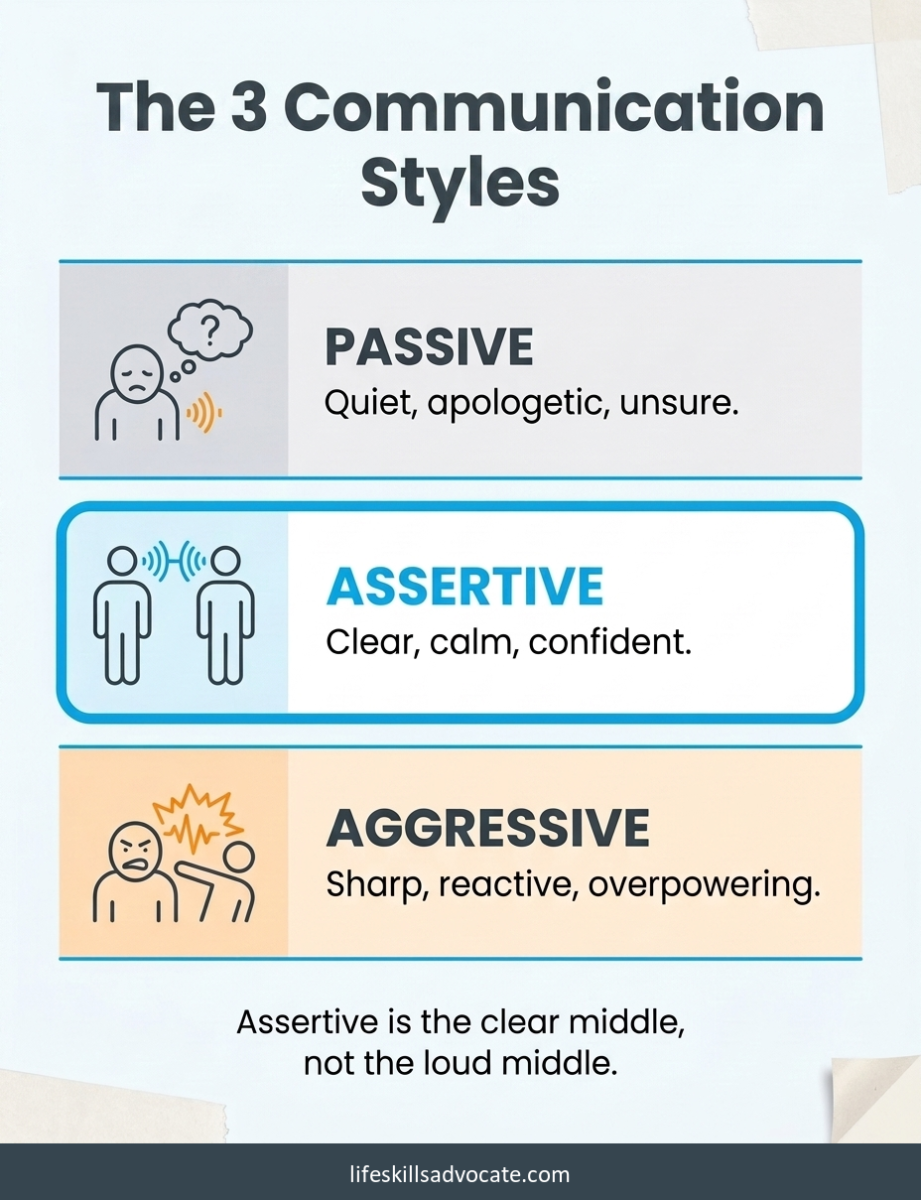
The 3 Communication Styles: Passive, Aggressive, Assertive
It helps to picture the three tone types side by side, because assertive is not the absence of the other two, it is the balance point between them. Most people move between three communication styles:
- Passive: quiet, apologetic, unsure.
- Aggressive: sharp, reactive, overpowering.
- Assertive: honest, calm, confident.
Assertive communication is not the loud middle. It is the clear middle. It is speaking in a way that respects your needs and the other person’s needs at the same time. And most people can learn it.
What Assertive Communication Actually Sounds Like
Assertive communication is not fancy or complicated. It is direct without being harsh, truthful without being hurtful, and clear without apologizing for existing. It is also one of the core Power Skills in the free Adulting Like a Champ Workbook, and there is a dedicated Assertive Communication Workbook for practicing it. You do not need either to start. In everyday moments, it sounds like this:
- “I’m not able to do that today.”
- “I need more time to finish this.”
- “I feel overwhelmed when plans change last minute.”
- “I’m willing to hear your point. Now here’s how I see it…”
12 Assertive Communication Examples in Real Situations
Here are twelve assertive communication examples you can actually use. As you read them, picture the calm voice and relaxed body language that would go with each one. The first four are full scenarios that show the difference between passive, aggressive, and assertive. The next eight are shorter starter scripts you can adapt.
- Someone interrupts you mid-sentence. A passive reply gives your point away (“Oh, it’s okay, never mind”). An aggressive reply comes in hot (“Can you not interrupt me? Seriously?”). The assertive version holds your ground without the heat: “I wasn’t finished yet. I’d like to finish my point.”
- Someone borrows your things without asking. Passive lets it slide (“It’s fine, I guess, just put it back”). Aggressive attacks (“Stop touching my stuff, what is wrong with you?”). Assertive names the need and asks for a change: “I’m not comfortable with my things being borrowed without asking. Can you please check with me first?”
- You are pressured into plans you do not have energy for. Passive gives in (“Okay, sure, I guess I can go”). Aggressive lashes out (“Why do you always force me into things?”). Assertive states the boundary without a justification: “I’m not up for going out tonight. I’m going to stay in and rest.” You do not always have to explain a no.
- A group partner is not doing their share. Passive absorbs it (“It’s fine, I can just do it all myself”). Aggressive blames (“You’re being lazy and making me do everything”). Assertive moves toward a solution: “I need us to divide this project more evenly. Can you complete your part by tomorrow so we stay on schedule?”
How to Build Assertive Language You Feel Comfortable With
A lot of people imagine that assertive communication takes polished speeches or perfectly worded sentences. It does not. Assertiveness is built on clarity. The goal is not to sound showy or imposing. It is to say what is happening, how you feel, and what you need in the most straightforward way you can.
For neurodivergent teens and young adults, that often means letting go of the pressure to “sound normal” or “say it perfectly.” Assertive communication should sound like you, just a clearer, calmer version of your everyday voice. If a script does not fit your natural style, it will feel uncomfortable to use, which means you will avoid it when it counts. Assertive communication combines:
- Voice: steady, not rushed.
- Words: clear and simple.
- Body: neutral face, relaxed shoulders, grounded posture.
The 3-Part Assertive Message Formula
Once you see it this way, you can build assertive language from a simple three-part message. First, describe what happened as neutrally as you can, without judgment or blame. Next, share how the situation affects you using an “I” statement, the same kind of I statement at the heart of declarative language. Finally, explain what you need, or why the situation matters.
For example, you might say: “When you raise your voice at me, I feel overwhelmed and shut down, because it becomes hard for me to stay in the conversation.” That structure keeps things steady and helps your message feel grounded rather than reactive. It also gives the other person a clear picture of what you are experiencing and what needs to change.
If naming the feeling is the hard part, a neurodivergent feelings wheel can help you find the word before you are in the moment. This three-part message works in a lot of settings: at school, at home, with friends, even at a job.
More Assertive Communication Examples: Starter Scripts to Borrow
These assertive communication examples pick up where the scenarios left off. Each script uses the three-part message, so you can copy a line as-is or swap in your own details. Read them as items five through twelve of the same set.
- When you need help: “When I look at this assignment, I feel stuck because I’m not sure how to begin. Can you show me the first step?”
- When you need more time: “This information came at me fast. I’m feeling overwhelmed and need more time to process it. I’ll respond later today.”
- When you want space: “When there’s a lot of noise or talking around me, I feel overstimulated and need a few minutes of quiet so I can reset.”
- When a boundary is crossed: “When my things are used without asking, I feel disrespected because I like to know where my belongings are. Please check with me first.”
- When someone speaks over you: “When I’m interrupted mid-sentence, I lose my train of thought. I’d like to finish what I was saying.”
- When you disagree: “When I hear your perspective, I feel thoughtful about it, but I also see things differently because ___. Here’s my point of view…”
- When you need to say no: “When I’m asked to take on something I don’t have capacity for, I start to get stressed because I already have a full load. I’m not able to do that.”
- When you want clarity: “When I get directions that feel unclear, I feel confused and unsure of what to do next. Can you explain it another way?”
One of those scripts is about asking for help, which is its own skill worth practicing, and it tends to be one of the hardest for people who were taught to handle everything alone.
Recommended tool
Assertive Communication Workbook
A gamified workbook of fill-in-the-blank assertive scripts you can borrow until they feel like your own, built around the same three-part message and starter sentences in this article.
Best for: a teen or young adult who wants to rehearse these scripts in a structured, low-pressure way (a $15 printable, separate from the free Adulting Like a Champ Workbook).
Why Building Assertive Language Takes Practice
Assertive communication strengthens with repetition, the same way any skill does. For many neurodivergent people, practicing out loud lowers the executive function load that makes speaking up feel so heavy in the moment. Rehearsing in a quiet space, writing out possible responses, or running lines with a trusted friend can make these phrases feel familiar and safe before you ever need them.
Over time, the scripts stop being memorized lines and start being your own voice. The goal is not to sound perfect. It is to build enough confidence that your words come more naturally when you need them.
What to Do When Assertiveness Feels Awkward (or When People Push Back)
Even with perfect wording, assertive communication can feel uncomfortable, especially the first few times. Awkwardness does not mean you are doing it wrong. It means you are using a skill you have not practiced much yet. For a lot of neurodivergent teens and young adults, speaking up sets off a stress response that makes your voice shake, your brain freeze, or your heart race. That discomfort is normal, and it eases with repetition.
When You Experience Pushback
Sometimes the awkward part comes not from what you say but from how people respond. Assertiveness can surprise people who are used to you staying quiet, masking, or going along with things. They might get defensive, ignore your request, push back emotionally, or try to guilt you into changing your mind.
When that happens, your job is not to abandon your boundary. It is to stay calm and restate your message clearly. A simple “broken record” approach helps: repeat your boundary in a steady tone without getting pulled into a long explanation. For example, “I understand you’re upset. My answer is still no.”
If someone reacts strongly to your assertiveness, it does not mean you were wrong to speak up. It often means you are shifting a pattern they were comfortable with.
That said, no script works in every situation. Some conversations, especially with someone who will not hear you or who is not safe, call for more than a good sentence, and that is not a failure of your wording. The goal is not to avoid all discomfort for other people. It is to build a voice you can trust, even when the moment feels hard.
Assertive Communication: Key Terms
Here is a quick reference for the terms in this article, in language you can quote or share.
| Term | What it means |
|---|---|
| Assertive communication | Speaking in a way that is clear and direct and respects your needs and the other person’s at the same time. It is firm without being harsh. |
| Passive communication | Downplaying or hiding your needs to keep other people comfortable. It often sounds apologetic or unsure and leaves you feeling unheard. |
| Aggressive communication | Pushing your needs in a way that overpowers or blames the other person. It often sounds sharp or reactive. |
| The three communication styles | The idea that most people move between three styles, passive, aggressive, and assertive, with assertive as the clear middle rather than the loud middle. |
| The 3-part assertive message | The structure behind the assertive communication examples in this article: describe what happened, say how it affects you (“I feel…”), and state what you need. |
| Broken-record technique | Calmly repeating your boundary in a steady tone without getting pulled into a long explanation, as in “I understand you’re upset. My answer is still no.” |
Frequently Asked Questions
Is assertive communication a skill or a personality trait?
It is a skill. Some people do seem naturally direct, but assertiveness is a set of habits anyone can build with practice, not a fixed part of who you are. If speaking up feels hard now, that is a starting point, not a verdict. The scripts in this article are exactly the kind of thing you can rehearse until they feel like your own words.
What’s the difference between assertive and aggressive communication?
The difference is mostly about how you treat the other person’s needs. Aggressive communication pushes your point in a way that overpowers or blames, so it tends to sound sharp, loud, or reactive (“Stop touching my stuff, what is wrong with you?”). It gets your feelings out, but it usually puts the other person on the defensive.
Assertive communication holds the same boundary while still respecting the other person. It is clear and direct without the heat (“I’m not comfortable with my things being borrowed without asking. Can you please check with me first?”). Same message, very different delivery, and the assertive version is far more likely to actually get you what you asked for.
The words are not the whole story either. Tone and body language carry a lot of it, so the same sentence can land as assertive or aggressive depending on how steady your voice is and whether your body looks relaxed or braced for a fight.
What are some everyday assertive communication examples?
Everyday assertive communication examples usually name a situation and a need without blame. For asking for help, that might be “Can you show me the first step?” For needing space, “I need a few minutes of quiet so I can reset.” For saying no, “I’m not able to do that.”
The pattern underneath them is the same three-part message: describe what is happening, say how it affects you, and state what you need. Once you have that shape, you can build your own examples for almost any moment, at school, at home, with friends, or at a job.
Why does speaking up feel so hard for a lot of neurodivergent people?
Often it comes down to mixed messages and past feedback. Many neurodivergent people were told both to “be polite” and not “make a big deal,” and also that their natural tone was “too much” or “too blunt.” That narrows the acceptable middle to something almost impossible to hit. On top of that, high-stakes moments can trigger a stress response that makes it genuinely harder to find words in real time.
What do I say when someone pushes back after I set a boundary?
Stay calm and repeat your boundary without over-explaining. The “broken record” line works well: “I understand you’re upset. My answer is still no.” You do not owe a long justification.
What if these assertive communication examples still feel awkward or fake?
Awkward does not mean wrong. A new script feels stiff for the same reason a new pair of shoes does, because you have not worn it in yet.
Borrowing someone else’s phrasing at first is normal, and it does not make your point any less real. For some people the effort never fully disappears, and speaking up stays a little bit of work even years in. That is okay. The goal is not to make it effortless. It is to make it possible.
Your Next Steps: Building Your Assertive Communication Toolkit
The fastest way to make any of these examples stick is to pick one and use it before the stakes are high. Assertiveness is really self-advocacy in action, and it grows every time you practice it in a small, low-pressure moment.
- Say one line out loud today. Pick a script from the twelve above and say it to an empty room. Rehearsing out loud lowers the executive function load when the real moment comes.
- Notice your default. For a week, note whether you tend to go passive, aggressive, or assertive under pressure. Awareness comes before change.
- Keep your go-to lines somewhere findable. Save two or three in your notes app or on a sticky note, so you are not starting from scratch mid-conversation.
- Work through it step by step. The Assertive Communication Workbook turns these scripts into gamified practice, or start with the free Adulting Like a Champ Workbook and its wider set of life skills.
Assertive communication is a “power skill” of adulting, one that supports school, work, friendships, and your own well-being. It is also one part of the broader set of executive function skills that make daily life feel more manageable.
Your voice has value, and it gets a little easier to use every time you practice. If asking for what you need still feels vulnerable, it can help to see it the way we do: asking for help is a neurodivergent strength, not a weakness.
Further Reading
- The Power of Declarative Language for Neurodivergent Communicators – Life Skills Advocate
- How to Use a Neurodivergent Feelings Wheel – Life Skills Advocate
- The Double Empathy Problem Explained – Life Skills Advocate
- Practicing Real-World Self-Advocacy – Life Skills Advocate
- 9 Strategies to Help Teens Learn How to Ask for Help – Life Skills Advocate
- Why Asking for Help Is a Neurodivergent Superpower – Life Skills Advocate
- Executive Functioning 101 – Life Skills Advocate
- Adulting Like a Champ Workbook (free) – Life Skills Advocate
- Assertive Communication Workbook – Life Skills Advocate