
Somebody probably said the word near you before you ever went looking for it. A coworker used it in a meeting. A podcast dropped it. A comment under a video, or a line on your kid’s evaluation paperwork: neurodivergent.
And somewhere in there, a quieter question showed up.
Does that describe me?
That is the question most pages about being neurodivergent rarely answer. They hand you a clean definition, tell you it is not a medical diagnosis, and point you toward getting evaluated. Useful, as far as it goes. It skips the part you probably care about most.
I work as an executive function coach, and I was diagnosed with ADHD at 35, so I have sat on both sides of that question. This is a guide to what it means to be neurodivergent, how to tell whether the word fits you, and what you can do about it, with or without a formal evaluation.
TL;DR
The short version, plus the reframe most definitions leave out: neurodivergent describes how a brain works, not a condition you are diagnosed with, and you do not need a label to start working with how yours operates. Here is what this guide covers:
- What does it mean to be neurodivergent, in everyday terms?
- How is a neurodivergent brain different from a neurotypical one, and which conditions count?
- How do you tell whether the word describes you, without a symptom checklist?
- Do you need a formal diagnosis to call yourself neurodivergent?
- What can you do next, with or without one?
This is educational, not a clinical evaluation. It can help you understand yourself and ask sharper questions, but only a qualified professional can formally identify a condition.
What Does It Mean to Be Neurodivergent?
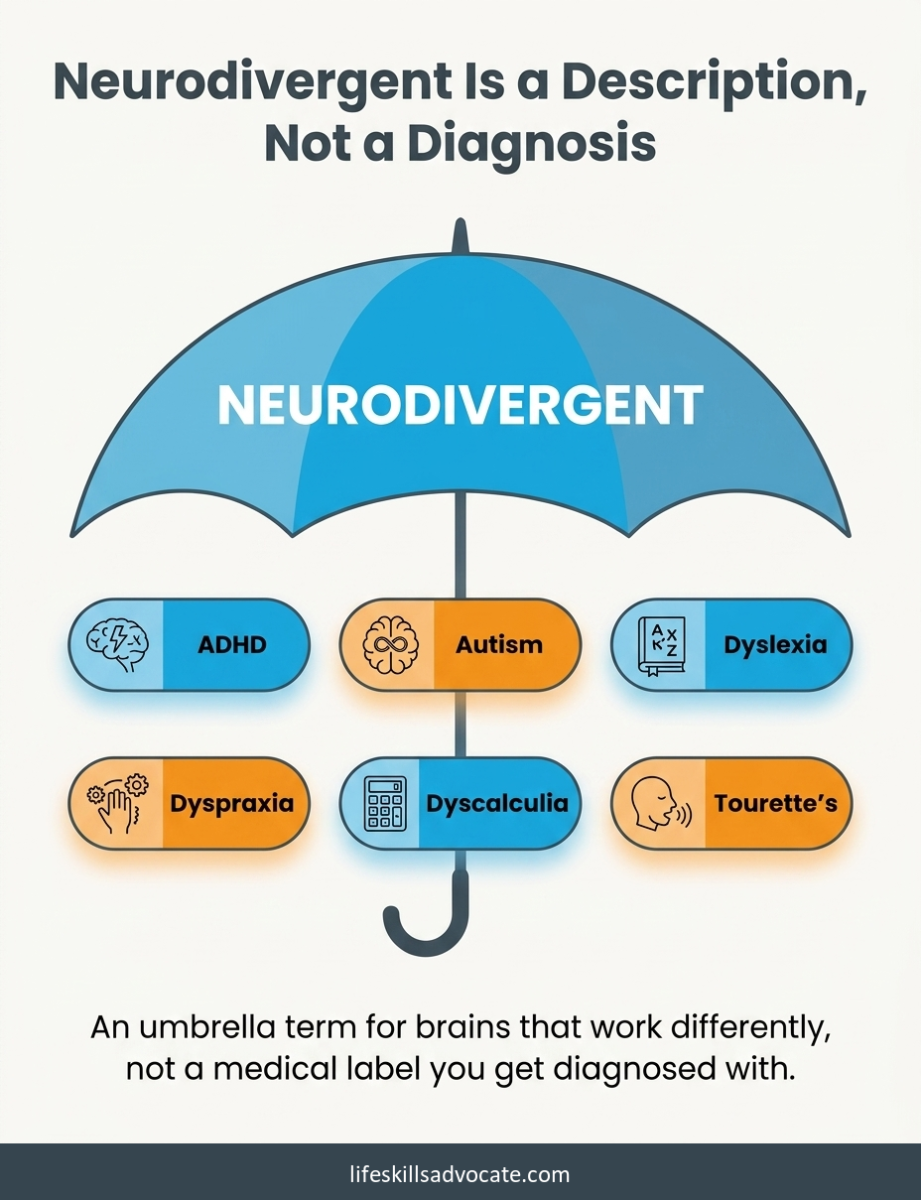
Neurodivergent means your brain learns, processes, or works differently from what is considered typical. That is the whole definition. It is an umbrella term, not one specific condition, and it does not say anything is wrong with you. It says your wiring runs on a different pattern than the statistical average.
The word grew out of “neurodiversity,” a term the sociologist Judy Singer helped popularize in the late 1990s. Neurodiversity describes the whole range of human brains. Neurodivergent is the person-level version: one brain that diverges from the norm.
Here is the part worth holding onto. As the Cleveland Clinic explains in its overview, neurodivergent is a nonmedical, descriptive term, not a diagnosis a doctor writes down. A person can be neurodivergent and never set foot in an evaluation. The word describes a lived reality, and the reality comes first.
Neurodivergent vs. Neurotypical: What the Distinction Means
Neurotypical is the flip side of the word. It describes a brain that develops and works in the way most people’s do, close enough to the average that the world’s default settings mostly fit.
Neurodivergent brains diverge from that average. The difference is not a hard wall with two boxes on either side. It is a spread, and plenty of people land somewhere in the middle or shift over time.
“Typical” here means statistically common, nothing more. It is not a synonym for normal, healthy, or better.
How common is divergence? Northwestern Medicine notes that an estimated 15 to 20 percent of people are neurodivergent in some way. That is roughly one in five, which is a large enough slice that a differently wired brain is a normal part of how humans come, not a rare exception.
Which Conditions Count as Neurodivergent?
There is no official checklist, because neurodivergent is a community and identity term, not a medical category with a gate on it. The umbrella usually includes ADHD, autism, dyslexia, dyspraxia, dyscalculia, and Tourette’s, and often stretches to other learning and processing differences.
Some people also count conditions they were not born with, and the edges of the term are genuinely fuzzy. That is worth saying plainly rather than pretending the list is settled. Many people are also both ADHD and autistic at once, sometimes called AuDHD, which is a reminder that these categories overlap far more than a tidy list suggests.
The point of the umbrella is not to police who belongs under it. It is to give a lot of different people a shared word for “my brain works in a way the default was not built for.”
You Might Recognize Yourself Here
This is usually the real reason people go looking, and it is the part a bare definition cannot give you. So instead of a list of “signs,” here is what it can feel like from the inside. Some might land, some might not, and either is fine.
You start a task, look up twenty minutes later, and you are three tabs deep in something unrelated with no memory of leaving the first thing. Time feels slippery, so you are either painfully early or somehow late with no in-between. You need a written system for things other people seem to just hold in their heads.
Or the social version, which a lot of neurodivergent adults describe: it can feel like everyone else got handed a script for how to do the small talk and the eye contact and the group chat, and your copy went missing. So you built your own version by watching and copying, which works and is also exhausting. That effort has a name, masking, and it is a common thread across ADHD and autism.
None of these prove anything on their own. Everybody loses focus and runs late sometimes. Recognizing yourself in a pattern is a starting point, a reason to get curious, not a verdict.
I am a coach, not a clinician, so I can help you understand a pattern and build around it. I cannot tell you whether you meet the criteria for any specific condition, and neither can a blog post. Only a qualified professional can do that.
Where the Differences Show Up Day to Day: Executive Function
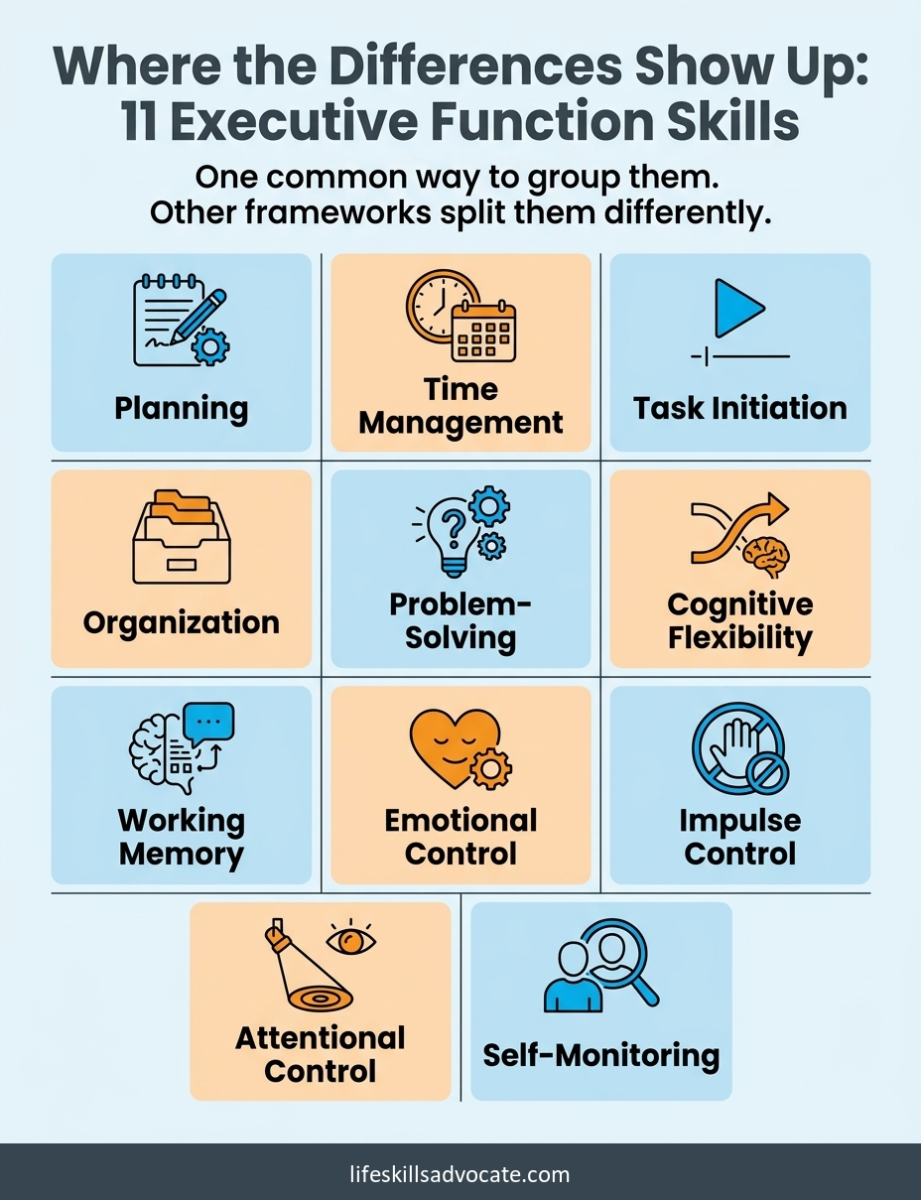
When people describe what is genuinely hard about being neurodivergent, they are often describing executive function without using the term. Executive function is the set of mental skills that run the show behind the scenes: getting started, planning, keeping track, switching gears, holding information in mind, and steadying emotions long enough to act.
At Life Skills Advocate we group executive function into eleven skills (planning, time management, task initiation, organization, problem-solving, cognitive flexibility, working memory, emotional control, impulse control, attentional control, and self-monitoring). That is the set our resources use. Other frameworks split them up differently, so treat it as a useful map, not the one true list.
That reframe is the one that tends to help most. A label like ADHD or autism can feel abstract. “My task initiation and working memory take more effort than average” is concrete, and concrete is coachable. If you want the mechanics of how these skills work and how to strengthen them, that is a whole topic of its own, covered in our guide to executive dysfunction signs and strategies.
Do You Need a Diagnosis to Call Yourself Neurodivergent?
No.
Because neurodivergent is a descriptive, community-rooted word rather than a clinical one, self-recognition and self-identification are valid entry points, and a lot of the community arrived exactly that way.
That said, this is a place for straight talk rather than cheerleading. A formal evaluation can do things self-identification cannot. It can open the door to workplace or school accommodations, medication where that applies, and support that requires paperwork. If access to those matters to you, an evaluation is worth pursuing.
Some people find real relief in a formal answer, and others find their own recognition is enough to start changing how they work. Both are legitimate.
What you do not have to do is earn the word by suffering enough or by getting a professional’s permission first. Self-identification, self-recognition, and a formal evaluation are three doors into the same room, and you get to choose which one you walk through. If you are wondering whether a difference that showed up later in life still counts, our piece on recognizing ADHD as an adult gets into that.
What You Can Do Next, With or Without a Diagnosis
Here is where most of the pages on this topic go quiet, because the affirming ones stop at “be supportive” and the clinical ones stop at “book an evaluation.” There is a lot of ground in between, and none of it requires a label.
Find out where the friction actually is. A free, non-clinical way to start is our executive functioning self-assessment. It does not diagnose anything. It shows you which of the eleven skills are pulling their weight and which ones need support, which is far more useful day to day than a single label.
Change the environment before you change yourself. Pick the one thing that trips you up most this week and put an external support around it: a written brain dump so your working memory has help, a visible timer, a phone reminder, a checklist by the door. Small and boring beats big and inspiring here.
Decide about a formal evaluation on your own terms. If accommodations or a formal answer matter to you, look into who does evaluations near you. If they do not, you are allowed to skip that step and get on with the supports.
And if you want a person in your corner for the skill-building part, that is what executive function coaching is. It is educational and practical, focused on building systems that fit how your brain works, and it is not therapy, which addresses mental health. For adults sorting this out, executive function coaching for adults is one option among several, alongside learning to advocate for what you need.
Neurodivergence Quick Facts
| Fact about being neurodivergent | What it means | Source |
|---|---|---|
| An estimated 15 to 20 percent of people are neurodivergent. | Roughly one in five. A neurodivergent brain is common, not a rare exception. | Northwestern Medicine |
| Neurodivergent is a nonmedical, descriptive term, not a diagnosis. | You can be neurodivergent without a clinical evaluation; the word describes lived reality. | Cleveland Clinic |
| The term grew out of “neurodiversity,” popularized in the late 1990s. | It is a community and identity term, not an old medical category. Judy Singer is widely credited. | University of Washington DO-IT |
| There is no single official list of neurodivergent conditions. | The umbrella has no fixed boundary. It commonly includes autism, ADHD, learning disabilities like dyslexia, and Tourette’s, among others. | University of Washington DO-IT |
FAQ
How does being neurodivergent connect to executive function?
Closely, and this is the connection most explanations miss. A lot of what is genuinely hard about being neurodivergent day to day runs through executive function: starting tasks, managing time, staying organized, holding things in working memory, and steadying emotions long enough to act.
Naming it that way turns an abstract label into something you can work on. Instead of “I have ADHD, so I struggle,” it becomes “task initiation and time management take more effort for me, so I build systems around those.” That shift is the whole reason the executive function lens is worth having.
It also explains why two people with the same label can look completely different. Executive function is a set of separate skills, not one dial, so one neurodivergent person might have a sharp memory and a shaky sense of time while another is the reverse. A single label rarely tells you what a person needs day to day, which is why mapping the specific skills beats the diagnosis alone.
Do you have to be diagnosed to be neurodivergent?
No. Neurodivergent is a descriptive, community term, so self-identification is a valid entry point. A formal evaluation matters when you want accommodations or medication, but it is not required to use the word or to start supporting how your brain works.
Is everyone a little neurodivergent?
Not really, and it is worth being careful here. Everyone has quirks and off days, but neurodivergent describes a brain whose differences are persistent and significant enough to shape daily life, not an occasional bad-focus afternoon.
At the same time, the line is genuinely blurry, and reasonable people disagree about where it sits. The word is less about qualifying for a club and more about whether it gives you a useful way to understand yourself. If it does, it does.
Is anxiety or depression considered neurodivergence?
This one depends on who you ask. Anxiety and depression are usually classed as mental health conditions rather than as neurodivergence, which typically refers to lifelong differences in how the brain is wired, like ADHD or autism. Even so, some people use neurodivergent as a broad umbrella that includes mental health conditions too, and the two often show up together. There is no single ruling everyone agrees on.
Can you become neurodivergent later in life?
Mostly, neurodivergence is something you are born with rather than something you catch, even if nobody recognized it until adulthood. Plenty of people are identified late, which can feel like “developing” it, when really the wiring was there all along and the recognition is what is new.
Next Steps
If the word fits, the useful move is not to spiral about labels but to get specific about where your brain needs support. A few places to go from here:
- Take the free self-assessment. The executive functioning self-assessment shows you which skills need backup, no diagnosis required.
- Run one experiment this week. Name the single thing that trips you up most, put one external support around it, and see what changes. You can do this today, for free.
- Sort out the language you use for yourself. If the terms feel confusing, our guide to neurodiversity-affirming language is a good primer.
- Consider a professional in your corner. Whether that is an evaluation, therapy for mental health, or executive function coaching for the skill-building, pick the support that matches what you actually need.
Further Reading
- Neurodivergent: What It Is – Cleveland Clinic
- Understanding Neurodiversity – Northwestern Medicine
- What Do Neurodiverse and Neurodivergent Mean? – University of Washington DO-IT
- Executive Dysfunction Signs and Strategies – Life Skills Advocate
- AuDHD and Executive Function in Daily Life – Life Skills Advocate
- What ADHD Masking Is – Life Skills Advocate
- Can You Develop ADHD as an Adult? – Life Skills Advocate
- Neurodivergent Burnout: Signs and Recovery – Life Skills Advocate
- Neurodiversity-Affirming Language – Life Skills Advocate
- Practicing Real-World Self-Advocacy – Life Skills Advocate
- Free Executive Functioning Assessment – Life Skills Advocate
- Executive Function Coaching for Adults – Life Skills Advocate