
The chart is still on the fridge. The stickers stopped somewhere around week four.
Since then you have probably offered money. You may have taken the phone, or the console, or both. Maybe you asked your teen point blank what it would take, and got a shrug, or a flat no to something you were certain no sixteen-year-old could turn down.
Most advice on how to motivate a teenager with ADHD is written for a parent who has not tried anything yet. It opens by suggesting a reward system. If you are reading this on attempt number four, that advice is describing the thing that already broke in your house.
So this starts somewhere else: with why each of those moves lost its grip, and what you can say tonight when the whole thing goes sideways again.
TL;DR
If the chart, the cash offer, and taking the phone away have all stopped working, here is what is going on underneath:
- Knowing how to motivate a teenager with ADHD starts with one distinction. Your teen has a brain-built reward system, and you built a second one on the fridge. They run on different currencies.
- A reward system that worked at first and then faded was running partly on novelty, and novelty gets used up.
- Raising the offer does not help, because distance in time drains a reward faster than size restores it. That is why a car six months out can land as a real no.
- Taking the console away removes reward without adding pull toward the task.
- In the moment, the more useful question is whether the first step is small enough to start, rather than whether your teen is willing to try.
This is educational, not medical or diagnostic advice. If your family is already working with a professional on this, treat what follows as something to bring to that conversation rather than a replacement for it.
Why ADHD Teens Seem Unmotivated
Your teen can build an entire Minecraft world in one sitting and cannot start a ten-minute reading assignment. Both of those are true at the same time, and the second one is not a smaller version of caring less.
ADHD shapes attention, and it also shapes how the brain registers reward and effort. Once that pattern is visible, a lot of evenings make more sense.
It Starts in the Brain’s Reward System
The brain uses dopamine to signal that something is worth doing. PET imaging work by Volkow and colleagues in JAMA found adults with ADHD had lower availability of dopamine receptors and transporters in the brain’s reward centers, and that the difference tracked with reduced motivation. That study looked at adults, though the underlying biology runs across the lifespan.
Teens with ADHD often need a task to be new, interesting, urgent, or personally theirs before the motivation system comes online. Which is why the same kid who can hyperfocus for four hours on a game that delivers constant novelty and instant feedback cannot open a textbook that pays out in June.
The Prefrontal Cortex Is Still Under Construction
The prefrontal cortex handles planning, prioritizing, impulse control, and staying on a task after it stops being interesting. According to the National Institute of Mental Health’s overview of the teen brain, it is one of the last regions to finish maturing, continuing into the mid-twenties.
ADHD adds a second layer. Summaries of the research suggest executive function development in teens with ADHD may run roughly two to three years behind same-age peers. So a fifteen-year-old can handle advanced coursework and still plan like a twelve-year-old. That mismatch confuses everyone in the house, including the teen.
When I walk families through this in coaching, I sometimes watch a parent’s shoulders drop about halfway through. The timeline is longer than anyone told them.
The Two Reward Systems You Are Working With
There are two reward systems running in your house right now, and almost nothing written about how to motivate a teenager with ADHD names both of them at once.
One of them you built. The other one came installed.
The System on the Fridge
The parent-built system is the chart, the allowance, the phone plan, the screen time, the car keys, the deal about the grade. You designed it, which means you set what it pays and when it pays.
It usually pays on a schedule: Friday, end of the quarter, when the report card comes. It usually pays the same amount each time. Both of those are sensible properties for a system a working parent has to administer on top of everything else. Predictable is easier to run.
The System in the Brain
The brain-built system was not consulted about any of this.
It pays out now, not Friday. CHADD describes the ADHD brain as responding to novelty, urgency, interest, competition, and enjoyment, which is a very different list from points and privileges. And it pays less for the same thing the fifth time than it paid the first.
Where the Two Miss Each Other
Three mismatches, and they compound.
The first is timing. The fridge pays Friday; the brain pays in the next few minutes or not at all.
The second is currency. The fridge pays in points and privileges. The brain pays in interest, and interest is not something a parent can hand over.
The third is the sneaky one. Sameness is a feature when you are the one running the system and a problem for a brain that discounts the familiar. The reward that has not changed in six weeks is not being ignored out of spite. It has simply stopped registering as news.
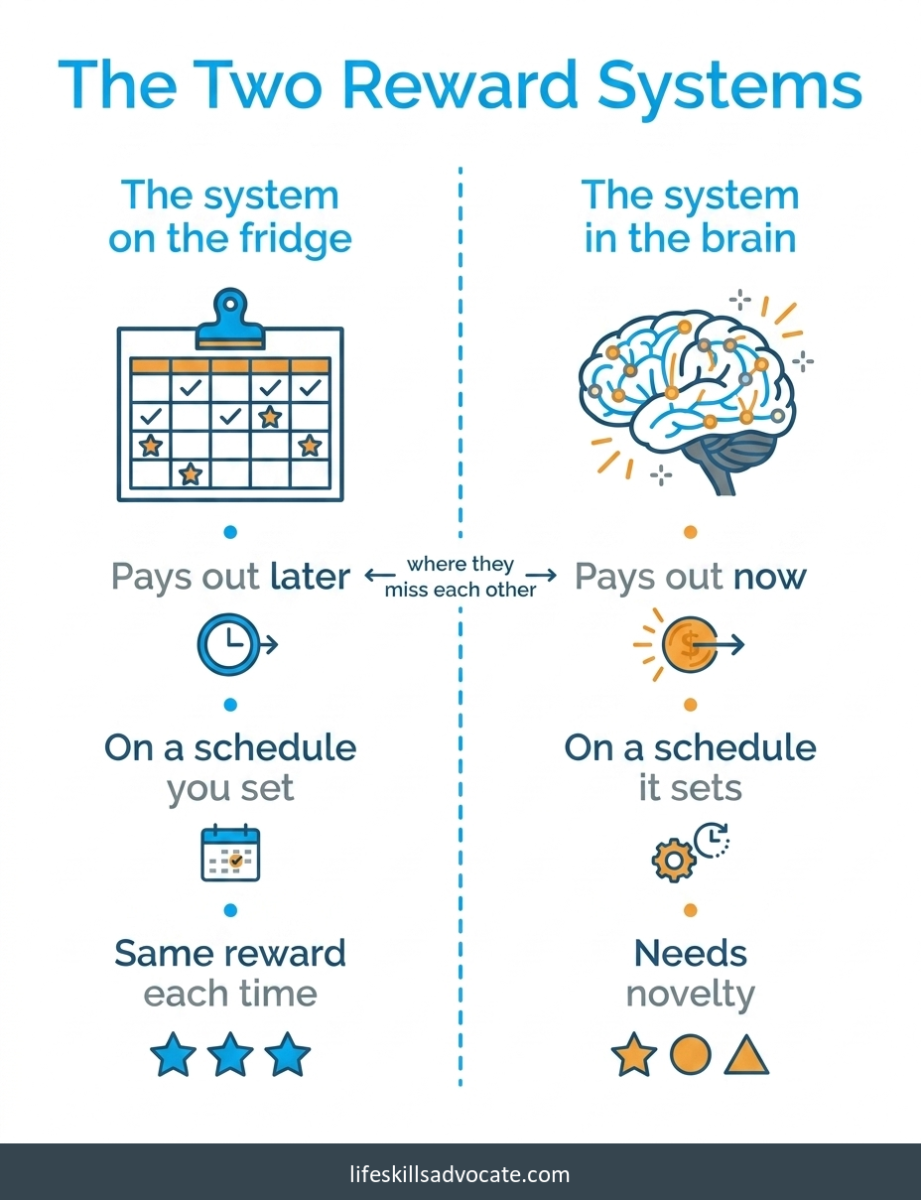
For a parent-built system to actually reach the brain-built one, it has to pay close to the moment, change often enough to stay interesting, and include something your teen had a hand in picking. That last part is where building a dopamine menu together earns its keep.
Why the Reward Chart Stopped Working
Week one, the chart worked. Week five, it was wallpaper. What actually changed?
Two things, and neither of them is that you ran it wrong.
The first is novelty. A new system is interesting on its own, separately from whatever it pays. For a few weeks the chart was delivering both a reward and a small hit of newness. Then the newness ran out and the chart was left carrying the whole load by itself, on a payout schedule the brain was already discounting.
The second is what the research says about these programs over time. A review of behavioral parent training by van der Oord and Tripp in Clinical Child and Family Psychology Review found moderate effects on behavior and parenting practices, and also noted that over time the effects of training tend to dissipate. The same review points to a growing evidence base that children with ADHD differ as a group in their sensitivity to reinforcement.
Read that carefully, because it is easy to misread. It does not say reward systems are a dead end. Behavioral parent training is one of the better-supported things a parent can do. What it says is that the effect fades, which is an argument for re-tuning the system on a schedule instead of expecting one build to last a school year.
Practically: rotate what the reward is before it goes stale, shorten the gap between doing the thing and getting the thing, and let your teen pick from a short list rather than receiving a fixed prize. A system that changes shape every few weeks holds its pull far longer than one that runs untouched, and it also sidesteps the crash that follows a big push when the payoff finally lands and there is nothing behind it.
Bigger Rewards Do Not Solve a Timing Problem
A car in six months is worth close to nothing at seven o’clock on a Tuesday. That is a statement about time, not about your teen’s character or their gratitude.
The mechanism has a name: delay discounting. Rewards lose value as they move further away, and they lose it faster in ADHD. In a large study of children and teens with ADHD, Marco and colleagues in Neuropsychology found participants chose smaller-sooner rewards over larger-later ones more often than their peers did. Two things seem to drive that: a pull toward the immediate, and a genuine aversion to the waiting itself.
Which reframes the moment a lot of parents describe as the worst one. You asked what it would take. You went as high as you could go. Your teen said no.
That no was usually accurate.
They were not refusing to want a car. They were reporting, correctly, that a car in June exerts no pull on a Tuesday night, and being unable to explain why is not the same as being unwilling to try. Size cannot compensate for distance, which is why raising the number produces the same shrug at a higher price.
The good news sits in the same research. A systematic review of 98 studies by Scholten and colleagues in Psychonomic Bulletin and Review found that delay discounting is context-dependent and changeable rather than a fixed trait. How a reward is structured is adjustable. The distance is the lever, not the price tag.
Taking the Phone Away Did Not Create Drive
Confiscation is the move almost every parent reaches for, and it is a reasonable move against a distraction. It just gets asked to do a second job it was never built for.
A consequence can do one of two things. It can mark a limit, as in the phone lives in the kitchen after ten. That is a boundary, and as a boundary it works fine.
Or it can be expected to generate motivation for a task that was already hard. Those are different jobs.
For a lot of ADHD teens, the console is the single most reliable source of reward in the day. Taking it away lowers the total amount of reward available without adding any pull toward the homework. The dependable thing is gone, and the difficult thing is exactly as difficult as it was.
So the evening gets flatter rather than more driven. The same review by van der Oord and Tripp that flagged fading effects also flags specific cautions around the use of punishment with this group.
None of that means the phone should stay in their hand at midnight. It means the phone is the wrong instrument for a starting problem, and it works much better as a negotiated limit than as leverage. If screens are their own ongoing fight in your house, that is a separate conversation worth having on its own terms: here is how to approach getting buy-in on screen time limits.
The Executive Function Connection
“Motivation” covers a lot of ground, and most of what you are watching at the kitchen table is not really about wanting.
ADHD affects executive function, the set of mental skills that let someone plan, start, organize, and finish. When those are strained, a teen who genuinely wants the assignment done can still be unable to work out where it begins.
Which EF Skills Affect Motivation Most
The framework I use at Life Skills Advocate organizes executive function into eleven skills. That is the set our resources are built around rather than a list everyone in the field agrees on, and other frameworks divide them differently. Five of them do most of the work in a motivation standoff:
- Task initiation: getting started, even when the task is dull. For a lot of ADHD teens this is the whole hill.
- Planning and prioritization: working out what comes first when five assignments, a practice, and a group chat are all competing.
- Time management: sensing how long something takes, and feeling urgency before it turns into a crisis at 11pm.
- Working memory: holding the steps in mind long enough to finish them without losing the thread.
- Emotional control: staying in a task that is producing frustration instead of leaving the room.
If you want a structured way to work out which of these is the actual weak link for your teen, our free executive functioning assessment is built to answer exactly that question, and it takes about ten minutes.
If you would rather work from a book, Peg Dawson and Richard Guare’s Smart but Scattered Teens walks parents through a similar self-assessment and matches approaches to whichever skill comes up short.
Recommended tool
Real-Life Executive Functioning Workbook
Once you know which skill is the weak link, this is the part that works on it. Eleven chapters and 81 exercises, one skill at a time, so your teen practices the specific thing that is hard rather than motivation in general.
Best for: Parents whose teen is ready to work on the skill itself, with exercises the teen can do rather than another system you have to run. It is our own workbook and it is a paid one, so start with the free assessment above.
What This Looks Like at Home and School
A teen sits down after dinner, opens the laptop, reads the assignment list, and then stalls. Or writes half a sentence, gets stuck, picks up the phone for a second, and forty-five minutes disappear.
From the outside that reads as a kid who does not care. From the inside it is closer to being frozen while the clock keeps going.
One weak skill rarely stays contained, either. It sets off the executive functioning ripple effect: a teen who cannot start puts off the work, falls behind, feels guilty, avoids harder, sleeps worse, and eventually looks like they have stopped caring.
The not-caring is usually the last stage of a long cascade rather than the first. If that arc sounds familiar, it is worth looking at whether signs of executive dysfunction are doing more of the work here than motivation is, and at the practical ways to make starting easier that target the problem directly.
How to Tell “Can’t” From “Won’t” in the Moment
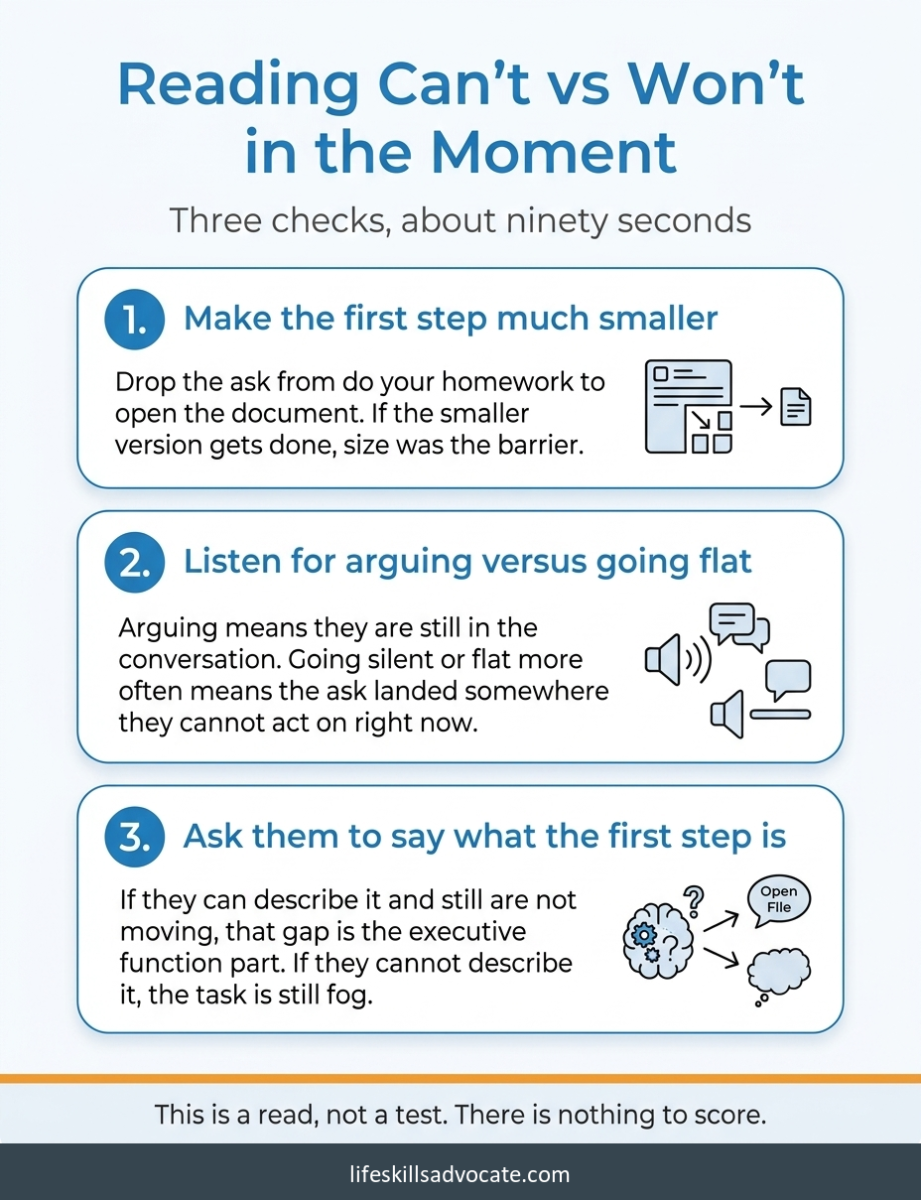
Almost every article on this topic tells you the difference matters and then leaves you to work out which one is standing in your kitchen. Here are three things you can check in about ninety seconds.
This is a read, not a test. There is nothing to score and no result to write down.
Make the first step much smaller and watch what happens. Drop the ask from “do your homework” to “open the document.” If the smaller version gets done, size was the barrier. If the smaller version lands exactly like the big one did, something other than size is in the way.
Listen for arguing versus going flat. A teen who argues is still in the conversation and still holding a position, which usually means there is room to negotiate. Going silent, going still, changing the subject, or flaring up out of nowhere more often means the ask has landed somewhere they cannot act on right now.
Ask them to say what the first step is. If they can describe exactly what to do and are still not moving, the gap between knowing and doing is the executive function part, and pressure will not close it. If they cannot describe it, the task is still fog, and no amount of pressure clears fog.
Some nights you will run all three and still have no idea. That is a real outcome rather than a failed read.
When you cannot tell, treating it as a “can’t” is the cheaper mistake. Treating a can’t as a won’t costs you trust that takes months to rebuild. Treating a won’t as a can’t costs you one evening.
What to Say When It Is Already Going Badly
Scripts for a planned sit-down conversation are easy to find. Scripts for eight o’clock, when it is already sideways and you have both said something you regret, are not.
Each of these is paired with the moment it fits. Copy the one you need.
When they say “I’ll do it later”:
“Okay. Do you want to pick the time, or do you want me to?”
When they go silent and stay there:
“You don’t have to answer. I’m going to sit here for five minutes and then I’ll head out.”
When you have already raised your voice:
“I came in too hot. I still need this done, and I want to start that over.”
When they say “I don’t care”:
“You don’t have to care about it tonight. Ten minutes, and then you’re done with me.”
When you need to end the conversation before it gets worse:
“I’m going to stop talking about this now. It’ll still be here tomorrow and so will I.”
What makes these land is not the wording. It is that none of them ask your teen to explain themselves, and explaining requires the exact skills that are offline in that moment.
7 Ways to Motivate a Teenager With ADHD
None of these are new in the sense that nobody has said them before. What changes is the order and the timing, because you are not starting from scratch. You are re-tuning something that already ran once and quit.
1. Lead With Connection Before Correction
When motivation is low and tension is high, the single most useful thing you can do has nothing to do with the assignment. Without a workable relationship, no system you build will land.
That does not mean avoiding the hard conversation. It means opening it with curiosity. Swap “why haven’t you started your homework” for “what’s getting in the way tonight.” One reads as an accusation and the other opens a door. Nemours KidsHealth notes that teens with ADHD are often especially sensitive to criticism, and criticism rarely moves behavior in the direction you want.
2. Shrink the Distance, Not the Price
This is the practical form of everything above. If a reward is not landing, the instinct is to make it bigger. Make it sooner instead.
A small thing tonight beats a large thing in June, reliably. Twenty minutes of the game after twenty minutes of the essay will outperform a car at the end of the year, and it costs you almost nothing. Let your teen name the small thing, because a reward they chose carries interest that you cannot manufacture on their behalf.
3. Use What the ADHD Brain Already Responds To
Novelty, urgency, interest, choice. You can lean on all four without lowering a single expectation.
Let them pick which assignment goes first. Move the work to a different room. Put a visible timer on a low-stakes task to manufacture some urgency. Help them find one real thread between the boring assignment and something they actually care about, which is where the difference between extrinsic and intrinsic motivation stops being academic and starts being useful.
4. Make Starting Smaller Than Seems Reasonable
Getting started is the steepest part of the hill for most ADHD teens. Once they are moving, momentum does real work.
So make the entry point almost embarrassingly small. Not “do your homework” but “open the doc and write one sentence.” Not “clean your room” but “pick up the five things closest to your feet.”
External structure helps here too: a checklist on the wall, a body-doubling session where you sit nearby doing your own work, or fifteen minutes on and five off. If you would rather hand the whole shrinking job to your teen than run it yourself every night, our Task Initiation Workbook turns it into a set of small starting missions they own.
5. Support the Skill, Then Step Back
Support the thing your teen is almost able to do alone, then remove the support as they pick it up. That is different from taking the task over.
Concretely: you put due dates on a shared calendar, they check it each evening. You help brainstorm the first three steps, they choose the order and do the work. You agree on a homework window together, and you do not stand in the doorway during it.
The psychologist Adam Price, whose book He’s Not Lazy argues that opting out is usually fear rather than indifference, sums it up as less is more. Take on less, and there is room for them to pick it up. Calibrating that without dropping the bar is its own skill, covered in setting expectations for neurodivergent teens.
6. Watch for the Shame Spiral
Years of “you’re not trying” accumulate. Told often enough, a teen starts to believe it, and then avoids tasks to protect against another round of failing, which produces worse outcomes and confirms the belief.
My own brain answers vague instructions with “nope, too much,” which is why I keep every step small and specific with the teens I work with. If yours has stopped trying altogether, shame is probably the bigger barrier, and no system will stick until that eases. Describe what the brain is doing (“task initiation is stuck tonight”) rather than who they are.
7. Say What You Noticed, Not Just What Got Finished
Small wins count for more than they seem to for a teen who mostly hears about what went wrong.
One framework for thinking about this, set out by Morsink and colleagues in the Journal of Attention Disorders, treats motivation as running on autonomy, relatedness, and competence, and notes that leaning harder on external rewards can carry costs for the internal kind. Naming something specific your teen did speaks to competence without adding another payment to the pile.
“You started ten minutes earlier tonight” does work that “good job” does not.
Before You Walk In: Your Own Reset
Your state going into the room sets the ceiling on how the exchange goes, because your teen is reading tone well before content. This is not a request to become a different person by seven o’clock. It is about ninety seconds of setup.
Decide the one ask before you walk in. One. Walk in with three and it becomes a list, and lists escalate.
Decide in advance what happens if the answer is no, so you are not inventing a consequence mid-argument and then living with it for a month.
Put a hard stop on it. Ten minutes, then you leave the room whether or not it worked.
If you have two other kids waiting and a full workday behind you, this is the version that fits in the space you actually have. It is not the thorough version. It is the one that survives a Tuesday.
Lazy or Stuck?
The question underneath that word is whether the barrier is willingness or access.
A teen who genuinely does not mind the outcome tends to be relaxed about it, and that turns out to be rare. Far more common is the teen who does mind, has failed at it repeatedly, and has stopped trying because trying and failing hurts worse than not trying at all.
In my years teaching special education, I do not remember the label helping once. Naming the specific barrier did. If that distinction is the thing you are actually trying to settle, we have written about telling laziness from a learning difference in much more depth than fits here.
When to Bring In Professional Support
Most of what shows up as low motivation is task-shaped. It attaches to schoolwork, chores, and things with deadlines, and it leaves the rest of your teen’s life more or less intact.
Sometimes it is not task-shaped. When the flatness has spread past homework into friendships, sleep, and things they used to genuinely enjoy, that is worth raising with a professional.
Not so you can arrive with a theory. Motivation that has gone global is simply a different question from motivation stuck on one task, and it is not something a parent or a coach sorts out at the kitchen table. A therapist or your teen’s doctor is the right room for that one.
Executive function coaching sits alongside that kind of support rather than replacing it. It is educational and skills-focused: task initiation, planning, follow-through, built collaboratively with the teen instead of imposed on them. It is not therapy and does not treat mental health concerns. If your teen would use structured practice on the skills underneath all of this, you can read more about executive function coaching and how it works.
What the Research Says About How to Motivate a Teenager With ADHD
| Finding | What it means | Source |
|---|---|---|
| Behavioral parent training shows moderate effects on behavior and parenting practices, and those effects tend to dissipate over time. | A reward system fading is a documented pattern, and an argument for re-tuning it on a schedule. | van der Oord & Tripp, 2020 |
| Children and teens with ADHD chose smaller-sooner rewards over larger-later ones more often than peers did. | When you are working out how to motivate a teenager with ADHD, distance in time drains a reward faster than size restores it. | Marco et al., 2009 |
| Delay discounting is context-dependent and changeable rather than a fixed trait. | How a reward is structured can be adjusted, so the timing is a lever you actually control. | Scholten et al., 2019 |
| The prefrontal cortex continues developing into the mid-twenties. | Planning and follow-through are still under construction through the high school years, and for longer in ADHD. | NIMH, 2023 |
Frequently Asked Questions
Why did my ADHD teen’s reward chart stop working?
Because part of what made it work in week one was that it was new. A fresh system delivers a small hit of novelty on top of whatever it pays out, and the ADHD brain weights novelty heavily. Once the chart became familiar, it was left carrying the whole load on a payout schedule already too far away to register.
Reviews of behavioral parent training find real, moderate effects that tend to fade over time, so a chart losing its grip after a month or two is the expected arc rather than a sign it was set up wrong. Re-tune rather than abandon: rotate the reward before it goes stale, and shorten the gap between the effort and the payout.
I offered my ADHD teen money to bring his grades up and he said no. Why?
Most likely because the offer genuinely did not reach him, and he told you so accurately.
Rewards lose value as they move further away in time, and in ADHD they lose it faster. Research on children and teens with ADHD finds they pick smaller-sooner rewards over larger-later ones more often than their peers do, driven both by a pull toward the immediate and by an aversion to the waiting itself.
A payout at the end of the semester, or a car in June, sits so far outside the window where the brain registers reward that raising the amount changes almost nothing.
His no was probably a report rather than a refusal. He was not saying he does not want a car. He was saying, without the vocabulary to explain it, that the car is not doing anything for him right now.
So shrink the distance instead of raising the price. Something small tonight moves more than something large in six months, and it costs you far less. Let him name the small thing, too, because a reward he picked carries interest you cannot supply on his behalf.
Does taking away the phone work for an unmotivated ADHD teen?
It depends entirely on what you need it to do. As a limit, it works: the phone lives in the kitchen after ten, and that is a boundary a household can hold.
As a motivator for schoolwork, it tends not to. For many ADHD teens the phone or console is the most dependable source of reward in the day, so removing it lowers the total reward available without adding any pull toward the assignment.
The reliable thing is gone and the hard thing is unchanged, which often produces a flatter teen rather than a more driven one. Reviewers of parent training programs also flag specific cautions about punishment with this group.
Negotiating the limit in advance, when nobody is angry, tends to hold better, because then the phone is a rule your teen helped write. Whether you hand it back tonight is a genuinely open question, and it depends on your house more than on anything I can tell you from here.
Is knowing how to motivate a teenager with ADHD different from motivating any teenager?
Mostly in timing. Every teenager discounts a distant reward and responds better to choice than to orders.
What differs in ADHD is how steep that discount is and how fast a familiar reward stops registering. The chart that carries a neurotypical fifteen-year-old through a semester can go flat here in a month. The standard advice still applies, just on a much shorter clock.
How to motivate a teenager with ADHD who says they don’t care?
Treat “I don’t care” as information about the moment rather than a settled position. Shrink the ask to ten minutes, drop the requirement that they explain themselves, and come back when the room is not already hot.
Is my teen unmotivated or is something else going on?
A useful first cut is whether the flatness is task-shaped or global. Motivation that attaches to homework, chores, and deadlines while friendships, sleep, and hobbies stay roughly intact usually points at the reward-and-starting problem this article describes, and the moves here apply.
When it has spread across everything they used to enjoy, including the things nobody was ever nagging them about, that is a different question and a good reason to talk to a professional. You do not need a theory before you make that call.
Next Steps: Putting It Into Practice
Pick the one that fits tonight, not all five.
- Run the can’t-versus-won’t read once this week. Shrink the first step, listen for arguing versus flat, and ask them to name step one. Ninety seconds, no equipment.
- Take one reward you already offer and move it closer. Same reward, shorter wait. That single change tells you more about what is happening than another month of the current chart would.
- Find out which executive function skills are hardest for your teen using our free executive functioning assessment, so you are working on the actual weak link.
- If you want the whole set of skills laid out with exercises, the Real-Life Executive Functioning Workbook by Chris Hanson and Amy Sippl covers them one at a time.
- Structured, ongoing help is what executive function coaching is for, if the skills piece is where your teen keeps getting stuck.
Progress on this does not look dramatic. It looks like one fewer argument this week, or your teen sitting down eleven minutes earlier than they did yesterday. That is the size real movement comes in, and it is worth counting.
Further Reading
- How to Improve Behavioral Parent and Teacher Training for Children With ADHD – van der Oord & Tripp, 2020
- Delay and Reward Choice in ADHD: An Experimental Test of the Role of Delay Aversion – Marco et al., 2009
- Behavioral Trainings and Manipulations to Reduce Delay Discounting: A Systematic Review – Scholten et al., 2019
- Studying Motivation in ADHD: The Role of Internal Motives and the Relevance of Self Determination Theory – Morsink et al., 2021
- Evaluating Dopamine Reward Pathway in ADHD – Volkow et al., 2009
- The Teen Brain: 7 Things to Know – National Institute of Mental Health
- Parenting Teens With ADHD – CHADD
- Parenting a Teen With ADHD – Nemours KidsHealth
- Executive Functioning Deficits That Deflate Motivation – ADDitude
- Smart but Scattered Teens – Richard Guare, Peg Dawson, and Colin Guare
- He’s Not Lazy – Adam Price
- 6 Practical Steps To Build a Dopamine Menu for ADHD – Life Skills Advocate
- ADHD Dopamine Crash: 4 Types and How to Recover – Life Skills Advocate
- Interest-Based Nervous System – Life Skills Advocate
- The Difference Between Extrinsic and Intrinsic Motivation – Life Skills Advocate
- What Is the Executive Functioning Ripple Effect? – Life Skills Advocate
- 9 Clear Signs of Executive Dysfunction – Life Skills Advocate
- 5 Task Initiation Strategies for High School Students – Life Skills Advocate
- Setting Expectations for Neurodivergent Teens – Life Skills Advocate
- Getting Kids to Buy In to Screen Time Limits – Life Skills Advocate
- Is My Teen Lazy? – Life Skills Advocate
- Free Executive Functioning Assessment – Life Skills Advocate
- Real-Life Executive Functioning Workbook – Chris Hanson and Amy Sippl
- Task Initiation Workbook – Life Skills Advocate
- Executive Function Coaching for High School Students – Life Skills Advocate