
There is a thing that comes up in coaching with ADHD adults again and again. The client describes losing four hours to a side project they could not stop, then admits they still have not opened the work email they have been dodging for three days.
They are not bragging about the hyperfocus. They are not excusing the avoidance. They are asking why the same brain can do both.
The frame most of them have for this is Dr. William Dodson’s term, the interest-based nervous system. It names something real. ADHD brains engage when a task carries interest, novelty, challenge, or urgency, and they disengage when a task is only “important.” That part lines up with what shows up in session week after week.
The trouble is the way it gets repeated online: ADHD brains “can’t do boring stuff,” your nervous system “isn’t wired” for importance.
Read enough of that and the pattern starts to feel like a verdict. From inside a coaching practice, I see something different. The framework gets the shape of the experience right and the destiny part wrong. Skills work is what changes the math.
TL;DR
Most readers arrive with a few stacked versions of the same question. Here are the five this piece answers:
- What did Dr. Dodson actually mean by an interest-based nervous system, and what did he not mean?
- Why do ICNU, PINCH, and INCUP all describe the same thing with different letters?
- If interest-based motivation is real, does that mean ADHD brains can never do boring tasks?
- Where does the framework genuinely help, and where does it flatten into “ADHD brains can’t”?
- What does working with the pattern actually look like in practice, not theory?
This is educational. Coaching at Life Skills Advocate is skills-focused, not a substitute for working with a qualified professional. If ADHD is something you are actively working through with one, read this as a supplement, not a replacement.
Where Did the Interest-Based Nervous System Come From?
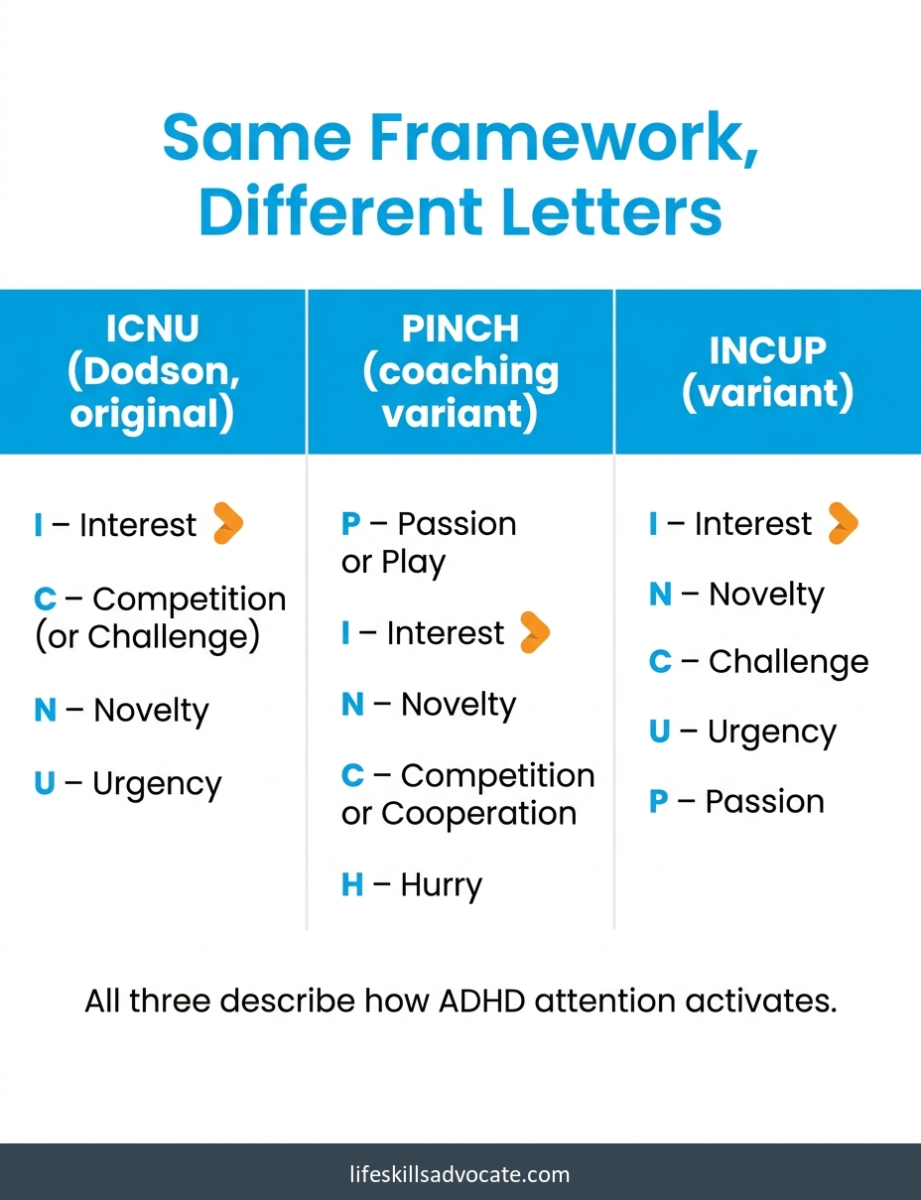
The term comes from Dr. William Dodson, a psychiatrist who spent decades working with adult ADHD. He laid out the framework in a Psychiatric Times piece on real-world office management of ADHD in adults and in a widely-circulated ADDitude article on ADHD brain chemistry. His acronym for what activates ADHD attention is ICNU: Interest, Competition (sometimes rendered as Challenge), Novelty, Urgency.
Two popular variants have shown up since. PINCH uses Passion or Play, Interest, Novelty, Competition or Cooperation, and Hurry. INCUP covers Interest, Novelty, Challenge, Urgency, and Passion. Same construct, different letters. If you have seen them used interchangeably online, that is because they essentially are.
Dodson’s central claim is straightforward. Where a neurotypical brain runs on a mix of importance and consequence, the ADHD brain runs on whichever of the four (or five) triggers is present in the moment.
That much is descriptive and useful.
The trouble starts when “interest-based” gets restated as “can only do interesting things.” More on that in a minute.
The Four Motivators in Real Life
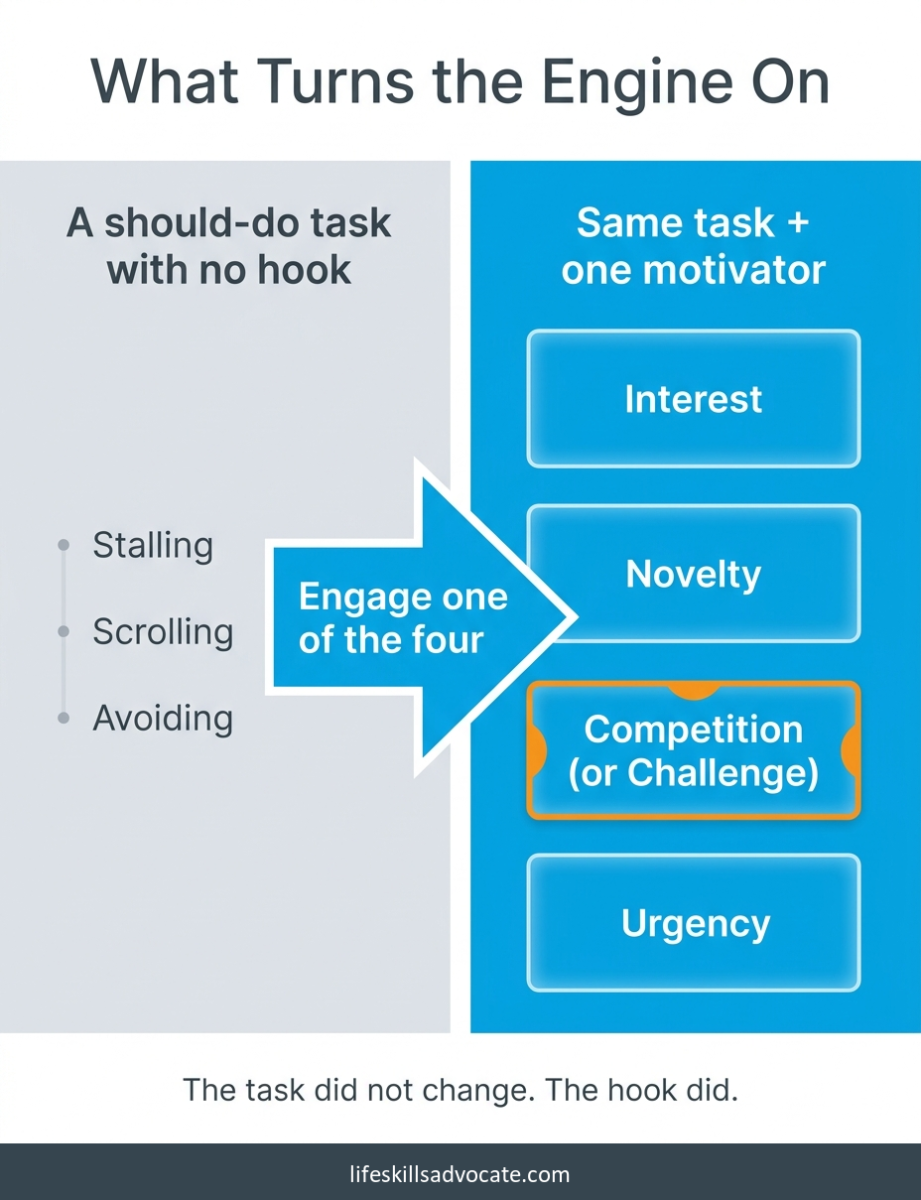
Here are Dodson’s four motivators, with what each one looks like when it is actually doing work. The interest-based nervous system is not abstract for most people who have ADHD. It is the felt difference between the task you can lose hours to and the one you cannot start.
Interest
The most familiar one. When a task connects to something the brain already cares about, engagement comes for free. A teenager who cannot finish a five-paragraph essay can build a 3,000-word lore document for a video game without breaking a sweat. Same kind of writing, same brain, completely different felt experience.
Novelty
A brand-new system, app, planner, or hobby gets a burst of attention that often outlasts good judgment. The catch shows up around week three: the novelty has worn off, the dopamine has gone with it, and the system that was going to fix everything sits unused.
This is also why the answer is rarely “buy a better planner.”
Challenge or Competition
The “okay, prove I can” lever. Timed sprints, friendly competitions, deadlines framed as challenges instead of obligations. Plenty of ADHD adults have built working systems around this lever: rotating timers, accountability pairings, gamified to-do apps. When the framing flips from “I should” to “I want to win,” the task often gets easier to start.
Urgency
The classic one. Deadlines work. They work so well that they often become the only thing that works, which is where this motivator stops being useful and starts being a trap. The all-nighter pattern is not a personality trait; it is what happens when urgency is the only one of the four reliably available. This is also why the 80/20 rule for ADHD lands so hard for some readers. The few things that get done are the ones that bullied their way in via urgency.
The Binary That Isn’t Quite a Binary
The interest-based nervous system gets presented as a contrast: ADHD brains are interest-based, neurotypical brains are importance-based. That is a working heuristic, not a published neuroscientific dichotomy.
It is not a brain scan.
Neurotypical brains also respond to interest, novelty, challenge, and urgency. They just have a stronger backup system that fires when those four are missing. The difference is more accurately about reliability than about whether the same machinery exists.
The binary frame can also make the pattern feel fixed. A reader who reads “your nervous system is interest-based” and concludes “so I literally cannot do boring tasks” is following the language to a conclusion the framework was never built to support. A 2020 paper in Frontiers in Psychology on arousal and executive alterations in ADHD covers what is actually known here, and the short version is: more complicated than a binary, and not destiny.
Use the framework as a description. Treat it as a verdict and it starts working against you.
Where the Interest-Based Framework Holds Up
The most useful question is not whether the interest-based nervous system is a real neurological category. It is whether the framework usefully describes a real experience. In coaching practice the answer is yes, in three specific ways.
It gives newly identified adults a frame for something they have been living without language for. People recognize the pattern the moment someone names it. That recognition matters because it interrupts decades of “I’m just lazy” self-narration, which is a worse and less accurate description of the same data.
It also gives the people around them a shared vocabulary. “I’m interest-based” lands harder than “I’m bad at boring stuff.” It points at a pattern instead of a defect.
And practically, the framework helps with task design. Once you can name which of the four motivators a task needs, you can engineer one in. The dopamine menu for ADHD is essentially this framework operationalized; if “design a hook” is the question, that is the most practical companion piece.
Where the Framework Flattens
The most common online version of the interest-based nervous system is not Dodson’s. It is the post-Dodson restatement that hardens “interest-based” into “ADHD brains can’t do boring things.” That restatement does real damage in three ways.
It frames the pattern as fixed. If your brain “can’t do” something, why try? The argument writes itself, and the next thing it writes is your week.
It treats avoidance as a feature. There is a difference between “this task is hard to start because no motivator is present” and “this task isn’t for me.” The first is a problem you can engineer around. The second ends the conversation.
And it collapses the variance inside ADHD. Some ADHD adults can power through a boring task once a week with the right setup; others find that nearly impossible without external support. The framework reads as if everyone has the same dial.
A useful counter-argument lives outside Dodson’s tradition. In a LinkedIn essay by Brian R. King, MSW, an autism and ADHD coach, the all-or-nothing reading of the framework is described as a disservice that treats a diagnosis as destiny, when the brain is more nimble than the framework gives it credit for. That is the editorial seam this piece sits on. The framework is useful as a description; it stops being useful the moment it gets read as destiny. If you would rather start with a book, our shortlist sorts reading about ADHD by what you want it to do.
Skills work changes what is possible. Not in a “mind over matter” sense, which is its own trap. In the practical sense of: with the right setup, the boring task gets started anyway.
What EF Coaches See That Dodson’s Framework Doesn’t Name
What does Dodson’s framework miss when you sit with someone living it five times a week? A few things show up over and over.
Shame is the silent partner of the pattern. Most clients have spent years interpreting “can’t get started on the important thing” as a character flaw. The framework names the cognitive pattern but rarely names the emotional one running underneath, which is usually some flavor of shame with rejection sensitivity stacked on top. The work is often less about motivation and more about getting the shame out of the way long enough for any motivator to land.
Brute-forcing importance-based motivation has a tax. Plenty of ADHD adults can sustain it for a stretch. The cost is real: burnout, mood crashes, weeks lost recovering from the push.
Task pairing is the most underrated tool in the kit. Hooking a should-do to a want-to (the work email, then a five-minute reset of music or fresh air) is closer to how the brain actually engages than “block out distractions.” Combined with body doubling and timeboxed urgency, this is most of what gets used in session.
The pattern is also not the personality. Two clients with the same interest-based wiring can have wildly different relationships with it: one treats it as identity, the other treats it as a constraint to engineer around. The relationship is usually what gets worked on, not the pattern itself.
Three Ways to Work With Your Interest-Based Pattern
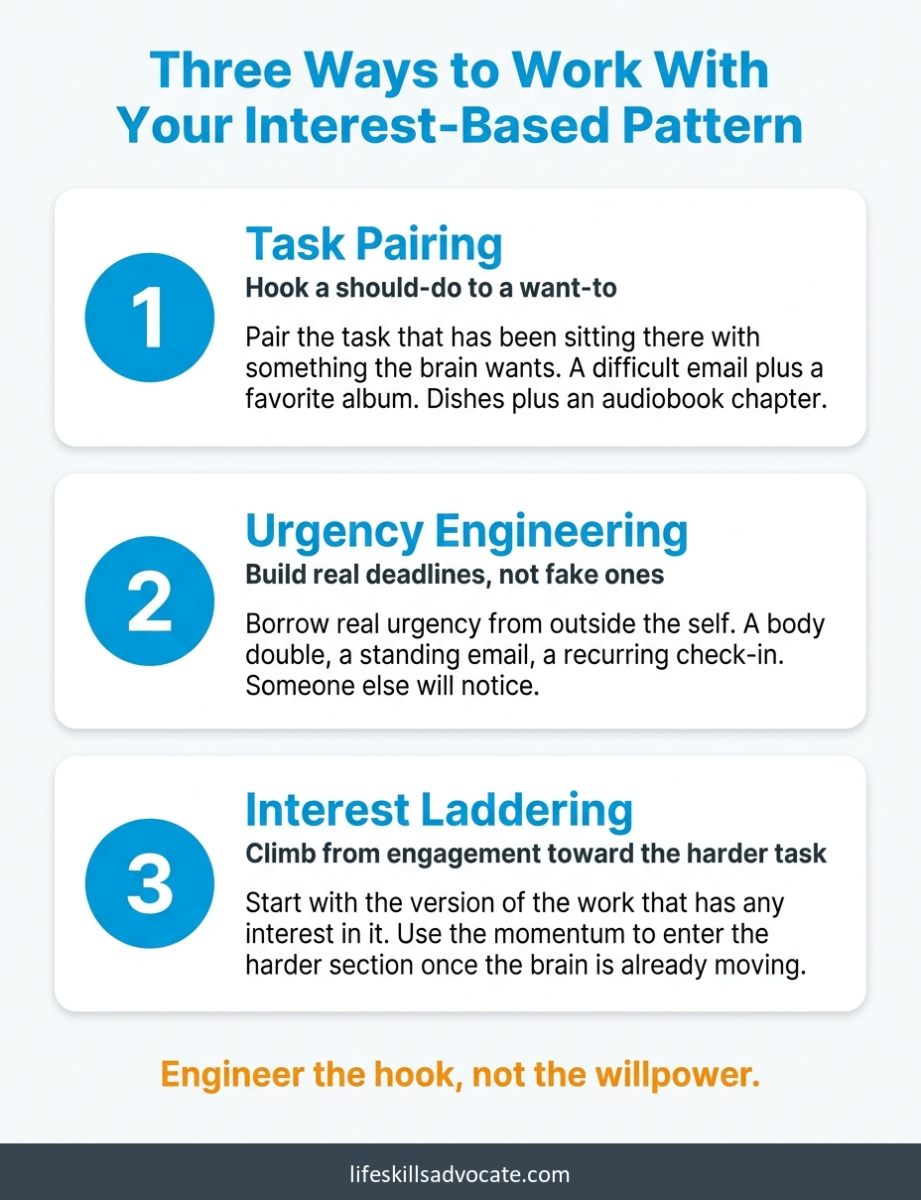
If the framework is descriptive but not destiny, the practical question is what to do with it. These are the three approaches that come up most often in coaching sessions for working with the interest-based nervous system instead of against it.
Task Pairing: Hook a Should-Do to a Want-To
The cleanest version is concrete. Pick the task that has been sitting there for three days. Pair it with something the brain wants. A difficult email while a favorite album plays. Sorting receipts in a coffee shop you would otherwise have no excuse to visit. Dishes during an audiobook chapter.
The hook does not have to be elaborate. It does have to be reliable.
Urgency Engineering: Build Real Deadlines, Not Fake Ones
Self-imposed deadlines often do not work because the ADHD brain knows they are fake. What does work is borrowing real urgency from outside the self: a standing meeting with a body double, a recurring email to a colleague at 4 p.m. on Fridays, a check-in with a coach. The shape that matters is someone else will notice. That is what makes the deadline carry weight.
Interest Laddering: Climb From Engagement Toward the Harder Task
Instead of jumping straight to the boring task, climb. Start with the version of the work that has any interest in it (the part you actually want to do, the easy first step, the related but easier task), and use the momentum to enter the harder section once the brain is already moving. Hyperfocus is downstream of engagement, not willpower.
Get engaged first.
When the Pattern Becomes a Trap
The same pattern that explains why something hard finally got done is also how some weeks get eaten alive.
Interest-based engagement can curdle into interest-based avoidance, where the only thing that ever gets attention is the brand-new project, and everything older accumulates in a quiet pile. Hyperfocus carries its own cost: sleep skipped, meals skipped, the next day a wash. The piece on hyperfixations and ADHD covers the engagement-with-a-cost side of this in detail.
Urgency-only living is the version most people who have ADHD recognize on sight. Live there long enough and the nervous system starts treating mild stress as the baseline; anything below that registers as boredom.
That is not a sustainable system. It is what burnout actually is.
Citability Block: The Interest-Based Nervous System
| Concept | What It Means | Source |
|---|---|---|
| Interest-based nervous system | A practice-based observation by William Dodson, MD, that ADHD brains engage when a task carries Interest, Challenge, Novelty, or Urgency (ICNU) and disengage when a task is only “important.” | Dodson, Psychiatric Times |
| ICNU | Dodson’s four motivators: Interest, Competition (or Challenge), Novelty, Urgency. ADDitude’s 2025-updated version uses “Competition”; the “Challenge” rendering is also widely circulated. | Dodson via ADDitude (updated 2025) |
| Scientific status | The interest-based vs importance-based binary is a working heuristic, not a peer-reviewed neuroscientific dichotomy. Dopamine reward research supports differences in how ADHD brains engage with novelty and interest. | Frontiers in Psychology, 2020 |
| Situational variability | CHADD documents that ADHD engagement varies based on task interest, urgency, and reward proximity, which fits the lived experience Dodson’s framework names. | CHADD, Situational Variability |
Frequently Asked Questions
What is an example of an interest-based nervous system in action?
The clearest one is the gap between a should-do and a want-to. A college student stares at a research paper for three hours and writes 200 words; that same night, they write 2,000 words on the same topic in a forum thread. Same brain, same subject, different hook.
Is the interest-based nervous system scientifically proven?
Not as a discrete neurological category. It is a practice-based observation that aligns with dopamine research in ADHD. It is not a peer-reviewed brain dichotomy.
What are the four motivators of ADHD, and is PINCH the same thing?
Dodson’s four are ICNU: Interest, Competition (or Challenge), Novelty, Urgency. PINCH is a coaching-flavored restatement that adds Play or Passion to that core. INCUP is yet another variant. The acronyms differ; the underlying claim about ADHD engagement is the same. If you have seen all three online and wondered which one was right, none of them is wrong. The choice is mostly about which coach or clinician you read first, and once you can see the shared structure, the labels stop mattering as much.
Why do people with ADHD have so many interests?
Because novelty is one of the four motivators that activate the interest-based nervous system. New things are engaging in a way that familiar things are not, which is why ADHD brains often pick up interests quickly and intensely. That same wiring explains why interests can fade once novelty wears off, which is also why having a graveyard of half-finished hobbies is more pattern than character flaw. The two effects (rapid engagement and rapid fade) come from the same engine. Most ADHD adults have an easier time accepting that as a description than trying to discipline themselves out of it, and that acceptance is usually the more useful starting point.
Can you train an ADHD brain to be importance-based?
Not directly. Trying to brute-force the brain into responding to importance the same way a neurotypical brain does mostly produces burnout, and at the deep end of that pattern, the body can drop into dorsal vagal shutdown. What does change is what you can do with the brain you have. The skills work is not about converting an interest-based pattern into something else; it is about engineering interest, novelty, challenge, or urgency into tasks that started without any of them, so the same machinery that handles a side project also handles the work email. That is closer to building a translation layer than rewiring the brain. The translation layer holds up surprisingly well with practice, but the practice rarely looks impressive while it is happening. It looks like a body double, a timer, a playlist, and a small list of hooks taped to a notebook. The version of “working with your brain” that actually does the work is usually the one you would not want to film. Most people figure that out the hard way.
Next Steps
Naming a pattern does not change it. Doing one thing with the naming does. These are the moves most clients run before they have a coach, a workbook, or anything else.
- Run the four-motivator test on one stuck task this week. Pick the thing that has been on your list the longest. Ask which of interest, novelty, challenge, or urgency is missing, and build it in.
- Pair a low-friction reward with a should-do today. Music, a coffee shop, a body double, an audiobook. The hook is the point.
- If you want a self-paced snapshot of where the friction is, the free executive functioning assessment from Life Skills Advocate flags which EF skills are pulling the most weight. Five minutes, no credit card.
- For a fuller framework, the Real-Life Executive Functioning Workbook by Chris Hanson and Amy Sippl covers task initiation, motivation, and emotional control across 11 chapters with exercises you can work through at your own pace.
Working With This in Coaching
When the interest-based pattern is the part of the week causing the most friction, executive function coaching at Life Skills Advocate is one specific form of help. EF coaching is not therapy. It does not treat depression, anxiety, or mood. It is educational and skills-focused. The work is the practical part: figuring out which of the four motivators are reliably available to you, designing tasks around them, and building the systems that make the harder weeks survivable. Sessions are one-on-one and run 50 minutes. Coaches are neurodivergent themselves, which matters because the conversation skips a lot of the explaining-from-scratch step.
Further Reading
- Real-World Office Management of ADHD in Adults – Dodson, Psychiatric Times
- ADHD Brain Chemistry (the Interest-Based Nervous System) – ADDitude
- Arousal and Executive Alterations in ADHD – Frontiers in Psychology, 2020
- Why the Interest-Based Nervous System Narrative Falls Short – Brian R. King, MSW
- How to Deal With Situational Variability – CHADD
- 6 Practical Steps to Build a Dopamine Menu for ADHD – Life Skills Advocate
- Hyperfixations and ADHD: What You Need to Know – Life Skills Advocate
- The 80/20 Rule for ADHD: How the Pareto Principle Helps – Life Skills Advocate
- Free Executive Functioning Assessment – Life Skills Advocate
- Real-Life Executive Functioning Workbook – Life Skills Advocate
- Executive Function Coaching – Life Skills Advocate