
You sat down to do the thing. Your heart rate climbed, your jaw set, and then nothing. The body refused to move forward, and an hour later you were still in the chair, no closer to the task and a lot more tired.
Most people who land on this page have already wondered if what they are describing is just ADHD burnout under a different name. It is a reasonable guess. Another one worth ruling out is the fawn response, which also stops you saying what you meant to say, but organizes itself around a particular person rather than powering the system down. Dorsal vagal shutdown shows up in nervous-system language that the ADHD community is only starting to use, and the felt experience overlaps with burnout in ways that can make the two indistinguishable from the inside. The difference matters anyway, because the moves that help recover from each one are different.
What follows are seven patterns the coaching team at Life Skills Advocate sees regularly when clients describe what looks at first like burnout and turns out to be something else. The framing comes from Stephen Porges’s polyvagal work rather than from a professional assessment, and the goal is recognition, not a label.
If two or more of these patterns sound familiar, the closing section covers what to try first, including the recovery moves coaches actually use with clients at low capacity.
TL;DR: The Pattern in 4 Lines
Here is the quick version, in case you are reading this from inside the experience itself:
- Dorsal vagal shutdown is a protective nervous-system state where the body slows down and goes offline after overwhelm. It is not laziness, not depression, and not always ADHD burnout.
- The seven signs covered here are paralysis between fight-and-shutdown, numbness that reads as flatness, brain fog that does not lift with caffeine, somatic slowdown (cold hands, digestive slowing), time distortion, the “I can’t even” wall in front of small tasks, and wanting connection but being unable to reach for it.
- The fastest differentiator from ADHD burnout: it can hit in minutes, and the usual stimulation rescue moves (coffee, music, body doubling) do not lift it the way they sometimes lift ADHD initiation difficulty.
- What helps first is safety, not strategy. Active interventions applied before the body registers safety tend to deepen the shutdown rather than shift it.
This article is for general education and does not replace medical or mental health care. If the patterns described here are interfering with daily life or safety, please contact a qualified professional.
Quick Definitions: The Language of Dorsal Vagal Shutdown
| Term | Plain-language definition |
|---|---|
| Dorsal vagal shutdown | A protective nervous-system state where the body slows down and goes offline after overwhelm. Not a failure or a diagnosis; a built-in collapse response. |
| Sympathetic activation | The fight-or-flight state. Heart rate up, attention narrowed, body ready to move. This is the state that shutdown is the alternative to. |
| Ventral vagal state | The “safe and social” state. Calm, connected, available for conversation. This is the state recovery aims to return to. |
| Window of tolerance | The range where a person can think clearly, feel emotions without being overwhelmed, and respond rather than react. Shutdown means dropping below it. |
Sign 1: Dorsal Vagal Shutdown Hits After Activation, Not Before
Dorsal vagal shutdown rarely arrives without warning. The hallmark version starts with a spike: the heart speeds up, the jaw tightens, and the sympathetic system loads as if to launch into action. Then the launch does not happen. The activation has nowhere to go, and the nervous system drops down through the collapse door instead.
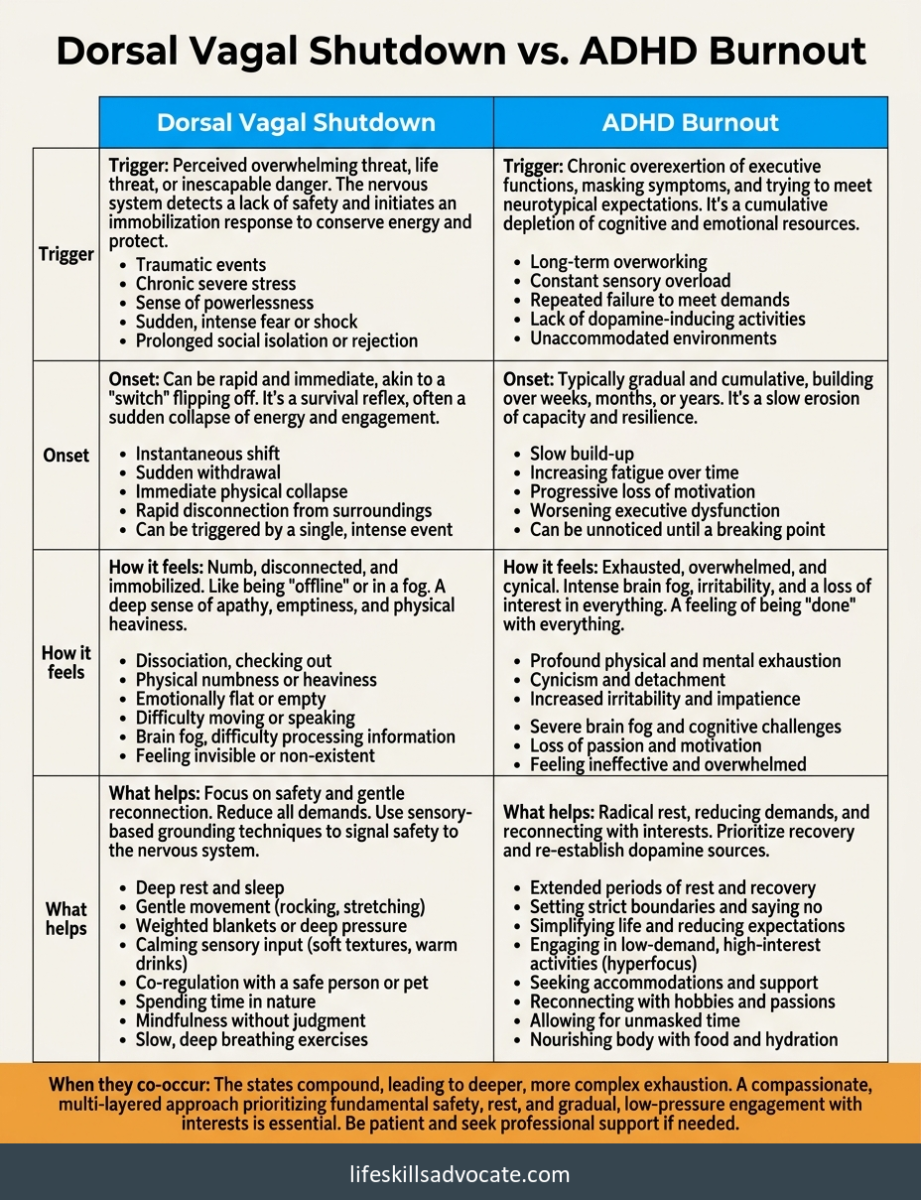
This is the sign most reliably misread as ADHD burnout, and it is also the cleanest differentiator from it. Burnout is depletion that has built up over weeks or months, and rest is at least directionally useful. Shutdown can hit in minutes, and rest alone often will not lift it because the issue is state, not energy.
Clients describe the moment in surprisingly similar language. “My body refused to move forward.” “I was about to start, and then I just was not.” The internal experience is paralysis with adrenaline still humming underneath, which is why some people describe it as feeling wired and frozen at the same time.
That combination is the tell.
For neurodivergent adults whose interest-based nervous system already runs on activation and reward, the drop from sympathetic loading to dorsal vagal offline can feel especially confusing. The same body that found the energy yesterday cannot find it now, and there is no obvious reason.
What to try first when this is the pattern
Before reaching for any active intervention, lower the input load: dim the lights, lower the music or turn it off, and physically move away from the screen or the task that triggered the spike. The first job is signaling safety to the body, not solving the task that started this.
Sign 2: The Numbness That Feels Like Emotional Flatness
A common version of shutdown shows up as muted affect rather than collapsed energy. Not sad. Not calm. Just absent. The reader registers it as “I do not feel anything right now and I should,” and then layers self-blame on top.
This is the sign most people search for using the felt experience rather than a clinical term. They type things like “why do I feel nothing” or “is this depression” because the language for it is hard to find. Practitioner write-ups at NeuroSpark Health and SpringSource describe the same reduced-affect pattern as one of the more reliable signatures of the dorsal vagal branch coming online.
The misreading goes a particular way: emotional flatness gets interpreted as “I do not care anymore,” which is almost never true. Caring is still there. The system that connects caring to feeling has gone quiet because the body is in protective offline mode.
That is a state change, not a values change.
One signal that flatness is shutdown rather than burnout: it lifts when safety arrives, not when rest arrives. Crawling into a familiar blanket on a couch in a quiet room, with no demand to do anything, returns feeling in a few hours for many people. Sleep alone rarely does.
Sign 3: Brain Fog That Doesn’t Lift With Caffeine
How do you tell the difference between ordinary ADHD brain fog and shutdown brain fog? The cleanest test is the one most people accidentally run: try the usual rescue moves and see what happens.
Coffee, a brisk walk, a favorite playlist, body doubling on a video call. Any of these can shift ADHD initiation difficulty because they raise activation and reward signals enough to get a stuck task moving. None of them reliably touch dorsal vagal shutdown, because the body is not under-stimulated. It is offline.
The lived version sounds like this: you drank the coffee. Twenty minutes later, you are still staring at the same screen, more anxious now, no clearer. The activation you added went into the system and got absorbed without producing any forward motion.
This non-response to stimulation is informative. It is one of the in-the-moment ways to distinguish shutdown from the kind of emotional regulation pattern ADHD readers are more used to noticing.
ADHD struggle responds, at least partly, to stimulation. Shutdown does not.
The practical implication: when the rescue moves stop working, that is a signal to switch tracks, not to try harder. Adding more activation to a body that has already collapsed under activation deepens the shutdown.
Sign 4: Cold Hands, Cold Feet, and Digestive Slowdown
The body has a quieter way of announcing shutdown that most people miss because the somatic signals look like ordinary glitches. Peripheral circulation slows, so hands and feet go cold even in a warm room. Digestion slows too, which shows up as nausea, bloating, or a sudden absence of hunger.
These are the textbook somatic signatures of the dorsal vagal branch coming online: vasoconstriction in the limbs, gut motility slowing, reduced general sensation. Most people feel them, attribute them to “I’m just cold” or “I ate something weird,” and move on. Naming them as part of the same nervous-system state prevents a different problem: the medical doom spiral that comes from treating each somatic signal as its own potential issue.
None of this rules out an actual medical cause. Cold extremities and digestive slowdown can have other explanations, and prolonged or severe versions warrant a separate medical look. The frame here is recognition, not labeling: if these signs tend to cluster with the other ones on this list, the nervous-system explanation is more likely than the worst-case medical one.
Sign 5: Time Distortion (Hours Disappear Without Action)
ADHD time blindness is one thing. Hyperfocus is another. The shutdown version of time loss is different from both, and naming the difference is what interrupts the self-blame spiral that comes after.
It looks like this: it is 4 p.m. You sat down at 11 a.m. to do one task. The task is not done. You were not on your phone, you were not absorbed in a tangent, you were not asleep. You just do not know where the time went, and instead of the relief of a finished thing, the afternoon arrives with dread.
Hyperfocus typically leaves behind a thing that got made or solved. ADHD time blindness tends to leave behind a memory of switching between tabs or noticing the wrong noise. Shutdown leaves behind nothing. The hours were spent in the chair, technically present, mentally offline.
The closest sibling experience in the neurodivergent vocabulary is autistic inertia, which can look similar from the outside. The mechanism is not identical, but the felt experience overlaps enough that AuDHD adults regularly recognize both vocabularies in the same episode.
What helps here is not better time tracking. It is the recovery sequence in the First Moves section below, applied as soon as the time-loss pattern is recognized.
Sign 6: The “I Can’t Even” Wall in Front of Tiny Tasks
The shutdown sign LSA’s coaches see most frequently in client check-ins is also the one most people try hardest to push through. The task is small: load the dishwasher, send the email, change clothes. The barrier in front of it feels insurmountable in a way that makes no sense, because the task takes three minutes and the body is right there.
One client put it like this, in a session note: “I haven’t washed my hair in five days. It isn’t even disgust. I just cannot find the step that comes before turning on the water.”
The “step before the step” is where the wall sits. The motor plan that would normally start the task does not load.
This is where coaching authority is doing real work. Other articles describe the experience of “I can’t even.” Coaches see what actually shifts it in a session. The move that works most reliably is what coaches call “one degree of motion”: not the task, not even a step of the task, but any movement at all that proves the system can still produce action. Standing up. Walking to the sink. Touching the dishwasher handle.
The “one degree of motion” reset
The intent is not to trick the body into the task. It is to send a single signal that movement is available, without making the task itself the unit of measurement. After three or four small motions, the motor plan for the task starts to load on its own. When it does not, that is information too: the body is not ready yet, and the next move is to drop down to the recovery sequence rather than push further.
Readers familiar with autistic meltdown patterns will notice the parallel. Both states resist top-down management. Both respond better to bottom-up nervous-system care.
Sign 7: Wanting Connection but Unable to Reach for It
The seventh sign of shutdown is the most isolating because it locks the recovery lever inside the room with the person who needs it. Co-regulation with a trusted other is one of the most reliable shifts out of the state, and the dorsal vagal branch tends to block the social-engagement system that would let someone ask for it.
The lived version: your partner is in the next room. You want them. You do not text. You also cannot get up.
The wanting feels far away from the doing, and the gap between them is what makes the experience read as so disconnected from values, choices, or effort.
This is not introversion, and it is not social anxiety in the usual sense. It is the social-engagement system going temporarily offline as part of the same protective response that shut down the rest of the body. Dr. Megan Anna Neff at Neurodivergent Insights publishes on dorsal vagal shutdown for ND audiences specifically. Some readers will also recognize the shape from Pathological Demand Avoidance patterns, where even a self-initiated reach can register as a demand the nervous system blocks.
The implication for partners, friends, and roommates: the absence of reaching out during shutdown is not a sign of disinterest or withdrawal from the relationship. Quiet proximity (sitting nearby, low voice, no demand) does more good than asking what is wrong or trying to talk it out. The social system is the lever, but it has to be approached without weight.
How to Come Out of Dorsal Vagal Shutdown: First Moves Coaches Use
What helps first when the body is in dorsal vagal shutdown and none of the usual rescue moves are working? Coaches use a short sequence, in a specific order, because the order is the work.
Skipping the first step makes the rest land flat.
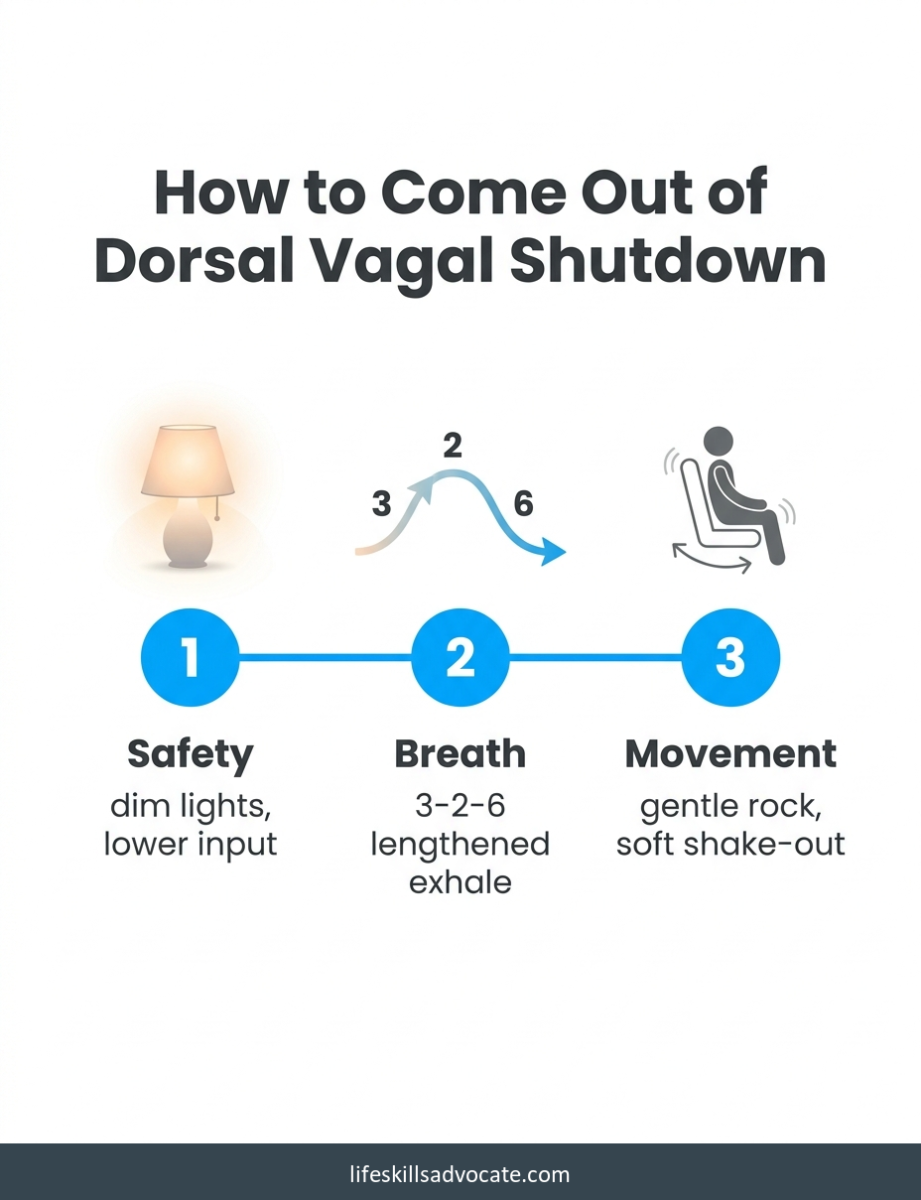
Move one: safety. Before any active intervention, lower the input load. Dim the lights or turn one off. Silence notifications, including the watch on the wrist and the speaker on the desk. Move away from the trigger location if there is one.
Familiar smell helps (a candle, a hot drink), as does a familiar texture (a heavy blanket, a known sweater). The body reads these cues before it reads any internal instruction. Two to five minutes of input reduction is typically enough to shift the baseline.
Move two: breath. The 3-2-6 pattern (inhale for three counts, hold for two, exhale for six) lengthens the exhale, which is what tips the autonomic balance toward the parasympathetic side. Slow and deliberate matters more than the exact count; the long exhale is the active ingredient. Practitioners at TheBreathEffect describe similar lengthened-exhale patterns as a first-line move for the same reason. Two minutes is plenty.
Move three: movement. Not exercise. The goal is gentle discharge of trapped sympathetic activation: a slow rock side to side, a soft shake-out of the hands and shoulders, a stretch that takes thirty seconds. The nervous system reads “the body can move” as a signal that whatever the system registered as a threat has passed. Coaches at Bay Area CBT Center describe this kind of small-movement sequence as one of the more reliable bottom-up moves available.
Order matters more than perfect form on any single move.
Optional fourth move: co-regulation. If a trusted person is nearby and the social-engagement system has come back online enough to allow it, quiet co-presence (sitting near each other, soft voice, no problem-solving) accelerates recovery. This is the move from Sign 7 in the other direction: when the social system has reopened, even small contact does a lot.
The most common mistake is reversing the order. Active interventions (breath work, movement, calls to family) applied before safety deepen the shutdown by adding demand to a system already in protective offline mode. Safety first, then everything else. If the patterns are persistent and recovery is not lifting them, the LSA Free Executive Functioning Assessment can help identify which EF skills the shutdown pattern is most consistently affecting, which is a useful input for any coaching or therapy conversation.
Frequently Asked Questions
How is dorsal vagal shutdown different from ADHD burnout?
Burnout is a depletion pattern that builds over weeks or months and responds, at least partly, to rest. Dorsal vagal shutdown is a nervous-system state that can hit in minutes and does not respond to rest alone the same way.
The conflation is well-known in the ADHD community: Add.org’s “ADHD Paralysis Is Real” notes how readers describe what is actually a freeze response and call it burnout because the felt experience overlaps. The two also genuinely co-occur, which makes telling them apart harder: burnout makes the system more susceptible to shutdown episodes, and shutdown episodes make burnout worse.
The in-the-moment test is the rescue-move test. If coffee, body doubling, and a change of scene shift the stuckness at least a little, the pattern is closer to ADHD initiation difficulty. If those moves leave the stuckness untouched, dorsal vagal shutdown is more likely, and the recovery sequence in this article is the better starting point.
Can dorsal vagal shutdown happen without trauma?
The polyvagal-theory literature primarily discusses dorsal vagal shutdown in trauma contexts, and practitioners also see the state in chronic-overwhelm contexts, after AuDHD masking depletion, and during illness recovery. Whether non-trauma episodes are mechanistically the same response is still debated; recent peer-reviewed evaluations of polyvagal theory have challenged parts of the underlying mechanism, and a scholarly response defends the framework. For most readers the practical answer is yes, it can happen without identifiable trauma, and the recovery moves are similar regardless of mechanism.
What’s the difference between dorsal vagal shutdown and autistic shutdown?
The two vocabularies overlap, especially for AuDHD adults. Autistic shutdown is most commonly described as a response to sensory or social overload: a recognizable “I cannot process more input right now” state with a clear environmental trigger. Dorsal vagal shutdown is a broader collapse response that includes the somatic signatures and the felt-safety prerequisite for recovery. Many AuDHD adults experience both flavors at once.
How long does dorsal vagal shutdown last?
There is no useful average, and the honest answer reframes the question. Acute episodes triggered by an identifiable overwhelm event can lift in hours once safety is re-established and the input load drops back to a tolerable baseline.
Episodes layered on top of chronic stress, sleep debt, or unresolved AuDHD masking depletion can stretch across days or weeks, sometimes resolving in waves rather than a single shift back to baseline.
What affects duration most: how fast safety cues arrive, whether the underlying chronic load is also reduced, and whether the social-engagement system reopens enough for co-regulation to become available. Tracking the pattern across episodes is more useful than tracking the duration of any single one.
Is dorsal vagal shutdown a medical emergency?
Not on its own. If you cannot move, cannot respond to others, lose consciousness, or remain in this state for days, contact a qualified professional. Persistent or severe somatic issues always warrant separate evaluation.
Next Steps
If two or more signs above sounded familiar, here are the next three things worth doing.
- Bookmark this article and re-read it when the body is not in shutdown. Pattern recognition has to happen between episodes, not during; the first read does not stick well in the middle of one.
- Take the Free Executive Functioning Assessment to see which EF skills the shutdown pattern is most consistently affecting. This is a useful baseline whether the next move is solo work, therapy, or coaching.
- If shutdown patterns are persistent and interfering with daily function, working with an EF coach who uses this vocabulary can speed up the pattern-recognition work. LSA’s executive function coaching is built for adults working through exactly this kind of nervous-system-state-aware skill building.
Further Reading
- The Vagal Paradox: A Polyvagal Solution – Porges, PMC (2023)
- Why Polyvagal Theory Is Untenable – PMC (2026)
- Scholarly Response on Polyvagal Theory – PMC (2026)
- Dorsal Vagal Shutdown – Dr. Megan Anna Neff, Neurodivergent Insights
- ADHD Paralysis Is Real – Add.org
- Dorsal Vagal Shutdown: A Practitioner Overview – NeuroSpark Health
- Understanding the Freeze Response, Neurodivergent Sensory Overload & Dorsal Vagal Shutdown – SpringSource Center
- Understanding and Overcoming Dorsal Vagal Shutdown – Bay Area CBT Center
- How to Get Out of Dorsal Vagal Shutdown – TheBreathEffect
- Interest-Based Nervous System: What an EF Coach Actually Sees – Life Skills Advocate
- Emotional Regulation and ADHD: What You Need to Know – Life Skills Advocate
- Autistic Inertia: A Practical Guide to Starting, Stopping, and Switching – Life Skills Advocate
- What Is an Autistic Meltdown? A Practical Guide for Adults – Life Skills Advocate
- Pathological Demand Avoidance in Adults – Life Skills Advocate
- Free Executive Functioning Assessment – Life Skills Advocate
- Executive Function Coaching – Life Skills Advocate