
An ADHD marriage does not have to turn one partner into a parent and the other into a kid. Worth saying that first, because almost everything written about ADHD in marriage starts from the opposite assumption.
Most of the advice out there is written for the partner who does not have ADHD, and it reads like a survival guide: how to cope with someone who forgets, interrupts, and leaves the mental load to you.
I have ADHD myself, identified at 35, and I coach executive function for a living, so I read that framing differently. The parent-child trap is real and it is common. It is also not a life sentence.
The friction here is rarely about love, and it is not a flaw you can scold out of someone. It is an executive-function mismatch. Once you see it that way, the work changes. It stops being “fix the person” and becomes “build something neither of you has to carry alone.”
TL;DR
Strip away the doom and ADHD in marriage comes down to four things worth understanding.
- Most conflict in an ADHD marriage is an executive-function mismatch, not a sign the love is gone.
- The parent-child dynamic forms when one partner carries the entire mental load. It breeds resentment on one side and shame on the other.
- A forgotten task is usually a working-memory lapse, not a verdict on how much your partner cares.
- What helps is not trying harder. It is moving reminders out of one head and into systems you both own.
A quick note before we go further: this is executive-function coaching perspective, not couples therapy or medical advice. If home feels genuinely unsafe or you are in real distress, a licensed professional is the right call, and nothing here has to replace that.
The Parent-Child Trap in an ADHD Marriage
The pattern rarely announces itself.
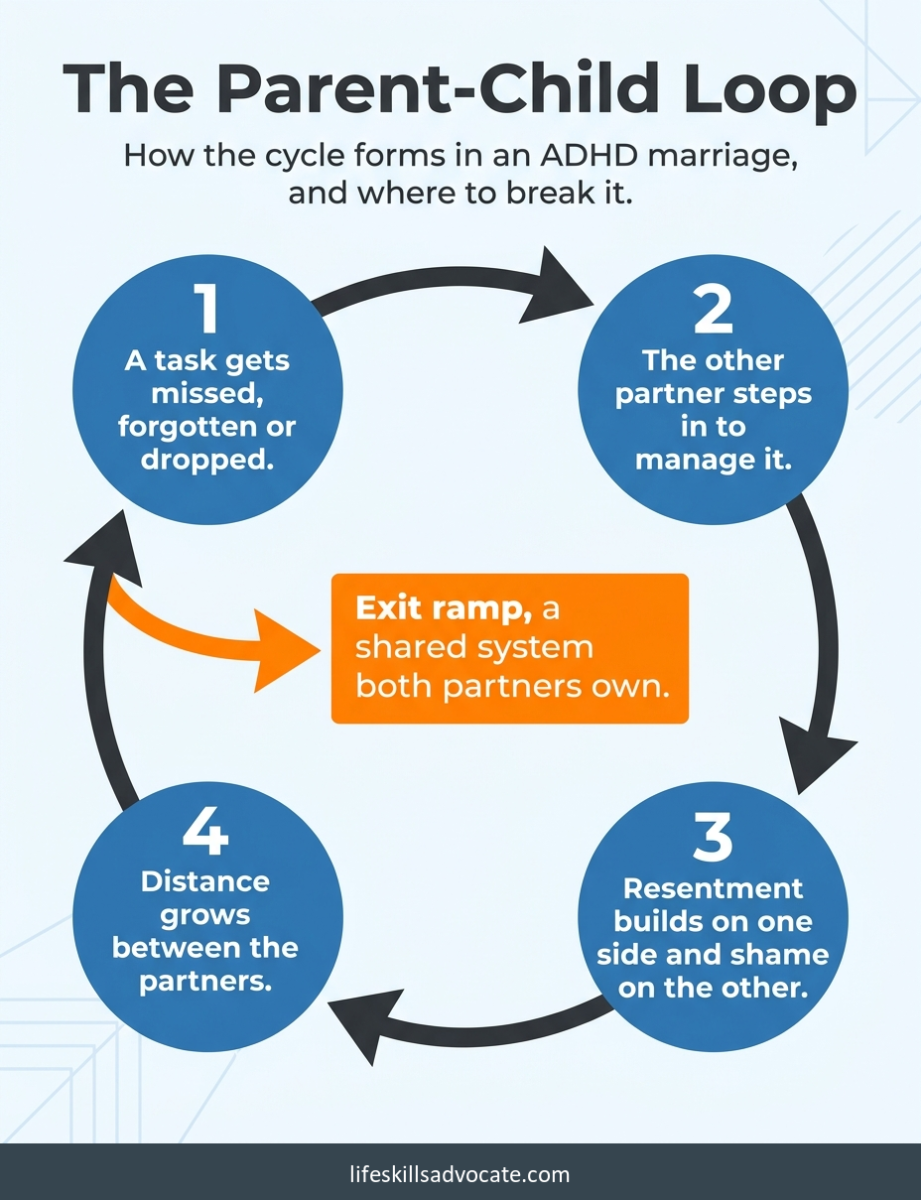
ADHD in marriage builds the trap slowly, one dropped ball at a time, until one partner is quietly running the whole operation and the other feels like a kid waiting to get caught. One person forgets the appointment, misses the bill, or leaves the dishes a third night running. The other steps in to keep things from falling apart. That makes sense in the moment. Do it for a year and a role has hardened.
Melissa Orlov, who wrote the book The ADHD Effect on Marriage, has written about this more than almost anyone, and the pattern even has a name: the parent-child dynamic. CHADD, the national ADHD organization, describes the same thing as a set of destructive cycles that wear couples down over time.
The labels matter less than the feeling, which people married to someone with ADHD describe in strikingly similar words: “I feel like his mom.” “She treats me like another one of the kids.”
Here is the part the survival guides miss. Both partners lose. The managing partner is exhausted and resentful, carrying a load nobody agreed to hand them. The managed partner is not getting off easy. They feel criticized, incompetent, and ashamed, which for many ADHD adults is the most corrosive feeling there is.
And it is common, which can be a strange relief to hear when you were sure it was your own private failing.
Common is not the same as permanent. The dynamic forms around a specific problem, so you can take it apart by solving that problem instead of blaming the person attached to it.
The ADHD Effect on Marriage: Understand and Rebuild Your Relationship in Six Steps
Melissa Orlov named this parent-child dynamic before almost anyone and built a six-step plan for taking it apart. She coaches couples for a living, so it stays practical and keeps the focus on the pattern rather than blaming the partner.
Best for: couples where one partner has ADHD and the relationship has slid into manager-and-managed roles, who want a structured way back. It is a couples self-help book, not a replacement for couples therapy if resentment has already hardened.
What ADHD in Marriage Actually Changes
ADHD in marriage is rarely about the love itself. It is about the executive-function machinery between intention and follow-through.
When relationship strain shows up in coaching, it almost never travels alone. It arrives bundled with the same few executive-function challenges: tracking time, planning, running a household together, and handling emotions in the heat of a moment. That pattern is consistent enough that these stop reading as communication problems and start reading as load problems. If reading is where you would rather start, Orlov’s book sits in our shortlist of ADHD books alongside eleven others, sorted by what you need one for.
A study of marriage and adult ADHD points the same way, finding lower marital adjustment and more conflict on average. That is the average, though, not your destiny.
My own profile is an ordinary case of ADHD: shaky attentional control, leaky working memory, slow task initiation. When I was identified with ADHD at 35, a pile of old friction finally had a name that was not “lazy” or “selfish.”
Some of that friction traces to what gets called the 30% rule. Once you understand what the 30% rule means, the idea that ADHD executive-function age can run about 30% behind chronological age, it gets harder to read a slow follow-through as a deliberate choice.
Working Memory and the Forgotten Task
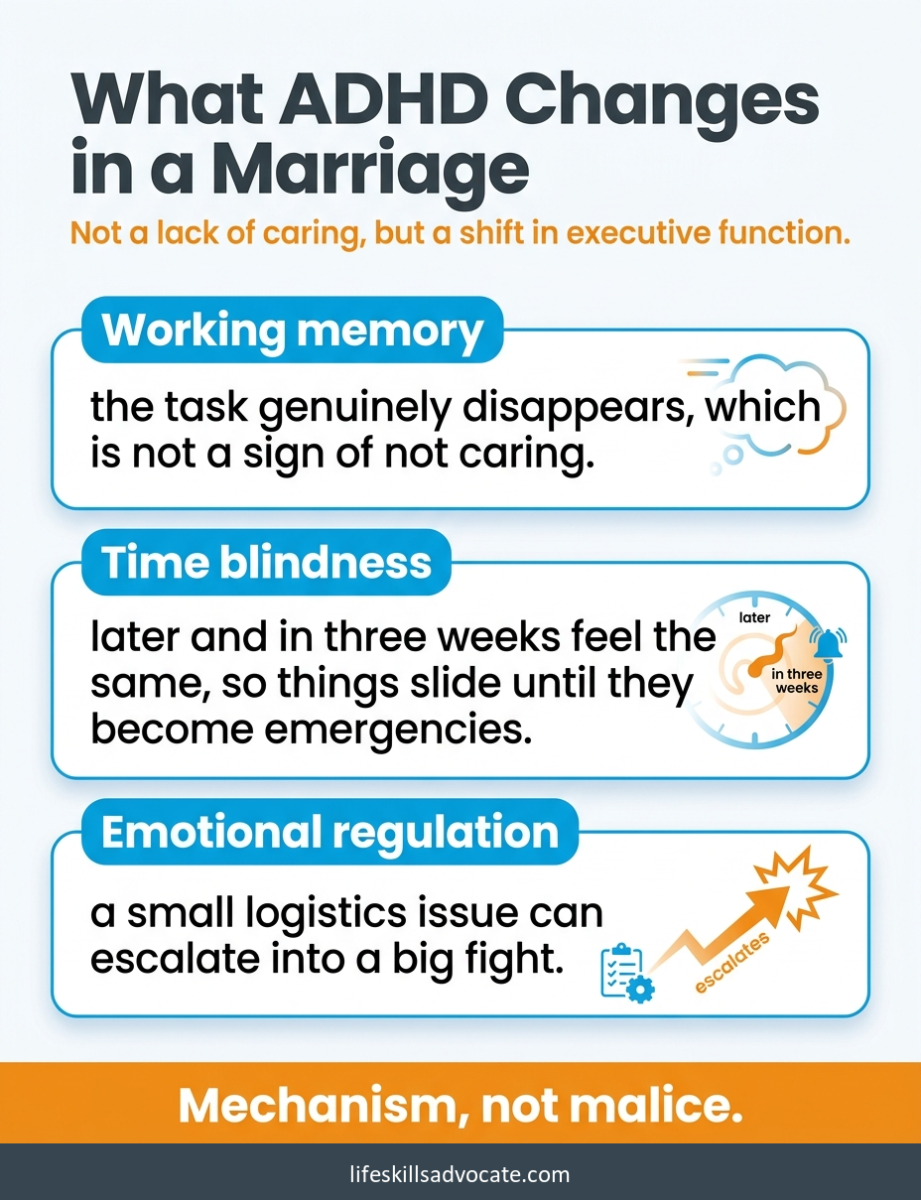
Working memory is the brain’s sticky note, and in ADHD the glue is weak. A task you heard about an hour ago is not filed in some drawer you can open. For a lot of us it is simply gone, with no sense that anything is missing. This is why “but I reminded you yesterday” and “I have no memory of that” can both be true at once.
Time works the same way. Time blindness means the gap between “later” and “three weeks out” does not register the way it does for other people, so things that matter slide until they become emergencies.
When Emotions Outrun the Conversation
Emotional regulation is executive function too, and it is what turns a small logistics issue into a real fight. A reminder about the trash lands as an attack, the reply comes out hot, and now you are arguing about respect instead of garbage. Learning how emotional regulation and ADHD interact does more for most couples than any communication script.
None of that excuses unkind behavior, and the frustrated partner is not wrong to be frustrated. It explains a mechanism, and a mechanism is something you can work with. It is also part of why anger hits so hard when a tense exchange tips over the edge.
A Short Glossary for ADHD in Marriage
Four terms that come up again and again when it comes to ADHD in marriage, and what each one means. Quote or share them freely.
| Term | What it means |
|---|---|
| Parent-child dynamic | The most common shape ADHD in marriage takes: one partner slides into managing the other like a child, which breeds resentment on one side and shame on the other. |
| The 30% rule | A rule of thumb that ADHD executive-function age can run about 30% behind chronological age, so age-based expectations tend to miss. |
| Mental load | The invisible work of remembering, planning, and tracking what needs to happen, carried almost entirely by the non-ADHD partner. |
| Externalizing | Moving reminders and plans out of one person’s head and into shared tools both partners can see. |
Forgetting Isn’t Not-Caring
Why does a forgotten errand land like a betrayal?
Because we read behavior as a signal of priorities. If you remembered, you cared. If you forgot, you must not have cared enough. That logic holds up for most people. It falls apart with ADHD, where remembering and caring run on separate tracks.
I can tell you from the inside that when I drop something, it is not a quiet vote against the person who asked. It is working memory failing in real time, while I am mid-thought about something else. The feeling afterward is not indifference. It is a stomach-drop of “not again,” tangled up with the shame so many ADHD adults already carry.
That shame has a name. Rejection-sensitive dysphoria is the tendency for perceived criticism to land far harder than anyone meant it, so a partner’s frustrated sigh can register as “you are a failure.” The forgetful partner gets defensive, the other feels dismissed, and the real issue, a working-memory glitch, never gets solved.
The reframe is not “stop being upset.” Forgotten things have real costs and that frustration is fair. The reframe is that forgetting is a wiring problem, not a love problem, so the fix is a wiring fix: external systems, not better intentions.
ADHD in marriage tempts you to push the forgetful partner to try harder. The better move is to stop relying on memory at all, because memory is exactly what ADHD compromises.
The goal is to externalize: move the mental load out of one head and into something you both own and can see. Notice the word “both.” A system the non-ADHD partner builds alone is just reminding with extra steps. A system both partners own is what retires the parent-child role.
A lot of recurring fights map cleanly onto a system that would have prevented them.
| The recurring friction | The shared system that retires it |
|---|---|
| Reminding your partner about the trash every single week | A repeating calendar event assigned to them, with an alert the night before |
| “You forgot to book the appointment again” | A shared task list where appointments live, visible to both of you |
| Chasing a bill that is late, again | Autopay for fixed bills, so paying them stops depending on memory |
| “You said you’d handle dinner and nothing happened” | A weekly meal plan you set together, posted where you both see it |
| “I have to remember everything around here” | A 15-minute weekly sync to review the calendar together, so the load is shared |
Externalize the Calendar
Pick one shared calendar and make it the source of truth for both of you. Appointments, kid logistics, social plans, and recurring chores all live there, with alerts set early enough to act on. If a full digital calendar feels like too much, a simple daily planner worksheet is a lower-stakes place to start.
Make the Task Visible
A task you cannot see does not exist, at least to an ADHD brain. Move the invisible stuff onto something shared: a whiteboard on the fridge, a notes app, a list you both check. The point is not the tool. It is that the responsibility stops living inside one person’s memory, where it was always going to leak.
Decide Once, Then Let It Run
Every recurring decision you automate is one less thing to fight about. Put fixed bills on autopay. Set the trash reminder to repeat. Standardize the Sunday grocery order. Each one quietly removes a task from the “did you remember” column, which is where resentment grows.
None of this is a one-person job, and this is where the companion guide for the supporting partner is worth reading together, since the non-ADHD partner needs their own playbook. The best version of these talks starts from “how can I support you?” rather than “what is wrong with you?” One question opens a system. The other reopens a wound.
One personal thing, though. The biggest difference in my own marriage has not been any single app or whiteboard. It is that my wife understands the executive-function lens, and that shared understanding has done more than any one system on its own.
When Trying Harder Isn’t the Answer
What happens when the systems are in place and things are still hard?
Sometimes that means the strain is sitting somewhere a shared calendar cannot reach. If depression or anxiety is in the mix and going unaddressed, or there is steady contempt, or a level of distress the systems are clearly not touching, that is a cue to bring in a professional rather than build another spreadsheet.
Coaching and therapy are different tools for different jobs, and it helps to know which one you actually need. Therapy works on mental health and the emotional wounds in a relationship. Executive function coaching is skill-building: the practical, in-the-weeds work of designing the systems above and sticking to them.
Here is the honest limit of an article like this one. I can describe the pattern and the mechanics, but I cannot tell you whether your marriage is in executive-function-mismatch territory or in something deeper. Only the two of you, and sometimes a good professional, can sort that out.
Frequently Asked Questions
What is the 30% rule for ADHD in marriage?
It is the idea that ADHD executive-function age can run about 30% behind chronological age, which explains how a capable adult partner can still struggle with planning and follow-through. It is a rule of thumb, not a measurement. For the fuller picture, see how ADHD executive age works.
Why do I feel like my ADHD partner’s parent?
Because you have gradually absorbed the parts of life your partner’s executive function keeps dropping, and doing that long enough hardens into a role. It is common, and it reverses once the mental load is genuinely shared instead of transferred.
Is it normal to consider leaving an ADHD marriage?
Yes, and a lot of people do at some point, often while still loving their partner. Surveys of ADHD-affected couples find a meaningful share have thought about it. Whether the answer is to leave or rebuild depends on factors no article can weigh for you, including how willing both partners are to change the system instead of each other. Sitting in that uncertainty for a while is not, by itself, a failure.
Does ADHD in marriage really cause divorce?
The honest answer is more careful than the headlines. The often-repeated claim that ADHD doubles the divorce rate comes mostly from older research on the parents of children who have ADHD, not on adults’ own ADHD inside their marriages, so it does not map neatly onto your situation. One widely cited 2008 cohort study found higher divorce rates among parents of kids with ADHD, and a separate self-reported survey of ADDitude readers found 38% of those with ADHD said their marriage had once come close to divorce. Both are real signals, and neither proves cause and effect. ADHD is associated with more marital strain on average, yet plenty of these marriages are stable and happy, and the difference usually comes down to whether the executive-function load gets handled as a team. ADHD does not divorce people. Unaddressed patterns sometimes do.
What is the 10-3 rule for ADHD?
The 10-3 rule is a focus technique, not a relationship rule: you work in focused 10-minute stretches with 3-minute breaks to make a task feel less overwhelming. It can help with the kind of shared chores that tend to stall out, so it lowers the friction around them, but it is a productivity tool rather than anything specific to marriage.
Next Steps
If you recognized your own marriage in the parent-child section, the move is not a grand relationship overhaul. It is picking one leaky spot and externalizing it this week.
- Pick one recurring fight and turn it into a system. Trash, bills, appointments, whatever comes up most. Build the shared calendar event or set up the autopay today, together.
- Swap the question. Next time you would normally remind or be reminded, try “how can I support you?” and notice what it opens up.
- Get a read on the executive-function gaps driving the friction with the free executive functioning assessment, so you are solving the right problem instead of guessing.
- If the strain runs deeper than logistics, talk to a professional about whether therapy, coaching, or both is the right fit. The sooner you ask, the better.
Further Reading
- Melissa Orlov on the parent-child dynamic – adhdmarriage.com
- The destructive cycles that tear ADHD marriages apart – CHADD
- ADHD marriage statistics and personal stories – ADDitude
- Divorce rates among parents of children with ADHD (2008 cohort) – PMC, National Library of Medicine
- Marriage and adult ADHD: marital adjustment and conflict – PMC, National Library of Medicine
- What the 30% rule really means (ADHD executive age) – Life Skills Advocate
- Emotional regulation and ADHD – Life Skills Advocate
- Rejection-sensitive dysphoria signs – Life Skills Advocate
- Why anger hits so hard with ADHD – Life Skills Advocate
- Supporting a partner with executive functioning challenges (17 strategies) – Life Skills Advocate
- Coaching vs. therapy: which one do you need? – Life Skills Advocate
- My neurodivergent experience growing up with ADHD – Life Skills Advocate
- Daily planner worksheet (free) – Life Skills Advocate
- Executive function coaching – Life Skills Advocate
- Free executive functioning assessment – Life Skills Advocate