
For most late-identified adults, rejection sensitive dysphoria didn’t start the day they heard the name. It just finally had one.
Before the name, it usually went by other ones: too sensitive, too dramatic, anxiety, depression, “you take everything personally.” The signs were there for years, sometimes decades, but they slipped past the adult themselves and past the clinicians they sat across from. By the time the ADHD picture came together, most adults had already built a quiet inventory of evidence that something was off, and a separate inventory of explanations they had been handed for why each piece of it was something else.
The adults reading this are usually past the “what is this?” stage. The signs below are the ones late-identified readers most often spot in themselves later than they would have liked, paired with the misattribution each one carried before the ADHD picture came together.
TL;DR
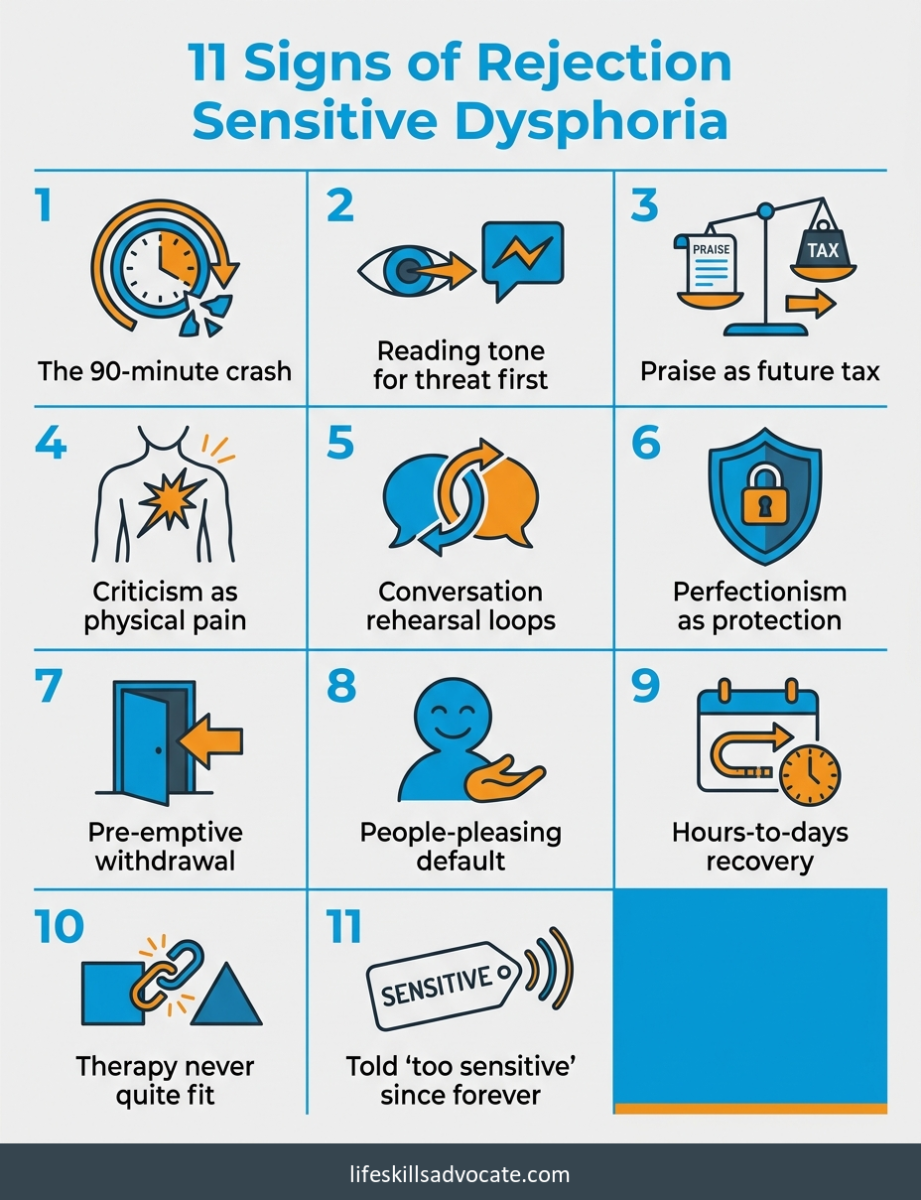
Rejection sensitive dysphoria rarely shows up labeled. For most late-identified adults with ADHD, it shows up as something else for years before it shows up by name. Here is what the 11 signs actually look like in adult daily life:
- A disproportionate emotional crash after one critical comment, with a 90-minute to several-hour recovery window misread as “having a bad day.”
- Reading tone for threat before content, and rehearsing conversations for days before and after.
- Praise that feels like a tax to be repaid, and criticism that lands as a physical sensation, not a thought.
- Perfectionism as protection. People-pleasing as default.
- Pre-emptive withdrawal, often misread as introversion or social anxiety.
- Therapy that worked on “anxiety” but never touched the core feeling, and the “too sensitive” label heard since childhood.
- Honest scope: this is not in the DSM-5. The term was popularized in ADHD literature by psychiatrist William Dodson, and research on the specific construct is limited, but the underlying emotional dysregulation pattern is well-documented.
This article is educational, not a professional evaluation, and rejection sensitive dysphoria is not officially recognized in the DSM-5. The signs below describe a recognizable pattern, not a quiz to self-score. If the pattern feels familiar, working through it with a clinician or coach is more useful than figuring it out alone.
Why Rejection Sensitive Dysphoria Signs Hide in Plain Sight
Most adults living with rejection sensitive dysphoria spent years pulling on the wrong explanations. The disproportionate crash after a single sideways comment got read as anxiety. The hours of mental playback got read as overthinking. The pre-emptive withdrawal from situations where rejection might happen got read as introversion. None of those readings were unreasonable on their own. The problem is that they were all close enough to fit, and the closer fit was sitting one frame over.
Late-identified adult ADHD is a recent enough category in primary care that most clinicians who saw an adult with RSD signs in the 2000s or 2010s reached for anxiety, depression, or borderline personality features first. That sequencing matters. By the time the ADHD picture came together, most adults had already absorbed a particular story about themselves: that they were too sensitive, too reactive, too emotional, too much. The RSD pattern fit that story because nothing about it argued back.
Rejection sensitive dysphoria is also not in the DSM-5. The term was popularized in ADHD literature by psychiatrist William Dodson, and research on RSD as a distinct construct remains limited. The phenomenon being described, emotional dysregulation in ADHD that responds disproportionately to perceived rejection, is well-documented in qualitative research and in what clinicians have consistently observed. The label is contested; the lived experience is not. Both can be true.
The pattern is also under-recognized in high-masking women, who are more likely to internalize the response and present as composed in the moment.
The interior weather is not always visible from the outside.
For longer-form reading specifically on the late-identified, often-high-masking adult ADHD experience that RSD lives inside, A Radical Guide for Women with ADHD by Sari Solden and Michelle Frank is among the most consistently recommended books in adult ADHD communities.
Quick Facts: Rejection Sensitive Dysphoria
| Quick fact about rejection sensitive dysphoria | Scope | Source |
|---|---|---|
| The term was popularized in ADHD literature by psychiatrist William Dodson beginning in the 1990s to describe extreme emotional reactions to perceived rejection. | Origin and terminology | ADDitude (Dodson, 2025) |
| Rejection sensitive dysphoria is not officially recognized in the DSM-5 or ICD-11. The label is considered descriptive rather than a formal medical category. | Official status | Cleveland Clinic (2022) |
| Adult qualitative research documents three primary themes in lived RSD experience: Withdrawal, Masking, and Bodily Sensations. | What it looks like | Rowney-Smith et al., 2026 (PLoS One) |
| RSD is triggered by perceived, anticipated, or actual rejection, not only actual events. | Trigger pattern | ADDitude (Dodson, 2025) |
| The pattern is frequently misattributed to anxiety, depression, BPD, or social anxiety, especially in high-masking women and late-identified adults. | Misattribution pattern | ADDitude (Misdiagnosis) |
11 Signs of Rejection Sensitive Dysphoria in Adults
This is not a checklist to self-administer. It is a list of patterns adults with rejection sensitive dysphoria tend to recognize in themselves, often with the relief of finally having vocabulary for something that has been going on for a long time.
Sign 1: The disproportionate crash after one critical comment
A peer says, “Did you check the spreadsheet I sent?” and the rest of the afternoon is gone.
Not “annoying” gone. Functionally gone. The adult goes through the motions, performs whatever the workday requires, and arrives home several hours later still hollowed out without quite being able to point at why.
The trigger, in retrospect, was a sentence.
The response, in real time, was a low-grade emotional crash that took 90 minutes to several hours to climb back out of. Most adults file the afternoon under “I just had a rough day” because the actual cause, a comment that read as criticism, seems too small to justify the size of the reaction. Naming the comment usually feels embarrassing. So the recovery window happens privately, and the adult treats it as moodiness rather than as a recognizable pattern.
Sign 2: Reading tone for threat before reading it for content
Slack messages get read twice. The first read is for tone: is this person upset? The second read, if there is one, is for what they actually said. Email lands as a small physical event before it lands as information.
This runs faster than thinking.
Adults with rejection sensitive dysphoria often describe it as a background process they cannot turn off: every social signal gets routed through a threat detector first, then released to the conscious part of the brain. Most of the time the detector is wrong. The cost of being wrong about a real rejection signal feels too high to drop the screening, so the screening stays on. The downstream effect is a low-level cognitive tax across all interpersonal communication that is not obvious until the workday is over.
Sign 3: Praise feels like a tax you’ll have to repay later
A compliment from a manager creates two simultaneous experiences. The first is the small lift any human feels when their work is recognized. The second is a quiet calculation about how long until the next piece of work has to clear an even higher bar, and how the praise will get reissued as criticism when it inevitably does not.
For adults with rejection sensitive dysphoria, praise rarely sits in the “wins” column.
It moves directly into the “expectations now raised” column. Compliments often produce more anxiety than pleasure, which then gets misread by the adult as ingratitude or imposter syndrome. The underlying mechanic is the same one driving the crash response: any signal that comes back about the adult’s performance, positive or negative, gets weighed against the possibility of future rejection.
Sign 4: Criticism lands as a physical sensation, not a thought
Some signs show up first as words and then as feelings. This one runs in reverse.
A critical comment lands in the body before it lands in the brain. Sudden chest tightness. A sinking pit in the stomach. A “punched” sensation. The cognitive content of what was said arrives a half-second later, and by then the body has already responded.
A 2026 qualitative study from Brighton and Sussex Medical School documented this bodily dimension as one of three core themes in adult ADHD lived experience of rejection sensitivity. Participants used language like “wounded,” “physically struck,” and “hit.” The body response is invisible from the outside, and most adults learn early that describing a bodily reaction to a comment will be heard as melodrama. So the description gets edited out, and the experience gets kept private.
Sign 5: You rehearse conversations before and after, sometimes for days
Before a phone call with a parent. Before a one-on-one with a manager. Before sending a message to a friend the adult hasn’t seen in a while. The conversation gets rehearsed in advance, often several times, with branching contingencies for how the other person might respond and how to respond back. Then the actual conversation happens. Then it gets replayed for the next two days.
This is exhausting.
Adults often do not realize how much cognitive bandwidth it consumes until they try to stop. The loops are usually not “what did I say wrong” so much as “where could rejection be hiding in what they said back.” The pattern often gets misattributed to anxiety, perfectionism, or “overthinking,” all of which are partial fits and none of which capture the rejection-specific shape of the loop.
Sign 6: Perfectionism feels like protection, not ambition
Most discussions of perfectionism frame it as a drive: the high achiever pushing for excellence. For adults with rejection sensitive dysphoria, the experience runs the other direction. Perfectionism functions as a defense against being criticized, dismissed, or judged. The work product gets checked four times not because the adult is chasing excellence but because the alternative, sending something that might be wrong, would expose them to a response their nervous system is already trying to head off.
From the inside, this feels different from ambition-driven perfectionism.
There is less satisfaction in the finished product and more relief in the absence of feedback. Adults often describe it as walking a tightrope rather than climbing a ladder. Most clinicians and managers treat perfectionism as either a personality trait or an anxiety trait. The rejection-sensitivity layer underneath rarely gets named.
Sign 7: You withdraw before anyone can reject you
A party invitation arrives. The adult decides, quietly and quickly, that they are too tired. A friend stops texting back for a few days; the adult decides the friendship is over and stops reaching out first. A potential opportunity opens up at work; the adult decides they are not the right fit and does not apply. None of these decisions feel like avoidance from the inside.
They feel like clean realism.
Pre-emptive withdrawal is one of the most consistently documented features of adult RSD in qualitative research. The 2026 Brighton and Sussex study identified withdrawal as a core theme, with participants describing it as a deliberate self-protective stance rather than passivity. From the outside, this looks like introversion or social anxiety, and often the adult themselves believes one of those labels for years.
Introversion is about energy management. Pre-emptive withdrawal is about damage control.
Sign 8: People-pleasing is the default, even when it costs you
The yes comes out before the question finishes. A favor gets agreed to during a brief hallway interaction. A boundary that took weeks to formulate dissolves in a single conversation because the other person looked, very briefly, like they might be disappointed. Hours later, the adult is annoyed at themselves for saying yes again.
The annoyance does not change the next yes.
People-pleasing here is not a personality quirk. It is real-time avoidance of the disproportionate emotional cost of being seen as the person who said no. When the yes lands before you have decided anything at all, that is closer to the fawn response. The cost is often invisible to the people receiving the “yes,” so the pattern persists. Most adults living inside this have spent considerable time trying to “set better boundaries” using standard advice, and have watched themselves fail. The failure then gets read as a personal weakness, which produces more shame, which makes the next “no” even harder to deliver. The standard advice did not know to account for the size of the cost on the other side. Naming the mechanic underneath, which is rejection sensitivity rather than weakness, usually does more to change the pattern than another boundary script.
Sign 9: Recovery from an RSD episode takes hours or days, not minutes
The crash response is one phase. The recovery window is another.
After a rejection-triggered episode, adults often describe a stretch of hours, sometimes a full day or longer, where executive function visibly suffers. Task initiation slows. Tolerance for ordinary friction drops. The unfinished work from the morning becomes a wall.
This recovery window compounds with other ADHD challenges. A single episode can route directly into the ADHD shame spiral and stay there for the rest of the day. The most common misattribution here is depression. The adult, and often their clinician, reads the recovery-window flatness as a depressive episode rather than the second half of a rejection response. Once the pattern is named, the recovery window becomes something to plan around, not a moral failure to push through.
Sign 10: Therapy that worked on “anxiety” never quite touched the core feeling
Many late-identified adults have already done significant work in therapy. The work often helped with the layer it was aimed at: anxiety regulation, depressive episodes, cognitive reframes, communication skills. The core feeling, the one that shows up in the chest a half-second after a critical comment, usually persisted underneath.
This is not a verdict on the therapy. It is a structural mismatch.
Cognitive approaches are well-suited to managing the aftermath of an episode but less suited to interrupting the physiological response itself, which is closer to a reflex than a thought. Many adults describe the realization as “the work I did was real, but it was working on the wrong layer.”
Sign 11: You’ve been told you’re “too sensitive” so many times you stopped arguing
By the time most late-identified adults are old enough to recognize this pattern, they have heard the phrase “too sensitive” from caregivers, partners, teachers, managers, and the occasional well-meaning friend. The repetition does its own work. Most adults stop disputing the label and begin treating it as a fact about themselves.
The cost is real.
Adults often arrive at late identification carrying decades of accumulated evidence that the responsibility for their emotional responses sits entirely with them, and that the responses themselves are out of proportion to anything an “ordinary” person would feel. Naming the actual mechanic, a rejection-sensitive neurological response rather than a character defect, does not erase the prior decades. It does change what the response means, which is sometimes enough to start loosening the shame. A simple visual like a feelings wheel can help with the naming step itself, especially for adults who have spent years treating their emotional vocabulary as suspect.
Why Rejection Sensitive Dysphoria Looks Like Anxiety or Depression
How does rejection sensitive dysphoria end up misread as anxiety or depression for years on end? Mostly because the surface presentations overlap enough that most reasonable clinicians, faced with an adult who is anxious in social situations and low after rejection events, will reach for the categories they already have. RSD is not in their default toolkit. Generalized anxiety and depression are. The same default-toolkit problem shows up with ADHD and OCD overlap, where the OCD half of the picture is missed under an “anxiety” or “perfectionist” label.
The pattern that distinguishes it from generalized anxiety is the trigger shape. Anxiety tends to be diffuse and forward-looking. RSD episodes are often misdiagnosed as depression or anxiety in adults because the presentations read similar. But episodes are point-triggered and disproportionate to the trigger. The trigger is almost always interpersonal, and almost always related to perceived or anticipated rejection.
What distinguishes it from depression is the time course. Depression is sustained. RSD recovery, even at its worst, usually resolves within hours to days. The post-episode flat stretch can look exactly like a depressive episode from the outside, which is one reason the misattribution sticks. The difference is that it lifts when the recovery window closes, while depression generally does not.
The signs also get often confused with anxiety because both can produce avoidance, rehearsal, and physiological arousal. The cleanest tell is the rejection-specificity of the trigger and the disproportionate intensity of the response. Once an adult notices that pattern in themselves, the misattribution starts to come apart on its own.
What to Do With This Recognition
Recognition is doing most of the work in an article like this. Naming the pattern is often the threshold step, especially for adults who have spent years filing it under something else.
What helps next is usually less dramatic than the recognition.
Building a usable recovery window matters more than trying to suppress the initial response, which is largely involuntary. That can mean keeping a short list of low-effort regulating activities ready for the hours after an episode (a short body-scan mindfulness exercise is a common one), lowering the bar on what counts as a productive afternoon when the episode happened that morning, and planning task initiation for the post-episode window with the same care a person would plan a meal during a fever.
The emotional regulation challenges in ADHD that show up in adult life are not character problems to overcome. They are nervous-system patterns to support. The work is closer to learning to plan for predictable downtimes than to learning to “stop overreacting.”
Professional support helps for adults who want it. Therapy is the right fit for the cognitive aftermath and the underlying mood patterns. Coaching is the right fit for the executive function side, especially the recovery-window planning. The two complement each other; one is not a substitute for the other.
FAQ: Rejection Sensitive Dysphoria
Can you have rejection sensitive dysphoria without ADHD?
Yes. Rejection sensitive dysphoria patterns appear in autism, AuDHD, complex trauma, and some mood-related conditions. The term originated in ADHD circles via psychiatrist William Dodson, but the underlying emotional dysregulation it describes is not ADHD-exclusive.
Why don’t standard rejection-sensitivity coping strategies work for RSD?
Most coping advice assumes the reader can intercept the initial response. Adults with rejection sensitive dysphoria describe the response as largely involuntary; by the time it can be cognitively named, it has already happened. The more useful frame for daily life is the recovery window: what gets a person through the next 90 minutes to several hours after an episode, not how to prevent the episode itself. Cognitive approaches can help with the aftermath. The physiological response is a different problem and needs different handling.
How do you “remove” rejection sensitivity?
“Remove” is probably the wrong frame, and not because of toxic positivity. For most late-identified adults, rejection sensitive dysphoria is not a behavior to extinguish. It is closer to a feature of how the nervous system responds to certain interpersonal signals, and the response runs faster than conscious thought can intervene. The useful work is usually around recovery time, building executive function skills around the post-episode window, and naming the pattern so it stops being read as a character flaw rather than as a recognizable nervous-system response. The shame attached to it, accumulated over decades of being told the response was disproportionate or inappropriate, often takes longer to loosen than the recovery-window planning itself. Executive function coaching can help with the recovery-window side, alongside whatever therapy or self-directed work an adult is already doing.
Is rejection sensitive dysphoria real, or just emotional dysregulation with a brand name?
Both arguments have weight. Some researchers point out that emotional dysregulation in ADHD is already documented in peer-reviewed literature and does not require a new label. Other clinicians, particularly those working with adult ADHD daily, argue that the specific intensity and trigger pattern of dysphoric rejection responses describes something the broader emotional-dysregulation umbrella does not quite capture. The honest answer is that the underlying phenomenon is real and well-described in qualitative research; whether “RSD” survives as a distinct construct or eventually gets folded into emotional dysregulation more generally is, as of 2026, an open question that the available research has not yet settled.
What are the most commonly missed signs of rejection sensitive dysphoria in adults?
Pre-emptive withdrawal, the bodily-pain dimension, and the post-episode recovery window are the three most commonly missed. The pre-emptive pattern gets misattributed to social anxiety. The recovery window gets misattributed to depression. The bodily dimension usually gets edited out of the description before anyone hears it, which keeps it invisible to the clinicians who might otherwise notice the pattern.
Next Steps
If most of those signs sound familiar, the work is not about reacting less. It is about recognizing the episode while it is happening and building executive function support around the recovery so the next 24 hours do not compound the original hit.
- Track your own recovery window for the next month. When an RSD episode happens, note the time, the trigger, and how long it took before energy and task initiation came back online. Most adults underestimate the length of their recovery window until they actually log it. The pattern usually clarifies within four or five episodes.
- Take the free Executive Functioning Assessment. Identifies which executive function skills compound RSD recovery the most, especially task initiation, emotional control, and attentional control. The post-episode window is where these compound, and knowing which ones are already thin is useful planning information.
- If structured support fits, consider executive function coaching. Coaching is not therapy. It is educational and skill-focused, aimed at building the executive function side of recovery rather than addressing the underlying mood or trauma layer. For RSD specifically, the work often centers on protecting task initiation through the post-episode window.
Further Reading
- The lived experience of rejection sensitivity in ADHD – Rowney-Smith et al., 2026 (PLoS One)
- New Insights Into Rejection Sensitive Dysphoria – ADDitude (William Dodson)
- RSD Misdiagnosed as Depression or Anxiety in Adults – ADDitude
- Rejection Sensitive Dysphoria (RSD) – Cleveland Clinic
- Rejection Sensitivity Dysphoria: The Actual Research – Psychology Today
- A Radical Guide for Women with ADHD – Sari Solden and Michelle Frank (book)
- Can You Develop ADHD as an Adult? (Late-Identified ADHD Explained) – Life Skills Advocate
- ADHD or Anxiety? How to Tell the Difference – Life Skills Advocate
- Emotional Regulation and ADHD: What You Need to Know – Life Skills Advocate
- The ADHD Shame Spiral – Life Skills Advocate
- ADHD in Women and Girls – Life Skills Advocate
- Body Scan Mindfulness Activity (free printable) – Life Skills Advocate
- Feel Wheel Exercise (free printable) – Life Skills Advocate
- Free Executive Functioning Assessment – Life Skills Advocate
- Executive Function Coaching – Life Skills Advocate