
If you are Googling “can you develop ADHD as an adult,” you probably already know what the medical sites will say.
They will say no.
Then they will say “but it can be identified later in life,” which sort of feels like a non-answer if your focus seems to have fallen apart at 34 in a way it did not at 24.
You will not get the same flat answer here.
TL;DR
Anyone Googling “can you develop ADHD as an adult” is usually stacking three or four questions on top of each other. The article works through them in order.
- Is there a version of ADHD that genuinely begins in adulthood, or is the research clear that it does not?
- What’s the difference between late-identified and late-onset ADHD, and why does that distinction change what to do next?
- Why does ADHD so often look new in someone’s 30s or 40s, even when it was quietly there the whole time?
- What’s more likely to be behind suddenly losing focus and follow-through as an adult, if it isn’t new ADHD?
- What are the patterns from earlier in life that suggest ADHD was there all along?
A note before we get into it: this is educational, not medical advice or a substitute for evaluation. If you are working through ADHD with a professional, treat this as background reading, not a replacement for that conversation.
The Honest Answer to “Can You Develop ADHD as an Adult?”
If you ask whether you can develop ADHD as an adult, the honest research answer is no, with an immediate “but.” ADHD is neurodevelopmental, which means it starts in childhood. According to the NIMH overview of ADHD, the current DSM-5 criteria require some traits to have been present before age 12, even if no one connected the dots until much later.
Yes, plenty of adults are correctly identified for the first time in their 30s, 40s, and beyond. A 2025 review in World Psychiatry estimates that around 2.5% of adults worldwide live with ADHD, and up to 70% of children identified with ADHD continue to experience traits as adults.
When someone asks whether they “caught” ADHD at 34 because work got harder and their old workarounds stopped working, the answer is usually no, you did not catch it, but yes, what you are noticing is real.
The table below is the version you can share or send to a skeptical relative.
| Term or fact | Definition | Source |
|---|---|---|
| Can you develop ADHD as an adult? | Current research says no in the strict research sense: ADHD requires some traits to have been present before age 12. But many adults are correctly identified for the first time in adulthood. | NIMH (2023) |
| Late-identified ADHD | ADHD that was present in childhood but missed at the time, often because the traits were masked or the environment was structured enough to compensate. | CHADD (2019) |
| Late-onset ADHD | A disputed category for ADHD-like traits that appear to start after puberty. Recent research finds most apparent cases are better explained by other causes once those are ruled out. | Sibley 2018 |
| Adult ADHD prevalence | Roughly 2.5% of adults worldwide as of 2025. | Cortese 2025 |
| Persistence from childhood | Up to 70% of children identified with ADHD continue to experience ADHD traits in adulthood. | Cortese 2025 |
Late-Identified vs. Late-Onset ADHD: Why the Distinction Matters
Most people Googling “can you develop ADHD as an adult” are actually asking two questions stacked on top of each other. The first is “is there a version of ADHD that begins in adulthood?” The second is “why does mine feel like it just showed up?” Late-onset and late-identified are how the research field separates those questions.
What “late-identified” means in practice
Late-identified ADHD describes the situation that fits most adults who land on this question. The traits were there, sometimes loud and sometimes quiet, but no one named them at the time. Maybe school was structured enough to keep things upright. Maybe the inattentive presentation did not look like the hyperactive boys clinicians of the 80s and 90s were trained to spot. Maybe a parent ran a tight household and the gap was invisible until that household stopped doing the work for you. The lived experience feels like emergence, but the trait pattern reaches all the way back. CHADD has documented this gap for women in particular, who are routinely identified later in life.
Where the “late-onset” research stands
Late-onset ADHD is the more contested label. A handful of long-term studies, most notably Moffitt 2015 and Caye 2016, reported small subsets of adults whose ADHD-like traits appeared to ascend after puberty. A 2018 Sibley study took those findings apart and found that most apparent late-onset cases were better explained by something else, most often heavy substance use or another mental health condition. The field is still divided. I am not the person to settle that debate.
Can You Develop ADHD as an Adult? Why It Often Looks That Way
When people ask, “can you develop ADHD as an adult,” what they often mean is “why does mine feel like it just appeared?” This pattern shows up again and again in late-identified ADHD stories and in the LSA community: ADHD does not suddenly show up. Adulthood is just when it becomes impossible to ignore.
When external structure goes away
For a lot of people, school is doing more lifting than they realize. Bell schedules. Classroom routines. A parent making sure homework happens. A teacher saying it is time for lunch. Even people who hated school often admit, looking back, that the external scaffolding was keeping the wheels on. When that drops away after graduation, the gap that was always there becomes the gap you trip into every Monday. Research on how executive function develops with age tracks this: the demands climb just as the supports vanish.
When masking stops paying off
Masking is the energy you spend looking like you have it together. For years it works. You stay up late. You triple-check your bag. You write a Sunday plan that takes two hours and gets you through Monday. Then you have a kid, take on a bigger job, or your partner gets sick, and the energy bank empties. Masking does not break gracefully. It collapses. The collapse looks a lot like the moment ADHD started, but it is closer to a workaround finally running out of room. The neuroscience behind ADHD self-discipline helps explain why brute-forcing this stage so often fails.
Life transitions that expose hidden traits
Hormonal shifts in perimenopause. New parenthood. A promotion that loads the cognitive plate higher than ever. A breakup. A pandemic. ADDA and other ADHD organizations consistently name these as common points when previously compensated ADHD becomes visible. None of them caused the ADHD. They removed the conditions that hid it.
What Looks Like New ADHD But Probably Is Not
Sometimes the question “can you develop ADHD as an adult” has the same answer twice over: no, and also no, ADHD is not what you are looking at. If your focus and follow-through were fine for years and then dropped off a cliff, the most likely cause is not ADHD.
Sleep apnea will shred working memory and attention in ways that look like ADHD. So will anxiety, depression, thyroid issues, grief, and the chronic weight of caregiving. The Mayo Clinic page on adult ADHD is direct about this: anxiety, mood disorders, sleep apnea, and the hormonal shifts of menopause can all produce attention problems that mimic ADHD.
None of this is about dismissing the question. The pattern you are noticing is real. It is just worth holding the ADHD possibility open while also considering sleep, mood, and physical health, because the supports for each are different.
Signs You May Have Had ADHD All Along
How do you know whether you can develop ADHD as an adult or whether you simply missed it the first time? You look back, not forward. The signs of ADHD that get missed in childhood show up most clearly when you cast your memory backward and stop grading yourself on what was supposed to be normal.
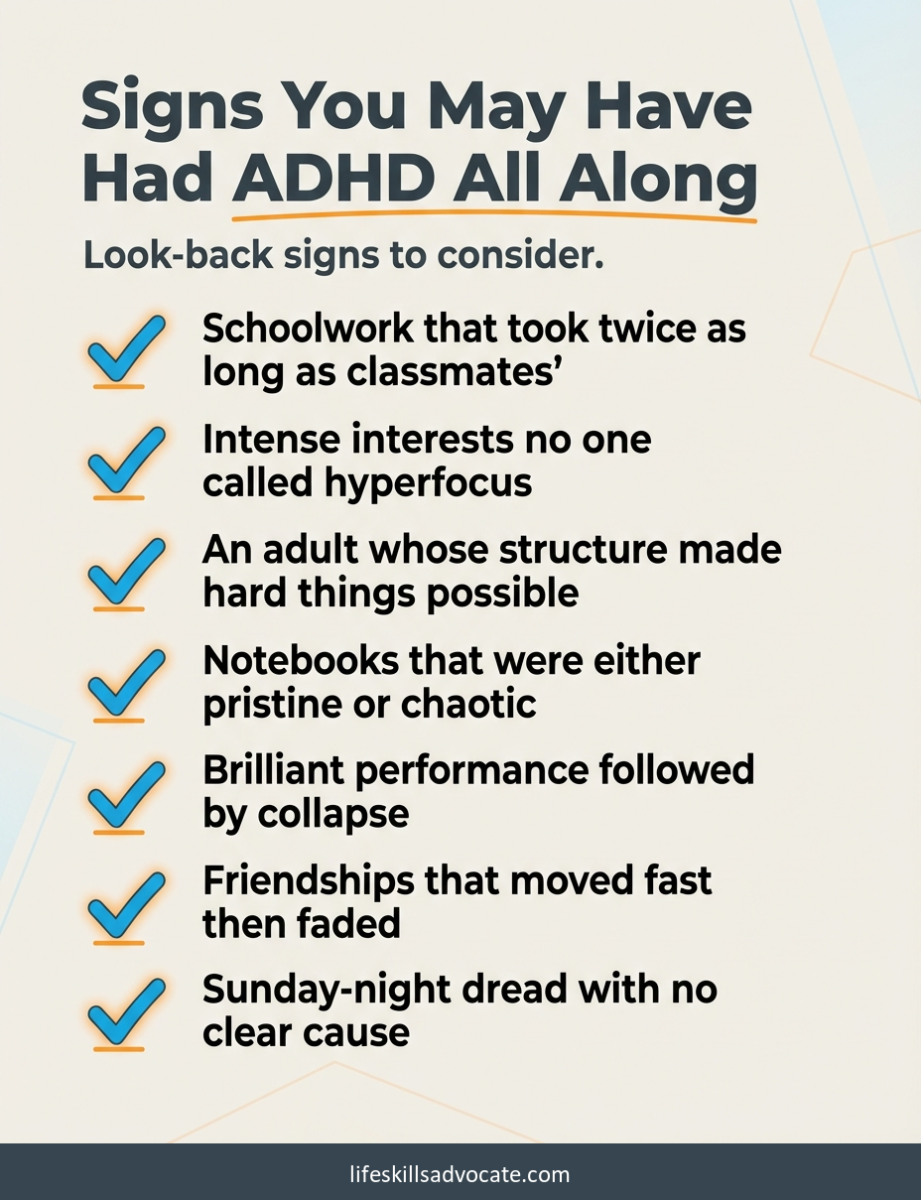
A few common look-back signs to consider:
- Schoolwork that took twice as long as classmates’ for no clear reason at the time
- Intense interests no one called hyperfocus, just “Chris is obsessed with that thing again”
- An adult in your life whose external structure made the hard things possible
- Notebooks that were either pristine or chaotic, with nothing in between
- Brilliant performance followed by collapse, often around the same time of year
- Friendships that moved fast at the start and were hard to maintain after the new wore off
- A Sunday-night dread that had nothing to do with the actual Monday
If several of these read like a transcript of your childhood, that is information. It is not a substitute for evaluation, but it is the sort of pattern that nudges practical adult ADHD calming techniques from a “maybe” to a “worth a try.”
Frequently Asked Questions
Can you develop ADHD as an adult after a brain injury?
Yes and no, depending on the doctor. A brain injury can produce attention and executive function problems identical to ADHD, but whether to call that “ADHD” or a separate post-injury condition is contested. Talk to a neurologist. The label may keep shifting under you, and that part is exhausting.
Can stress or burnout cause adult ADHD?
No. Stress and burnout can wreck attention in ways that look like ADHD, but they do not cause it. The supports for each are completely different.
Can you develop ADHD as an adult if you are a woman over 35?
Most likely, no. ADHD in girls and women has been under-identified for decades, partly because the inattentive presentation is quieter and partly because the old reference points were built around hyperactive boys. Many women hit a wall around perimenopause, when hormonal shifts amplify traits that were always there but easier to hide. The traits did not develop in adulthood. The cover finally wore through, and the difference matters because it changes what helps.
Should I get evaluated if I think I have adult ADHD?
Probably yes if it is affecting your work, relationships, or daily wellbeing. Adult evaluation usually requires evidence that ADHD traits were present in childhood, so it helps to talk with family or dig out old records before the appointment. Self-identification before formal evaluation is also legitimate, and many adults find a lot of clarity from learning the framework before pursuing assessment. The evaluation is one piece. Knowing what you are looking at, and being able to name it without needing someone in a white coat, is another. If the people in your life are skeptical, an evaluation can be the thing that changes that conversation. None of it is magic, but the combination of self-knowledge and a name tends to be more useful than either one on its own.
Next Steps
If this article gave you a yes-or-no answer but left the bigger question open, that bigger question is the right one to sit with for a few days. A handful of things to try:
- Write down three moments from childhood when school felt unusually hard, even if no one noticed at the time. The pattern matters more than any single memory.
- The free executive functioning assessment is a structured starting point that does not require a professional, if you want one.
- Ask one trusted family member what you were like at ten, and listen for the parts of their description you would never have included yourself.
- Talk to a professional if the pattern is affecting your work, relationships, or wellbeing. Executive function coaching can run alongside that conversation, not instead of it.
Further Reading
- ADHD: What You Need to Know – National Institute of Mental Health
- Adult ADHD review (2025) – Cortese et al., World Psychiatry
- Late-Onset ADHD Reconsidered – Sibley et al., American Journal of Psychiatry 2018
- Women Often Diagnosed With ADHD Later in Life – CHADD
- Adult ADHD: Symptoms and Causes – Mayo Clinic
- How Executive Function Develops with Age – Life Skills Advocate
- The Neuroscience of ADHD Self-Discipline – Life Skills Advocate
- ADHD Calming Techniques for Adults – Life Skills Advocate
- Free Executive Functioning Assessment – Life Skills Advocate
- Executive Function Coaching – Life Skills Advocate