
Most executive functioning IEP goals fall apart in the same spot, and it is not the behavior. It is the measurement. A goal like “the student will improve time management” reads fine in a meeting, then sits in the document all year with no clean way to show whether the student actually got there.
This page is built to fix that. Every example below is a full executive functioning IEP goal you can adapt and drop into a draft: a timeframe, the student, an observable behavior, a measurable criterion, and a data-collection method that fits the skill being measured. The goals are grouped by the executive function skills LSA’s resources use, so you can jump to the area a student is working on instead of scrolling past goals for skills they already have down.
If you write goals for a living, you already know how thin most example banks are. The ones floating around online tend to stop at the behavior and skip the criterion and the data method, which are the two parts a teacher actually has to defend at the table. Goals like these work best alongside the day-to-day work of teaching executive function skills in the classroom. These were written by a former special education teacher, with those parts included.
One rule before you start.
Set the numbers to the student.
TL;DR
A working bank of measurable executive functioning IEP goals you can adapt, organized by skill area:
- Goals are grouped by the executive function skills LSA’s resources use: planning, time management, task initiation, organization, problem-solving, cognitive flexibility, working memory, emotional control, impulse control, attentional control, and self-monitoring.
- Every goal is written in full: a timeframe, an observable behavior, a measurable criterion, and a data-collection method matched to the skill.
- Jump to the area a student is working on, set the numbers to their baseline, and adapt.
These are educational examples, not legal advice or a replacement for your IEP team’s judgment. A real goal is built from an individual student’s present levels, so treat every number here as a placeholder to adjust.
What Makes Executive Functioning IEP Goals Measurable?
Measurable executive functioning IEP goals share one trait: two people reading the same data would agree on whether the student met them. That sounds obvious. It is also where most goals quietly fail, because executive function is a process, not a worksheet you can grade.
Under IDEA, an annual goal has four parts. According to the IRIS Center at Vanderbilt, a measurable annual goal names the target behavior, the conditions under which it will happen, the criterion for acceptable performance, and the timeframe for meeting it. IDEA also asks, separately, for a statement of how progress will be measured and reported.
The goals on this page fold that last part, the data-collection method, into the goal sentence itself (“as measured by…”). That is best practice, and it is what keeps a goal honest: if you cannot name how you will measure it, you cannot really measure it.
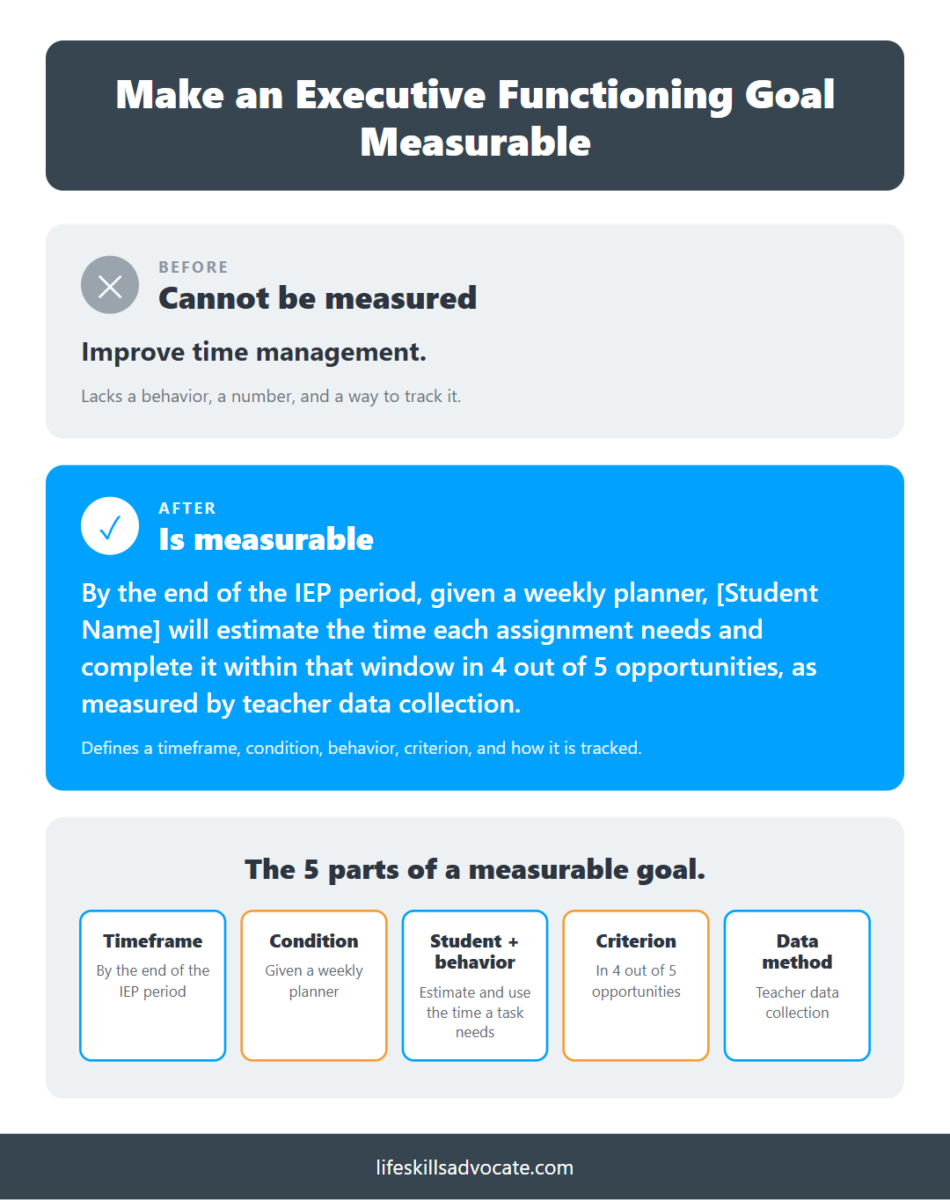
Here is the difference in practice. “Improve time management” is a hope, not a goal. Compare it to what the practitioner program SMARTS-EF recommends: swap vague wording for an observable, quantified target, such as following a daily schedule with 80% accuracy. Now there is a behavior, a number, and something to track.
So a complete executive functioning IEP goal looks like this: By the end of the IEP period, given a weekly planner, [Student Name] will estimate the time each assignment needs and complete it within that window in 4 out of 5 opportunities, as measured by teacher data collection. Five parts, all present, nothing left to argue about.
One caution worth stating plainly: the data method has to match the behavior. A self-awareness goal is measured by student self-rating, not by a teacher tally the student never sees. A binder-organization goal is measured by a work sample review, not by a quiz. Matching the method to the skill is the step most goal banks skip, and it is the one that makes a goal real.
How to Use These Executive Functioning IEP Goals
Treat every executive functioning IEP goal here as a starting draft, not a finished one. Three quick moves turn an example into a goal that fits a specific student.
Set the criterion to baseline. The percentages and ratios in these goals are illustrative. If a student starts an assigned task within 5 minutes about half the time now, “8 out of 10 opportunities” is a fair target. “10 of 10” is a setup for a goal nobody meets. Pull the starting number from present levels and write the target a reasonable stretch above it.
Pick the data method you can actually keep. A beautiful goal measured by a method no one has time to run is a goal that gets marked “insufficient data” in May. Choose the lightest method that still answers the question: teacher data collection for frequency counts, work sample review for written products, teacher observation for in-the-moment behaviors, and student self-rating for self-awareness.
Adapt the behavior by grade. The same skill shows up differently at 8 and at 17. There is a section further down on how a goal shifts from elementary through transition age, which matters because the high schoolers and young adults this bank is built for need goals that sound like their lives, not a younger child’s.
If you would rather start from a student’s own profile than from a list, the Advocate360 Goal Generator drafts a goal around the student you describe. The bank below is the browse-and-borrow option.
Writing measurable goals from a blank page is the slow part. This bank gives you 2,142 ready-to-adapt IEP goals across 6 domains and 100+ skill areas, so you can start from a solid draft and set the criteria to the student.
Best for: Teachers, case managers, and parents who write or review IEP goals and want a vetted, sortable set to adapt. Each goal is a template to adapt to the student.
Executive Functioning IEP Goals by Skill Area
These executive functioning IEP goals are grouped by the executive function skills used across LSA’s resources, the same set behind the EF 101 Resource Hub. Executive function is not one ability; it is a cluster of related skills, and there is no single agreed-on list of them, so other frameworks split the same territory differently.
As Harvard University’s Center on the Developing Child notes, these skills keep developing through the teen years and into early adulthood. That is why a goal for a high schooler can read very differently from one for a third grader, even when the skill has the same name. Each skill below gets a short definition, a set of complete goals you can adapt, and a link to a deeper bank if you need more.
Planning
Planning is looking ahead, breaking a goal into steps, and putting those steps in order before diving in. When it is weak, a capable student can still freeze in front of a big assignment. Our planning IEP goals post carries more examples than the table below.
:root{–link-color:#00a1ff;–border-color:#e1e5ea;–cell-padding:0.75rem;–font-base:0.95rem;–hover-bg:#f9fbfc;}.table-container{overflow-x:auto;-webkit-overflow-scrolling:touch;margin-bottom:1rem;border:0 !important;}.cmp-table{width:100%;font-size:var(–font-base);table-layout:fixed;border-collapse:separate !important;border-spacing:0;border:0 !important;outline:0 !important;box-shadow:none !important;font-family:inherit;}.cmp-table–planning col.col-a{width:74%;}.cmp-table–planning col.col-b{width:26%;}.cmp-table thead th{background:#fafafa;font-weight:600;padding:var(–cell-padding);border:1px solid var(–border-color);text-align:left;line-height:1.45;white-space:normal !important;word-break:keep-all;overflow:hidden;}.cmp-table td{padding:var(–cell-padding);border:1px solid var(–border-color);vertical-align:top;background:#fff;line-height:1.55;white-space:normal !important;overflow-wrap:anywhere;word-break:normal;hyphens:auto;overflow:hidden;font-family:inherit;}.cmp-table–planning td>p{margin:0;padding:0;}.cmp-table tbody tr:hover td{background:var(–hover-bg);}.cmp-table a{color:var(–link-color);}@media (min-width:769px){.cmp-table–planning td::before{content:none;}}@media (max-width:768px){.table-container{overflow-x:visible;}.cmp-table–planning colgroup,.cmp-table–planning thead{display:none;}.cmp-table–planning,.cmp-table–planning tbody{display:block;width:100%;}.cmp-table–planning tr{display:block;margin-bottom:1rem;border:1px solid var(–border-color);border-radius:0.35rem;overflow:hidden;}.cmp-table–planning td{display:block;border-left:0;border-right:0;border-top:0;border-bottom:1px solid var(–border-color);}.cmp-table–planning td:last-child{border-bottom:0;}.cmp-table–planning td::before{content:attr(data-label);display:block;font-weight:600;margin-bottom:0.25rem;color:#5e6a72;}.cmp-table–planning td[data-label=”Measurable Planning IEP Goal”]{background:#fafafa;font-weight:600;}.cmp-table–planning td[data-label=”Measurable Planning IEP Goal”]::before{font-size:0.8em;text-transform:uppercase;letter-spacing:0.04em;}.cmp-table–planning tbody tr:hover td{background:#fff;}}@media (max-width:480px){.cmp-table{font-size:0.9rem;}}
| Measurable Planning IEP Goal | What it targets |
|---|---|
| By the end of the IEP period, given a multi-step assignment and a planning template, [Student Name] will break the task into sequenced steps with a target date for each step with 80% accuracy in 4 out of 5 assignments, as measured by work sample review. | Sequencing steps |
| By the end of the IEP period, given a long-term project, [Student Name] will create a backward plan from the due date that lists each milestone and its deadline in 3 out of 4 projects, as measured by work sample review. | Backward planning |
| By the end of the IEP period, before starting a graded task, [Student Name] will identify the materials and steps needed and gather them before beginning in 4 out of 5 opportunities, as measured by teacher observation. | Preparing to start |
| By the end of the IEP period, given a weekly assignment list, [Student Name] will plan which assignments to do on which days and record the plan in a planner with 75% accuracy in 5 out of 6 weekly checks, as measured by teacher data collection. | Weekly planning |
| By the end of the IEP period, [Student Name] will estimate how many days a project will take and compare the estimate to the actual time on completion in 4 out of 5 projects, as measured by student self-rating compared to teacher data collection. | Estimating effort |
| By the end of the IEP period, given an unfamiliar assignment, [Student Name] will write a short plan of attack (first step, next step, where to get help) before asking what to do in 3 out of 4 opportunities, as measured by work sample review. | Independent planning |
| By the end of the IEP period, [Student Name] will build a study plan for an upcoming test that spaces review across at least three days in 4 out of 5 testing opportunities, as measured by work sample review. | Study planning |
| By the end of the IEP period, given a rubric, [Student Name] will plan the order of work so the highest-point sections are done first in 4 out of 5 assignments, as measured by work sample review. | Prioritizing within a task |
| By the end of the IEP period, [Student Name] will use a checklist to plan the steps of a daily living task, such as packing for the school day, and complete the steps in order with 90% accuracy in 4 out of 5 days, as measured by teacher data collection. | Planning daily routines |
Time Management
Time management is planning’s close partner: estimating how long things take and spending time in line with priorities. The time management IEP goals collection goes further on estimation and pacing.
:root{–link-color:#00a1ff;–border-color:#e1e5ea;–cell-padding:0.75rem;–font-base:0.95rem;–hover-bg:#f9fbfc;}.table-container{overflow-x:auto;-webkit-overflow-scrolling:touch;margin-bottom:1rem;border:0 !important;}.cmp-table{width:100%;font-size:var(–font-base);table-layout:fixed;border-collapse:separate !important;border-spacing:0;border:0 !important;outline:0 !important;box-shadow:none !important;font-family:inherit;}.cmp-table–time-management col.col-a{width:74%;}.cmp-table–time-management col.col-b{width:26%;}.cmp-table thead th{background:#fafafa;font-weight:600;padding:var(–cell-padding);border:1px solid var(–border-color);text-align:left;line-height:1.45;white-space:normal !important;word-break:keep-all;overflow:hidden;}.cmp-table td{padding:var(–cell-padding);border:1px solid var(–border-color);vertical-align:top;background:#fff;line-height:1.55;white-space:normal !important;overflow-wrap:anywhere;word-break:normal;hyphens:auto;overflow:hidden;font-family:inherit;}.cmp-table–time-management td>p{margin:0;padding:0;}.cmp-table tbody tr:hover td{background:var(–hover-bg);}.cmp-table a{color:var(–link-color);}@media (min-width:769px){.cmp-table–time-management td::before{content:none;}}@media (max-width:768px){.table-container{overflow-x:visible;}.cmp-table–time-management colgroup,.cmp-table–time-management thead{display:none;}.cmp-table–time-management,.cmp-table–time-management tbody{display:block;width:100%;}.cmp-table–time-management tr{display:block;margin-bottom:1rem;border:1px solid var(–border-color);border-radius:0.35rem;overflow:hidden;}.cmp-table–time-management td{display:block;border-left:0;border-right:0;border-top:0;border-bottom:1px solid var(–border-color);}.cmp-table–time-management td:last-child{border-bottom:0;}.cmp-table–time-management td::before{content:attr(data-label);display:block;font-weight:600;margin-bottom:0.25rem;color:#5e6a72;}.cmp-table–time-management td[data-label=”Measurable Time Management IEP Goal”]{background:#fafafa;font-weight:600;}.cmp-table–time-management td[data-label=”Measurable Time Management IEP Goal”]::before{font-size:0.8em;text-transform:uppercase;letter-spacing:0.04em;}.cmp-table–time-management tbody tr:hover td{background:#fff;}}@media (max-width:480px){.cmp-table{font-size:0.9rem;}}
| Measurable Time Management IEP Goal | What it targets |
|---|---|
| By the end of the IEP period, given a weekly planner, [Student Name] will estimate the time each assignment needs and complete it within that window in 4 out of 5 opportunities, as measured by teacher data collection. | Time estimation |
| By the end of the IEP period, [Student Name] will use a timer or visual countdown to finish a timed in-class task before the timer ends in 8 out of 10 opportunities, as measured by teacher data collection. | Pacing to a clock |
| By the end of the IEP period, given a class period with two tasks, [Student Name] will divide the time between them and begin the second with enough time to finish in 3 out of 4 class periods, as measured by teacher observation. | Allocating time |
| By the end of the IEP period, [Student Name] will record assignment due dates in a single calendar within one day of their being assigned with 85% accuracy across 6 weekly checks, as measured by work sample review. | Tracking deadlines |
| By the end of the IEP period, when given a homework block, [Student Name] will work for a set interval and take a planned break, returning to work on time in 4 out of 5 observed intervals, as measured by teacher observation. | Work and break cycles |
| By the end of the IEP period, [Student Name] will turn in assignments by the due date in 8 out of 10 assignments across a grading period, as measured by teacher data collection. | Meeting deadlines |
| By the end of the IEP period, [Student Name] will rate how long a task will take before starting, then adjust the next estimate based on the actual time, in 4 out of 5 tasks, as measured by student self-rating compared to teacher data collection. | Calibrating estimates |
| By the end of the IEP period, given a morning routine checklist, [Student Name] will complete each step within the allotted time and be ready for first period on time in 4 out of 5 school days, as measured by teacher data collection. | Managing routines |
| By the end of the IEP period, [Student Name] will name one daily time trap, such as a phone or a slow start, and use a chosen workaround for it in 3 out of 4 self-recorded days, as measured by student self-rating. | Spotting time drains |
Task Initiation
Task initiation is the gap between knowing what to do and actually starting. For a lot of students, that gap is the whole problem. There is a deeper set in the task initiation IEP goals post.
:root{–link-color:#00a1ff;–border-color:#e1e5ea;–cell-padding:0.75rem;–font-base:0.95rem;–hover-bg:#f9fbfc;}.table-container{overflow-x:auto;-webkit-overflow-scrolling:touch;margin-bottom:1rem;border:0 !important;}.cmp-table{width:100%;font-size:var(–font-base);table-layout:fixed;border-collapse:separate !important;border-spacing:0;border:0 !important;outline:0 !important;box-shadow:none !important;font-family:inherit;}.cmp-table–task-initiation col.col-a{width:74%;}.cmp-table–task-initiation col.col-b{width:26%;}.cmp-table thead th{background:#fafafa;font-weight:600;padding:var(–cell-padding);border:1px solid var(–border-color);text-align:left;line-height:1.45;white-space:normal !important;word-break:keep-all;overflow:hidden;}.cmp-table td{padding:var(–cell-padding);border:1px solid var(–border-color);vertical-align:top;background:#fff;line-height:1.55;white-space:normal !important;overflow-wrap:anywhere;word-break:normal;hyphens:auto;overflow:hidden;font-family:inherit;}.cmp-table–task-initiation td>p{margin:0;padding:0;}.cmp-table tbody tr:hover td{background:var(–hover-bg);}.cmp-table a{color:var(–link-color);}@media (min-width:769px){.cmp-table–task-initiation td::before{content:none;}}@media (max-width:768px){.table-container{overflow-x:visible;}.cmp-table–task-initiation colgroup,.cmp-table–task-initiation thead{display:none;}.cmp-table–task-initiation,.cmp-table–task-initiation tbody{display:block;width:100%;}.cmp-table–task-initiation tr{display:block;margin-bottom:1rem;border:1px solid var(–border-color);border-radius:0.35rem;overflow:hidden;}.cmp-table–task-initiation td{display:block;border-left:0;border-right:0;border-top:0;border-bottom:1px solid var(–border-color);}.cmp-table–task-initiation td:last-child{border-bottom:0;}.cmp-table–task-initiation td::before{content:attr(data-label);display:block;font-weight:600;margin-bottom:0.25rem;color:#5e6a72;}.cmp-table–task-initiation td[data-label=”Measurable Task Initiation IEP Goal”]{background:#fafafa;font-weight:600;}.cmp-table–task-initiation td[data-label=”Measurable Task Initiation IEP Goal”]::before{font-size:0.8em;text-transform:uppercase;letter-spacing:0.04em;}.cmp-table–task-initiation tbody tr:hover td{background:#fff;}}@media (max-width:480px){.cmp-table{font-size:0.9rem;}}
| Measurable Task Initiation IEP Goal | What it targets |
|---|---|
| By the end of the IEP period, when given a written assignment, [Student Name] will begin working within 5 minutes of the start cue in 4 out of 5 class periods, as measured by teacher observation. | Starting on cue |
| By the end of the IEP period, [Student Name] will start a non-preferred task after using one self-start routine, such as writing the first sentence or setting a two-minute timer, in 4 out of 5 opportunities, as measured by teacher observation. | Self-starting |
| By the end of the IEP period, given a multi-part assignment, [Student Name] will name the first concrete step out loud or in writing before beginning in 3 out of 4 opportunities, as measured by teacher data collection. | Identifying step one |
| By the end of the IEP period, [Student Name] will move from a preferred activity to an assigned task within 3 minutes of the request in 8 out of 10 opportunities, as measured by teacher data collection. | Starting after transitions |
| By the end of the IEP period, when stuck at the start of a task, [Student Name] will use a visual prompt card to choose a first step rather than waiting for an adult in 4 out of 5 opportunities, as measured by teacher observation. | Using start prompts |
| By the end of the IEP period, [Student Name] will begin homework within 10 minutes of sitting down in 4 out of 5 self-recorded sessions, as measured by student self-rating. | Starting at home |
| By the end of the IEP period, given a daily entry task, [Student Name] will start it independently without a verbal reminder in 7 out of 10 class periods, as measured by teacher data collection. | Starting without prompts |
| By the end of the IEP period, [Student Name] will break a delayed start into a two-minute starter step and report whether it helped in 3 out of 4 opportunities, as measured by student self-rating. | Lowering the start bar |
| By the end of the IEP period, when given group work, [Student Name] will state their role and begin their part within the first 5 minutes in 4 out of 5 group tasks, as measured by teacher observation. | Starting in groups |
Organization
Organization covers both the physical (binders, backpacks, files) and the systems a student uses to find what they need. More physical and digital organization examples live in the organization IEP goals post.
:root{–link-color:#00a1ff;–border-color:#e1e5ea;–cell-padding:0.75rem;–font-base:0.95rem;–hover-bg:#f9fbfc;}.table-container{overflow-x:auto;-webkit-overflow-scrolling:touch;margin-bottom:1rem;border:0 !important;}.cmp-table{width:100%;font-size:var(–font-base);table-layout:fixed;border-collapse:separate !important;border-spacing:0;border:0 !important;outline:0 !important;box-shadow:none !important;font-family:inherit;}.cmp-table–organization col.col-a{width:74%;}.cmp-table–organization col.col-b{width:26%;}.cmp-table thead th{background:#fafafa;font-weight:600;padding:var(–cell-padding);border:1px solid var(–border-color);text-align:left;line-height:1.45;white-space:normal !important;word-break:keep-all;overflow:hidden;}.cmp-table td{padding:var(–cell-padding);border:1px solid var(–border-color);vertical-align:top;background:#fff;line-height:1.55;white-space:normal !important;overflow-wrap:anywhere;word-break:normal;hyphens:auto;overflow:hidden;font-family:inherit;}.cmp-table–organization td>p{margin:0;padding:0;}.cmp-table tbody tr:hover td{background:var(–hover-bg);}.cmp-table a{color:var(–link-color);}@media (min-width:769px){.cmp-table–organization td::before{content:none;}}@media (max-width:768px){.table-container{overflow-x:visible;}.cmp-table–organization colgroup,.cmp-table–organization thead{display:none;}.cmp-table–organization,.cmp-table–organization tbody{display:block;width:100%;}.cmp-table–organization tr{display:block;margin-bottom:1rem;border:1px solid var(–border-color);border-radius:0.35rem;overflow:hidden;}.cmp-table–organization td{display:block;border-left:0;border-right:0;border-top:0;border-bottom:1px solid var(–border-color);}.cmp-table–organization td:last-child{border-bottom:0;}.cmp-table–organization td::before{content:attr(data-label);display:block;font-weight:600;margin-bottom:0.25rem;color:#5e6a72;}.cmp-table–organization td[data-label=”Measurable Organization IEP Goal”]{background:#fafafa;font-weight:600;}.cmp-table–organization td[data-label=”Measurable Organization IEP Goal”]::before{font-size:0.8em;text-transform:uppercase;letter-spacing:0.04em;}.cmp-table–organization tbody tr:hover td{background:#fff;}}@media (max-width:480px){.cmp-table{font-size:0.9rem;}}
| Measurable Organization IEP Goal | What it targets |
|---|---|
| By the end of the IEP period, [Student Name] will maintain an organized binder and digital folder and locate a requested material within one minute in 4 out of 5 weekly checks, as measured by teacher data collection. | Keeping a system |
| By the end of the IEP period, given a returned assignment, [Student Name] will file it in the correct place rather than loose in a bag in 4 out of 5 opportunities, as measured by teacher observation. | Filing as you go |
| By the end of the IEP period, [Student Name] will use a consistent file-naming system so a named digital file can be found within one minute in 4 out of 5 checks, as measured by work sample review. | Digital organization |
| By the end of the IEP period, [Student Name] will pack all materials needed for homework before leaving school in 4 out of 5 daily checks, as measured by teacher data collection. | Materials management |
| By the end of the IEP period, given a weekly locker or backpack check, [Student Name] will clear out what is no longer needed and sort the rest in 3 out of 4 weekly checks, as measured by teacher observation. | Decluttering |
| By the end of the IEP period, [Student Name] will set up a workspace with only the materials needed for the current task before beginning in 4 out of 5 opportunities, as measured by teacher observation. | Workspace setup |
| By the end of the IEP period, [Student Name] will keep a single running assignment list rather than scattered notes and check it at the start of each work session in 4 out of 5 sessions, as measured by work sample review. | One source of truth |
| By the end of the IEP period, [Student Name] will use color-coding or labels to separate materials by subject and keep the system organized in 4 out of 5 weekly checks across a grading period, as measured by teacher data collection. | Sorting systems |
| By the end of the IEP period, [Student Name] will rate how organized their materials are and name one thing to fix in 3 out of 4 weekly self-checks, as measured by student self-rating. | Self-checking systems |
Problem-Solving
Problem-solving is the ability to define what is wrong, generate options, and pick one, instead of stalling or guessing. The problem-solving IEP goals post breaks down each step of that process.
:root{–link-color:#00a1ff;–border-color:#e1e5ea;–cell-padding:0.75rem;–font-base:0.95rem;–hover-bg:#f9fbfc;}.table-container{overflow-x:auto;-webkit-overflow-scrolling:touch;margin-bottom:1rem;border:0 !important;}.cmp-table{width:100%;font-size:var(–font-base);table-layout:fixed;border-collapse:separate !important;border-spacing:0;border:0 !important;outline:0 !important;box-shadow:none !important;font-family:inherit;}.cmp-table–problem-solving col.col-a{width:74%;}.cmp-table–problem-solving col.col-b{width:26%;}.cmp-table thead th{background:#fafafa;font-weight:600;padding:var(–cell-padding);border:1px solid var(–border-color);text-align:left;line-height:1.45;white-space:normal !important;word-break:keep-all;overflow:hidden;}.cmp-table td{padding:var(–cell-padding);border:1px solid var(–border-color);vertical-align:top;background:#fff;line-height:1.55;white-space:normal !important;overflow-wrap:anywhere;word-break:normal;hyphens:auto;overflow:hidden;font-family:inherit;}.cmp-table–problem-solving td>p{margin:0;padding:0;}.cmp-table tbody tr:hover td{background:var(–hover-bg);}.cmp-table a{color:var(–link-color);}@media (min-width:769px){.cmp-table–problem-solving td::before{content:none;}}@media (max-width:768px){.table-container{overflow-x:visible;}.cmp-table–problem-solving colgroup,.cmp-table–problem-solving thead{display:none;}.cmp-table–problem-solving,.cmp-table–problem-solving tbody{display:block;width:100%;}.cmp-table–problem-solving tr{display:block;margin-bottom:1rem;border:1px solid var(–border-color);border-radius:0.35rem;overflow:hidden;}.cmp-table–problem-solving td{display:block;border-left:0;border-right:0;border-top:0;border-bottom:1px solid var(–border-color);}.cmp-table–problem-solving td:last-child{border-bottom:0;}.cmp-table–problem-solving td::before{content:attr(data-label);display:block;font-weight:600;margin-bottom:0.25rem;color:#5e6a72;}.cmp-table–problem-solving td[data-label=”Measurable Problem-Solving IEP Goal”]{background:#fafafa;font-weight:600;}.cmp-table–problem-solving td[data-label=”Measurable Problem-Solving IEP Goal”]::before{font-size:0.8em;text-transform:uppercase;letter-spacing:0.04em;}.cmp-table–problem-solving tbody tr:hover td{background:#fff;}}@media (max-width:480px){.cmp-table{font-size:0.9rem;}}
| Measurable Problem-Solving IEP Goal | What it targets |
|---|---|
| By the end of the IEP period, given a real-world problem scenario, [Student Name] will generate at least two options and choose one with a stated reason in 4 out of 5 opportunities, as measured by work sample review. | Generating options |
| By the end of the IEP period, when an attempt does not work, [Student Name] will name what went wrong and try a different approach before giving up in 3 out of 4 opportunities, as measured by teacher observation. | Adjusting after failure |
| By the end of the IEP period, given a word problem, [Student Name] will identify what is being asked and the steps to solve it before computing in 8 out of 10 problems, as measured by work sample review. | Defining the problem |
| By the end of the IEP period, when facing a social conflict, [Student Name] will describe the problem from both points of view and propose one fair option in 4 out of 5 role-play opportunities, as measured by teacher observation. | Social problem-solving |
| By the end of the IEP period, [Student Name] will break an open-ended assignment into a smaller question they can answer first in 4 out of 5 opportunities, as measured by work sample review. | Reducing complexity |
| By the end of the IEP period, given a task with missing materials or information, [Student Name] will identify what is missing and where to get it in 3 out of 4 opportunities, as measured by teacher data collection. | Finding what you need |
| By the end of the IEP period, [Student Name] will use a decision checklist (define, options, pick, check) to work through a multi-step problem in 4 out of 5 opportunities, as measured by work sample review. | Following a process |
| By the end of the IEP period, [Student Name] will look back at a solved problem and state one thing they would keep and one they would change in 3 out of 4 opportunities, as measured by student self-rating. | Reviewing solutions |
Cognitive Flexibility
Cognitive flexibility is shifting gears: handling a changed plan, accepting feedback, or seeing a second way to do something. See the cognitive flexibility IEP goals post for goals around transitions and revision.
:root{–link-color:#00a1ff;–border-color:#e1e5ea;–cell-padding:0.75rem;–font-base:0.95rem;–hover-bg:#f9fbfc;}.table-container{overflow-x:auto;-webkit-overflow-scrolling:touch;margin-bottom:1rem;border:0 !important;}.cmp-table{width:100%;font-size:var(–font-base);table-layout:fixed;border-collapse:separate !important;border-spacing:0;border:0 !important;outline:0 !important;box-shadow:none !important;font-family:inherit;}.cmp-table–cognitive-flexibility col.col-a{width:74%;}.cmp-table–cognitive-flexibility col.col-b{width:26%;}.cmp-table thead th{background:#fafafa;font-weight:600;padding:var(–cell-padding);border:1px solid var(–border-color);text-align:left;line-height:1.45;white-space:normal !important;word-break:keep-all;overflow:hidden;}.cmp-table td{padding:var(–cell-padding);border:1px solid var(–border-color);vertical-align:top;background:#fff;line-height:1.55;white-space:normal !important;overflow-wrap:anywhere;word-break:normal;hyphens:auto;overflow:hidden;font-family:inherit;}.cmp-table–cognitive-flexibility td>p{margin:0;padding:0;}.cmp-table tbody tr:hover td{background:var(–hover-bg);}.cmp-table a{color:var(–link-color);}@media (min-width:769px){.cmp-table–cognitive-flexibility td::before{content:none;}}@media (max-width:768px){.table-container{overflow-x:visible;}.cmp-table–cognitive-flexibility colgroup,.cmp-table–cognitive-flexibility thead{display:none;}.cmp-table–cognitive-flexibility,.cmp-table–cognitive-flexibility tbody{display:block;width:100%;}.cmp-table–cognitive-flexibility tr{display:block;margin-bottom:1rem;border:1px solid var(–border-color);border-radius:0.35rem;overflow:hidden;}.cmp-table–cognitive-flexibility td{display:block;border-left:0;border-right:0;border-top:0;border-bottom:1px solid var(–border-color);}.cmp-table–cognitive-flexibility td:last-child{border-bottom:0;}.cmp-table–cognitive-flexibility td::before{content:attr(data-label);display:block;font-weight:600;margin-bottom:0.25rem;color:#5e6a72;}.cmp-table–cognitive-flexibility td[data-label=”Measurable Cognitive Flexibility IEP Goal”]{background:#fafafa;font-weight:600;}.cmp-table–cognitive-flexibility td[data-label=”Measurable Cognitive Flexibility IEP Goal”]::before{font-size:0.8em;text-transform:uppercase;letter-spacing:0.04em;}.cmp-table–cognitive-flexibility tbody tr:hover td{background:#fff;}}@media (max-width:480px){.cmp-table{font-size:0.9rem;}}
| Measurable Cognitive Flexibility IEP Goal | What it targets |
|---|---|
| By the end of the IEP period, when a routine or plan changes unexpectedly, [Student Name] will use a coping step and continue the activity in 4 out of 5 observed instances, as measured by teacher observation. | Handling change |
| By the end of the IEP period, given feedback on a draft, [Student Name] will revise the original idea rather than restate it in 3 out of 4 opportunities, as measured by work sample review. | Acting on feedback |
| By the end of the IEP period, [Student Name] will find a second way to solve a problem when the first approach stalls in 4 out of 5 opportunities, as measured by teacher data collection. | Switching approaches |
| By the end of the IEP period, when a preferred plan is not possible, [Student Name] will accept an alternative and move forward within 3 minutes in 8 out of 10 opportunities, as measured by teacher observation. | Accepting alternatives |
| By the end of the IEP period, given a rule that works differently in two settings, [Student Name] will state how the expectation changes in 3 out of 4 opportunities, as measured by teacher data collection. | Reading context |
| By the end of the IEP period, [Student Name] will shift between two task types, such as reading and discussion, within the time allowed in 4 out of 5 transitions, as measured by teacher observation. | Shifting between tasks |
| By the end of the IEP period, when corrected, [Student Name] will try the suggested method before returning to their own in 3 out of 4 opportunities, as measured by teacher observation. | Trying a new method |
| By the end of the IEP period, [Student Name] will name one benefit of an idea different from their own during discussion in 4 out of 5 opportunities, as measured by teacher data collection. | Considering other views |
Working Memory
Working memory is holding information in mind while using it, like keeping step two in your head while doing step one. The working memory IEP goals post has more examples for holding and using information.
:root{–link-color:#00a1ff;–border-color:#e1e5ea;–cell-padding:0.75rem;–font-base:0.95rem;–hover-bg:#f9fbfc;}.table-container{overflow-x:auto;-webkit-overflow-scrolling:touch;margin-bottom:1rem;border:0 !important;}.cmp-table{width:100%;font-size:var(–font-base);table-layout:fixed;border-collapse:separate !important;border-spacing:0;border:0 !important;outline:0 !important;box-shadow:none !important;font-family:inherit;}.cmp-table–working-memory col.col-a{width:74%;}.cmp-table–working-memory col.col-b{width:26%;}.cmp-table thead th{background:#fafafa;font-weight:600;padding:var(–cell-padding);border:1px solid var(–border-color);text-align:left;line-height:1.45;white-space:normal !important;word-break:keep-all;overflow:hidden;}.cmp-table td{padding:var(–cell-padding);border:1px solid var(–border-color);vertical-align:top;background:#fff;line-height:1.55;white-space:normal !important;overflow-wrap:anywhere;word-break:normal;hyphens:auto;overflow:hidden;font-family:inherit;}.cmp-table–working-memory td>p{margin:0;padding:0;}.cmp-table tbody tr:hover td{background:var(–hover-bg);}.cmp-table a{color:var(–link-color);}@media (min-width:769px){.cmp-table–working-memory td::before{content:none;}}@media (max-width:768px){.table-container{overflow-x:visible;}.cmp-table–working-memory colgroup,.cmp-table–working-memory thead{display:none;}.cmp-table–working-memory,.cmp-table–working-memory tbody{display:block;width:100%;}.cmp-table–working-memory tr{display:block;margin-bottom:1rem;border:1px solid var(–border-color);border-radius:0.35rem;overflow:hidden;}.cmp-table–working-memory td{display:block;border-left:0;border-right:0;border-top:0;border-bottom:1px solid var(–border-color);}.cmp-table–working-memory td:last-child{border-bottom:0;}.cmp-table–working-memory td::before{content:attr(data-label);display:block;font-weight:600;margin-bottom:0.25rem;color:#5e6a72;}.cmp-table–working-memory td[data-label=”Measurable Working Memory IEP Goal”]{background:#fafafa;font-weight:600;}.cmp-table–working-memory td[data-label=”Measurable Working Memory IEP Goal”]::before{font-size:0.8em;text-transform:uppercase;letter-spacing:0.04em;}.cmp-table–working-memory tbody tr:hover td{background:#fff;}}@media (max-width:480px){.cmp-table{font-size:0.9rem;}}
| Measurable Working Memory IEP Goal | What it targets |
|---|---|
| By the end of the IEP period, given a three-step verbal direction, [Student Name] will complete all steps in the correct order with 80% accuracy in 4 out of 5 opportunities, as measured by teacher data collection. | Following multi-step directions |
| By the end of the IEP period, [Student Name] will use a written or visual reminder to hold multi-step instructions rather than asking for a full repeat in 4 out of 5 opportunities, as measured by teacher observation. | Offloading to a support |
| By the end of the IEP period, after reading a paragraph, [Student Name] will recall the main idea and one detail in 8 out of 10 passages, as measured by work sample review. | Holding what you read |
| By the end of the IEP period, [Student Name] will jot a quick note to hold a thought during a task and return to it without losing the original step in 3 out of 4 opportunities, as measured by work sample review. | Parking a thought |
| By the end of the IEP period, given a mental math problem within their level, [Student Name] will hold the numbers and produce the answer with 75% accuracy in 4 out of 5 problems, as measured by teacher data collection. | Mental manipulation |
| By the end of the IEP period, [Student Name] will restate a direction in their own words before starting in 4 out of 5 opportunities, as measured by teacher observation. | Confirming understanding |
| By the end of the IEP period, [Student Name] will follow a two-part routine, such as turning in work and then starting the warm-up, without a reminder in 8 out of 10 class periods, as measured by teacher data collection. | Holding routines |
| By the end of the IEP period, during a discussion, [Student Name] will hold their point until it is their turn and still deliver it in 3 out of 4 opportunities, as measured by teacher observation. | Holding ideas in turn |
| By the end of the IEP period, [Student Name] will use a checklist to keep their place in a multi-step procedure and finish without skipping a step in 4 out of 5 opportunities, as measured by work sample review. | Tracking your place |
Emotional Control
Emotional control is managing a feeling well enough to keep working through it, not pushing the feeling away. For a wider range, the emotional control IEP goals post expands on regulation goals.
:root{–link-color:#00a1ff;–border-color:#e1e5ea;–cell-padding:0.75rem;–font-base:0.95rem;–hover-bg:#f9fbfc;}.table-container{overflow-x:auto;-webkit-overflow-scrolling:touch;margin-bottom:1rem;border:0 !important;}.cmp-table{width:100%;font-size:var(–font-base);table-layout:fixed;border-collapse:separate !important;border-spacing:0;border:0 !important;outline:0 !important;box-shadow:none !important;font-family:inherit;}.cmp-table–emotional-control col.col-a{width:74%;}.cmp-table–emotional-control col.col-b{width:26%;}.cmp-table thead th{background:#fafafa;font-weight:600;padding:var(–cell-padding);border:1px solid var(–border-color);text-align:left;line-height:1.45;white-space:normal !important;word-break:keep-all;overflow:hidden;}.cmp-table td{padding:var(–cell-padding);border:1px solid var(–border-color);vertical-align:top;background:#fff;line-height:1.55;white-space:normal !important;overflow-wrap:anywhere;word-break:normal;hyphens:auto;overflow:hidden;font-family:inherit;}.cmp-table–emotional-control td>p{margin:0;padding:0;}.cmp-table tbody tr:hover td{background:var(–hover-bg);}.cmp-table a{color:var(–link-color);}@media (min-width:769px){.cmp-table–emotional-control td::before{content:none;}}@media (max-width:768px){.table-container{overflow-x:visible;}.cmp-table–emotional-control colgroup,.cmp-table–emotional-control thead{display:none;}.cmp-table–emotional-control,.cmp-table–emotional-control tbody{display:block;width:100%;}.cmp-table–emotional-control tr{display:block;margin-bottom:1rem;border:1px solid var(–border-color);border-radius:0.35rem;overflow:hidden;}.cmp-table–emotional-control td{display:block;border-left:0;border-right:0;border-top:0;border-bottom:1px solid var(–border-color);}.cmp-table–emotional-control td:last-child{border-bottom:0;}.cmp-table–emotional-control td::before{content:attr(data-label);display:block;font-weight:600;margin-bottom:0.25rem;color:#5e6a72;}.cmp-table–emotional-control td[data-label=”Measurable Emotional Control IEP Goal”]{background:#fafafa;font-weight:600;}.cmp-table–emotional-control td[data-label=”Measurable Emotional Control IEP Goal”]::before{font-size:0.8em;text-transform:uppercase;letter-spacing:0.04em;}.cmp-table–emotional-control tbody tr:hover td{background:#fff;}}@media (max-width:480px){.cmp-table{font-size:0.9rem;}}
| Measurable Emotional Control IEP Goal | What it targets |
|---|---|
| By the end of the IEP period, when feeling frustrated, [Student Name] will use a self-chosen regulation tool before responding in 4 out of 5 observed situations, as measured by teacher observation. | Pausing before reacting |
| By the end of the IEP period, [Student Name] will name the emotion they are feeling and rate its intensity on a scale when prompted in 4 out of 5 opportunities, as measured by student self-rating. | Naming feelings |
| By the end of the IEP period, after a setback such as a low grade, [Student Name] will use a coping step and return to the task within 5 minutes in 3 out of 4 opportunities, as measured by teacher observation. | Recovering from setbacks |
| By the end of the IEP period, [Student Name] will request a break using an agreed signal before reaching the point of escalation in 4 out of 5 opportunities, as measured by teacher data collection. | Asking for a break |
| By the end of the IEP period, when given critical feedback, [Student Name] will respond calmly and ask one clarifying question in 3 out of 4 opportunities, as measured by teacher observation. | Taking feedback |
| By the end of the IEP period, [Student Name] will identify two personal triggers and a matching calming step for each in 4 out of 5 check-ins, as measured by student self-rating. | Knowing your triggers |
| By the end of the IEP period, during a disappointing change of plans, [Student Name] will use a calming step and stay in the activity in 8 out of 10 opportunities, as measured by teacher observation. | Staying regulated |
| By the end of the IEP period, [Student Name] will do a feelings check-in at the start of class and choose a calming tool when needed in 4 out of 5 days, as measured by student self-rating. | Proactive check-ins |
| By the end of the IEP period, after using a calming step, [Student Name] will rate how well it worked and decide whether to use it again in 3 out of 4 opportunities, as measured by student self-rating. | Evaluating coping tools |
| By the end of the IEP period, [Student Name] will recover from a frustrating moment and rejoin group work without adult prompting in 7 out of 10 opportunities, as measured by teacher data collection. | Rejoining after upset |
Impulse Control
Impulse control is the pause between an urge and an action, the moment that lets a student choose a response. The IEP goals for impulse control post adds more examples across settings.
:root{–link-color:#00a1ff;–border-color:#e1e5ea;–cell-padding:0.75rem;–font-base:0.95rem;–hover-bg:#f9fbfc;}.table-container{overflow-x:auto;-webkit-overflow-scrolling:touch;margin-bottom:1rem;border:0 !important;}.cmp-table{width:100%;font-size:var(–font-base);table-layout:fixed;border-collapse:separate !important;border-spacing:0;border:0 !important;outline:0 !important;box-shadow:none !important;font-family:inherit;}.cmp-table–impulse-control col.col-a{width:74%;}.cmp-table–impulse-control col.col-b{width:26%;}.cmp-table thead th{background:#fafafa;font-weight:600;padding:var(–cell-padding);border:1px solid var(–border-color);text-align:left;line-height:1.45;white-space:normal !important;word-break:keep-all;overflow:hidden;}.cmp-table td{padding:var(–cell-padding);border:1px solid var(–border-color);vertical-align:top;background:#fff;line-height:1.55;white-space:normal !important;overflow-wrap:anywhere;word-break:normal;hyphens:auto;overflow:hidden;font-family:inherit;}.cmp-table–impulse-control td>p{margin:0;padding:0;}.cmp-table tbody tr:hover td{background:var(–hover-bg);}.cmp-table a{color:var(–link-color);}@media (min-width:769px){.cmp-table–impulse-control td::before{content:none;}}@media (max-width:768px){.table-container{overflow-x:visible;}.cmp-table–impulse-control colgroup,.cmp-table–impulse-control thead{display:none;}.cmp-table–impulse-control,.cmp-table–impulse-control tbody{display:block;width:100%;}.cmp-table–impulse-control tr{display:block;margin-bottom:1rem;border:1px solid var(–border-color);border-radius:0.35rem;overflow:hidden;}.cmp-table–impulse-control td{display:block;border-left:0;border-right:0;border-top:0;border-bottom:1px solid var(–border-color);}.cmp-table–impulse-control td:last-child{border-bottom:0;}.cmp-table–impulse-control td::before{content:attr(data-label);display:block;font-weight:600;margin-bottom:0.25rem;color:#5e6a72;}.cmp-table–impulse-control td[data-label=”Measurable Impulse Control IEP Goal”]{background:#fafafa;font-weight:600;}.cmp-table–impulse-control td[data-label=”Measurable Impulse Control IEP Goal”]::before{font-size:0.8em;text-transform:uppercase;letter-spacing:0.04em;}.cmp-table–impulse-control tbody tr:hover td{background:#fff;}}@media (max-width:480px){.cmp-table{font-size:0.9rem;}}
| Measurable Impulse Control IEP Goal | What it targets |
|---|---|
| By the end of the IEP period, during group discussion, [Student Name] will wait to be called on before speaking in 4 out of 5 opportunities, as measured by teacher data collection. | Waiting your turn |
| By the end of the IEP period, [Student Name] will use a stop-and-think step before reacting to a peer in 3 out of 4 observed situations, as measured by teacher observation. | Pausing with peers |
| By the end of the IEP period, when tempted to leave a task, [Student Name] will check their plan and stay with the task for the set interval in 8 out of 10 opportunities, as measured by teacher data collection. | Resisting task-switching |
| By the end of the IEP period, [Student Name] will read or reread directions in full before answering in 4 out of 5 assignments, as measured by work sample review. | Slowing down on work |
| By the end of the IEP period, [Student Name] will keep hands and materials to themselves during transitions in 9 out of 10 transitions, as measured by teacher data collection. | Managing physical impulses |
| By the end of the IEP period, before sending a message or posting online, [Student Name] will use a one-minute check step in 3 out of 4 self-recorded opportunities, as measured by student self-rating. | Pausing online |
| By the end of the IEP period, when an off-topic thought comes up, [Student Name] will write it down to handle later instead of interrupting in 4 out of 5 opportunities, as measured by teacher observation. | Holding off-topic urges |
| By the end of the IEP period, [Student Name] will pause and choose a response rather than reacting when told no in 3 out of 4 opportunities, as measured by teacher observation. | Responding to limits |
Attentional Control
Attentional control is steering and holding focus, including pulling it back after a distraction. More focus and sustained-attention examples are in the attentional control IEP goals post.
:root{–link-color:#00a1ff;–border-color:#e1e5ea;–cell-padding:0.75rem;–font-base:0.95rem;–hover-bg:#f9fbfc;}.table-container{overflow-x:auto;-webkit-overflow-scrolling:touch;margin-bottom:1rem;border:0 !important;}.cmp-table{width:100%;font-size:var(–font-base);table-layout:fixed;border-collapse:separate !important;border-spacing:0;border:0 !important;outline:0 !important;box-shadow:none !important;font-family:inherit;}.cmp-table–attentional-control col.col-a{width:74%;}.cmp-table–attentional-control col.col-b{width:26%;}.cmp-table thead th{background:#fafafa;font-weight:600;padding:var(–cell-padding);border:1px solid var(–border-color);text-align:left;line-height:1.45;white-space:normal !important;word-break:keep-all;overflow:hidden;}.cmp-table td{padding:var(–cell-padding);border:1px solid var(–border-color);vertical-align:top;background:#fff;line-height:1.55;white-space:normal !important;overflow-wrap:anywhere;word-break:normal;hyphens:auto;overflow:hidden;font-family:inherit;}.cmp-table–attentional-control td>p{margin:0;padding:0;}.cmp-table tbody tr:hover td{background:var(–hover-bg);}.cmp-table a{color:var(–link-color);}@media (min-width:769px){.cmp-table–attentional-control td::before{content:none;}}@media (max-width:768px){.table-container{overflow-x:visible;}.cmp-table–attentional-control colgroup,.cmp-table–attentional-control thead{display:none;}.cmp-table–attentional-control,.cmp-table–attentional-control tbody{display:block;width:100%;}.cmp-table–attentional-control tr{display:block;margin-bottom:1rem;border:1px solid var(–border-color);border-radius:0.35rem;overflow:hidden;}.cmp-table–attentional-control td{display:block;border-left:0;border-right:0;border-top:0;border-bottom:1px solid var(–border-color);}.cmp-table–attentional-control td:last-child{border-bottom:0;}.cmp-table–attentional-control td::before{content:attr(data-label);display:block;font-weight:600;margin-bottom:0.25rem;color:#5e6a72;}.cmp-table–attentional-control td[data-label=”Measurable Attentional Control IEP Goal”]{background:#fafafa;font-weight:600;}.cmp-table–attentional-control td[data-label=”Measurable Attentional Control IEP Goal”]::before{font-size:0.8em;text-transform:uppercase;letter-spacing:0.04em;}.cmp-table–attentional-control tbody tr:hover td{background:#fff;}}@media (max-width:480px){.cmp-table{font-size:0.9rem;}}
| Measurable Attentional Control IEP Goal | What it targets |
|---|---|
| By the end of the IEP period, during independent work, [Student Name] will sustain attention to task for 15 minutes with no more than one redirection in 4 out of 5 class periods, as measured by teacher data collection. | Sustained attention |
| By the end of the IEP period, [Student Name] will use a focus tool, such as noise-reducing headphones or a checklist, to return to task after a distraction in 4 out of 5 opportunities, as measured by teacher observation. | Recovering focus |
| By the end of the IEP period, [Student Name] will redirect their own attention back to a lesson within one minute of noticing they are off task in 8 out of 10 opportunities, as measured by student self-rating. | Self-redirecting |
| By the end of the IEP period, given a two-part work session, [Student Name] will stay on the first part until it is done before switching in 3 out of 4 sessions, as measured by teacher observation. | Resisting distraction |
| By the end of the IEP period, [Student Name] will identify the most distracting part of their environment and make one change to reduce it in 3 out of 4 self-checks, as measured by student self-rating. | Shaping the environment |
| By the end of the IEP period, during a teacher-led lesson, [Student Name] will take part with notes, answers, or questions at least twice without prompting in 4 out of 5 lessons, as measured by teacher data collection. | Active attention |
| By the end of the IEP period, [Student Name] will hold attention through a full set of directions before beginning in 4 out of 5 opportunities, as measured by teacher observation. | Attending to directions |
| By the end of the IEP period, [Student Name] will use a self-check signal at set intervals to confirm they are still on task in 4 out of 5 work sessions, as measured by student self-rating. | Monitoring focus |
| By the end of the IEP period, [Student Name] will finish a timed independent task without leaving their seat more than once in 8 out of 10 opportunities, as measured by teacher data collection. | Staying with the task |
Self-Monitoring
Self-monitoring is the skill of watching your own performance and adjusting, the one that ties all the others together. The self-monitoring IEP goals post goes deeper on self-checking and self-rating.
:root{–link-color:#00a1ff;–border-color:#e1e5ea;–cell-padding:0.75rem;–font-base:0.95rem;–hover-bg:#f9fbfc;}.table-container{overflow-x:auto;-webkit-overflow-scrolling:touch;margin-bottom:1rem;border:0 !important;}.cmp-table{width:100%;font-size:var(–font-base);table-layout:fixed;border-collapse:separate !important;border-spacing:0;border:0 !important;outline:0 !important;box-shadow:none !important;font-family:inherit;}.cmp-table–self-monitoring col.col-a{width:74%;}.cmp-table–self-monitoring col.col-b{width:26%;}.cmp-table thead th{background:#fafafa;font-weight:600;padding:var(–cell-padding);border:1px solid var(–border-color);text-align:left;line-height:1.45;white-space:normal !important;word-break:keep-all;overflow:hidden;}.cmp-table td{padding:var(–cell-padding);border:1px solid var(–border-color);vertical-align:top;background:#fff;line-height:1.55;white-space:normal !important;overflow-wrap:anywhere;word-break:normal;hyphens:auto;overflow:hidden;font-family:inherit;}.cmp-table–self-monitoring td>p{margin:0;padding:0;}.cmp-table tbody tr:hover td{background:var(–hover-bg);}.cmp-table a{color:var(–link-color);}@media (min-width:769px){.cmp-table–self-monitoring td::before{content:none;}}@media (max-width:768px){.table-container{overflow-x:visible;}.cmp-table–self-monitoring colgroup,.cmp-table–self-monitoring thead{display:none;}.cmp-table–self-monitoring,.cmp-table–self-monitoring tbody{display:block;width:100%;}.cmp-table–self-monitoring tr{display:block;margin-bottom:1rem;border:1px solid var(–border-color);border-radius:0.35rem;overflow:hidden;}.cmp-table–self-monitoring td{display:block;border-left:0;border-right:0;border-top:0;border-bottom:1px solid var(–border-color);}.cmp-table–self-monitoring td:last-child{border-bottom:0;}.cmp-table–self-monitoring td::before{content:attr(data-label);display:block;font-weight:600;margin-bottom:0.25rem;color:#5e6a72;}.cmp-table–self-monitoring td[data-label=”Measurable Self-Monitoring IEP Goal”]{background:#fafafa;font-weight:600;}.cmp-table–self-monitoring td[data-label=”Measurable Self-Monitoring IEP Goal”]::before{font-size:0.8em;text-transform:uppercase;letter-spacing:0.04em;}.cmp-table–self-monitoring tbody tr:hover td{background:#fff;}}@media (max-width:480px){.cmp-table{font-size:0.9rem;}}
| Measurable Self-Monitoring IEP Goal | What it targets |
|---|---|
| By the end of the IEP period, [Student Name] will use a checklist to rate the completion and accuracy of assignments, matching teacher ratings with 80% agreement in 4 out of 5 sessions, as measured by student self-rating compared to teacher data collection. | Accurate self-rating |
| By the end of the IEP period, [Student Name] will check their work against a rubric and fix at least one issue before turning it in, in 4 out of 5 assignments, as measured by work sample review. | Checking before submitting |
| By the end of the IEP period, [Student Name] will track whether they met a daily goal and record it in 4 out of 5 days, as measured by student self-rating. | Tracking daily goals |
| By the end of the IEP period, after a task, [Student Name] will name one thing that went well and one to change next time in 3 out of 4 opportunities, as measured by student self-rating. | Reflecting on work |
| By the end of the IEP period, [Student Name] will notice when they are off task and mark it on a self-monitoring sheet in 4 out of 5 work periods, as measured by student self-rating compared to teacher observation. | Noticing off-task moments |
| By the end of the IEP period, [Student Name] will compare their predicted grade on a task to the actual grade and note the gap in 4 out of 5 tasks, as measured by work sample review. | Calibrating self-judgment |
| By the end of the IEP period, [Student Name] will use a checklist to confirm all parts of a multi-step assignment are done before submitting in 8 out of 10 assignments, as measured by work sample review. | Final self-checks |
| By the end of the IEP period, [Student Name] will monitor their use of a target skill, such as starting on time, and graph it weekly in 4 out of 5 weeks, as measured by student self-rating compared to teacher data collection. | Self-graphing progress |
| By the end of the IEP period, [Student Name] will check in on their progress toward an IEP goal and state whether they are on track in 3 out of 4 check-ins, as measured by student self-rating. | Tracking goal progress |
| By the end of the IEP period, [Student Name] will catch and correct a careless error on review in 4 out of 5 assignments, as measured by work sample review. | Catching errors |
Self-Advocacy and Transition Goals
Some executive function goals are not the kind a student practices four out of five times a week. They happen once or twice a period, like presenting at an IEP meeting or asking a teacher for an accommodation. These use a milestone shape instead: a timeframe, the behavior, and a way to measure it, with no percentage to chase. They matter most for high schoolers and transition-age students, who are the readers this bank is built for.
- By the end of the IEP period, [Student Name] will present their strengths and accommodation needs at their annual IEP meeting, as measured by teacher observation.
- By the end of the IEP period, [Student Name] will lead one section of their annual IEP meeting, such as reviewing progress on their goals, as measured by teacher observation.
- By the end of the IEP period, [Student Name] will request one accommodation from a general education teacher using a prepared script at the start of a new semester, as measured by teacher observation.
- By the end of the IEP period, [Student Name] will explain how their executive function challenges affect their schoolwork and name one support that helps during a transition planning meeting, as measured by teacher observation.
- By the end of the IEP period, [Student Name] will set one goal for after high school and name a first step toward it, as measured by work sample review.
How the Same Goal Shifts From Elementary to High School
The skill stays the same; the way it shows up does not. That gap is where most executive functioning IEP goals miss for older students, because the example banks online skew elementary. Writing an age-appropriate goal means matching the behavior to where the student actually lives.
Take time management as one example, traced across three stages.
Elementary. The goal is concrete and adult-supported. A young student might “follow a picture schedule to complete a three-step morning routine with 80% accuracy,” with the teacher running the data. The skill is the same; the scope is small and the support is heavy.
Middle school. The goal moves toward planning across a day or a week. A middle schooler might “record assignments in a planner and complete them by the due date in 4 out of 5 weeks.” The student is now holding more time, with less adult hand-holding.
High school and transition. The goal stretches toward independence and life after school. A high schooler might “build and follow a weekly schedule that balances classes, a job, and study time, then adjust it based on what worked, in 3 out of 4 weeks.” The behavior looks adult because it is rehearsing adult life.
The same logic works for any of these skills. Keep the skill, raise the stakes, and pull the adult support back as the student climbs grade bands.
Facts and Sources You Can Cite
:root{–link-color:#00a1ff;–border-color:#e1e5ea;–cell-padding:0.75rem;–font-base:0.95rem;–hover-bg:#f9fbfc;}.table-container{overflow-x:auto;-webkit-overflow-scrolling:touch;margin-bottom:1rem;border:0 !important;}.cmp-table{width:100%;font-size:var(–font-base);table-layout:fixed;border-collapse:separate !important;border-spacing:0;border:0 !important;outline:0 !important;box-shadow:none !important;font-family:inherit;}.cmp-table–citability-block col.col-a{width:34%;}.cmp-table–citability-block col.col-b{width:44%;}.cmp-table–citability-block col.col-c{width:22%;}.cmp-table thead th{background:#fafafa;font-weight:600;padding:var(–cell-padding);border:1px solid var(–border-color);text-align:left;line-height:1.45;white-space:normal !important;word-break:keep-all;overflow:hidden;}.cmp-table td{padding:var(–cell-padding);border:1px solid var(–border-color);vertical-align:top;background:#fff;line-height:1.55;white-space:normal !important;overflow-wrap:anywhere;word-break:normal;hyphens:auto;overflow:hidden;font-family:inherit;}.cmp-table–citability-block td>p{margin:0;padding:0;}.cmp-table tbody tr:hover td{background:var(–hover-bg);}.cmp-table a{color:var(–link-color);}@media (min-width:769px){.cmp-table–citability-block td::before{content:none;}}@media (max-width:768px){.table-container{overflow-x:visible;}.cmp-table–citability-block colgroup,.cmp-table–citability-block thead{display:none;}.cmp-table–citability-block,.cmp-table–citability-block tbody{display:block;width:100%;}.cmp-table–citability-block tr{display:block;margin-bottom:1rem;border:1px solid var(–border-color);border-radius:0.35rem;overflow:hidden;}.cmp-table–citability-block td{display:block;border-left:0;border-right:0;border-top:0;border-bottom:1px solid var(–border-color);}.cmp-table–citability-block td:last-child{border-bottom:0;}.cmp-table–citability-block td::before{content:attr(data-label);display:block;font-weight:600;margin-bottom:0.25rem;color:#5e6a72;}.cmp-table–citability-block td[data-label=”Fact”]{background:#fafafa;font-weight:600;}.cmp-table–citability-block td[data-label=”Fact”]::before{font-size:0.8em;text-transform:uppercase;letter-spacing:0.04em;}.cmp-table–citability-block tbody tr:hover td{background:#fff;}}@media (max-width:480px){.cmp-table{font-size:0.9rem;}}
| Fact | Detail and scope | Source |
|---|---|---|
| Measurable executive functioning IEP goals have four required parts | Under IDEA, an annual goal names the target behavior, the conditions, the criterion for acceptable performance, and the timeframe. How progress will be measured is stated separately. | IRIS Center, Vanderbilt University |
| Executive function keeps developing into early adulthood | These skills continue to grow and mature through the teen years and into early adulthood, which is why goals should scale with age. | Center on the Developing Child, Harvard University |
| ADHD plus executive function challenges raises academic risk | In a US sample of 481 children and adolescents, those with ADHD and executive function deficits had higher risk of grade retention and lower achievement than peers with ADHD alone, after controlling for socioeconomic status, learning disabilities, and IQ (2004). | Biederman et al., 2004 |
| Vague goals fail on measurability | Practitioner guidance is to replace vague wording like “improve time management” with an observable, quantified target such as following a daily schedule with 80% accuracy. | SMARTS-EF |
Frequently Asked Questions About Executive Functioning IEP Goals
How many executive functioning IEP goals should one student have?
Fewer than most people expect. A goal is a year-long teaching target with data behind it, so one to three well-chosen executive function goals usually carry more weight than a long list nobody can track. The right number depends on the student’s present levels, how many other goal areas the IEP already covers, and what the team can realistically track. More goals does not mean better support, and often the opposite is true.
What executive function skills can an IEP goal target?
An executive functioning IEP goal can target any of the executive function skills LSA organizes its resources around: planning, time management, task initiation, organization, problem-solving, cognitive flexibility, working memory, emotional control, impulse control, attentional control, and self-monitoring. There is no single, widely agreed list of executive function skills, so other frameworks group them differently. Focus on the one or two that create the most friction for the student.
How do you write an executive functioning IEP goal for a high school or transition-age student?
Keep the skill and raise the stakes to match adult life. A high school executive functioning IEP goal should sound like what the student is about to face: managing a job and classes, self-advocating with a teacher, or following through on a plan without an adult over their shoulder. Start from the student’s present levels, not a template. Write an observable behavior set in a real high school or post-school context. Attach a criterion pulled from baseline data, and pick a data method the student can take part in, since tracking yourself is a transition skill on its own. The milestone goals here, like leading part of an IEP meeting, fit this age group, where a four-out-of-five-trials criterion would not make sense. When in doubt, picture the skill the year after graduation and write toward that.
What data-collection method should you use for an executive functioning goal?
Match the method to the behavior. Use teacher data collection for frequency counts, work sample review for written products, teacher observation for in-the-moment behaviors, and student self-rating for anything about self-awareness.
Can you copy these executive functioning IEP goals directly into a student’s IEP?
No, and you should not. These goals are drafts to adapt, not finished goals. Copying an example straight into a live IEP skips the most important step, which is building the goal from the individual student’s present levels and baseline data. Use these to see what a complete goal looks like, then rewrite the behavior, the criterion, and the data method to fit the student in front of you.
Are these executive functioning IEP goals aligned to academic standards?
These examples are written to be measurable and IDEA-compliant, not mapped to a specific state standard, because executive function goals are usually functional rather than tied to grade-level academic standards. If your team needs standards-aligned goals, the IEP Goal Bank includes a large set of Common-Core-aligned goals alongside the functional ones.
Next Steps
The fastest way to use these executive functioning IEP goals is to stop scrolling and start with the one skill costing a student the most.
- Name the friction point. Write down the single executive function skill that creates the most trouble in the student’s week. That is the section to start in, and you can do it in two minutes without buying anything.
- Pull a baseline before you set a number. Grab a week of informal data on the target behavior so the criterion you write is a real stretch, not a guess.
- Start from the student, not a list. The Advocate360 Goal Generator writes a goal from the profile you describe.
- Go deeper when you need the full set. The Comprehensive IEP Goal Bank carries 2,142 goals across six domains and 100+ skill areas when one section here is not enough.
- Support between meetings. If the student is working on these skills outside school too, executive function coaching is one option for skill-building. Coaching is educational and skills-focused, not therapy or a mental health service, and the free Executive Functioning Assessment shows where the gaps are first.
Further Reading
- Developing High-Quality IEP Goals – IRIS Center, Vanderbilt University
- InBrief: Executive Function – Center on the Developing Child, Harvard University
- Impact of Executive Function Deficits in Children With ADHD – Biederman et al., 2004
- Writing Effective Executive Function Goals for IEPs – SMARTS-EF
- Planning IEP Goals – Life Skills Advocate
- Time Management IEP Goals – Life Skills Advocate
- Task Initiation IEP Goals – Life Skills Advocate
- Organization IEP Goals – Life Skills Advocate
- Problem-Solving IEP Goals – Life Skills Advocate
- Cognitive Flexibility IEP Goals – Life Skills Advocate
- Working Memory IEP Goals – Life Skills Advocate
- Emotional Control IEP Goals – Life Skills Advocate
- IEP Goals for Impulse Control – Life Skills Advocate
- Attentional Control IEP Goals – Life Skills Advocate
- Self-Monitoring IEP Goals – Life Skills Advocate
- Executive Functioning 101 Resource Hub – Life Skills Advocate
- Advocate360 Goal Generator – Life Skills Advocate
- IEP Goal Bank ($29) – Life Skills Advocate
- Executive Function Coaching – Life Skills Advocate
- Free Executive Functioning Assessment – Life Skills Advocate