
Picture the end of a sensory-heavy day. The lights feel too bright, every sound has an edge, and the one thing that sounds genuinely good is sinking into something soft and letting it hold you for a while.
That instinct is part of why sensory bean bag chairs show up in so many bedrooms, classrooms, and therapy spaces. A good one molds to the body, gives steady physical feedback, and turns a corner of a room into a low-stakes place to settle down and regulate.
Most roundups treat these as kids’ furniture and rank them on price and color. This one is built for autistic and sensory-seeking teens and adults, plus the parents, educators, and occupational therapists who buy for them. It names what each chair actually does for your body, says plainly which picks fit an adult frame, and stays honest about the gap between a chair that wraps you up and one that gives firm, grounding pressure.
Nine picks, sorted by the kind of input they give rather than by who the box is marketed to.
TL;DR: The Short Version
The right sensory bean bag chair depends less on brand and more on the kind of input your body is looking for. Here is the quick read on the nine sensory bean bag chairs below, grouped by feel.
- Want to sink in and be cradled: the bead-filled Posh Creations is the proven, washable all-rounder.
- Want to disappear into a soft cocoon: the oversized Maxyoyo faux fur shell wraps the whole way around you.
- Want firm, supportive structure: the Big Joe Fuf holds its shape for years, and two memory-foam picks (HABUTWAY and Codi) contour without packing flat.
- Want movement and crash input: the Matini crash pad and the convertible KreyNa give a flop-and-rebound jolt instead of a still sit.
- Short on space or budget: the LinkRomat shell and the low Hobestluk lounger cover the in-between.
This is a buying guide from an executive function coaching team, not medical or occupational therapy advice. If you are working with an OT, use it as a starting point for that conversation rather than a replacement for it.
How a Sensory Bean Bag Chair Actually Helps
A sensory bean bag chair works because it does something a regular chair cannot: it conforms to the whole body at once and pushes back gently against a lot of surface area. That contact feeds the body’s sense of where it is in space, a sense called proprioception, and for many sensory-seekers that steady feedback reads as calming and organizing.
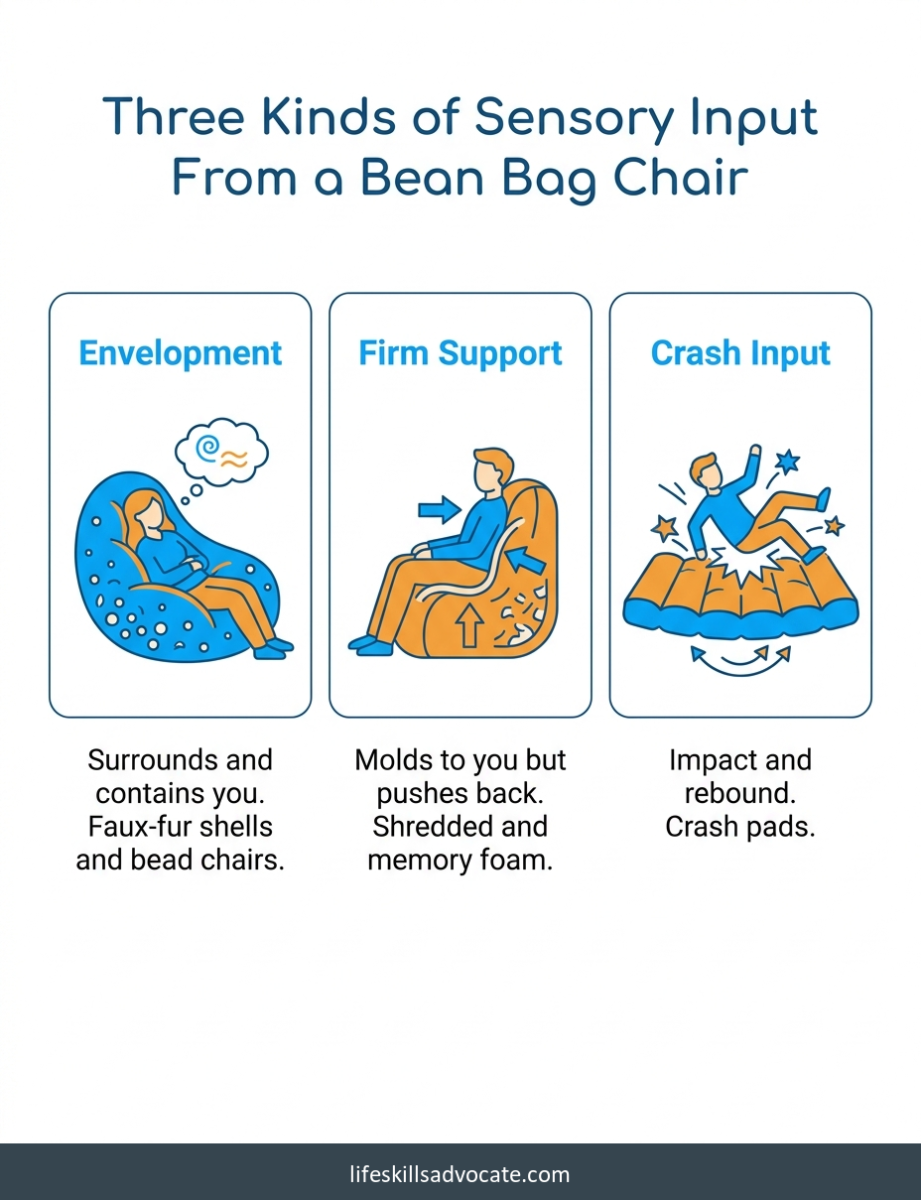
It helps to be clear about what the feel actually is. A soft, sink-in bean bag mainly gives envelopment: a surrounding, cocoon-like containment that feels safe and held. That is not the same as true deep pressure, the firm, even, sustained pushback you get from a weighted blanket.
Both can help, but they are different sensations, and a chair that markets itself as deep pressure is usually describing the cocoon feeling. A crash pad is a third thing again: you flop into it for a quick burst of impact and rebound, which is movement input, not a still hug.
None of this is a treatment, and the research on bean bags specifically is thin. What exists points to deep-pressure and proprioceptive input in general, and sensory preferences vary so much from person to person that the only reliable test is whether a particular chair helps a particular body feel better. The picks below are sorted to make that match easier.
Sensory Seating, by the Research
A few facts worth quoting when someone asks whether sensory bean bag chairs really do anything.
| Fact | What it means | Source |
|---|---|---|
| Proprioception is the body’s sense of where its parts are and how they are moving. | It is why the firm, whole-body contact from a sensory bean bag chair can feel grounding without you having to look or think about it. | Cleveland Clinic (2024) |
| Sensory differences are part of how autism is defined. | The DSM-5 lists hyper- or hypo-reactivity to sensory input among the core features of autism, which is why sensory seating is a common support. | CDC (2024) |
| Sensory approaches commonly use pressure, movement, and touch input matched to a person’s preferences. | Matching that input to what an individual actually likes is a recognized way to support self-regulation, which is the role a sensory bean bag chair can play at home, though response varies from person to person. | Frontiers in Psychology (2022) |
What to Look For in Sensory Bean Bag Chairs
The best sensory bean bag chairs are not the ones with the longest spec sheet. An earlier version of this guide ran through a dozen features; most of them never changed the decision. These six do.
- The feel you actually want. Decide first what you are after: cocoon envelopment, firm contouring support, or crash-and-rebound movement. Everything else is secondary to getting this right.
- Size for the body and the room. A 4 to 5 foot chair lets an adult sink in fully; a smaller one is a corner accent, not a full-body seat. Measure the floor space before you fall for a giant.
- A weight rating that fits an adult. Many listings are quietly sized for children. Check the stated capacity and dimensions, not just the photo, so the chair holds up under an adult frame.
- A removable, washable cover. Sensory seating gets heavy daily use. A cover that unzips and goes in the machine is the difference between a chair that lasts and one that gets retired early.
- Filling type, because it sets the feel and the lifespan. Polystyrene beads sink and cradle but compress over time, shredded or memory foam holds loft and pushes back longer.
- Durability under real use. Double-stitched seams, a sturdy inner liner, and a brand with a track record matter more than thread count or trendy colors.
The 9 Best Sensory Bean Bag Chairs
These nine sensory bean bag chairs are sorted by the kind of input they give, not by price. The table has the at-a-glance specs; the write-ups underneath explain who each one is genuinely for, and where it falls short.
| Sensory Bean Bag Chairs | Sensory feel | Size | Best for | Price (approx.) |
|---|---|---|---|---|
| Posh Creations Bean Bag Chair | Bead sink-in | 38 in (Large) | Households wanting one shared, washable chair | $45-60 |
| Maxyoyo Giant Shell-Shaped Faux Fur Bean Bag | Cocoon envelopment | ~47 x 43 x 33 in | Sensory-seekers who want to wrap up when overwhelmed | $90-130 |
| LinkRomat Faux Fur Shell Bean Bag | Firm foam-shell | ~43 x 37 x 28 in | Shell fans who want more back support | $70-100 |
| Hobestluk Bean Bag Lounger | Lay-back lounger | Large floor lounger | People who recline, read, or nap (not desk-sitters) | $50-80 |
| Big Joe Fuf 5Ft Foam Bean Bag Chair | Firm never-flat foam | 5 ft | Buyers who want firm support that lasts for years | $125-160 |
| Matini Home Sensory Crash Pad | Flop-and-rebound | 48 x 48 in | Movement-seekers who need to crash and land | $70-110 |
| KreyNa Convertible Bean Bag and Crash Pad | Convertible crash pad | Folds to ~4.6 x 6.2 ft | Small spaces needing a chair-plus-crash-pad in one | $90-130 |
| HABUTWAY Giant 4ft Memory Foam Bean Bag | Memory-foam contour | 4 ft | People who prefer a firm, molded seat to a loose one | $80-110 |
| Codi 4FT Memory Foam Bean Bag | Memory-foam contour | 4 ft | Tactile seekers who want a soft cover over firm foam | $70-100 |
1. Posh Creations Bean Bag Chair
Posh Creations Bean Bag Chair is the safe first pick: a polystyrene-bead fill that sinks and cradles, a washable cover, and one of the largest review bases in the category. The feel is classic sink-in containment, soft and surrounding rather than firm. Beads do compress over months and need topping up, and the listing comes in several sizes, so choose the 38 inch Large for an adult, not the smaller kids version.
Best for: someone who wants a reliable, washable, no-overthinking chair that the whole household can share.
2. Maxyoyo Giant Shell-Shaped Faux Fur Bean Bag
Maxyoyo Giant Shell-Shaped Faux Fur Bean Bag is built to be climbed into. The deep shell shape and high-density foam-chunk fill wrap around you on three sides, which is the closest this list gets to a true cocoon. It is genuinely adult-sized, so it also needs real floor space, and the faux fur sheds a little until it settles in.
Best for: sensory-seekers who want to disappear into a soft, enclosed space when the day gets to be too much.
3. LinkRomat Faux Fur Shell Bean Bag
LinkRomat Faux Fur Shell Bean Bag takes the same wrap-around shell idea and backs it with shredded foam, so it sits firmer and more upright than a loose-bead chair. Made for teens and adults, it is a good middle ground for anyone who likes being surrounded but wants something to push back against. The review history is thinner than the big sellers here, so it is a newer track record rather than a long one.
Best for: someone who wants the shell shape with more structure and back support.
4. Hobestluk Bean Bag Lounger
Hobestluk Bean Bag Lounger is less a chair and more a soft foam floor that you sprawl across, and it folds out flat enough to double as a nap mat. The high-density foam gives gentle, lay-back envelopment. Because it sits low, getting up from it takes a bit more effort, which is worth knowing if mobility is a factor. (The “Penguin” name floating around the listing is just a colorway, not a different product.)
Best for: reclining, reading, or napping rather than sitting upright at a desk.
5. Big Joe Fuf 5Ft Foam Bean Bag Chair
Big Joe Fuf 5Ft Foam Bean Bag Chair is the one pick here with a long brand history behind it. The never-flat shredded foam molds to you but springs back instead of packing down like beads, and the cover is removable and washable. It is the priciest option here and, at five feet, a real commitment of space, but it is the one most likely to still feel good years from now.
Best for: anyone who wants firm, durable support from a chair that will not go flat.
6. Matini Home Sensory Crash Pad
Matini Home Sensory Crash Pad is the one to reach for when sitting still is not the goal. The foam blocks compress and rebound when you flop or land, delivering a quick burst of proprioceptive input, and the non-slip base keeps it from sliding during energetic use. It is a pad, not a chair, so think of it as a dedicated movement tool rather than everyday seating.
Best for: movement-seekers who need to crash and get deep input, not just relax.
7. KreyNa Convertible Bean Bag and Crash Pad
KreyNa Convertible Bean Bag and Crash Pad earns its spot on flexibility: it sits as a memory-foam chair and unfolds into a full crash pad, so one purchase covers two needs in a small room. Be realistic about the track record, though: this is a newer listing with relatively few reviews, so the draw is the format, not years of proven use. Buy the Giant adult variant, since the kids version is a separate listing.
Best for: tight spaces where one product needs to be both a seat and a crash pad.
8. HABUTWAY Giant 4ft Memory Foam Bean Bag
HABUTWAY Giant 4ft Memory Foam Bean Bag trades the loose-bead sink for shredded memory foam, which contours to the body and holds a firmer, more supportive shape. It has one of the larger review counts among the foam options, which is reassuring for a no-name brand. Memory foam does run warm, so it is less ideal if you overheat easily.
Best for: someone who prefers a firm, molded seat over a loose, shifting one.
9. Codi 4FT Memory Foam Bean Bag
Codi 4FT Memory Foam Bean Bag sits in the same firm, contouring memory-foam family as the HABUTWAY, with one difference worth calling out: a mink-bonded cover that is noticeably softer to the touch, which tactile seekers tend to like. It carries the same warmth tradeoff that comes with memory foam. If the feel of the surface matters as much as the support underneath, this is the one.
Best for: tactile seekers who want firm memory-foam support plus a soft cover surface.
Where a Sensory Bean Bag Chair Fits With the Rest of the Room
A sensory bean bag chair is one piece of a bigger setup. Regulation tends to work best as a small kit rather than a single hero product. Some people pair a bean bag with active seating like a balance ball chair for the times they need to move, or keep a basket of fidget tools for regulation within reach. It also pairs naturally with the seating in our roundup of the best chairs for ADHD.
If sound is a bigger trigger than seating, a set of noise-cancelling headphones may do more than any chair could. It is worth thinking through the whole sensory-friendly environment at home before deciding the chair is the answer.
Frequently Asked Questions
Do Sensory Bean Bag Chairs Actually Give Deep Pressure?
Mostly no, and it is worth setting that expectation up front. Most sensory bean bag chairs give envelopment: a soft, surrounding, cocoon-like containment that feels safe and held. True deep pressure is the firm, even, sustained pushback you get from a weighted blanket, and a sink-in chair does not really replicate that.
Crash pads are different again, delivering a quick burst of impact and rebound when you flop into them, which is movement input rather than a steady hug. The firmer foam picks, the shredded-foam and memory-foam chairs, sit somewhere in between, with more pushback than beads but still short of sustained deep pressure.
All of these can be genuinely helpful for regulation. They are simply not the same sensation, so the useful question is not which chair gives the most deep pressure, but which kind of input your body actually settles into.
Are Sensory Bean Bag Chairs Good for Autistic Adults, Not Just Kids?
Yes, as long as you check the size and weight rating before you buy. Plenty of bean bag chairs are quietly built for children even when the photos look universal, so the detail that matters is the stated weight capacity and dimensions, not the marketing. The picks here that fit an adult frame are flagged that way, and a four to five foot chair is usually the right starting point for a full-body sink.
What Size Bean Bag Chair Should an Adult Get?
For a full-body sink, look at a four to five foot chair. Anything smaller works as a footrest or a corner accent, not a seat an adult disappears into.
What Are the Downsides of a Bean Bag Chair?
It depends on the type. Bead-filled chairs compress over time and need refilling, low loungers can be hard to climb out of, memory foam runs warm, and almost all of them take up real floor space. None of that is a dealbreaker, but matching the type to your priorities saves a return.
Next Steps
The fastest way to a sensory bean bag chair you will actually keep is to decide the feel first, then shop the spec sheet.
- Match the chair to the input, not the price. Cocoon, firm support, or crash-and-rebound: pick the lane before you compare listings.
- Measure the floor space today, before you fall for a five-foot giant that will not fit the corner you had in mind.
- If you are buying for someone else, notice what they already reach for when they are overwhelmed, and let that guide whether you choose a wrap-around, a firm seat, or a crash pad.
- If the harder part is the routine around regulation rather than the gear, executive function coaching can help build the habits that make the tools actually get used.
Further Reading
- Proprioception – Cleveland Clinic
- Diagnostic criteria for autism – CDC
- Sleep, Sensory Integration/Processing, and Autism: A Scoping Review – Frontiers in Psychology
- 9 Best Chairs for ADHD – Life Skills Advocate
- 8 Best Balance Ball Chairs – Life Skills Advocate
- Fidget Tools for Regulation – Life Skills Advocate
- Best Noise-Cancelling Headphones – Life Skills Advocate
- How to Create a Sensory-Friendly Environment at Home – Life Skills Advocate
- Executive Function Coaching for Adults – Life Skills Advocate