
The dishwasher running, a coworker talking two desks over, a car alarm down the block, the fridge humming in the next room: for a lot of neurodivergent brains, all of that lands at roughly the same volume, and none of it politely fades into the background. The result is a day spent either braced against overload or unable to settle into anything for more than a few minutes.
Headphones are one of the most common tools our community reaches for. The most common mistake is assuming there is a single best pair.
There is not. The best noise cancelling headphones for ADHD or autism depend on your sensory profile and on what you need them to do, because quieting a loud room and helping you focus are two different jobs that often call for different gear.
So this guide sorts eight verified picks by sensory fit, not just price. It also names a tradeoff worth knowing up front: active noise cancellation has a faint pressure-like feeling that some sensory-sensitive people genuinely cannot stand, and there is a pick here for them too.
TL;DR
Choosing headphones for a sensitive nervous system is less about the logo on the box and more about matching the form factor to what your ears can actually tolerate. This guide answers:
- Do noise cancelling headphones actually help ADHD focus and autistic overload, and when do they fall short?
- Should you choose over-ear ANC, in-ear ANC, or open-ear bone conduction for your sensory profile?
- Why do some headphones make your ears feel a strange pressure, and who should skip active noise cancellation altogether?
- Which eight picks are worth the money, from a premium anchor down to budget pairs that are genuinely good?
This guide is educational and reflects general patterns, not a personalized recommendation. Sensory fit is individual, so treat these picks as starting points and trust your own ears.
How Noise Cancelling Headphones Help ADHD and Autistic Brains (and Where They Fall Short)
Noise cancelling headphones do two jobs, and most people only think about one of them. Sound sensitivity, where ordinary noise feels louder and harder to tune out, is common in both ADHD and autism. It shows up in two different ways: getting overwhelmed by a noisy environment, and being unable to hold focus because every small sound grabs your attention. The right pair depends on which problem you are solving.
Blocking Overload Versus Helping Focus
Blocking is about turning down a world that is too loud. When a busy office, a classroom, or a full house pushes you toward overload or shutdown, the goal is simply less input, and sealed over-ear or in-ear headphones do that well.
Focus is a different goal. Some people concentrate best in near-silence. Others focus better with a steady, low-stakes background sound that keeps a restless brain occupied, and that second group is not really after silence at all.
There is even active research interest here. A registered clinical trial is studying noise cancelling headphones for ADHD, so the focus benefit is best described as promising and under study, not proven. And to be clear, headphones support focus and regulation. They help you work with ADHD and autism, not erase them.
The ANC Pressure Problem (and Who Should Skip It)
Active noise cancellation, usually shortened to ANC, uses tiny microphones to listen to steady ambient sound and then plays an inverted version of it to cancel that sound out. It is very good at constant low hums like fans, engines, and air conditioning. It does much less about sudden noises and human voices.
Here is the part that catches sensory-sensitive people off guard. That cancellation can create a faint pressure or suction sensation, a bit like the feeling in your ears on a plane, and for some people it brings on headaches or low-grade dizziness. It is not dangerous. But if your nervous system already runs sensitive, that feeling can be a dealbreaker rather than a quirk.
If that describes you, you are not imagining it, and you are not stuck. Open-ear bone conduction, covered below, removes the pressure entirely because nothing seals your ear at all. This is also where a guide like this reaches its edge: we can map the tradeoffs, but only your own ears can tell you whether ANC feels like relief or like a vise.
What About White or Brown Noise?
White and brown noise are a separate tool from noise cancellation, and worth understanding before you spend money. ANC removes sound; white noise adds a steady wash to mask everything else. For some people that masking is genuinely calming or focus-friendly.
But the popular claim that background noise helps everyone concentrate is overstated. A 2015 study in Frontiers in Psychology found the effect of white noise is task-dependent and can even work against working memory in some situations. If a wash of sound is what your brain wants, a dedicated white noise machine may serve you better than headphones, and it helps to know how different colors of noise affect executive functioning before you choose.
Choosing Noise Cancelling Headphones for Your Sensory Profile
The fastest way to narrow the field of noise cancelling headphones is to start with your body, not the spec sheet. There are three broad form factors, and each makes a different tradeoff between how much it blocks and how it feels on your ears.
Match the Type to Your Sensory Need
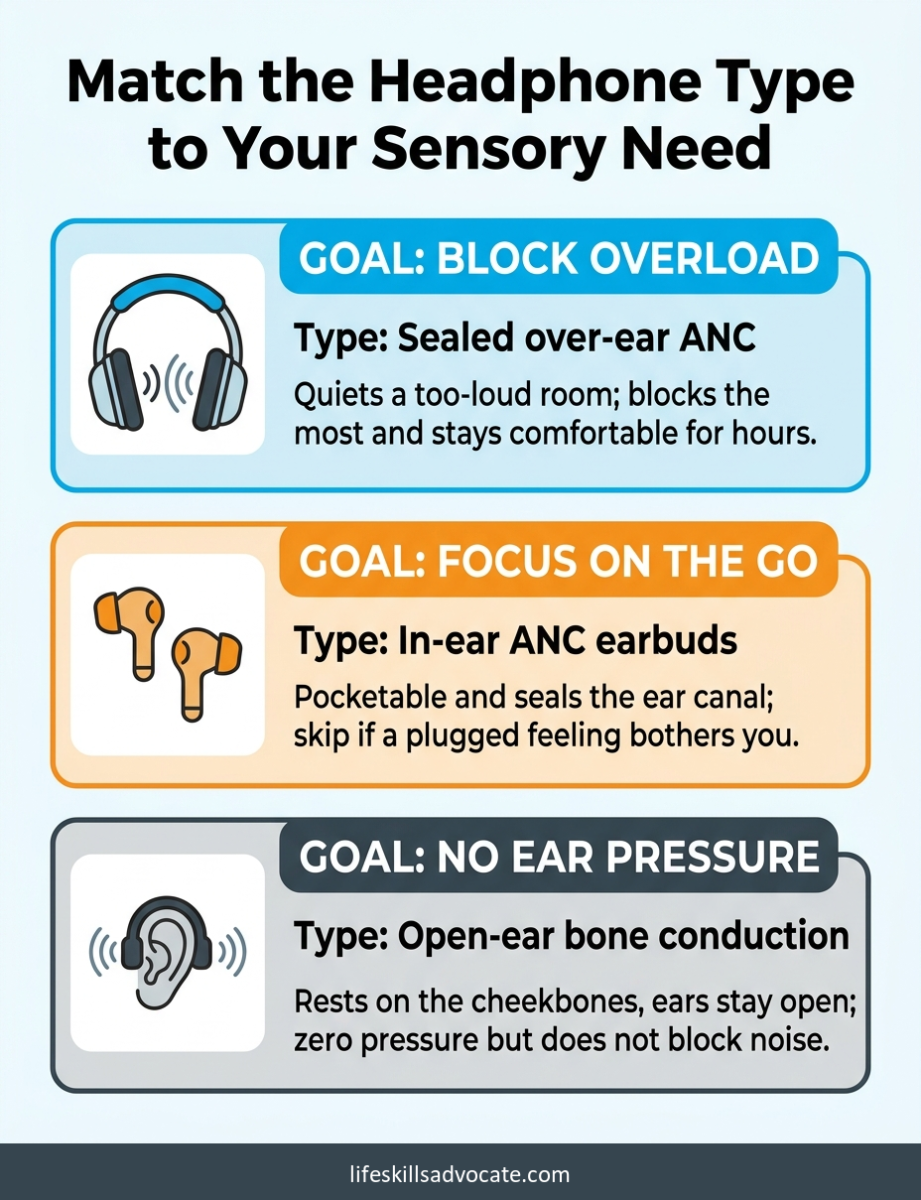
Sealed over-ear ANC cups your whole ear and spreads its pressure around the ear rather than inside the canal. It blocks the most and tends to be the most comfortable for long stretches, though it adds some clamp and can trap heat. This is the default choice for blocking overload.
In-ear ANC sits inside the ear canal and seals it. It is pocketable and blocks well for its size, but that seal is exactly the occluded, plugged-up feeling some sensory-sensitive people dislike. Great for portability, not for everyone’s ears.
Open-ear bone conduction rests on your cheekbones and leaves the ear canal completely open. It adds zero pressure and keeps you fully aware of your surroundings, which is the whole point. The catch is right there in the design: it does not block outside noise at all, so it solves the pressure problem and the awareness problem, not the overload problem.
What to Check Before You Buy
Beyond form factor, a few specs matter more than the marketing. Look for a wired option if you ever want to plug in or avoid battery anxiety. Check the real battery life with ANC switched on. Note the weight and clamp if you wear glasses or plan to keep them on for hours.
And treat manufacturer noise-reduction percentages with a grain of salt. Figures like “reduces up to 95 percent of noise” are marketing claims, not measured lab results. The table below lines up all eight picks on the specs that actually change the decision.
| Headphones | Type | Best sensory fit | Battery (ANC on) | Wired option | Price tier |
|---|---|---|---|---|---|
| Sony WH-1000XM4 | Over-ear ANC, premium | Deepest blocking with all-day comfort | ~30 hours | Yes (3.5mm) | Premium |
| Sony WH-CH720N | Over-ear ANC, mid | Light, near-weightless all-day wear | ~35 hours | Yes (3.5mm) | Mid |
| Soundcore Space One | Over-ear adaptive ANC, value | Best value blocking plus comfort | ~40 hours | Yes (3.5mm) | Budget |
| KVIDIO ANC | Over-ear ANC, budget | Cheapest over-ear blocking | ~40 hours | Yes (3.5mm) | Budget |
| RUNOLIM Hybrid ANC | Over-ear hybrid ANC, budget | Budget blocking with cable in the box | ~40 hours | Yes (3.5mm) | Budget |
| TOZO HT2 | Over-ear hybrid ANC, budget | Longest battery for the price | ~60 hours | Yes (3.5mm) | Budget |
| Soundcore Liberty 4 NC | In-ear ANC earbuds | Pocketable focus on the go | ~10 hours (buds), ~50 with case | No | Mid |
| Shokz OpenRun Pro | Bone conduction, open-ear | No ear pressure, full awareness | ~10 hours | No | Mid |
The 8 Best Noise Cancelling Headphones for ADHD and Autism
These are listed roughly from premium to budget, then by form factor, so you can jump to the tier and shape that fits. Every pick is in stock and was verified in June 2026, and each links to its product page if you want to dig deeper.
1. Sony WH-1000XM4: The Premium Anchor
Sony WH-1000XM4 is the splurge pick, and the one to beat if your main goal is the deepest, most reliable hush you can buy. The active noise cancellation is class-leading. The earcups are plushly padded, with a soft, low-fatigue clamp that holds up over hours. The transparency mode is realistic enough to hear a barista without taking them off. You get around 30 hours of battery, a folding travel design, a 3.5mm cable for wired use, and multipoint pairing. The main tradeoff is the price, plus an older Bluetooth and mic than the newer WH-1000XM5 and a slightly bass-forward sound out of the box. If you want the absolute latest, the Sony WH-1000XM5 and the Bose QuietComfort Ultra are the natural step-ups.
Best for: the reader who wants the strongest, most dependable blocking for overload and will wear them for long focus sessions.
2. Sony WH-CH720N: The Trusted Mid Pick
Sony WH-CH720N brings real Sony noise cancellation and a dedicated ambient-sound button at roughly a third of the flagship price. What makes it stand out for sensory comfort is the weight: at around 192 grams it is genuinely light, with a gentle clamp that disappears during long wear, and the battery runs about 35 hours. It is plastic rather than premium, and the clamp can press a little on glasses-wearers.
Best for: anyone who wants name-brand cancellation and near-weightless all-day comfort without paying flagship money.
3. Soundcore Space One: The Best Value
Soundcore Space One punches well above its price, and it replaces the now-discontinued Life P3i. It pairs adaptive active noise cancellation with an adjustable transparency mode and foam earpads that stay comfortable without the headache some cheaper pairs cause, plus a long 40-hour battery and a wired option. At around 253 grams it is a touch heavier than the Sony CH720N, and the transparency mode is good rather than flagship-grade.
Best for: the reader who wants serious noise blocking and all-day comfort on a budget.
4. KVIDIO Active Noise Cancelling Headphones: The Budget Workhorse
KVIDIO Active Noise Cancelling Headphones are a very-low-cost over-ear option with a huge pile of reviews behind them. The protein-leather earcups are soft and comfortable for long wear, the battery runs around 40 hours with ANC on, and there is a 3.5mm cable in the box. The cancellation is real and noticeable but average in strength, and the maker’s “up to 95 percent” figure is marketing, not a measured result.
Best for: budget-first readers who want functional over-ear blocking for as little money as possible.
5. RUNOLIM Hybrid Active Noise Cancelling Headphones: The Wired-Fallback Budget Pair
RUNOLIM Hybrid Active Noise Cancelling Headphones cover the same budget over-ear territory, with a 3.5mm cable included for a guaranteed wired fallback. The fit is well padded and comfortable for long sessions, and the battery lands around 40 hours with cancellation on. The “reduce up to 95 percent” claim is marketing, and the hybrid ANC is effective for the price rather than flagship-deep.
Best for: readers on a budget who want a wired option in the box without paying more for it.
6. TOZO HT2: The Long-Battery Budget Hybrid
TOZO HT2 is a genuine budget hybrid-ANC over-ear, and it earns its spot by replacing an earlier TOZO model that was passive-only and not actually noise cancelling. Its standout is battery: roughly 60 hours with ANC on, which is a lot of focus time between charges, alongside 40mm drivers and a wired option. The build is clearly budget, and the cancellation, while real, sits below flagship depth.
Best for: readers who want true hybrid ANC and marathon battery life at a low price.
7. Soundcore Liberty 4 NC: The ANC Earbuds
Soundcore Liberty 4 NC are the pick for readers who want pocketable noise cancellation, and they replace the discontinued Catitru earbuds. The adaptive ANC is genuinely strong on low rumble for the price, the buds run about 10 hours and roughly 50 with the case, and four tip sizes make the fit flexible. The real tradeoff is the form factor: sealing the ear canal is the occluded, pressured feeling some sensory-sensitive people dislike, and there is no wired option.
Best for: readers who want compact, take-anywhere ANC and are comfortable with a sealed in-ear fit.
8. Shokz OpenRun Pro: The No-Pressure Open-Ear Pick
Shokz OpenRun Pro is the answer for anyone who cannot tolerate ear pressure. These bone-conduction headphones rest on your cheekbones and leave the ear canal completely open, so there is no occlusion and full awareness of your surroundings. They weigh about 29 grams, last around 10 hours, and carry an IP55 sweat-and-dust rating. The tradeoff is fundamental, not a flaw: because nothing covers your ears, they do not block environmental noise, and the bass is limited.
Best for: autistic and other sensory-sensitive readers who need zero ear pressure and want to stay aware of the room, not sealed off from it.
Getting the Most Out of Your Noise Cancelling Headphones
Buying the right pair is half the work. How you use them is the part that turns a gadget into a real focus-and-regulation tool, and it is where a little executive function strategy pays off.
Keep the volume reasonable. Good cancellation lets you hear your audio at a lower volume, which is easier on your ears over a long day. If you find yourself turning it up to drown out a room, that is a sign the blocking, not the volume, needs to do the work.
Pair them with the right sound for the job. Silence for deep work, a steady background wash if your brain needs occupying, music with no lyrics for routine tasks. Match the input to the task instead of defaulting to the same playlist for everything.
Build in awareness and breaks. Sealed headphones can cut you off from a doorbell, your name being called, or your own body’s cues to move and rest. Plan short breaks, and use transparency mode or an open-ear pair when you need to stay reachable. Headphones are one piece of a calmer setup, alongside the rest of a sensory-friendly environment at home.
Noise Cancellation Terms, Explained
The jargon on headphone boxes can make it hard to tell what you are buying. Here is a glossary, in everyday terms, of what sits behind noise cancelling headphones, so each pick above makes sense.
| Term | What it means |
|---|---|
| Active noise cancellation (ANC) | The core of how most noise cancelling headphones work: microphones sample steady background sound and the headphones play an inverted wave to cancel it. Best on constant low hums like fans or engines, not sudden sounds or voices. |
| Hybrid ANC | Uses microphones both outside and inside the earcup, usually canceling a wider range of frequencies than basic single-microphone cancellation. |
| Adaptive ANC | Automatically adjusts the strength of cancellation in real time to match how loud your surroundings are. |
| Passive isolation | Physical noise blocking from the earcup seal or ear tips, with no electronics. More effective on high-pitched sound and voices than ANC. |
| Transparency (ambient) mode | Pipes outside sound back in through the microphones so you stay aware of your surroundings without taking the headphones off. |
| Bone conduction (open-ear) | Sends sound through the cheekbones to the inner ear while leaving the ear canal fully open, so it adds no pressure and does not block outside noise. |
Frequently Asked Questions
Do noise cancelling headphones actually help with ADHD?
For many people, yes, though it helps to be precise about how. Noise cancelling headphones reduce the steady background noise that pulls attention away or pushes a sensitive system toward overload, which can make it easier to start and stay with a task. They are being formally studied for ADHD, so the focus benefit is best treated as promising rather than proven, and the size of the effect varies a lot from one person to the next. Some people find them most useful for a defined block of focused work rather than all day long. What they do not do is change ADHD itself. They are a support that lowers one common barrier, and they tend to work best alongside other strategies, like a planned environment and clear task structure, rather than carrying the whole load on their own.
Are noise cancelling headphones good for autistic adults and teens?
They can be a real relief for autistic people who experience sensory overload, because lowering the volume of a too-loud environment can head off the spiral toward shutdown. The thing to watch is fit. Sealed over-ear and in-ear models block the most, but the pressure-like sensation of active noise cancellation, and the plugged feeling of in-ear tips, bother some autistic people enough to make them unwearable. If that is you, an open-ear bone-conduction pair gives you a way to manage sound without anything sealing or pressing on your ears. There is no single right answer here, only the one that matches your own sensory profile.
Why do noise cancelling headphones make my ears feel pressure?
That faint pressure or suction feeling is a known side effect of how active cancellation works, like changing altitude on a plane. It is harmless, but for some people it brings on headaches, with no reliable way to know in advance.
What type of noise cancellation is best for sensory issues?
It depends on the issue. If the goal is blocking overload, sealed over-ear ANC blocks the most while spreading pressure comfortably around the ear, which is why it is the usual starting point. If you want portability and do not mind a sealed canal, in-ear ANC works well. And if ear pressure itself is the problem, open-ear bone conduction removes it entirely, at the cost of not blocking noise. Start from what your body can tolerate, then choose the form factor that fits.
Are noise cancelling headphones safe to wear all day?
Generally yes, with two sensible habits: keep the volume moderate, which good cancellation makes easier, and take regular breaks so you stay aware of your surroundings and your own cues to move and rest. Whether all-day, every-day use is ideal over the long run is genuinely an open question, so it is wise to treat them as one tool among several rather than something you never take off.
Next Steps
The most useful move is to narrow before you buy, since the wrong form factor is the most common and most expensive mistake here.
- Name your main goal first. Decide whether you mostly need to block overload or to support focus, because that single answer rules out half the options before you compare a single price.
- Check your pressure tolerance. If sealed earbuds or airplanes have ever made your ears feel off, lean toward open-ear bone conduction and save yourself a return.
- Pair the headphones with other low-cost regulation tools you may already have, like fidget tools for regulation, so sound is one part of a fuller toolkit rather than the only lever.
- If focus and follow-through are a daily struggle that no gadget quite solves, executive function coaching works on the underlying skills, the planning, task initiation, and routines that headphones can support but not replace. Coaching is skill-building and practical, not therapy or medical treatment.
Further Reading
- Differential effects of white noise in cognitive and perceptual tasks – Herweg and Bunzeck, Frontiers in Psychology (2015)
- Noise cancelling headphones for ADHD (registered clinical trial) – ClinicalTrials.gov
- Best White Noise Machines – Life Skills Advocate
- Can Different Colors of Noise Help With Executive Functioning Skills? – Life Skills Advocate
- How to Create a Sensory-Friendly Environment at Home – Life Skills Advocate
- Fidget Tools for Regulation – Life Skills Advocate
- Executive Function Coaching – Life Skills Advocate