
Someone gets called “mind-blind” in the middle of an argument about why a birthday card didn’t land. The accusation hangs in the air. The accused is autistic, the accuser isn’t, and the term feels both technical and weaponized at the same time.
Same scene, three rooms over: a college student tells a Reddit thread they recently learned they have aphantasia, and a stranger replies that aphantasia and mind-blindness are the same thing. The stranger isn’t making it up. CNBC ran a 2019 piece titled “Aphantasia, or mind-blindness” that treats the terms as interchangeable.
Same scene, one professor’s office: a graduate student asks whether “mind-blindness” still belongs in a literature review on autism, given that the underlying theory has been contested for over a decade.
Three different conversations. One word. Six different jobs that word is doing.
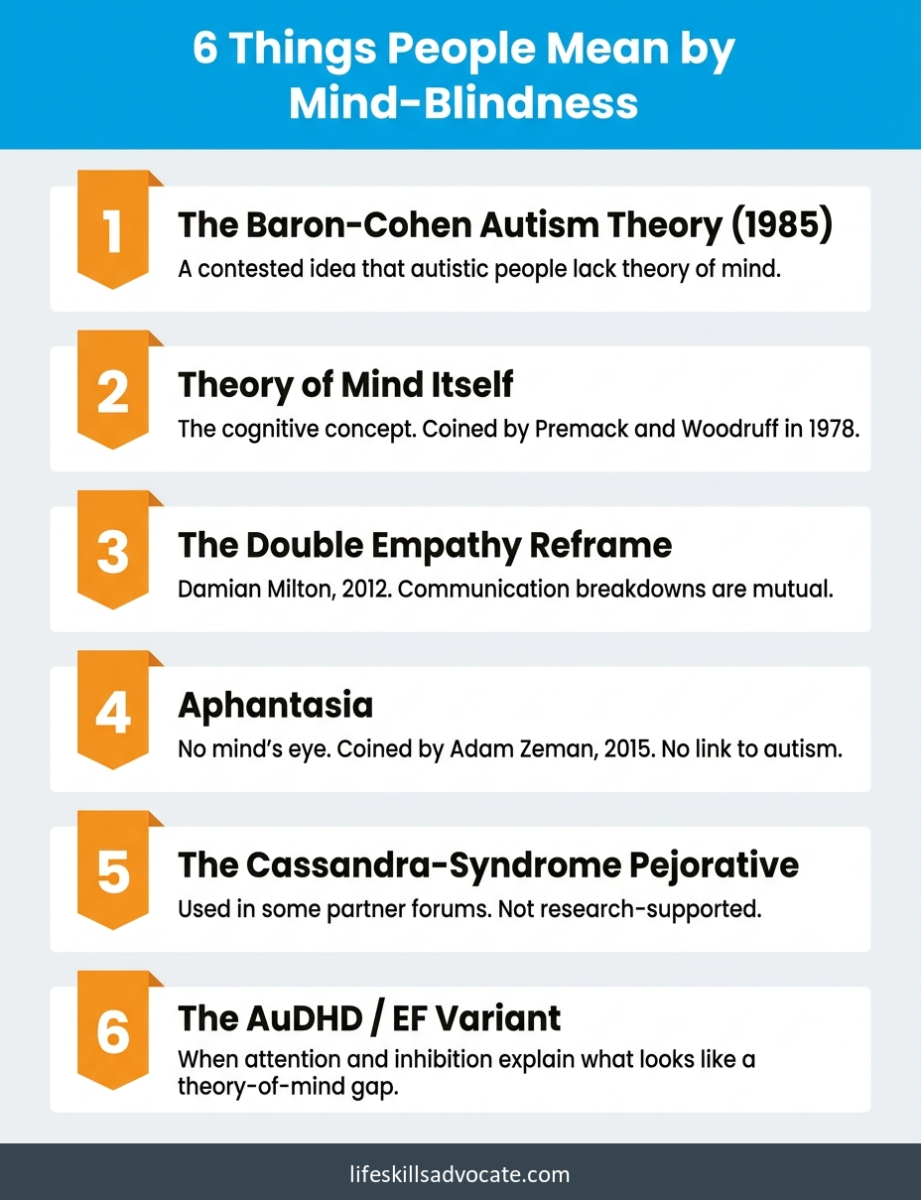
The term has drifted far enough that the only honest answer to “what does mind-blindness mean?” is “which version are you asking about?” Below: six versions, in rough order of how commonly each one shows up, with notes on which are research-current, which are contested, and which were never really about autism in the first place.
TL;DR
Six different things “mind-blindness” has come to mean, and which one applies depends entirely on who’s using the term:
- The Baron-Cohen autism theory from the mid-1980s, a widely contested hypothesis that autistic people lack theory of mind.
- Theory of mind itself, the cognitive concept the contested theory tried to apply to autism.
- Damian Milton’s 2012 double empathy reframe, which argues communication breakdowns between autistic and non-autistic people are mutual.
- Aphantasia, the inability to form mental images. No connection to autism. Popularly called mind-blindness since around 2015.
- The Cassandra-Syndrome pejorative, used in some non-autistic-partner forums as a relational accusation. Not supported by current research.
- The AuDHD or executive-function-mediated version, when attention and inhibition explain what looks like a theory-of-mind gap.
This is educational content drawn from current autism research and ND-community framing. It is not an evaluation tool and does not replace a conversation with a qualified professional who knows your situation.
1. The Baron-Cohen Autism Theory (1985): What Mind-Blindness Was Supposed to Mean
In 1985, Simon Baron-Cohen and his colleagues Alan Leslie and Uta Frith published a study titled “Does the autistic child have a ‘theory of mind’?” in the journal Cognition. The paper introduced what became one of the most cited frameworks in autism research, and it gave us the word mind-blindness in its technical sense.
The study used the now-famous Sally-Anne test. A doll named Sally puts a marble in a basket and leaves the room. While she’s gone, Anne moves the marble to a box. When Sally returns, where will she look for the marble? Children who understand that Sally doesn’t know what Anne did will say “the basket.” Children who don’t grasp that distinction will say “the box,” because that’s where the marble actually is.
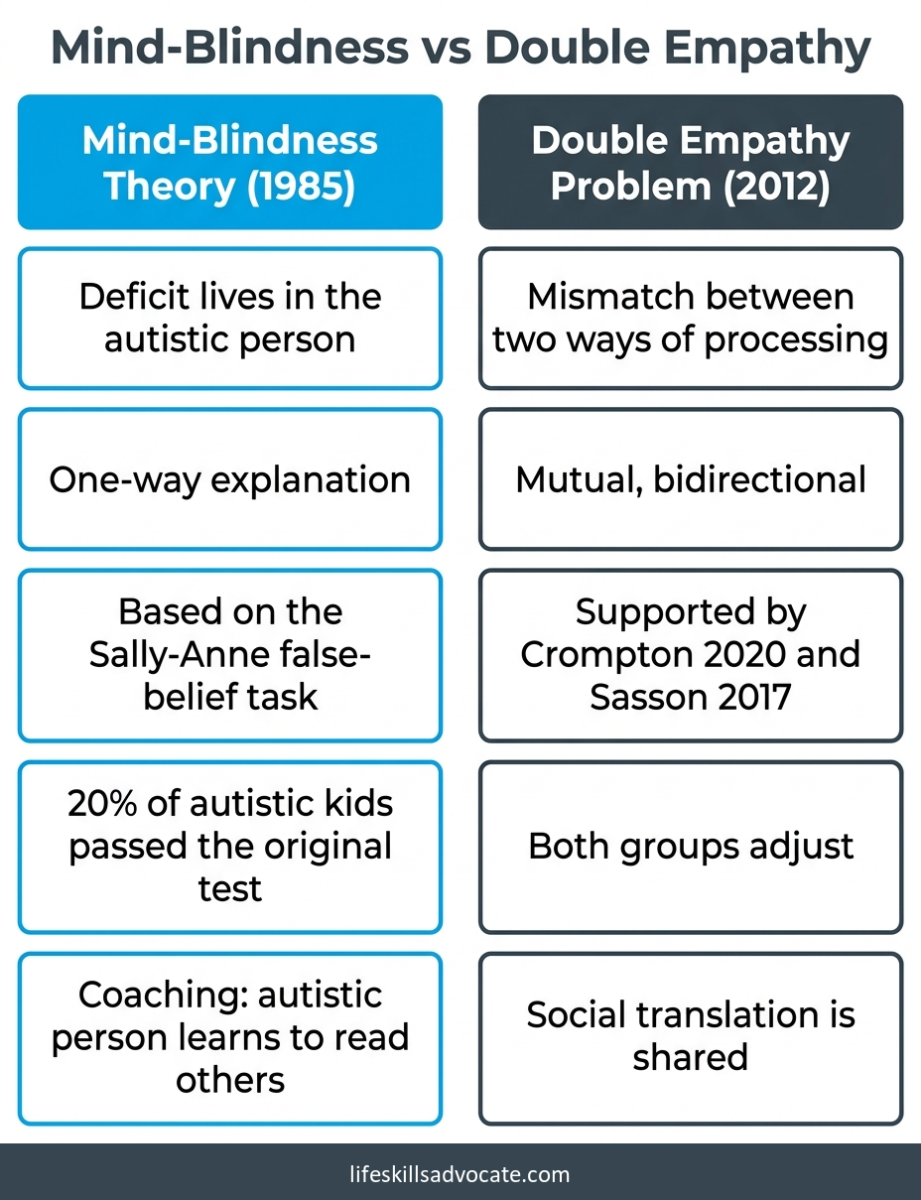
The original sample was small: 20 autistic children, 27 typically developing children, and 14 children with Down syndrome. Four of the 20 autistic children (20%) passed the false-belief task. The two comparison groups passed at 85% and 86% respectively. From those numbers, the research team proposed that autistic people have a fundamental difficulty representing other minds. Baron-Cohen later expanded the argument into a 1995 book, Mindblindness: An Essay on Autism and Theory of Mind.
The theory stuck.
It explained, in one tidy line, why social communication was hard for so many autistic people. It made for clean teacher trainings, parent handouts, and shorthand for professionals across education and psychology.
There was always a problem, though. About 20% of the autistic children in the original 1985 study did pass the false-belief task. Later studies pushed that number higher when the tests were redesigned to remove verbal demands or to give autistic participants more time. The “deficit” the theory named started looking less like a fixed cognitive feature and more like a performance pattern that varied with task design, language ability, and age.
This is the original technical meaning of the term. The next five things on this list emerged because the original theory, in its strongest form, didn’t hold up. The most influential alternative, the double empathy problem, is Thing #3.
2. Theory of Mind: The Underlying Cognitive Concept
Theory of mind, sometimes shortened to ToM, is the cognitive ability to attribute mental states to other people. It’s older than mind-blindness as a concept, and it’s not the same thing. The phrase was coined in 1978 by primatologists David Premack and Guy Woodruff in a paper asking whether chimpanzees can infer goals and intentions in others. Theory of mind was already a well-developed line of inquiry by the time Baron-Cohen’s team applied it to autism in the mid-1980s.
The shorthand confusion runs both ways. People call theory of mind “mind-blindness” when it appears reduced, as if the two terms describe the same thing. They don’t. Theory of mind is a measurable cognitive ability that varies in every population on earth. The Baron-Cohen framing is a particular research hypothesis about how that ability shows up (or doesn’t) in autism. One is a phenomenon. The other is a contested explanation for one slice of it.
The other piece worth holding on to: theory of mind isn’t a single thing. Researchers usually split it into cognitive empathy (inferring what someone is thinking) and affective empathy (feeling what someone is feeling). Autistic adults generally score similarly to non-autistic adults on affective empathy and lower on cognitive empathy in standard lab tasks. Whether that reflects a real difference in capacity or a difference in how each group reads test materials is itself an open question, and one the older framing did not have room for.
3. The Double Empathy Reframe (Milton 2012): The Modern Alternative
The Baron-Cohen framing assumed the deficit ran one way: autistic people struggle to read non-autistic minds. Damian Milton, an autistic sociologist and lecturer at the University of Kent, looked at the same data and asked a different question. What if the gap is mutual?
Milton published “On the ontological status of autism: the ‘double empathy problem'” in the journal Disability & Society in 2012. The core argument: communication breakdowns between autistic and non-autistic people are not a one-sided deficit. They are a mismatch between two different ways of processing social information, and both groups have trouble reading each other.
Two empirical studies have done most of the work to support this. A 2020 “diffusion chain” study by Catherine Crompton and colleagues at the University of Edinburgh, similar in design to the telephone game, found that autistic people pass information accurately to other autistic people, and non-autistic people pass it accurately to other non-autistic people. Mixed chains, where information had to cross between groups, broke down faster. A 2017 paper in Scientific Reports by Noah Sasson and colleagues showed that non-autistic participants formed less favorable first impressions of autistic adults from brief video clips, and were less interested in interacting with them. The “deficit,” in those studies, wasn’t located in any one person. It lived in the cross-group interaction. Both findings line up with what many late-identified autistic adults already say about their own social histories.
The older theory frames the problem as something the autistic person has. Double empathy frames it as something the two people are doing together. That reframe changes who’s responsible for adjusting. Under the older model, autistic people need to be coached to read others better. Under the double empathy model, both parties adjust, and the burden of social translation is shared. Our full breakdown of the double empathy problem works through the practical implications for educators, professionals, and partners.
If the strong form of the older theory was the wrong question, double empathy is the better one. The remaining three things on this list are what happens when people use “mind-blindness” anyway.
4. Aphantasia: When ‘Mind-Blindness’ Actually Means No Mind’s Eye
Most of the people typing “mind-blindness” into a search bar online aren’t asking about autism at all. They’re asking about aphantasia, the inability to form mental images.
Adam Zeman, a cognitive neurologist at the University of Exeter, coined “aphantasia” in a 2015 paper in Cortex. Some people, when asked to picture an apple, see it clearly in their mind’s eye. Others see nothing, just the concept of an apple. The latter group represents an estimated 2-5% of the population. Aphantasia is congenital for most people who have it, and it has no established link to autism, theory of mind, or social cognition.
The naming overlap is unfortunate. Lifestyle coverage in outlets like Time and CNBC began calling aphantasia “mind-blindness” in the mid-2010s, after Zeman’s term gained traction. The Cambridge Dictionary now defines mind-blindness as “a condition in which someone is unable to form pictures in their imagination.” Cambridge is talking about aphantasia. Baron-Cohen was talking about autism. Both are using the same word.
If a search for “mind-blindness” landed someone on this article and they actually meant aphantasia, the question is settled here. Otherwise: aphantasia and the autism theory share a name and almost nothing else.
| Term | Common-usage definition | Autism research view | Verdict |
|---|---|---|---|
| Mind-blindness (autism theory) | Autistic people can’t read other minds | The 1985 Baron-Cohen hypothesis. About 20% of autistic children passed the original false-belief task. Replication and reframing have weakened the unilateral-deficit reading since 2012. | Contested. Most current researchers prefer double empathy framing. |
| Theory of mind | Reading what other people think and feel | A real, measurable cognitive ability. Coined by Premack & Woodruff in 1978. Distinct from mind-blindness. | Established concept. Not synonymous with mind-blindness. |
| Double empathy problem | Autistic and non-autistic people misread each other | Milton’s 2012 reframe. Supported by Sasson 2017 first-impressions and Crompton 2020 information-transfer studies. | Current. Replaces mind-blindness as the working model for many researchers. |
| Aphantasia | “Mind-blindness” used to mean no visual imagination | Coined by Zeman in 2015. Estimated 2-5% prevalence. No established link to autism or theory of mind. | Separate condition. Shared name only. |
5. The Cassandra-Syndrome Pejorative: When a Partner Uses ‘Mind-Blind’ As an Insult
Outside autism research, the phrase “mind-blind” has a parallel life in a specific subset of online forums for non-autistic partners of autistic people. The phrase frequently appears alongside “Cassandra Syndrome” or “Affective Deprivation Disorder,” labels created within those communities for the experience of feeling emotionally unmet in a mixed-neurotype relationship.
Cassandra Syndrome is not a recognized condition in autism research. It does not appear in the DSM. It does not appear in mainstream peer-reviewed autism literature. The framing is rejected by major autism-led advocacy organizations, including the Autistic Self Advocacy Network. The concern is straightforward: the language frames autistic partners as the problem, and casts the relational difficulty as something the autistic person is doing to the non-autistic one. It is a one-directional story in a relationship dynamic that, by the 2020 Crompton evidence, is bidirectional.
What to do if someone uses “mind-blind” against you in a personal context is its own question. The honest answer: the term, used that way, is a relational accusation, not a research finding. It might be naming a real moment of mismatch (you didn’t catch what your partner needed, or vice versa), but the double empathy reframe is the more accurate description of what was happening in that moment. The same kind of functioning-label critique applies here that we’ve made about “high-functioning”: shorthand labels often do more for the person using them than for the person being described.
6. The AuDHD / EF-Mediated Variant: When Attention and Inhibition Are Doing the Work
In its strongest form, the Baron-Cohen theory was supposed to be a fixed deficit specific to autism. The AuDHD reading is different. Research on adults with ADHD suggests that what looks like a theory-of-mind difficulty in everyday social interaction is often a downstream effect of executive function challenges, especially attention and inhibitory control. When researchers statistically control for these EF measures, the apparent theory-of-mind gap shrinks or disappears.
This matters for two reasons.
First, for AuDHD adults, the part of “mind-blindness” that might actually describe a real moment-to-moment experience is executive function, not social cognition. Missing a partner’s facial cue because attention was on the dishwasher, or interrupting because inhibition was thin that day, isn’t about not understanding minds. It’s about real-time processing capacity under load. Naming what’s actually happening makes the conversation about it cleaner. The follow-up usually looks more like managing cognitive overload and overwhelm than working on perspective-taking.
Second, for non-autistic, non-ADHD partners or coworkers reading this: if the friction in your relationship looks like inconsistent attention rather than inability to take perspective, the framing changes what helps. “You don’t understand me” becomes “the conditions for understanding weren’t there.” That’s an EF issue, typically addressed with environmental adjustments and tolerable demand levels rather than empathy coaching.
The research base for this cross-condition framing is still growing, and the field has not converged on a single account of how ADHD-related EF differences interact with autistic social cognition. Intolerance of uncertainty tends to show up alongside the EF pattern in AuDHD adults and adds another layer the older theory was never designed to capture.
Frequently Asked Questions
Is mind-blindness the same as aphantasia?
No. Aphantasia is the inability to form mental images. Mind-blindness, in autism research, refers to a contested hypothesis about theory of mind. They share a popular name and almost nothing else.
If I’m AuDHD, does mind-blindness still apply to me?
Not in its original form. Research on ADHD and theory of mind suggests that apparent perspective-taking difficulties shrink or disappear once attention and inhibition are statistically controlled for. For AuDHD adults, the moments that look like the old framing in daily life are usually executive function challenges (attention slipped, working memory was full, response inhibition was low) rather than a structural inability to understand others. Naming the actual mechanism gives you more useful options than the older deficit framing did.
My partner says I’m mind-blind. Is that fair?
The short answer: maybe in a small sense, definitely not as a global label. “Mind-blind” used as a relational accusation isn’t a research finding. It can name a specific moment of mismatch (a tone you didn’t catch, a context you didn’t read), but it generalizes that moment into a trait, and current research doesn’t support that generalization. The double empathy framing is more accurate (something between the two of you broke down, not something defective in one of you) and tends to lead to conversations that move somewhere. Whether your partner is being fair in any given exchange isn’t something a research blog can answer. That’s a conversation, not a question with a clean answer.
Should I correct people who use the term ‘mind-blindness’?
Depends on context. In academic settings, “the field has moved on from the strong form of that theory” usually lands. In casual conversation, asking which version the speaker means does more useful work than a correction. When a partner uses it as an accusation, asking what specific moment they’re naming usually moves things forward better than relitigating the word.
What to Do With This
None of the six things on this list change what to do today. They do change which framing is worth reaching for when the term comes up in your life.
- If the double empathy reframe is what hooked you, our full breakdown of the double empathy problem works through how the model lands in actual relationships and schools.
- For AuDHD friction in particular, the part of mind-blindness worth naming is usually the executive function side. Our Real-Life Executive Functioning Workbook works through attention, working memory, and inhibition with prompts you can do in ten or fifteen minutes a day.
- For professionals and educators, the references in the citability table above (Milton 2012, Crompton 2020, Sasson 2017, Zeman 2015) are the current research base for the modern framing. Worth reading directly rather than secondhand.
Further Reading
- Does the autistic child have a “theory of mind”? – Baron-Cohen, Leslie & Frith, Cognition (1985)
- Does the chimpanzee have a theory of mind? – Premack & Woodruff, Behavioral and Brain Sciences (1978)
- On the ontological status of autism: the “double empathy problem” – Milton, Disability & Society (2012)
- Neurotypical Peers are Less Willing to Interact with Those with Autism based on Thin Slice Judgments – Sasson et al., Scientific Reports (2017)
- Autistic peer-to-peer information transfer is highly effective – Crompton et al., Autism (2020)
- Lives without imagery: Congenital aphantasia – Zeman et al., Cortex (2015)
- Aphantasia, or mind-blindness: Christina Farr describes her experience – CNBC (2019)
- The Double Empathy Problem – Life Skills Advocate
- High Functioning ADHD – Life Skills Advocate
- Understanding Autistic Meltdowns – Life Skills Advocate
- Intolerance of Uncertainty in Autism – Life Skills Advocate
- Real-Life Executive Functioning Workbook – Life Skills Advocate