
If a rescheduled meeting flattens the rest of your day, or an autistic kid melts down over a grocery run that went off-script, the instinct is to call it overreaction. That read is wrong. What you are seeing has a name in the research literature: intolerance of uncertainty in autism. It is a well-documented cognitive pattern, not a character flaw and not a parenting failure.
The academic side of this has been thoroughly studied since the late 2010s. The daily-life side has not. Reading a meta-analysis rarely tells you what to do at 7:42 a.m. when the schedule just shifted and someone in your house is dysregulated.
The goal here is something you can use on a Wednesday morning, not another abstract. Research gets pulled in where it genuinely helps, not to perform expertise. The focus stays on the pattern itself, why it shows up so heavily in autism, and the specific everyday moves that make it more workable.
TL;DR
If small changes in plans send you (or your autistic teen) into a disproportionate spiral, intolerance of uncertainty in autism is the pattern that has a name.
- Intolerance of uncertainty is a strong negative reaction, emotional and cognitive and behavioral, to situations where the outcome cannot be predicted. It runs higher in autistic people and is one of the strongest predictors of autism-related anxiety.
- Predictive-processing differences, monotropic attention, and constant sensory load each raise the cost of unexpected change. They stack.
- Day to day, it shows up as intense distress at last-minute changes, heavy reliance on routines, repeated requests to confirm the plan, and meltdowns or shutdowns when the unknown drags on.
- Naming the specific unknown, advance notice with real detail, structured practice with small uncertainties, sensory regulation, and programs like CUES or executive function coaching widen the window of what’s bearable. None of this aims to erase the trait.
A note before we get into it: this is educational, not a professional evaluation or a substitute for working with a therapist, occupational therapist, or coach who knows the person involved. Use it to inform those conversations, not replace them.
What Intolerance of Uncertainty in Autism Actually Means
Intolerance of uncertainty in autism has a specific research footprint, but the underlying construct didn’t start there. It originated in the generalized anxiety literature: the tendency to react strongly, and often badly, to situations whose outcome cannot be predicted. The response shows up across emotion (dread, anxiety), cognition (repetitive planning, worst-case loops), and behavior (avoidance, repeated requests for confirmation, refusal).
The pattern reads as four separate problems.
It is one mechanism.
A small example and a structural one clarify what that mechanism looks like. A meeting gets rescheduled: the dread isn’t about the new meeting, it’s about the unknown new time and everything attached to it. A medical test sits in the queue: the waiting period is harder than most results end up being. The common thread in both is not-knowing.
Where the Term Came From
Intolerance of uncertainty originated in the generalized anxiety literature, not the autism literature. Buhr and Dugas introduced it in the early 2000s as a cognitive style found across several anxiety patterns. Non-autistic people experience it too. What differs in autism is intensity, baseline level, and how easily a small shift sets the reaction off.
This matters because calling the reaction universal is useful. It removes the implication that the autistic brain is doing something pathological. The autistic brain is doing a recognizable thing more strongly.
Why It Stood Out in Autism Research
A 2020 systematic review and meta-analysis pulled together evidence from ten studies on intolerance of uncertainty in autism. Nine of those studies showed a significant positive correlation between intolerance of uncertainty and anxiety, with a large overall effect (r around 0.62). Effect sizes like that are unusual enough to get researchers’ attention.
That is also when the research moved from “autistic people seem to struggle with change” to naming the underlying cognitive pattern. The picture connects directly to the executive functioning skill of flexibility, which is not a willpower issue but a cost-of-switching issue. When switching is already expensive, unpredictability stacks more cost on top.
What It Looks Like Day to Day
On paper, intolerance of uncertainty in autism reads like a concept. In a house, a classroom, or a Monday-morning office, it reads like a pattern of behaviors that tend to get misread as stubbornness, attitude, or oversensitivity. The actual trigger is almost never the thing someone is visibly reacting to.
A few everyday scenes usually make it click: an autistic adult whose shift just got changed mid-day and now can’t tell if their evening is usable; a teen who keeps asking whether grandparents are really coming Sunday; a kid who refuses to try a new restaurant because the menu, the noise, the seating, and the parking are all unknowns at once; a colleague who asks the same question about a project deadline three times in a week.
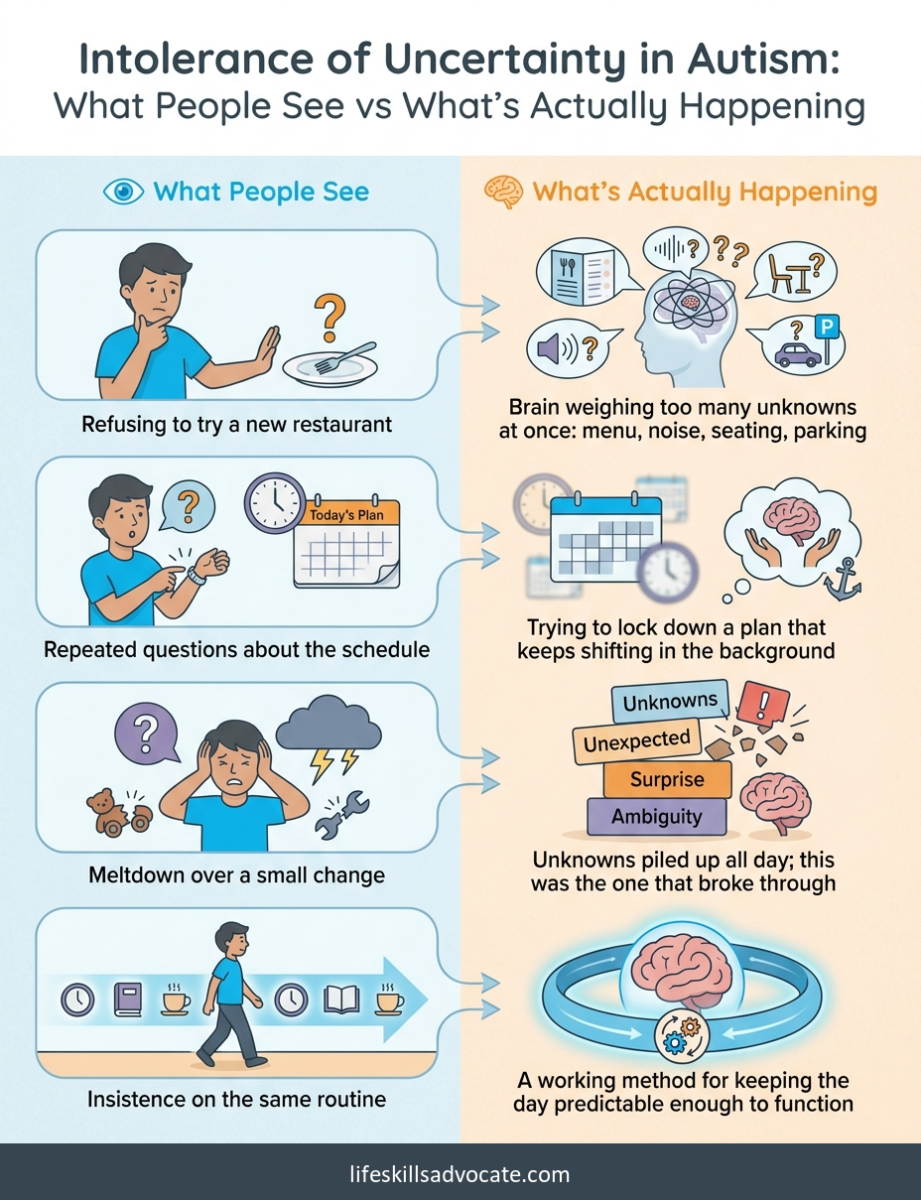
The same pattern shows a different surface shape depending on who is experiencing it. The inside is usually identical: a pile of unresolved sub-questions the brain cannot drop. A two-column read-through helps separate what other people see from what is actually going on.
| What people see | What's actually going on |
|---|---|
| Refusing to try a new restaurant | Brain weighing too many unknowns at once: menu, noise, seating, parking |
| Repeated questions about the schedule | Trying to lock down a plan that keeps shifting in the background |
| Meltdown over a small change | Unknowns piled up all day; this was the one that broke through |
| Insistence on the same routine | A working method for keeping the day predictable enough to function |
Once the mechanism is visible, the reaction stops looking random. The person isn’t refusing the restaurant; they are declining to take on four unknowns in exchange for a meal. The teen isn’t being annoying; they are trying to lock down a plan that keeps shifting in the background. The behavior is the tip.
The cost is underneath.
Why Intolerance of Uncertainty Hits Autistic Brains Harder
Intolerance of uncertainty in autism is most likely not one mechanism but three overlapping ones. A related contradiction shows up in novelty versus sameness anxiety in ADHD and OCD, where OCD demands sameness while ADHD chases novelty in the same brain. The research community is tracking three accounts that are not mutually exclusive, which is why one-note advice (“just expose them to more change”) tends to miss.
They stack.
How Predictive Processing Works
One leading theory is the predictive-processing account. Brains are forecasting machines; they build models of what should happen next, then compare incoming input to those models. The gap between prediction and reality is what drives updates and, when it is large, discomfort.
In this account, autistic brains may weight prior expectations differently when forecasting outcomes, so the gap between “what I expected” and “what happened” lands bigger than it would for a non-autistic brain. A 2024 paper in Scientific Reports by Shi and colleagues extends the same thread, linking autistic traits to a cognitive style called dichotomous thinking (seeing outcomes in all-or-nothing terms) by way of intolerance of uncertainty. This remains a theoretical model with growing empirical support, not a settled fact. The qualifier matters because it shapes how the advice lands downstream.
Monotropism and Attention Tunnels
Monotropism is the theory, developed by Murray, Lesser, and Lawson, that the autistic attentional style is narrow and deep. An autistic person’s attention tends to commit fully to one thing, rather than spreading thin across a wider field. That commitment is a feature, not a bug. It is why autistic people can focus so intensely on something genuinely interesting.
The cost of that style is the cost of being pulled out of an attention tunnel by something unexpected. The interruption is not just annoying; it is genuinely expensive. This connects to the experience of autistic inertia and the cost of switching tasks, where starting is hard, stopping is hard, and switching costs the most. An unexpected change is always a forced switch.
Sensory Load Sets the Floor
The third factor is the one people underestimate most. Autistic nervous systems are often already processing more sensory information per second than non-autistic ones: lights that would sit in the background stay in the foreground, sounds that would blend in stay distinct. That is the baseline, not a bad day.
That baseline leaves less spare capacity for unknowns. A 2021 study in Frontiers in Psychology by Normansell-Mossa and colleagues found that sensory sensitivity and intolerance of uncertainty each independently predicted anxiety in autistic adults, meaning you cannot treat one and expect the other to resolve. The system is not adding noise to noise; it is running out of headroom.
The Link to Anxiety, Meltdowns, and Burnout
Intolerance of uncertainty in autism rarely stays in its own lane. It connects forward into acute events (anxiety spikes, meltdowns, shutdowns) and into slower-moving ones (chronic stress, autistic burnout). The path from one to the other is rarely dramatic. It is usually a week of small unknowns that never quite resolved, a meeting that kept shifting, a text that never came.
Is It the Same as Anxiety?
No. They overlap and they feed each other, but they are different things. Anxiety is the sustained worry response. Intolerance of uncertainty is the upstream cognitive style that finds not-knowing intolerable in the first place. In a 2018 study, Vasa and colleagues found that intolerance of uncertainty in autistic youth was elevated even when anxiety was statistically removed from the equation. That is one reason current models treat it as a driver of autism-related anxiety, not a synonym for it.
The acute path is familiar. A plan gets cancelled, the unknowns pile up, sensory load spikes, and the system hits threshold. What follows is often read as what’s actually happening in an autistic meltdown (or a quiet shutdown, which gets misread as “fine”). Both are a nervous system out of capacity, not a choice.
The chronic path is harder to spot. Months of low-grade uncertainty (an unpredictable work schedule, shifting social rules, a house that runs on “we’ll see”) quietly drain capacity. The recognizable end state is autistic burnout, and the signs of neurodivergent burnout to watch for are routinely confused with depression. Uncertainty load is often part of what tipped the system past its line.
Quick Reference: Intolerance of Uncertainty in Autism
A compact, sourced reference on intolerance of uncertainty in autism that other writers and researchers can quote directly.
| Term | Definition | Source |
|---|---|---|
| Intolerance of uncertainty in autism | The tendency to react strongly (emotionally, cognitively, behaviorally) to situations whose outcome cannot be predicted. Elevated in autistic people compared to non-autistic comparison groups. | Jenkinson et al., 2020 (Autism) |
| How common in autism | Across 10 studies in the 2020 meta-analysis, autistic people scored significantly higher on intolerance of uncertainty than non-autistic peers, and the correlation with anxiety was large (r around 0.62). | Jenkinson et al., 2020 meta-analysis |
| Insistence on sameness | Reliance on routines and familiar arrangements. Visible behavior frequently driven by underlying intolerance of uncertainty. | Bird et al., 2024 systematic review |
| CUES program | Coping with Uncertainty in Everyday Situations: the first manualized program built specifically for autistic people who struggle with uncertainty. Evidence is feasibility-stage as of 2024. | Rodgers et al., 2018 |
What Helps: Practical Approaches for Uncertainty in Autism
What helps intolerance of uncertainty in autism, in one sentence: anything that makes a specific unknown more known, shrinks sensory load, or builds practice with small uncertainties in safe settings. The rest is which of those to reach for, in what order, and who is doing the reaching.
For the Person Themselves
Name the specific unknown. “I am anxious” is harder to work with than “I don’t know when the appointment rescheduled to, and I don’t know if that eats the gym hour I was counting on.” Writing the unknowns down in a notebook app or on a sticky note tends to shrink the pile, because half of what feels overwhelming is actually just not-yet-counted.
Practice with low-stakes uncertainty is a different lever. The goal is not desensitization, which usually reads as pressure. It is building evidence that not-knowing can pass through without disaster.
Board games with random elements, a flexible weekend slot, a meal where you pick the restaurant on the way: small, survivable, repeated. There are cognitive flexibility approaches you can experiment with on this front, one at a time rather than all at once.
For the People Around Them
Vague reassurance often makes things worse. “It’ll be fine” does not address the specific unknowns; it asks the other person to trust that an unnamed situation will resolve favorably, which is the very thing the cognitive style resists. A more useful move is to name what is known, what is not known, and when the unknown might resolve. “We know dinner is at six. We don’t know yet if Sam is coming. I’ll text them now and have an answer by four.”
For parents, this is also where “should I push or accommodate?” comes up. The usable answer is usually both, at different volumes. Accommodate the current week (remove unknowns where you can). Build small practice with uncertainty in low-stakes moments when the system has capacity. Do not treat accommodation as failure; it is what keeps capacity intact so the practice windows exist at all.
For the Environment (School, Work, Home)
Predictability can be engineered into a setting without treating it as a personal concession. Advance notice with real detail, printed or digital schedules, visible transition warnings, and “if-then” planning (if the field trip is cancelled, then we do this instead) build predictability into the environment itself, which reduces cognitive load for everyone and disproportionately helps autistic kids and adults. Classrooms and workplaces that already do this routinely tend not to need a separate “autism accommodation” conversation.
Transitions are a specific high-cost moment and deserve their own pass. If you are supporting an autistic adult through work changes, relocations, or shifting routines, 20 transition approaches for autistic adults collects practical moves grouped by situation.
What the CUES Program Actually Is
CUES stands for Coping with Uncertainty in Everyday Situations. It is the first intervention program built specifically for autistic people who struggle with uncertainty, developed in the UK by Rodgers and colleagues. The original 2018 single-case study showed feasibility in autistic adults, and versions for children and families have since run feasibility trials, documented through Autistica’s coping-with-uncertainty project page.
Honest scope matters here. CUES is feasibility-stage evidence, not randomized-controlled-trial evidence. Most of the practitioner approaches above (advance notice, visual schedules, processing time) sit in the same category: widely used, consensus-backed, but tested less rigorously than “evidence-based” sometimes implies.
That is not a reason to skip them. It is a reason to stay honest about what is known and what is still being worked out.
Where Coaching, Therapy, and Other Supports Fit
Is this something to handle alone? Sometimes, yes. For a lot of autistic adults and families, reading a piece like this and applying a few specific moves is enough. When it isn’t, the options are not interchangeable, and the difference is worth knowing before you pick one.
Therapy (particularly with a therapist experienced with autistic adults) is the right fit when anxiety is the presenting problem or when past invalidation has piled up into something heavier. Occupational therapy can help when sensory load is the dominant factor. Executive function coaching, separately, is where a lot of the practical-support work lives: building systems around uncertainty, setting up planning practices, and making the day more workable rather than managing the emotional aftermath. Coaching is educational, not mental health treatment. When both are needed, they work alongside each other, not in place of each other.
Frequently Asked Questions
Is intolerance of uncertainty in autism the same as anxiety?
No. They overlap and they fuel each other, but they are different things. Anxiety is the sustained worry response. Intolerance of uncertainty is the cognitive style that finds not-knowing intolerable in the first place. Intolerance of uncertainty in autism appears to be elevated even when researchers statistically remove anxiety, which is why current models treat it as one of the upstream drivers of autism-related anxiety rather than a synonym for it.
Can intolerance of uncertainty in autism be reduced or treated?
The honest answer is “it depends what you mean by reduced.” Programs like CUES (Coping with Uncertainty in Everyday Situations) have shown feasibility in small studies and are the first interventions designed specifically for this. Cognitive flexibility work, sensory regulation, and structured practice with small uncertainties all appear to help. The goal most autistic adults find sustainable is not to make intolerance of uncertainty disappear; it is to widen the window of uncertainty that’s bearable, while building the supports that catch the rest. Whether that counts as “reduced” depends on what you wanted in the first place.
Why do small changes in plans cause such a big reaction?
The size of the change is rarely what drives the size of the reaction. The cost is in the unknowing itself. A rescheduled meeting opens dozens of unresolved sub-questions: when, where, with whom, whether the new time wrecks the rest of the day. For an autistic brain already tracking extra sensory input and social cues, that pile of micro-unknowns lands heavier than on a non-autistic brain. The plan didn’t break; the predictability did.
How is intolerance of uncertainty different in autism vs ADHD?
ADHD often pairs with novelty-seeking, so unpredictability can feel energizing. Autism more often pairs with intolerance of uncertainty, where the same unpredictability is costly. In AuDHD profiles, both can run at once, which can look like inconsistency but is two real patterns in tension.
How can I help my autistic child or teen with intolerance of uncertainty in autism?
Three things tend to make the biggest difference. First, name the specific unknown rather than the general anxiety: “you don’t know yet whether your friend is coming” is more workable than “you’re being anxious again.” Second, give advance notice with the detail you actually have, including the parts you don’t know yet; vague reassurance often makes things worse. Third, build in regular practice with very small uncertainties in low-stakes settings (a board game with a random element, a flexible weekend slot), so the brain gets evidence that not-knowing can pass through without disaster. Punishing the reaction never works; it adds shame to an already costly experience. The work is slow and the wins are often quiet, but repeated low-stakes reps are what change the baseline over weeks and months.
Next Steps
Intolerance of uncertainty in autism doesn’t get smaller by being told to relax. It gets more workable when the people around it stop treating it as oversensitivity and start treating it as a real cognitive pattern.
- Naming the unknown. Pick the one recurring uncertainty in your week (the Sunday-night dread about the schedule, the half-known pickup time, the unread email) and write down what specifically you don’t know. That act alone is half the work.
- Read one of the adjacent pieces you needed in this one: the transition piece if transitions are the current trigger, or the cognitive flexibility piece if the pattern is chronic.
- If you want outside support on the practical side, executive function coaching from Life Skills Advocate focuses on building the scaffolding around uncertainty rather than treating the emotional experience.
- Start with the free assessment if you’re not sure where to begin: our free executive functioning assessment gives you a short read on which areas tend to be most load-bearing right now.
Further Reading
- Is Intolerance of Uncertainty Associated With Anxiety in Autism Spectrum Disorder and Children With Conditions of Intellectual Disability? – Jenkinson et al., 2020 (Autism)
- Relationships Between Anxiety and Intolerance of Uncertainty in Autism Spectrum Disorder – Vasa et al., 2018 (Journal of Autism and Developmental Disorders)
- Sensory Sensitivities and Intolerance of Uncertainty as Predictors of Anxiety in Autistic Adults – Normansell-Mossa et al., 2021 (Frontiers in Psychology)
- A Systematic Review of Intolerance of Uncertainty and Restricted and Repetitive Behaviours in Autism – Bird et al., 2024
- Coping With Uncertainty in Everyday Situations for Autistic Adults: A Single-Case Experimental Design Feasibility Study – Rodgers et al., 2018
- Coping With Uncertainty Project Page – Autistica
- Autistic Traits, Dichotomous Thinking, and Intolerance of Uncertainty – Shi et al., 2024 (Scientific Reports)
- Executive Functioning Skills 101: Flexibility – Life Skills Advocate
- Practical Ways to Work With Autistic Inertia – Life Skills Advocate
- Understanding Autistic Meltdowns – Life Skills Advocate
- 9 Clear Signs of Neurodivergent Burnout – Life Skills Advocate
- 20 Autism Transition Approaches for Adults – Life Skills Advocate
- 7 Cognitive Flexibility Approaches to Try – Life Skills Advocate
- Executive Function Coaching – Life Skills Advocate
- Free Executive Functioning Assessment – Life Skills Advocate