
You sit down to start something, you know exactly what it is, and your body just does not move. The email is two sentences. The dishes would take ten minutes. You are not confused about what to do, and you are not lazy, but you cannot get yourself to begin.
That stuck place has a name. Task paralysis is the can’t-start freeze: you want to begin, the task matters to you, and you still cannot make the first move. It shows up often for ADHD and autistic brains, and it is not a willpower problem.
According to Medical News Today’s overview of task paralysis, the sticking point is starting the task rather than the task itself. That points straight at task initiation, one of the executive functions the brain uses to get a plan moving.
Most of what helps is surprisingly small, and almost none of it is “try harder.” Once you can see the freeze for what it is, a stalled start rather than a character flaw, the moves that break it get much easier to reach for.
TL;DR
Task paralysis is the can’t-start freeze, and small mechanical nudges break it far better than willpower does. Here is the short version:
- What the freeze actually is, and why it is an initiation issue rather than a character flaw
- How it differs from procrastination and from overwhelm, which each need a different first move
- Eight ways to unstick a frozen start, from shrinking the day and micro-stepping to timer starts, body doubling, and momentum
- What to do when the freeze shows up most days, and where support fits
This is educational, not medical or diagnostic advice. If you are working on this with a professional, use it alongside that conversation rather than instead of it.
What Task Paralysis Actually Is
The freeze is the gap between wanting to do something and being able to begin it. The intention is there. The first physical action is not.
The cleanest way to understand it is as a breakdown in task initiation, the executive function skill that turns “I should” into “I am doing it now.” When that skill stalls, even a tiny job can feel welded to the floor. The size of the task is not the issue. The starting is the issue.
This is also why “just do it” advice lands so badly. The freeze is not a missing desire to act or a missing plan. It is the launch sequence failing to fire, and treating that as laziness only adds shame on top of a stall.
The task version is one slice of a bigger pattern. If you want the wider view of how the freeze shows up across mental, choice, and task overload, our guide to the three types of ADHD paralysis maps the whole territory. This article stays on the can’t-start freeze, and how to break it.
Task Paralysis vs Procrastination vs Overwhelm
These three get lumped together constantly, and they need different responses, so the distinction is worth a minute.
Procrastination is active avoidance. You have the capacity to start, and you steer your attention somewhere easier or more pleasant instead. Task paralysis is the opposite experience: you are not running toward something fun, you are frozen in place, wanting to start the very thing you cannot begin. Overwhelm is a third state, where too much is landing at once and the system shuts down rather than picking a lane.
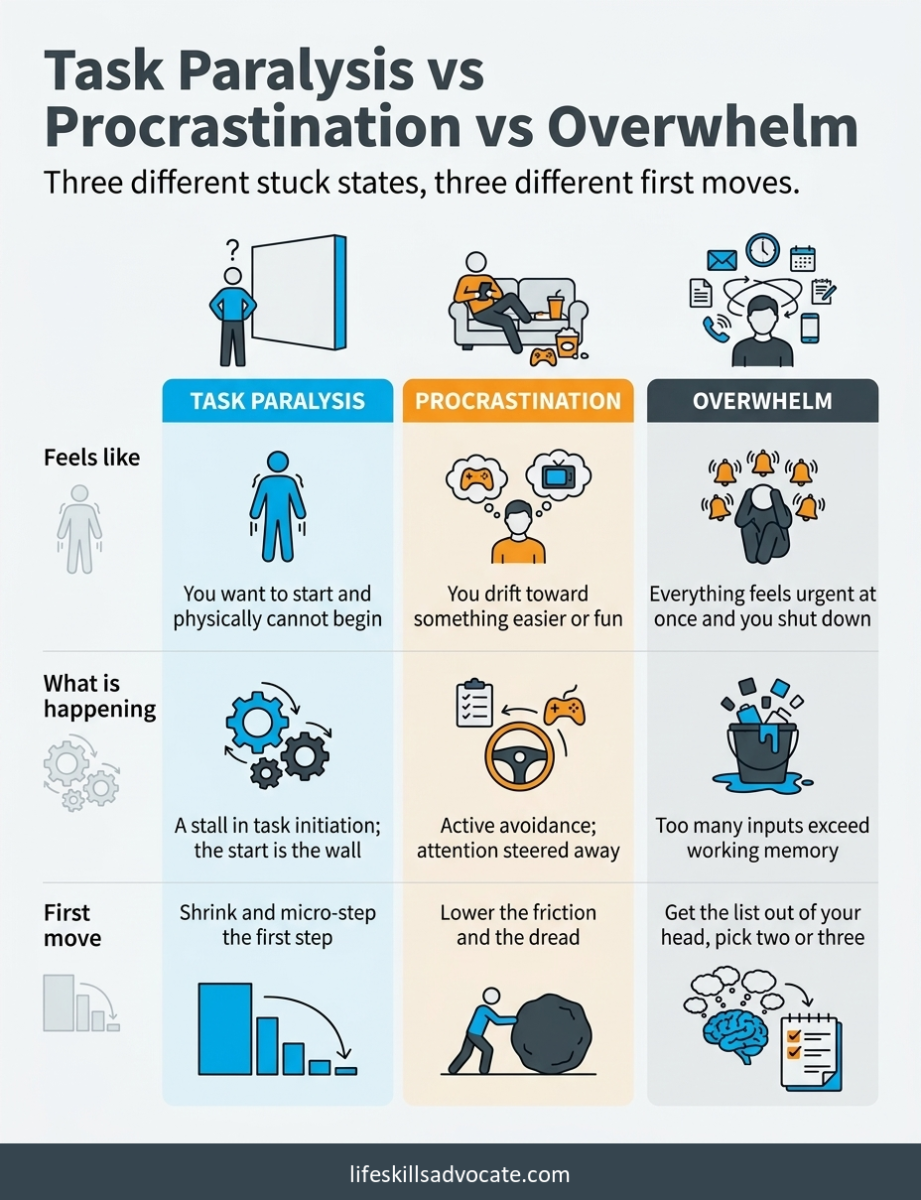
| State | What it feels like | What is really going on | What helps first |
|---|---|---|---|
| Task paralysis | You want to start and physically cannot begin | A stall in task initiation; the start itself is the wall | Shrink and micro-step the first move |
| Procrastination | You drift toward something easier or more fun | Active avoidance; attention gets steered away | Lower the friction and the dread around the task |
| Overwhelm | Everything feels urgent at once and you shut down | Too many inputs exceed working memory at once | Get the list out of your head, then pick two or three |
The line between them is not always clean, and a single bad afternoon can hold all three. If overwhelm is your usual entry point into the freeze, our tips on taking control of ADHD overwhelm pair well with what follows. If you tend to slide into avoidance instead, the science of procrastination digs into why.
Why Your Brain Freezes
Why does task paralysis turn a two-minute job into something physically impossible to start? Part of the answer is how ADHD and autistic brains generate the spark to begin.
Getting started takes activation, a kind of internal “go” signal. For a lot of neurodivergent people, that signal tends to need interest, novelty, or urgency before it shows up.
The European Consensus Statement on adult ADHD, a large clinician review led by J.J.S. Kooij and colleagues, describes the executive function and motivation differences that make planning and initiating harder in ADHD. A plain checklist item with no built-in interest or deadline can simply fail to produce enough “go” to move.
Stack a few of those items together, add a little dread, and the nervous system can tip into a freeze that looks a lot like the fight-flight-freeze response. The body treats “start the thing” as a threat and locks up. This is one reasonable read of the mechanism rather than a settled fact, and the exact wiring varies from person to person, but the felt experience is consistent: the harder you push, the more stuck you get. When the push itself is the problem, because being asked makes a task heavier, that pattern is closer to demand avoidance alongside ADHD.
None of this is unique to ADHD. Autistic inertia produces a similar wall around starting, stopping, and switching, which is why this guide is written for the whole neurodivergent audience rather than one label. Our practical guide to autistic inertia covers that version in depth.
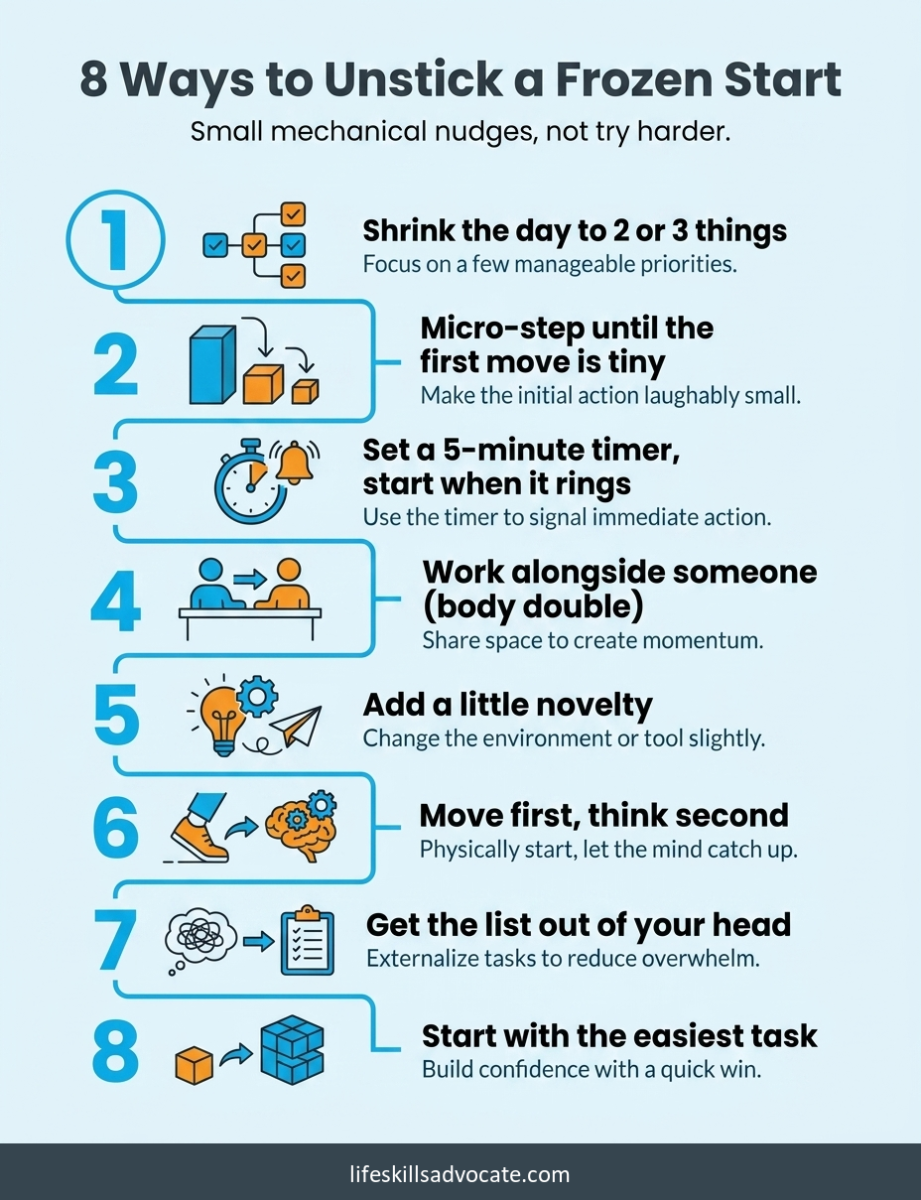
8 Ways to Unstick a Frozen Start
Here is the part that matters when you are frozen right now. None of these are “want it more.” They are small mechanical nudges that lower the cost of the first move. Treat the list as a menu, not a checklist, because not every move works for every brain.
1. Shrink the Day to Two or Three Things
A full to-do list is its own stressor. The brain reads twelve open items as one giant undifferentiated task and freezes. Pick the two, maybe three, that genuinely matter today. Everything else goes on a later list you are allowed to ignore until later. Fewer choices means less to push through before anything moves.
2. Micro-Step Until the First Move Is Tiny
“Clean the kitchen” is a freeze. “Pick up one plate” is a start. Break the task down until the first step takes under two minutes, and if that step still feels stuck, break it again. Task initiation needs a target small enough to clear the activation bar, and you can almost always shrink the first step smaller than you think.
3. Set a Short Timer and Start When It Goes Off
Set a timer for five minutes. The deal is that you only have to do the thing until it rings, and then you are free to quit. Most of the time you keep going, because starting was the hard part and you already paid that cost. A visual timer that shows the time draining as a colored wedge makes the countdown concrete instead of an abstract number you forget about.
Recommended tool
Time Timer MOD 60-Minute Visual Timer
A visual timer shows time draining as a colored disc, so a five-minute start becomes something you can see instead of an abstract number you forget about. That concrete time cue is often exactly what a frozen brain needs to begin.
Best for: People who lose track of time or stall when “five minutes” feels vague and want the countdown made visible. A plain phone or kitchen timer works too if you would rather not buy anything.
4. Work Alongside Someone (Body Doubling)
Do the task next to another person, in the same room or on a video call, even when they are doing something completely different. Their presence is a quiet external signal that nudges your brain into motion without anyone nagging. Body doubling borrows structure from outside when your own is offline, and it is one of the most reliable tools the neurodivergent community keeps coming back to.
5. Add a Little Novelty
If your brain needs interest to generate a start, give it some. Do the task somewhere different, put on one specific album, wear the ridiculous hat. Novelty is not a gimmick here; it is fuel. A boring task with a small new twist can produce just enough activation to get the first move out of you.
6. Move First, Think Second
When you are frozen, stop trying to think your way into the task. Just move your body: stand up, walk to the sink, pick up the pen. Action can lead and motivation can follow, rather than waiting for motivation to arrive first. Physical movement tends to help get things going, so let your limbs start before your head has fully agreed.
7. Get the List Out of Your Head and Where You Can See It
The overwhelming mental to-do list is heavier when it lives only in your head, because holding it takes working memory you could be spending on starting. Dump every loose thought onto paper or a single screen, then choose your two or three. Even color-coded blobs on a page, one per task, lower the start cost, because you are no longer carrying the whole pile at once.
Our free brain dump worksheet gives you a place to empty it all out and sort it into do-now, schedule, and ignore.
8. Start With the Easiest Task, Not the Most Important One
Momentum beats optimal order. The smallest, fastest, almost-embarrassingly-easy task gets the ball rolling, and a moving brain starts the next thing far more easily than a frozen one. Doing the “wrong” task first is fine if it breaks the freeze. You can reorder once you are already in motion.
When Task Paralysis Is a Daily Pattern
An occasional frozen afternoon is part of being human, especially a neurodivergent human. When the freeze is the default setting most days, and it is steadily costing you work, relationships, or your sense of yourself, that is worth taking seriously. It is not a sign that you are failing.
A persistent freeze is often one piece of a broader pattern. If you recognize yourself in several of the signs of executive dysfunction, that can be useful context rather than a verdict.
A common trap here is the shame spiral: you freeze, you get angry at yourself for “doing nothing,” and the self-criticism makes the next start even harder. Treating a frozen day as a moral failure reliably makes it worse. Dropping the shame is not soft; it removes a real barrier to moving.
If the freeze runs deep, working with someone can help. Executive function coaching for adults is skill-focused and practical: a coach helps you build initiation systems that fit your actual brain, rather than the one a productivity book assumes you have. Coaching is not therapy and not a substitute for mental health care; if the freeze is tangled up with anxiety, depression, or trauma, a therapist is the right partner for that part. The two work well side by side. If a book is where you would rather start, we keep a shortlist of ADHD books written for adults, plus a section on finishing the one you buy.
Task Paralysis at a Glance
A quick, sourced reference if you want to point someone else to the basics.
| Finding | What it means | Source |
|---|---|---|
| Task paralysis is difficulty starting a task, often under intense overwhelm, and is commonly seen in ADHD. | The barrier is starting, not the task itself or a lack of motivation. | Medical News Today (2025) |
| Adults with ADHD show executive function and motivation differences that affect planning and getting started. | Trouble initiating is part of the neurobiology, not a willpower failure. | Kooij et al., European Psychiatry (2019) |
| The freeze is most commonly linked to ADHD and is distinct from ordinary procrastination. | Being unable to begin is not the same as choosing to delay. | ADDA (Attention Deficit Disorder Association) |
Frequently Asked Questions
Is task paralysis the same as procrastination?
No. Procrastination is active avoidance: you can start, and you choose something easier instead. The freeze is being unable to begin a task you actually want to do. The feelings can overlap on a rough day, but the response that helps is different. Procrastination responds to lowering the dread around a task; task paralysis responds to shrinking the first step until it is small enough to clear.
What is the fastest way to get out of task paralysis right now?
Pick the single smallest physical action and do only that, then set a five-minute timer for whatever comes next. One plate, one sentence, one shoe. Starting is the wall, so make the start tiny.
Why can’t I start a task even when I want to?
Because wanting to start and being able to start use different machinery. Getting going takes activation, an internal “go” signal that for many neurodivergent brains needs interest, novelty, or urgency before it fires. A plain task with none of those can fail to produce enough of that signal to move, no matter how much you want the result. That is task initiation stalling, not a character flaw, even if internalized ableism keeps insisting otherwise.
Is the freeze an ADHD-only thing?
No. It shows up clearly in ADHD, but it is not exclusive to it. Autistic people often describe a near-identical wall around starting, stopping, and switching, sometimes called autistic inertia. Plenty of people without any diagnosis hit it under stress or burnout too. The strategies here are aimed at the freeze itself, so they travel across labels.
How do I keep a task system going past a few days?
This is the honest hard one, and the real answer is that most systems are not meant to last forever. A common pattern is that a planner or app works beautifully for three days and then quietly dies, which can feel like proof that you failed.
It usually is not. Novelty is part of why a new system works at first, so when the shine wears off, the system stops generating its own pull. Expecting to rotate or refresh your approach every few weeks is more realistic than expecting one perfect setup to stick.
What tends to help is keeping the system tiny and rebuilding the habit of starting rather than the tool. Whether any one method survives long term depends a lot on the person, so treat each one as an experiment instead of a verdict on you.
Next Steps
The freeze responds to preparation more than willpower, so set future-you up while you are not stuck.
- Cap tomorrow before it starts. Tonight, write down the two or three things that actually matter for tomorrow, and let everything else wait.
- Get the loop out of your head. Use the free brain dump worksheet to empty the mental to-do list onto paper so it stops circling.
- Build the underlying skill. The Real-Life Executive Functioning Workbook has structured practice for task initiation and the other skills behind the freeze.
- Let small starts count. On a frozen day, picking up one plate is a real win. Treat it like one, then see what follows.
Further Reading
- Task paralysis: symptoms, effects, and how to manage it – Medical News Today
- Updated European Consensus Statement on diagnosis and treatment of adult ADHD – Kooij et al., European Psychiatry
- ADHD Paralysis Is Real: Here Are 8 Ways to Overcome It – ADDA
- Time Timer MOD 60-Minute Visual Timer – Amazon
- ADHD Paralysis: The 3 Types and How to Get Unstuck – Life Skills Advocate
- 12 Tips To Take Control of ADHD Overwhelm – Life Skills Advocate
- Autistic Inertia: A Practical Guide to Starting, Stopping, and Switching Tasks – Life Skills Advocate
- The Science of Procrastination – Life Skills Advocate
- Executive Functioning Skills 101: The Basics of Task Initiation – Life Skills Advocate
- 9 Clear Signs of Executive Dysfunction – Life Skills Advocate
- Brain Dump Strategy worksheet – Life Skills Advocate
- Real-Life Executive Functioning Workbook – Life Skills Advocate
- Executive Function Coaching for Adults – Life Skills Advocate