
The email is written. It has been sitting in drafts since lunch, and you were going to send it. Then someone asks, “Did you send that yet?” and the email suddenly weighs about forty pounds.
If that moment is familiar, you may have wondered whether it is ordinary ADHD trouble getting started or something closer to PDA, the pattern of avoiding everyday demands that many people now call a persistent drive for autonomy. PDA and ADHD can produce the same frozen moment for different reasons.
One is a start problem: you want to, and the first step will not come into focus. The other is a threat problem: the ask itself sets off an alarm, even for something you wanted to do.
For ADHD and AuDHD adults, including people who found out about their ADHD later in life, telling the two apart in the moment is the useful part. They need different help, and a lot of standard ADHD advice works for one kind of stuck and backfires on the other.
TL;DR
PDA and ADHD can freeze you in the same spot for different reasons, and what helps depends on which reason it is:
- One UK study of adults found self-reported ADHD traits linked strongly with PDA traits, more strongly than autistic traits were, though PDA is not an official identification on its own.
- ADHD-style stuck usually means you want to start but cannot find the first step.
- PDA-style stuck means the ask itself makes the task heavier, even when it is something you wanted.
- Five quick questions can point to which kind you are in.
- Rewards, check-ins and countdowns can backfire when the stuck is about threat; fewer demands, real choices and softer wording tend to help more.
This is education, not an evaluation. PDA is not recognized as a standalone identification, and only a qualified professional can look at your full picture.
Where PDA and ADHD Overlap, and Where the Research Stops
The question underneath “is PDA part of ADHD?” is often a more personal one: am I allowed to relate to this if I am not autistic? The research on PDA and ADHD gives a partial answer, and it is more interesting than a yes or no.
Start with the label. According to the National Autistic Society’s guide to demand avoidance, PDA does not appear in the DSM or the ICD, so there is no standalone PDA identification. The term came from UK psychologist Elizabeth Newson in the 1980s.
The PDA Society describes PDA as a profile found within some autistic people. The National Autistic Society adds that marked demand avoidance has also been suggested to connect with other conditions, ADHD among them.
The ADHD link has some data behind it. In a UK study of 126 community adults, self-reported ADHD traits correlated strongly with PDA traits (r = 0.71), while autistic traits did not predict them. That 0.71 is a correlation from one self-report survey, not a percentage. The study did not measure how many people with ADHD have PDA traits.
Anxiety looks like part of the bridge. A US national survey of adults aged 18 to 44, with data collected from 2001 to 2003, found that 47.1% of adults with ADHD had an anxiety condition in the past year, compared with 19.5% of adults without ADHD.
Separately, two UK surveys of adults found that anxiety and autistic traits each predicted demand avoidance. Which comes first is still unclear.
One more limit worth knowing: we could not find a study that compares ADHD start trouble with PDA-style avoidance side by side. The two-lane model in the rest of this article is an executive function coaching lens built from that nearby research, not a tested framework. For the wider picture of PDA itself, our guide to pathological demand avoidance in adults covers what it is and how it shows up day to day.
ADHD Start Trouble vs. PDA-Style Threat: Two Kinds of Stuck
Avoidance in PDA and ADHD is not one thing. The complication is that from the outside, and often from the inside, the two kinds look identical: a task that sits there and does not get done.
Start trouble is the ADHD version most people know. You want to do the thing. The first step is foggy, the task feels bigger than it is, or working memory drops the plan somewhere between the couch and the desk.
Research backs the general shape. A meta-analysis of 83 studies found that groups with ADHD tend to show executive function differences in areas like planning and working memory, though not every person with ADHD does. If this kind of stuck is the main one for you, our guide to task paralysis goes much deeper on getting moving.
Threat works differently. The ask itself raises an alarm. A task you were planning to do gets harder the moment it becomes expected, checked on, or due. The PDA Society describes PDA as avoiding the everyday demands of life, “even things someone needs or wants to do.”
One person who lives with both put it this way: ADHD is like pressing the gas and not moving, and PDA is like the brakes slamming on by themselves.
The same person can have both, sometimes in the same afternoon. AuDHD readers may recognize this most, since how AuDHD affects executive function already involves a tug of war between two sets of needs. A pile of laundry can be pure start trouble at 10 a.m. and pure threat at 4 p.m., after someone has asked about it twice.
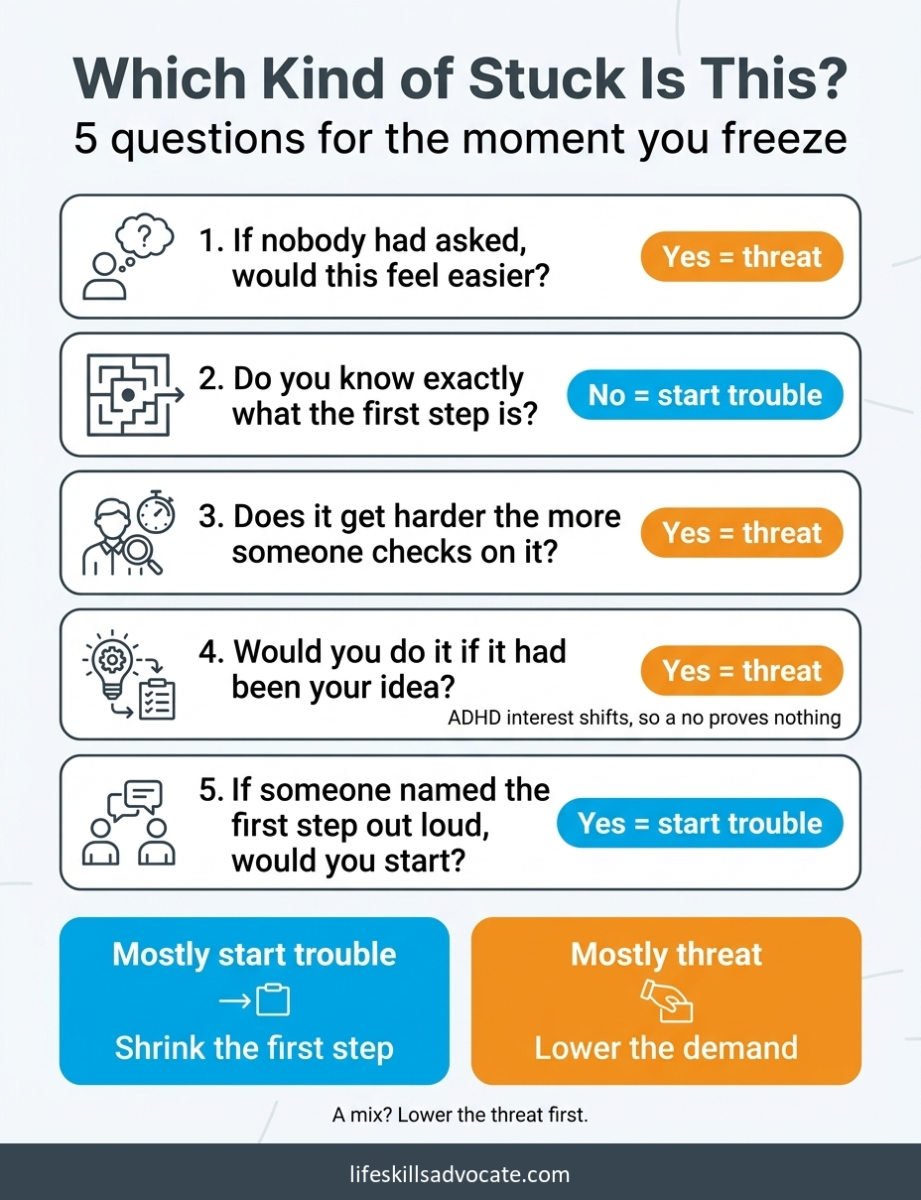
Is It ADHD or PDA? A 5-Question Check for the Moment You Freeze
So which one is happening right now? This check is built for the moment you notice you are stuck, and it works for PDA and ADHD whether you have one, the other, or both. It cannot tell you whether you “have” PDA. It can tell you where to start.
Ask yourself:
- If nobody had asked, would this feel easier? A yes points toward threat.
- Do you know exactly what the first step is? A no points toward start trouble.
- Does it get harder the more someone checks on it? A yes points toward threat.
- Would you do it if it had been your idea? A yes points toward threat. Read the note below before you trust a no.
- If someone sat with you and named the first step out loud, would you start? A yes points toward start trouble.
Question 4 needs a caveat for ADHD brains, because interest does not stay put: something you were excited to sign up for on Monday can feel flat by Thursday, with no demand involved at all. So a no on question 4 does not rule threat in or out. It mostly tells you your interest has shifted, which is an ADHD pattern in its own right.
Now count the leanings. Mostly start-trouble answers mean the start lane below, where shrinking the first step usually does the job. Mostly threat answers mean skipping ahead to lowering the threat.
A mix is common.
When it happens, lower the threat first. Pressure tends to make every step look bigger, so taking the alarm down often makes the start easier too.
Write down which lane it was, even in a phone note. After a week or two, patterns show up: certain people, certain times of day, certain kinds of tasks. That record is more useful than any single answer, and it gives you something concrete to bring to a coach or therapist.
What Helps When Getting Started Is the Hard Part
When the check points to start trouble, the standard ADHD toolkit is the right toolkit. Make the first step physical, small and obvious.
- Name the first physical action, not the task. “Open the laptop and find the email” beats “deal with the email.”
- Shrink it again if it still feels heavy. Two minutes of the task counts.
- Get the rest of the list out of your head with a brain dump worksheet, so working memory is holding one thing instead of twelve.
- Try body doubling, where another person stays nearby while you work.
That last one comes with a catch for anyone who scored a mix. A body double who checks in, comments, or asks how it is going has turned into another demand. Ask them to bring their own work and say nothing.
Rewards and countdown timers often work well in this lane too, which is exactly why they get a second look in the next one.
Lowering the Threat: Approaches for PDA-Style Avoidance With ADHD
Demand avoidance comes up again and again in executive function coaching, and with PDA and ADHD together, more structure is rarely the first answer. A rigid plan is one more set of demands. The goal in this lane is to lower the pressure before adding any structure.
The National Autistic Society (NAS) is clear that research on support for demand avoidance is limited, so the ideas below, drawn from its summary of personal accounts and professional advice, are practice-based, not proven.
Cut the Number of Demands First
Every demand you remove is one less thing for the alarm to react to. List the regular asks in your week, then sort each one three ways: drop it, automate it (autopay, a recurring grocery order, a reminder you never have to set again), or share it with someone else.
The decision fatigue audit worksheet covers a version of this, and it tends to surface demands you did not know you were carrying.
Turn Orders Into Options
A choice reads very differently from an instruction, even when the outcome is the same. “Do you want to do the dishes now or after the show?” lands softer than “Do the dishes.” Indirect phrasing helps too: describing the situation instead of directing it, which is the idea behind declarative language.
Build in an exit. One person quoted on the NAS page says that giving themselves an “out,” knowing they can change their mind whenever they want, makes demands much easier to meet. A plan you are allowed to abandon is often the plan that gets done.
Make the Planner a Menu
Self-set demands count too. A routine you designed on a good Sunday can read like a list of orders by Wednesday, and the planner you built yourself starts to feel like a boss you are avoiding.
Try writing a short “could do” list instead of a schedule of musts. Keep two or three fixed items a day, the ones with real consequences, and let everything else be optional. Skipping a day does not mean starting over. A brain dump first gets everything out of your head; the menu is what you pick from afterward.
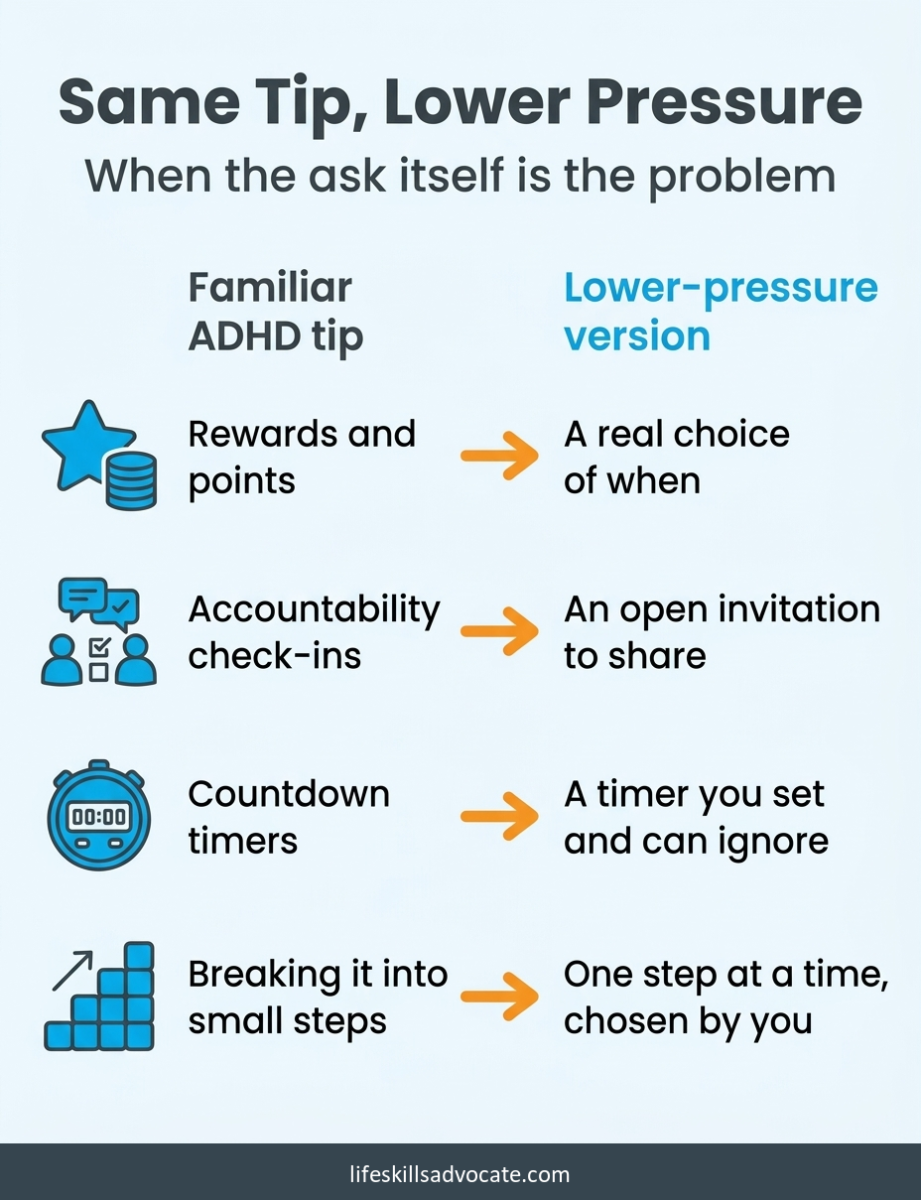
Familiar ADHD Tips Under Threat
Some of the most common ADHD tools can raise the threat level instead of lowering it. They still belong in the start lane; under threat, try the lower-pressure version.
| Familiar ADHD tip | What can go wrong under threat | Lower-pressure version |
|---|---|---|
| Rewards and points | The reward becomes one more condition to meet | A real choice of when, rather than a prize for doing it |
| Accountability check-ins | A check-in reads as being watched | An open invitation to share progress if it helps |
| Countdown timers and deadlines | The clock becomes the demand | A timer you set yourself and are free to ignore |
| Breaking it into small steps | A long step list looks like a longer list of demands | One step at a time, chosen by you, with no list in sight |
If the alarm is already high, none of this lands well. Sometimes the first job is settling an overloaded nervous system, and the task waits.
Words That Take the Pressure Off
The question most people bring is “how do I make myself do it?” A more useful version is “how do I make the ask lighter?” Wording does a lot of that work, for the voice in your own head and for the people around you. Copy any of these and change them until they sound like you.
For Yourself
Three swaps to try in your head or on a sticky note:
For a Partner
If you are the one with the demand avoidance, it can help to say so before the ask turns into a standoff:
Asking a partner? A statement plus an open door tends to land softer than a request with a deadline:
For a Manager
At work, it often helps to separate the what from the how. Ask for the outcome and the deadline, and keep the order and the method yours:
For an Older Teen
Declarative phrasing describes the situation and leaves the next step open:
PDA in teens deserves its own article, and we are working on one.
What Pressure-Free Support Looks Like for PDA and ADHD
Support for PDA and ADHD can help, and the wrong kind can add exactly the pressure that makes things worse. Accountability-heavy coaching, built on check-ins, streaks and “did you do it?” texts, is a common example.
Two kinds of help do different jobs. Therapy is the place for anxiety, past experiences and mental health. Coaching is educational and skills-focused: building systems, adjusting your environment, and working out which lane you are in this week. Neither replaces the other.
Whichever you choose, look for someone who works with you rather than directing you. In an Irish study that asked adults who identify with PDA directly, participants said greater autonomy and flexibility in support would help. For more first-hand accounts, PDA by PDAers by Sally Cat, an adult with PDA, gathers the voices of more than 70 people living with it.
Our executive function coaching for adults is one option, and with any coach, it is fair to ask how they handle a plan that is not working.
What the Research Says About PDA and ADHD
| Finding | What it means | Source |
|---|---|---|
| PDA is not listed in the DSM or the ICD | There is no standalone PDA identification; it is described as a profile | National Autistic Society |
| PDA and ADHD traits correlated strongly (r = 0.71) in 126 UK community adults (2020), while autistic traits did not predict PDA traits | A link in one self-report study, not a rate of PDA among people with ADHD | Egan, Bull and Trundle (2020) |
| 47.1% of US adults with ADHD had an anxiety condition in the past year, vs 19.5% without ADHD (adults aged 18 to 44, data from 2001 to 2003) | Anxiety often comes along with ADHD, which matters because anxiety is linked to demand avoidance | Kessler et al. (2006) |
| Anxiety and autistic traits each predicted demand avoidance in two UK adult surveys (2023); which comes first is unclear | Anxiety is part of the picture, but it is not shown to be the cause | White et al. (2023) |
| Research on support strategies is limited; current advice is practice-based | Lower demands, collaboration and indirect phrasing come from personal accounts and professional experience | National Autistic Society |
Frequently Asked Questions About PDA and ADHD
Is demand avoidance part of ADHD?
It can show up alongside ADHD, and the overlap is stronger than many people expect. In one UK survey of 126 adults, self-reported ADHD traits were strongly correlated with PDA traits, more strongly than autistic traits were.
That does not mean ADHD causes PDA, or that most people with ADHD have it. It was one self-report study in a community sample. Anxiety probably plays a part: it is far more common in adults with ADHD, and UK research links anxiety with demand avoidance, though which comes first is unclear.
A lot of ADHD avoidance is start trouble instead, where the person wants to do the task and cannot find the first step. The two can feel the same from the inside, which is why the 5-question check above asks about the moment itself rather than the task.
Can you have PDA and ADHD without being autistic?
Many people relate to PDA without being autistic, and the research leaves room for that.
The PDA Society describes PDA as a profile within autism, while the National Autistic Society notes it has been suggested to connect with other conditions, including ADHD. The UK adult study above found ADHD traits predicted PDA traits better than autistic traits did.
Because PDA is not an official identification, there is no agreed answer to whether a non-autistic person “has PDA” or has demand-avoidant traits that come from somewhere else, such as anxiety. Researchers and the PDA community are still debating where the label belongs, and that question is open.
Do rewards help with PDA and ADHD avoidance?
Rewards often help with ADHD start trouble. When the avoidance is about threat, a reward can turn into one more condition to meet and add pressure. A real choice of when tends to work better.
Why can I do something on my own but not when someone asks me to?
The ask changes what the task feels like. On your own, it is a choice. Once someone asks, it becomes an expectation, and for people with PDA-style avoidance that shift can set off a sense of threat even though the task is the same. It is a strong hint you are in the threat lane, not the start lane.
Does demand avoidance ease with age?
It might for some people, but the evidence is thin. A UK study of adults in the general population found that older people tended to report fewer demand-avoidant traits. That was a snapshot of different people at different ages, not the same people followed over time, so it cannot show that anyone’s traits change as they get older.
Fewer demands later in life, more control over a schedule, or better self-knowledge could all play a part. For any one person, nobody can say for sure.
Next Steps
The single most useful thing to come away with is which lane you tend to land in, and that takes about a week of noticing.
- Run the five questions the next time you freeze, and jot down which lane it was. No sign-up needed.
- Drop or automate one demand this week. The decision fatigue audit can help you find a good candidate.
- Curious which executive function skills carry the most load for you? Take the free executive functioning assessment.
- For help building a system that works with you, look into executive function coaching for adults.
Further Reading
- Demand avoidance – National Autistic Society
- What is PDA? – PDA Society
- Individual differences, ADHD, adult pathological demand avoidance, and delinquency – Egan, Bull and Trundle (2020)
- The prevalence and correlates of adult ADHD in the United States: Results from the National Comorbidity Survey Replication – Kessler et al. (2006)
- Understanding the Contributions of Trait Autism and Anxiety to Extreme Demand Avoidance in the Adult General Population – White et al. (2023)
- Validity of the executive function theory of ADHD: a meta-analytic review – Willcutt et al. (2005)
- A phenomenological exploration of the lived experience of adults experiencing pathological demand avoidance – Kenny and Doyle (2024)
- PDA by PDAers: From Anxiety to Avoidance and Masking to Meltdowns – Sally Cat
- Clear Answers About Pathological Demand Avoidance in Adults – Life Skills Advocate
- Task Paralysis: 8 Ways to Start When Your Brain Won’t Let You – Life Skills Advocate
- AuDHD and Executive Function – Life Skills Advocate
- How to Use Body Doubling – Life Skills Advocate
- The Power of Declarative Language for Neurodivergent Communicators – Life Skills Advocate
- How to Regulate Your Nervous System When Calm Won’t Come – Life Skills Advocate
- Brain Dump Strategy worksheet – Life Skills Advocate
- Decision Fatigue Audit worksheet – Life Skills Advocate
- Free Executive Functioning Assessment – Life Skills Advocate
- Executive Function Coaching for Adults – Life Skills Advocate