
The reply to your friend’s text has been sitting half-written for three days. You like this friend. You want to answer. Every time you open the message, something in your body locks up, as if the reply were a test you never agreed to take.
For a lot of people, pathological demand avoidance in adults is the name that finally fits that experience: everyday expectations, including ones you set for yourself, landing as a threat instead of a task. Many adults prefer another name for the same pattern, the persistent drive for autonomy, because it points at what sits underneath it: a strong need to stay in charge of your own choices.
The pattern rarely stays private. Share a home with someone and it shows up in the dishes, the rent, the plans for Saturday, and the way a simple “can you…” turns into a standoff neither person wanted. This guide is written for both people in that home.
TL;DR
When everyday requests hit this hard, the same few questions tend to pile up at once:
- What is pathological demand avoidance in adults, and why do many people call it a persistent drive for autonomy?
- Why can a task you want to do feel impossible the moment it becomes expected?
- Is it PDA, ADHD, or both?
- What changes at home when one partner or housemate has PDA traits, and what does the other person need?
- Which small changes lower the pressure this week without letting real deadlines slide?
This is education, not an evaluation. PDA is still debated among professionals, so use what follows alongside someone who knows you, not as a replacement for them.
What Is Pathological Demand Avoidance in Adults?
Pathological demand avoidance in adults describes a pattern where ordinary demands set off an anxiety and threat response strong enough to block action, even when the person wants the outcome. The complication is its status. PDA is a proposed profile, discussed mostly within autism, and professionals still disagree about where it belongs.
Persistent Drive for Autonomy, Pervasive Drive for Autonomy, and the Original Name
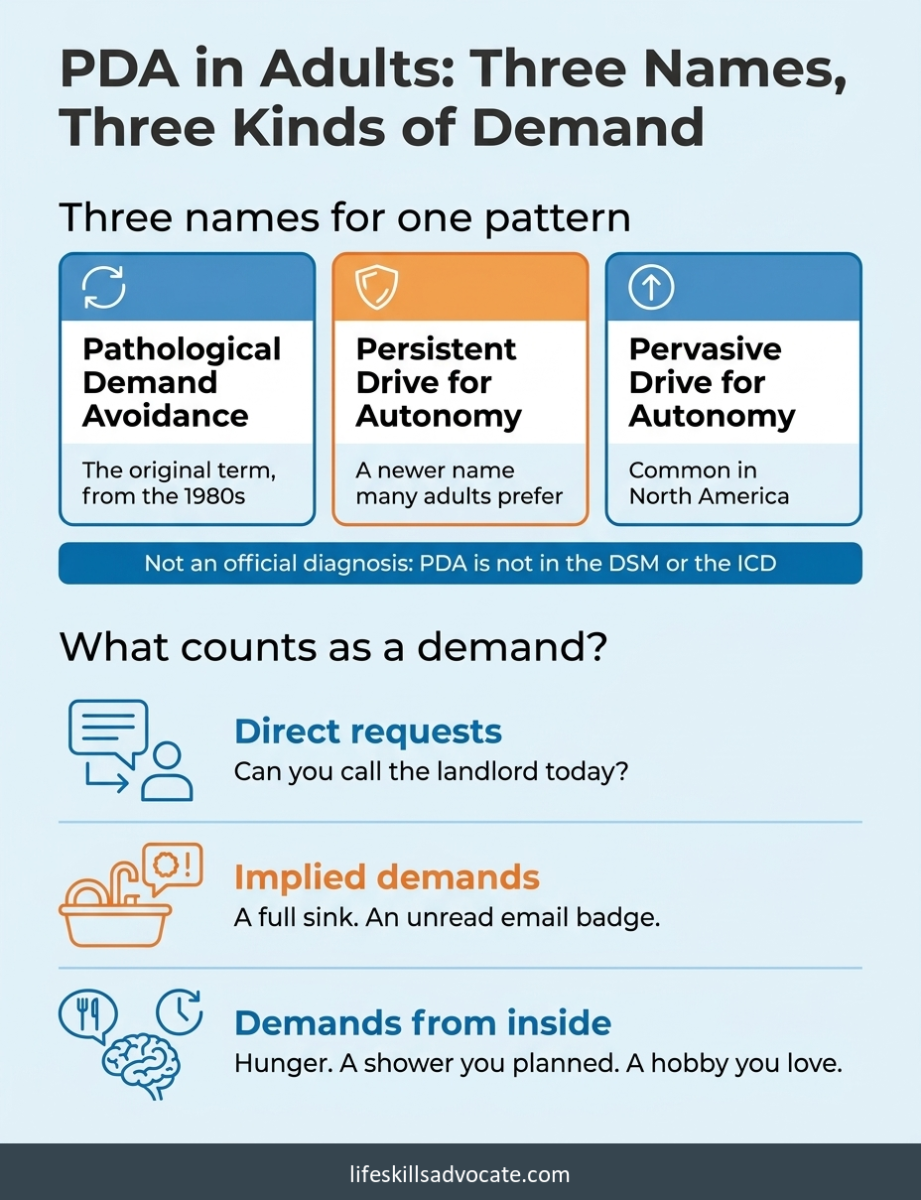
Developmental psychologist Elizabeth Newson introduced the term in the 1980s. The word “pathological” has drawn criticism ever since. The PDA Society’s history of the term notes that alternatives such as “Persistent Drive for Autonomy” have been suggested, and that some people feel the original term best reflects their lived experiences.
Two versions of the newer name circulate. The National Autistic Society’s page on demand avoidance mentions “Persistent Drive for Autonomy” and also notes that some people keep “pathological” because they find the traits all-consuming. PDA North America uses “Pervasive Drive for Autonomy.” Neither is a formal term.
This guide uses PDA and persistent drive for autonomy side by side. PDA is the name most people search for. The autonomy name says more about what is going on.
What Counts as a Demand?
When adults with PDA traits talk about demands, they mean a lot more than a boss handing out tasks. Three kinds tend to land with similar weight:
- Direct requests from other people, such as “can you call the landlord today?”
- Implied demands, like a full sink or an unread email badge.
- Demands from inside: hunger, a shower you planned, a hobby you love that now feels like it has to be done properly.
The third kind tends to surprise people. Dr. Donna Henderson writes that PDAers can have an intense negative reaction even to demands they themselves want to meet. A concert you bought tickets for can feel as heavy as a tax form once the day arrives. A plan that felt like a choice when you made it often turns into a demand when the time comes.
Behavior analysts would call the avoidance escape, one of the four functions of behavior. That label describes what the avoidance achieves. It says less about the anxiety pushing it.
Is PDA an Official Label?
No. According to the National Autistic Society, PDA does not appear in the DSM or the ICD, so nobody can receive a standalone PDA diagnosis. The PDA Society describes it as a profile that can be identified during an autism assessment, and points out that not everyone who identifies as PDA considers themselves autistic.
The research is thin. The PDA Society counts fewer than 100 peer-reviewed studies on PDA in total. A 2026 systematic review by Company and Rotella found 12 relevant studies, judged all of them at high risk of bias, and found only two that studied adults. Much of what is written about adults, this guide included, rests on what PDA-led organizations and adults themselves describe rather than on large studies.
For many adults, the label still works as the first explanation that matches what demands feel like from the inside.
How PDA Shows Up in Everyday Adult Life
From the outside, pathological demand avoidance in adults rarely looks dramatic. Far more often it looks like a pile of small things that do not happen: the form not sent, the call not made, the shower put off until it feels like a mountain.
At Home
At home, the hardest demands are often the smallest. You want a clean kitchen. You can see what needs doing. The moment it becomes something you should do right now, a wall goes up, and the longer the wall stays, the bigger the job gets in your head.
Body needs get caught in the same loop. Noticing you are hungry turns into “I should make something,” which turns into a demand, which turns into another hour on the couch getting hungrier.
Years of comments about being messy can add their own weight. A cluttered room then carries the job plus the memory of every time someone pointed at it.
At Work and in Classes
Many adults with PDA traits are capable, quick and creative, and still cannot start an assigned task once it lands on the list. Emails that expect a reply sit untouched. Some people finish everything at the last possible minute in a rush of panic, then crash. Others leave jobs or courses when the expectations pile up past what they can carry.
From the outside, that reads as unreliability. From the inside, it often feels closer to being cornered.
Masked PDA, Burnout, and the Capable-Looking Adult
Not every adult with PDA traits argues, refuses or cancels. Many mask. They say yes at work, go along with every request in public, and come home with nothing left. Some practitioners call this masked or “quiet” demand avoidance, and it tends to go unnoticed because the person seems fine.
The cost tends to land at home in the evening. Holding demands together all day uses the same capacity needed later for dishes, meals and conversation. The National Autistic Society lists burnout among the effects demand avoidance can have, and the PDA Society names emotional burnout as a strain in PDAers’ relationships. No study has measured burnout in adults with PDA specifically, so read that link as what adults and PDA organizations describe.
If the cycle sounds familiar, our guide to neurodivergent burnout covers the warning signs and what recovery tends to need.
PDA, ADHD, or Both?
ADHD can produce avoidance that looks almost identical from across the room. The difference usually shows up in what makes a task stick.
ADHD task avoidance tends to center on interest and getting started: a boring task stalls, and it gets easier when it turns interesting or urgent. PDA-type avoidance tends to center on the demand itself. An interesting task can become impossible the moment it is expected of you, and urgency can make that worse.
The two also overlap. In one survey of 126 adults, self-reported ADHD traits were strongly linked with PDA traits and predicted them better than autistic traits did. That is one survey showing a correlation, so it cannot say which causes which. It does match what plenty of adults describe: having both, and needing support that accounts for each.
Why Does PDA Happen? Anxiety, Autonomy, and Executive Function
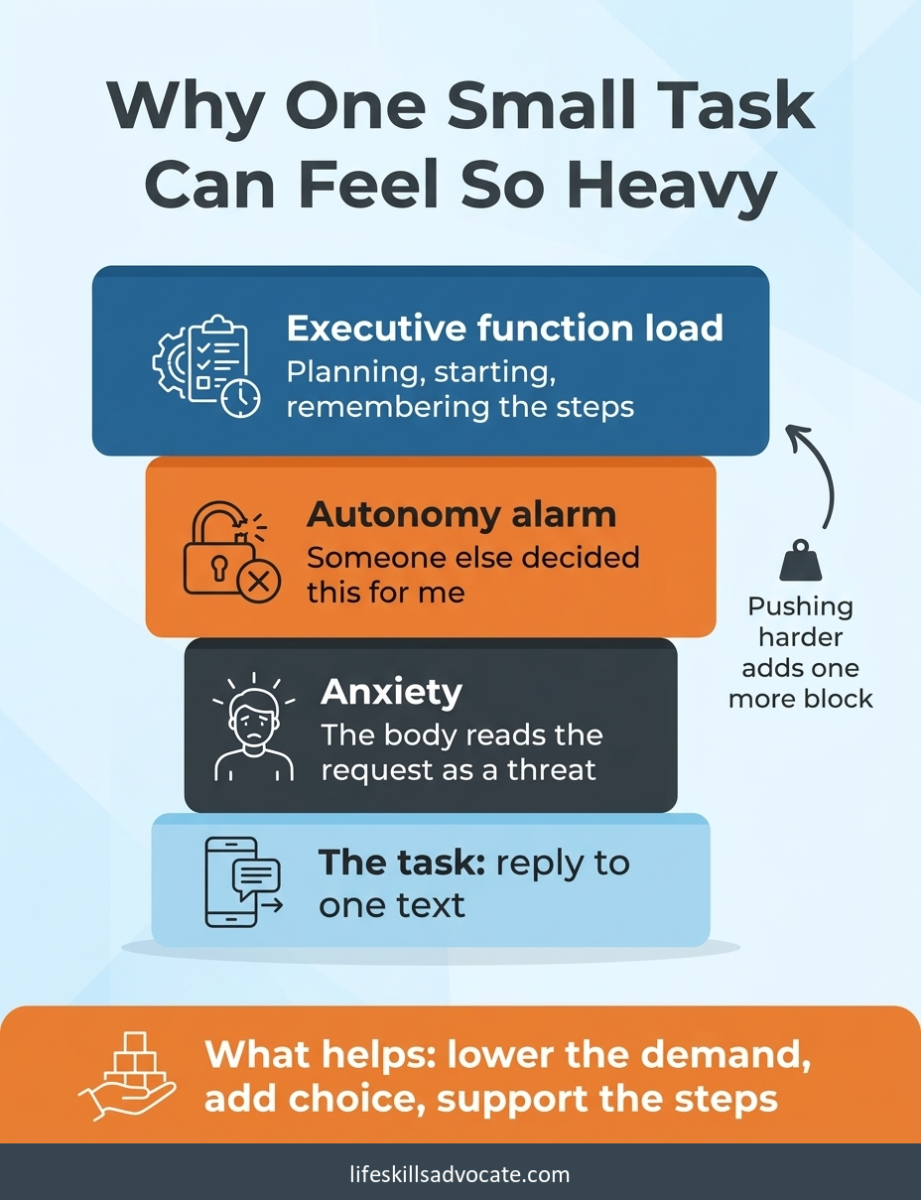
Why would anyone avoid something they want to do? With pathological demand avoidance in adults, the answer usually involves three things stacking on the same small task: anxiety, a threatened sense of control, and the executive function cost of doing it at all.
Is PDA Just Anxiety?
Anxiety is a large part of the picture. A 2023 study of adults found that autistic traits and anxiety were unique and equally important predictors of demand avoidance. The study measured traits at one point in time, so it cannot show which comes first. It does suggest that in adults, anxiety and demand avoidance tend to travel together.
Many adults also describe sensory overload, past experiences of being controlled, and years of masking feeding that anxiety. A common thread is difficulty with not knowing what comes next, which our article on intolerance of uncertainty covers in depth. Anxiety is one strong ingredient. Treating it as the only one can hide needs for more control, clearer information, or different executive function support.
Autonomy, Control, and Feeling Safe
A line quoted on the National Autistic Society’s page puts it plainly: the single most important thing to a PDA individual is their autonomy, deciding things for themselves and being in control of what they do. That is the core of a persistent drive for autonomy. Someone with this drive can be cooperative in many situations, then feel suddenly trapped when they sense a choice being taken away, even a small one.
When the threat response switches on, it does its job: protection. For some people that looks like arguing, joking, changing the subject or building elaborate reasons. For others it looks like freezing, going blank, or masking harder.
A more useful question than “how do I make myself do this?” is “what would make this feel voluntary enough that the brakes stay off?”
Where Executive Function Fits In
Executive function is the set of mental skills that let you plan, start, organize and follow through. Task initiation, planning, working memory and emotional control all draw on it. When those skills are stretched, a simple request can feel like juggling ten things at once.
For adults with PDA traits, executive function load and demand avoidance tend to feed each other. A task with many steps, unclear instructions or a switch of attention costs more effort to start. That extra cost raises the demand level of the task, which makes the autonomy alarm more likely to fire.
Starting is already hard for many autistic adults, a pattern known as autistic inertia. PDA adds a second layer on top, where the demand itself becomes the obstacle.
Avoidance then removes practice. A task you rarely get to do without pressure stays unfamiliar, so it keeps feeling big, so it keeps getting avoided. This loop is one reason demand avoidance tends to feel so stuck, and breaking it usually means lowering the demand and the executive function cost at the same time.
The free executive functioning assessment shows which skills carry the most load for you, and our guide to improving executive function in adults covers what tends to help once you know.
Why Willpower Advice Tends to Backfire
“Just push through” is advice adults with PDA traits hear a lot, and it tends to make things worse. Pushing harder is one more demand. Adding a demand to a system that already reads demands as threats raises the threat response, so the next attempt gets harder.
Adults’ own accounts point the same way. In a 2024 Irish study of adults experiencing PDA, the two adults interviewed in depth described pervasive anxiety and real difficulty handling everyday demands. Two people is a very small sample, so read it as an illustration of the pattern rather than proof. What helps tends to work in the opposite direction: lowering the demand, adding choice, and supporting the executive function steps underneath.
6 Practical Steps for Adults With a Persistent Drive for Autonomy
These steps share one aim: making a demand small and voluntary enough that your brain stops reading it as a threat. Most adults with a persistent drive for autonomy find that some steps help a lot and others do little for them, so treat the list as a menu and start with whichever one looks least like work.
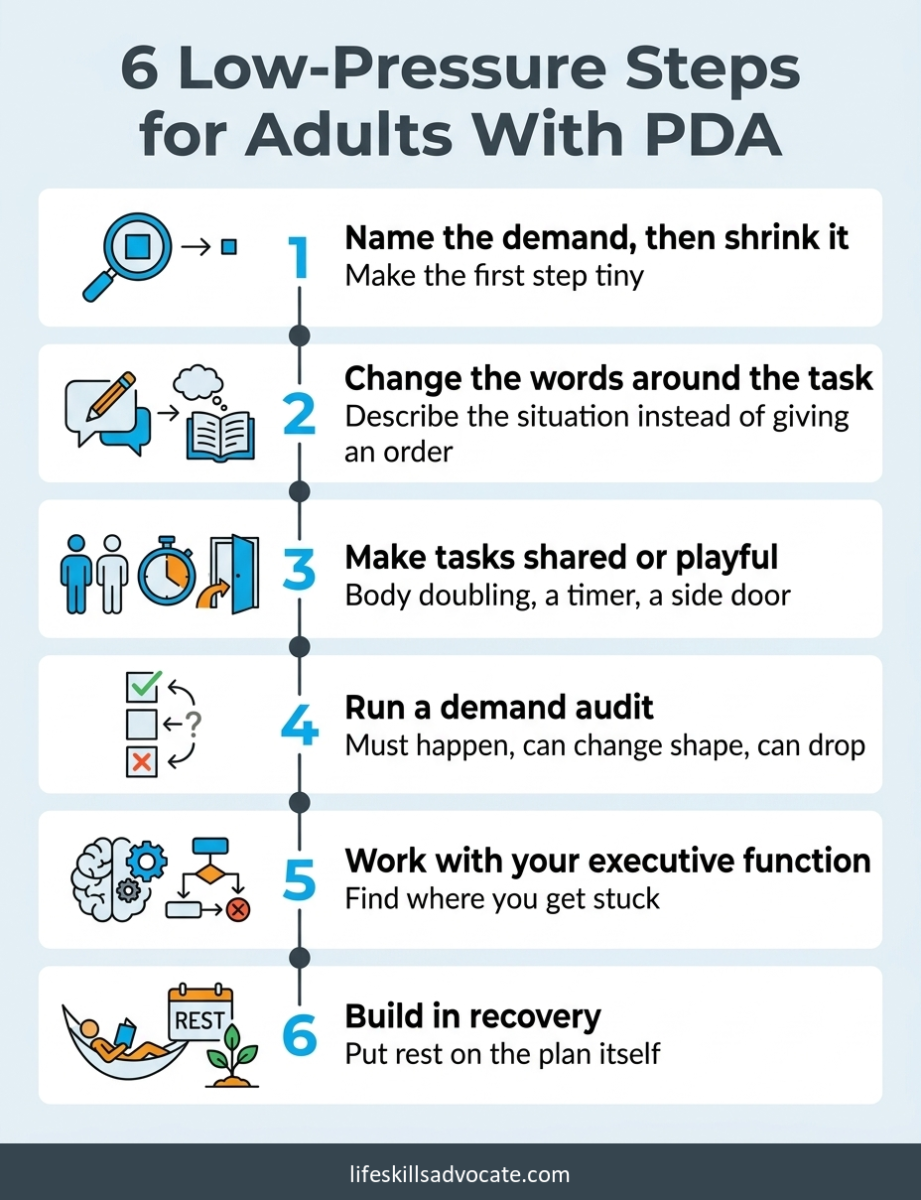
1. Name the Demand, Then Shrink It
When everything feels like too much, ask what the demand is. Is it someone else’s deadline, your own standard, or a body need like hunger? Naming it on paper makes it concrete and a little less foggy.
Then shrink it. “Clean the kitchen” becomes “move the mugs to the sink.” “Answer all my emails” becomes “open the inbox and sort it into three folders.” If that still feels heavy, the first step can be sitting at the table with the laptop closed for two minutes. The size of the step matters less than whether your brain lets you take it.
2. Change the Words Around the Task
The words you use, out loud or in your head, raise or lower the demand. Declarative language describes a situation instead of giving an instruction. “The trash is full” usually lands lighter than “I have to take out the trash right now.”
A few swaps people find useful:
- “I should do this” becomes “do I want to try five minutes of this and see?”
- “I have to finish it all” becomes “I can stop after the first piece.”
- “Other people find this easy” becomes “this is hard for a lot of people, and I need a different setup.”
3. Make Tasks Shared or Playful
Demands tend to feel lighter when you are not facing them alone. One adult quoted in the PDA Society’s self-help guide for adult PDAers credits their partner with the line “a demand shared is a demand halved.” Three ways to share or soften a task:
- Body doubling. Work in the same room or on a video call with someone doing their own task. Their company helps; supervision usually does not.
- Come in through a side door by pretending you are helping a future version of yourself, or treating the task as an experiment you chose to run.
- Light game rules? Set a Time Timer MOD visual timer for five minutes and see what happens, or roll a die to pick which small task to try. Keep the stakes low and optional.
4. Run a Demand Audit and Lower the Total Load
Sometimes the problem is the number of demands landing at once, more than any single task. When your capacity is already used up, a small request can be the last straw.
A demand audit makes the load visible. List everything you feel expected to do this week, including the self-imposed items, and sort each one into three buckets:
- Must happen: rent, medication, a work deadline with real consequences.
- Can change shape: it needs doing, but the how, when or who is flexible. Bills can go on autopay, shopping can become a shared list, dinner can rotate between three meals.
- Can drop: things on the list out of habit or someone else’s preference.
A lot of the relief usually comes from the middle bucket. Our decision fatigue audit worksheet walks through the same kind of sorting on paper if you want a structure to fill in. Low-demand days, where you plan less on purpose after a big week, belong in this step too.
5. Work With Your Executive Function
Because PDA and executive function load feed each other, knowing your own executive function profile pays off. Instead of “why can I never do anything?”, ask “do I get stuck on starting, on ordering the steps, or on the feelings around the task?” The Executive Functioning 101 hub breaks each skill down with everyday examples.
Once you know where you get stuck, supports can target that spot:
- Schedule harder tasks for the times your energy tends to hold steady.
- Use a visual checklist so the steps live on paper instead of in working memory.
- Attach tasks to cues that already happen: while the kettle boils, put one dish away.
- Plan only the first tiny step for tasks that reliably trigger avoidance.
6. Build in Recovery
Pushing through every demand without recovery usually makes PDA patterns louder. Time alone after social events, sensory-friendly movement, stimming, a special interest, or an hour in a space where nobody needs anything from you all give your nervous system a chance to stand down. Put recovery on the plan itself instead of saving it as a reward for finishing.
When you still cannot start: postpone on purpose and write down when you will revisit it, so the task stops hovering. Or ask someone to sit with you while you look at it, with no expectation of finishing. It also helps to check whether the block is about not knowing how, fear of the outcome, or having no capacity left today, since each needs a different kind of help.
Shared homes are where pathological demand avoidance in adults gets tested hardest. A home runs on a steady supply of small requests.
Who is doing the dishes. Whether the rent got paid. What time you are leaving on Saturday. Any one of those can land as a demand, and the other person usually has no idea they set off an alarm.
Plans are a common flashpoint. Saying yes is easy in the moment, especially for someone who masks. When the day comes, the same plan can feel like a trap, and a last-minute cancellation or an unanswered message follows.
Partners often read that as distance. The person with PDA traits often feels a flood of guilt with no words for what happened.
This section draws on PDA-led organizations and adults’ own accounts. No peer-reviewed study of PDA in adult couples exists yet, so treat it as practice wisdom to test.
When Plans and Closeness Start to Feel Like Demands
The PDA Society’s guide to romantic relationships lists several pressure points PDAers describe, including:
- physical and emotional closeness that can feel like a demand
- fear of losing independence when decisions are shared
- a strong fear of criticism or rejection
- engagement that comes and goes
That last point matters for partners. A dip in affection or attention after a stressful week usually reflects the person’s capacity. Reading it as a verdict on the relationship tends to add pressure.
Excitement can turn into a demand too. Writing for PDA North America, Ruth Hevelone, an adult PDAer, suggests skipping the build-up before a date (“I’ve been dying to go to that new restaurant”), because the pressure of a partner’s excitement can feel like a demand to make the evening happen. Her alternative is a low-key check the day before: is this still on, and if not, an easy plan to pivot.
Some couples keep closeness flexible by default: plans with an easy exit, affection that is offered without being expected, and an agreement that “not tonight” ends the conversation without a debate.
Household Work Without the Reminder Loop
A common household pattern runs like this: one person notices a job and asks, the request lands as a demand, the job stalls, the first person asks again, and the reminders become the problem. The person asking feels like a nag. The person asked feels managed.
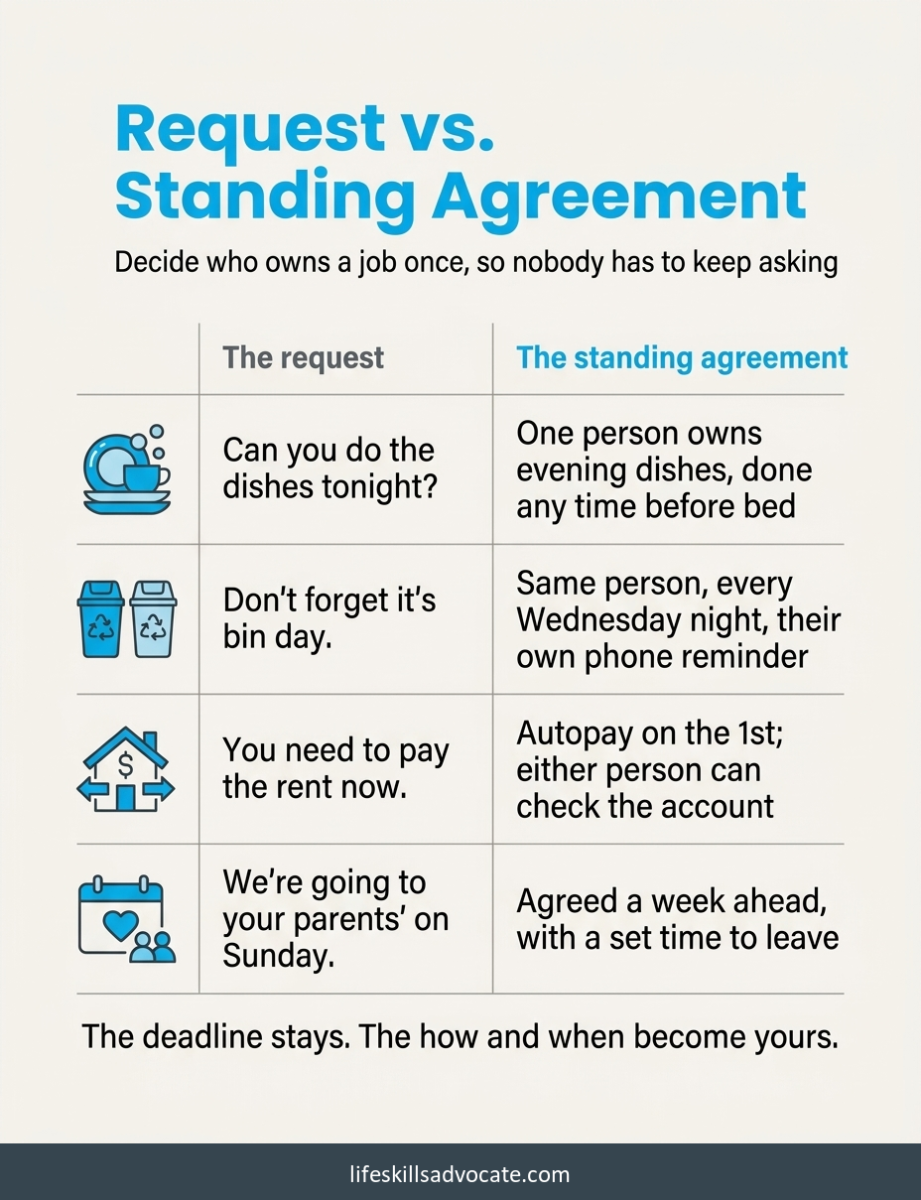
Standing agreements break that loop. A standing agreement decides who owns a recurring job, once, at a time when nobody is stressed, so the job never has to be requested again. Ownership replaces asking. The owner decides how and when, inside a shared boundary like “before the weekend.”
| Situation | The request version | The standing agreement | Why it lowers pressure |
|---|---|---|---|
| Evening dishes | “Can you do the dishes tonight?” | One person owns the evening dishes, done any time before bed | No request to push against; the owner picks the moment |
| Bin day | “Don’t forget it’s bin day.” | The same person takes the bins out every Wednesday night, with a phone reminder they set themselves | The reminder belongs to the owner instead of the other partner |
| Rent | “You need to pay the rent now.” | Rent goes out by autopay on the 1st, and either person can check the account | The deadline stays fixed and nobody has to chase it |
| Texting back | “Why haven’t you answered me?” | A slow reply means busy; anything urgent gets a phone call | Silence stops reading as a crisis |
| Family visits | “We’re going to your parents’ on Sunday.” | Visits get agreed a week ahead, with an agreed time to leave | The exit is built in, so the visit feels chosen |
| Date night | “I booked us a table for Friday!” | One loose evening a week is kept free; what it becomes gets decided on the day | The time is protected without a fixed plan attached |
The rent row is the one partners tend to worry about, and fairly: some deadlines are real. The agreement keeps the deadline fixed and makes the method negotiable. If the rent is due Friday and nothing has happened by Wednesday, a check-in such as “the rent is due Friday; how do you want to handle it this week?” keeps the date in view without turning it into an order.
Space helps as well. The PDA Society suggests that separate spaces or domestic areas each person fully controls can help couples who live together, and says plainly that some PDAers live apart from their partner when that is what makes the relationship work.
For the cleaning itself, KC Davis’s How to Keep House While Drowning is built on the idea that a home exists to work for the people living in it, with shortcuts for limited time and energy. It suits homes trying to take the shame out of chores.
Repair After a Hard Moment
Blow-ups happen in most homes. In a home with PDA traits, the repair step is where things often go wrong a second time. Hevelone writes that once a PDAer has had time to decompress, guilt and shame usually follow, and an apology can still feel out of reach because the apology is itself a demand. Her advice to partners is direct: demand an apology and you are unlikely to get a sincere one.
A repair sequence that tends to work better:
- Give both people time to come down before talking. Hours, sometimes a day.
- Reopen the subject with a statement instead of a question that demands an answer: “I’ve been thinking about last night.” Declarative phrasing does a lot of work here.
- Offer a written option. The PDA Society suggests writing down difficult conversations, which lets each person respond in their own time.
- Talk about what to change next time, which matters more than who apologizes first.
What the Other Person Needs Too
Living with someone who has PDA traits takes real effort, and the partner’s or housemate’s needs and limits are legitimate. Lowering pressure does not mean one person carries everything. A home where one person absorbs every task to avoid conflict usually ends in burnout for that person and guilt for the other.
The trap to watch for is the parent-partner pattern. Hevelone notes that many partners of PDAers hear that they are acting like a parent instead of a partner, and suggests taking that as information about how controlled the other person feels. The same dynamic shows up in plenty of ADHD relationships. Our article on ADHD in marriage covers the parent-child dynamic and how couples climb out of it.
When both partners are neurodivergent, the household system has to fit two brains. A partner with ADHD may want reminders and visible lists to keep their own jobs moving, while the partner with PDA traits may need fewer reminders aimed at them. Separate systems for each person’s jobs, with one shared place for anything joint, often beat a single system both people resent.
Housemates face a lighter version of the same problem. A short written list of who owns what, agreed when everyone moves in, removes most of the asking. Fairness runs both ways, so a housemate can also say which jobs they will not take on.
Family, Friends, and Coworkers
Support from the wider circle starts with an assumption: the person already cares about the things that matter, and pressure is what stands in the way. From there, most of the work is in how you ask.
- Ask before helping. “Do you want to brainstorm this, or do you want to vent?” respects their choice and tells you which kind of help to offer.
- Offer choices where you can, such as “would you rather do the phone call or the online form?”
- Plan at low-stress times and agree on first steps and backup plans before anyone is overwhelmed.
- Back off at the first signs of overload and come back to it later.
Repeating a demand louder, adding threats or guilt, and reward-and-punishment systems tend to raise the pressure, and for many PDAers they confirm that someone is trying to control them. At work, the same ideas become written requests with context, flexible deadlines where the work allows, and choice in how a task gets done. Reframing Autism’s guide for allies covers this kind of low-pressure communication, and our article on balancing independence and support goes further into respecting autonomy while still helping.
When to Look for an Evaluation or More Support
For pathological demand avoidance in adults, an evaluation can be worth pursuing when the avoidance leads to frequent shutdowns or panic, repeated breakdowns at work or in relationships, or long-running anxiety, low mood or burnout. If you are having thoughts of self-harm or feel unable to keep yourself safe, contact a crisis line first. In the US, you can call or text 988.
Because PDA is not an official label, evaluations usually look at the bigger picture: autistic traits, ADHD traits, anxiety and life history. Bring specific examples of how demands affect you. PDA North America’s list of PDA-affirming providers and the PDA Society’s organisation directory are starting points for finding someone who understands PDA, though neither guarantees fit.
Therapy and coaching do different jobs. Therapy addresses mental health, including anxiety and trauma. Executive function coaching for adults is educational and skills-focused, working on routines, planning and follow-through, and it sits alongside therapy rather than replacing it.
Pathological Demand Avoidance in Adults: What the Research Says
| Finding | What it means | Source |
|---|---|---|
| PDA does not appear in the DSM or the ICD | No one can receive a standalone PDA label; it may be noted as a profile during an autism assessment | National Autistic Society |
| “Persistent Drive for Autonomy” has been suggested as an alternative name | Some adults prefer it to “pathological”; others feel the original term fits their experience | PDA Society |
| Traits of pathological demand avoidance in adults can be measured by self-report and appear in the general population (2019) | Demand avoidance traits are not limited to people with an autism identification | Egan, Linenberg and O’Nions, 2019 |
| Autistic traits and anxiety were equally important predictors of adult demand avoidance (2023) | Anxiety is linked with the pattern; the study cannot say which comes first | White et al., 2023 |
| In one survey of 126 adults, ADHD traits were strongly linked with PDA traits (2020) | ADHD and PDA traits can overlap; one survey, not proof of cause | Egan, Bull and Trundle, 2020 |
| A 2026 systematic review found 12 studies, all at high risk of bias, two in adults | Adult research is at an early stage, so firm claims deserve caution | Company and Rotella, 2026 |
Frequently Asked Questions
Is pathological demand avoidance in adults an official diagnosis?
No. PDA does not appear in the DSM or the ICD, so adults cannot receive it as a standalone diagnosis. Some assessors note a PDA profile during an autism assessment, and many adults identify with the pattern without any formal label.
Is persistent drive for autonomy the same thing as PDA?
In most uses, yes. Persistent drive for autonomy is an alternative name suggested for pathological demand avoidance, largely because many people find the word “pathological” harsh.
Pervasive drive for autonomy is a common variant in North America. All three describe the same pattern: everyday demands setting off a strong threat response tied to a need for control over your own choices. None is formal.
Can you have PDA traits if you are not autistic?
Possibly. Research has studied PDA mostly alongside autism, but the picture is less tidy than that, and the label itself is still young. The PDA Society notes that not everyone who identifies as PDA considers themselves autistic.
Research on the adult EDA-QA questionnaire found PDA traits across the general population, and a separate survey linked ADHD traits strongly with PDA traits in adults.
Many adults who relate to PDA also have ADHD or a history of trauma around control; our article on ADHD or trauma covers how those overlap. In practice, the pattern is worth taking seriously whether or not autism is part of your picture, and the practical steps in this guide do not depend on having any label at all.
How can you tell pathological demand avoidance in adults apart from procrastination or executive dysfunction?
The clearest sign is how the avoidance feels. Ordinary procrastination is usually mild reluctance: a task is boring, so it slides, and a deadline or a reward gets it moving.
PDA-type avoidance tends to feel like a threat response. Adults describe a spike of panic, a sense of being trapped, and a pull to escape, even when they want the outcome. A deadline can make it harder.
Executive dysfunction is about skills: planning the steps, holding them in working memory, getting started. A task stalls because it is hard to organize. The same task can stall for PDA reasons when it is easy to organize but feels imposed.
Most adults with PDA traits have some of both, which is why the six steps above work on demand level and executive function together. One useful test: if a task gets easier when it is your own idea, or when someone stops asking, demand avoidance is probably part of the mix.
Can two people with PDA traits share a home?
Some do, though nobody has studied it, so there is no research to point to. What adults describe suggests it depends on three things: space where each person has areas they fully control, household agreements decided once instead of requested daily, and recovery time both people protect.
Two people who both read requests as demands can also be unusually good at not making them. Whether that balance holds through a stressful month, moving house or a new baby is harder to predict, and it may come down to how much slack the household has.
Next Steps
The first standing agreement in a home is usually the smallest one, and that works in your favor. One small job that runs without anyone asking shows both people the system can hold.
- Pick one recurring request in your home and turn it into a standing agreement this week: one owner, one boundary, no reminders.
- Notice one demand. Pay attention to one situation where you usually freeze, and name which kind of demand it is.
- Sort this week’s load into must happen, can change shape and can drop, using the decision fatigue audit worksheet if paper helps.
- Want help building these routines? Executive function coaching for adults at Life Skills Advocate works on standing agreements, task shrinking and recovery planning with you, and demand avoidance comes up regularly in sessions.
A collection of experiences from more than seventy autistic adults who live with PDA, covering anxiety, avoidance, masking, meltdowns, work, and relationships in their own words. For a lot of adults, reading how other people describe it is the first time the pattern makes sense.
Best for: Adults who relate to PDA and want to hear from people who live it. It is a lived-experience collection, not a step-by-step program, so pair it with the steps above.
Further Reading
- Demand avoidance – National Autistic Society
- What is PDA? – PDA Society
- Origins of the term PDA – PDA Society
- Romantic relationships and PDA – PDA Society
- Self-help, coping strategies and therapies for adult PDAers (PDF) – PDA Society
- Organisation directory – PDA Society
- PDA North America – PDA North America
- Building a healthy relationship with an adult PDA partner – Ruth Hevelone, PDA North America
- PDA-affirming providers – PDA North America
- Dr. Donna Henderson on PDA – Dr. Donna Henderson
- Pathological Demand Avoidance (PDA) and autism: a guide for allies – Reframing Autism
- The Measurement of Adult Pathological Demand Avoidance Traits – Egan, Linenberg and O’Nions, 2019
- Individual differences, ADHD, adult pathological demand avoidance, and delinquency – Egan, Bull and Trundle, 2020
- Understanding the contributions of trait autism and anxiety to extreme demand avoidance in the adult general population – White et al., 2023
- A phenomenological exploration of the lived experience of adults experiencing pathological demand avoidance – Kenny and Doyle, 2024
- A systematic review of pathological demand avoidance (PDA): a veritable diagnosis or a case of circular logic? – Company and Rotella, 2026
- The four functions of behavior – Life Skills Advocate
- Neurodivergent burnout: signs and recovery – Life Skills Advocate
- Intolerance of uncertainty and autism – Life Skills Advocate
- Autistic inertia – Life Skills Advocate
- How to improve executive function in adults – Life Skills Advocate
- Declarative language for neurodivergent communicators – Life Skills Advocate
- ADHD in marriage – Life Skills Advocate
- Balancing independence and support – Life Skills Advocate
- ADHD or trauma? – Life Skills Advocate
- Decision fatigue audit worksheet – Life Skills Advocate
- Free executive functioning assessment – Life Skills Advocate
- Executive Functioning 101 hub – Life Skills Advocate
- Executive function coaching for adults – Life Skills Advocate
- PDA by PDAers – Sally Cat
- How to Keep House While Drowning – KC Davis
- Time Timer MOD 60-minute visual timer – Time Timer
Hi Chris. I found your article incredibly interesting and illuminating. I am feeling very emotional as I reflect on 36 years of misunderstanding and misappraching my Adult son diagnosed with AS. I feel like I am starting to understand how we can navigate the present in fresh ways for a more hopeful future.
Thank you so much.
You’re very welcome 🙂