
You sit down to pay two bills and answer one email. An hour later, the bills are still open in a browser tab, the email has three half-finished drafts, and you feel a familiar wave of frustration at yourself.
If that scene is recognizable, the problem usually is not effort or laziness. It is executive function, the set of mental skills that lets you plan, start, and finish tasks, hold information in mind, manage time, and steady your emotions when something gets hard. When those skills are stretched thin, small things start to feel enormous.
This is a realistic guide to how to improve executive function in adults. Realistic means honest: the adult brain keeps a real capacity to change, and the right supports make daily life more manageable.
The change comes from practicing real skills in real situations and protecting the conditions your brain runs on, not from an app that promises to rewire you in ten minutes a day. It is especially relevant if you are neurodivergent, including adults with ADHD, autism, anxiety, or a history of burnout.
TL;DR
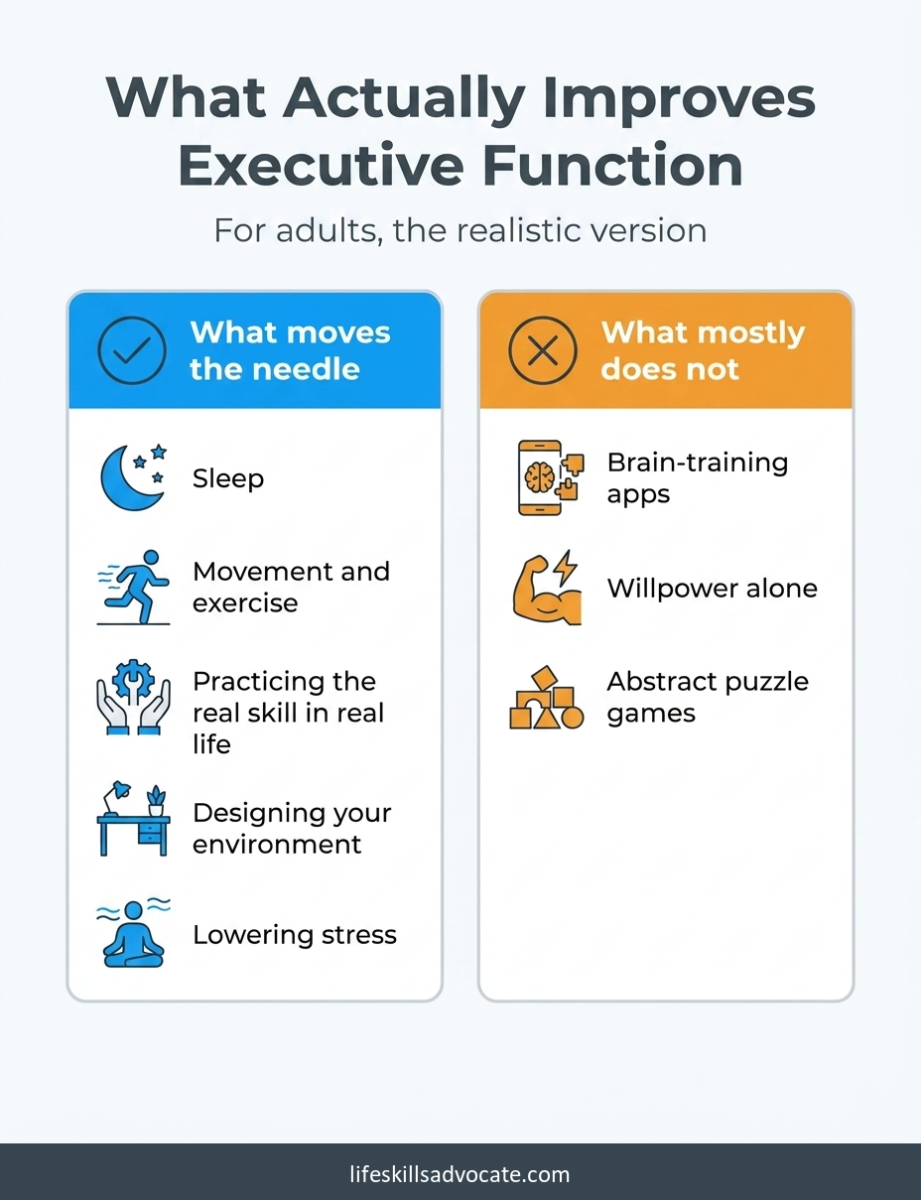
Knowing how to improve executive function in adults comes down to a few moves, stacked in this order:
- Executive function is a group of brain skills for planning, starting, time, memory, and emotional control, and it can genuinely strengthen with practice.
- Start with the foundations your brain runs on: sleep, movement, lower stress, food, and connection.
- Add external supports, such as timers, visible reminders, and a planner, so your environment carries some of the load.
- Practice a few core skills in small, repeatable steps, especially getting started, which is the hardest move for most people.
- Skip the brain-game hype. Training that transfers to real life looks like exercise and practicing the actual skill, not puzzle apps.
This is educational, not medical or diagnostic advice. If you are working with a clinician or coach, use it as a supplement to that conversation, not a replacement for it.
What Executive Function Looks Like in Adult Life
Executive function is the brain’s management system. The Cleveland Clinic overview of executive function describes it as the set of skills that lets you plan, focus attention, remember instructions, and juggle more than one task at a time. In adulthood, those skills are running constantly in the background, which is exactly why their absence is so disorienting.
In day-to-day terms, executive function is what gets you to start the report instead of reorganizing your desk, to leave on time because you tracked the minutes, to remember the thing you walked into the kitchen for, and to send a calm reply instead of the frustrated one. There are several distinct executive function skills involved, including task initiation, planning, working memory, time management, and emotional control, and most people are stronger in some than others.
When these skills are strained, the result is not dramatic. It is a pile of small failures that add up: the unanswered messages, the late fees, the half-cleaned kitchen, the project you keep meaning to start. None of that means a person is failing. It usually means the management system is overloaded, and an overloaded system can be supported.
Can Adults Really Improve Executive Function?
The central question in any guide to how to improve executive function in adults is whether the skills can really change. Yes, with a fair definition of improvement. The adult brain stays adaptable, and skills that get practiced in context tend to get easier.
What is achievable is not turning into someone with effortless focus. It is moving from constantly white-knuckling daily life to having systems that catch you, plus a few skills that genuinely work better than they used to.
Part of improvement is building the underlying skill, and part of it is good design, where the right tool or routine carries the load so your brain does not have to.
Both count.
Setting a recurring alarm so you never have to remember trash day is not cheating. It is solving the problem. A great deal of adult executive function support is environment design, not willpower.
It helps to be clear about the limits here. Individual variation is large, what reliably helps one person can do little for another, and the research on adults specifically is thinner than the research on children. Progress also tends to be uneven, with good weeks and rough ones. That is normal, and a rough week is not evidence that nothing is changing.
Why Executive Function Is Often Harder for Neurodivergent Adults
For neurodivergent adults, executive function challenges are often a core feature of how the brain is wired, not a personal flaw layered on top. ADHD directly affects task initiation, working memory, and time perception, and ADDA’s guide to executive function and ADHD describes these difficulties as central to the condition rather than incidental to it. Autistic adults often experience their own version, sometimes felt as inertia, where shifting into or out of a task takes enormous effort.
Mood and anxiety pile on. Stress is not just unpleasant; research on how acute stress affects core executive functions shows it measurably weakens the prefrontal systems that run planning and self-control. So the more overwhelmed you are, the less executive function you have available, right when you need it most.
The Shame Loop That Makes It Worse
There is a feedback loop worth naming. You struggle with a task, you judge yourself for struggling, the judgment raises your stress, and the raised stress drains the very skills you needed. Shame is not a motivator here. It is an executive function tax.
A lot of the most useful change starts with dropping the moral framing. The phrasing that tends to land with people is permission, not pressure: doing a task imperfectly beats not doing it, and the easy way is a legitimate way. If a task spikes a wave of shame or anxiety before you have even started, that reaction is information about load, not a verdict about you.
Start Here: If Your Executive Function Is at Zero Today
Sometimes you do not need a system. You need to get unstuck in the next five minutes. If you feel completely stuck, frozen, or scattered right now, skip the rest of this guide and try one of these low-effort moves:
- Shrink the task until it is almost too small to refuse. Not “clean the kitchen.” Just “carry one dish to the sink.”
- Set a timer for ten minutes and tell yourself you can stop when it goes off. Starting is the hard part, and ten minutes lowers the cost of starting.
- Body-double. Work alongside someone, on a video call, or even next to a video of a person working. Borrowed momentum is real.
- Meet one body need first. Water, a snack, the bathroom, a window open. A dysregulated body cannot run executive function well.
- Pick the single most urgent thing and ignore the rest of the list until that one is done.
That is the whole entry point. One small action breaks the freeze more reliably than a plan to fix everything, and you can come back for the deeper tactics when you have a little more in the tank.
The Foundations: What Your Brain Runs On
Before any clever strategy, executive function depends on the body it lives in. It is fair to think of your body as an animal you are responsible for feeding, resting, and walking. When the basics are met, every skill below gets easier. When they are not, no planner will save you.
Sleep
Sleep is the highest-impact foundation, and it is the one most adults quietly sacrifice. A 2023 review on sleep duration and executive function links short and disrupted sleep to measurable drops in working memory and attention. You do not need perfect sleep. You need to stop borrowing against it every night and calling the result a character problem.
Movement
Exercise is one of the few interventions with a genuine signal for adult executive function. A small 2024 study on exercise and inhibitory control found that three months of aerobic exercise improved inhibition, a core executive function, alongside measurable brain changes in older adults. The point is movement your body can actually tolerate and repeat, a walk that happens beats a gym plan that does not.
Stress and Emotional Load
Lowering your baseline stress is not a luxury add-on; it directly frees up the brain capacity you spend on planning and starting. That can mean fewer commitments, real breaks, or learning the link between emotional regulation and executive functioning so you can spot a dysregulated moment before it eats your afternoon.
Food and Connection
Steady fuel and human connection both belong here. Skipped meals make focus harder, and low-effort food still counts on a hard day, which is the whole premise behind The Neurodivergent-Friendly Cookbook.
Connection matters too. A 2021 systematic review on social support and cognition associates stronger social support with better cognitive function, so accountability and company are executive function tools, not soft extras. More ideas live in these self-care strategies to support executive functioning.
Day-to-Day Strategies That Work With Your Brain
With the foundations in place, these are the practical moves for the specific skills that tend to give adults the most trouble. Treat them as a menu, not a checklist.
Pick one, run it for a week, and keep it only if it earns its place.
Task Initiation: Getting Started When You Feel Frozen
Starting is the move most adults find hardest, so it deserves the most tools. The moves that consistently help people are small and slightly silly, and that is fine:
- Break it down, then break it down again. If “do taxes” will not move, the real first step might be “find last year’s folder.”
- Junebugging. Start near the task without committing to it. Stand by the sink, and the dishes often pull you in.
- Make it a game or put on a persona, like narrating yourself as if filming a tutorial. Lowering the stakes lowers the friction.
- Do it for future you. Set out the coffee, lay out the clothes, open the document to the right page so the next start is half done.
If switching tasks, rather than starting cold, is your particular wall, the pattern behind that, sometimes called the struggle to shift from one task to another, has its own set of workarounds worth reading.
Planning and Prioritizing When Everything Feels Urgent
When every task screams equally loud, the skill is not doing more, it is choosing. Get the whole mess out of your head and onto paper first, then sort. The act of writing it down is doing real work, because a brain holding twenty open loops cannot prioritize any of them. A brain dump worksheet gives that process a place to land, and a simple approach to planning your day turns the sorted list into something you can actually follow.
Time Management and Time Blindness
Many neurodivergent adults experience time as either “now” or “not now,” which makes planning and deadlines genuinely hard. The fix is to make time visible and external. A visual countdown timer shows time passing instead of asking you to feel it. Estimating how long things take is also a trainable skill, and a time estimation worksheet helps close the gap between the fifteen minutes you guessed and the forty it took.
Time Timer MOD (60-Minute Visual Timer)
Time blindness is one of the most common executive function struggles, and a visual timer helps by showing time as a shrinking colored disc instead of asking you to feel it pass. It turns “ten more minutes” into something you can actually see.
Best for: adults who lose track of time or struggle to start and stop tasks. It runs on one AA battery, and the colored silicone covers are sold separately.
Working Memory, Clutter, and Out of Sight, Out of Mind
If something leaves your visual field and then leaves your mind entirely, your environment needs to remember for you. Keep the things you need visible and the reminders physical. A small whiteboard by the door, a single notebook, or sticky notes at eye level all externalize working memory. This is the same principle behind common object permanence workarounds: out of sight should not mean out of mind, so keep the important things in sight.
Emotional Regulation and the Cost of Self-Talk
The hardest part of an executive function struggle is often the story you tell about it. A missed deadline becomes proof you are broken, and that spiral burns the energy you needed for the next attempt. Regulating the emotion is part of the skill, not separate from it.
When motivation is the wall, a dopamine menu of small rewarding inputs can help you follow through on the things that matter. Noticing the signs of executive dysfunction early lets you respond with a strategy instead of a self-judgment.
Executive Function Training: What Actually Transfers
This is where the promise in the title earns its keep, because executive function training is a phrase the internet has loaded with promises. The plain summary from the research is a useful disappointment: brain-training apps reliably make you better at the brain-training app, and that improvement mostly stays there. Reviews of cognitive training find strong near transfer, meaning gains on the trained task, and limited far transfer, meaning little carryover to everyday function.
So what does carry over? Two things, mostly. The first is practicing the actual skill in the actual context, because executive function is domain-specific, and getting better at planning your real week beats getting better at a planning puzzle. The second is the body-level supports already covered, especially exercise, which shows up across intervention studies as one of the more dependable ways to move adult executive function.
None of this means structured training is worthless. A coach, a class, or a program can be genuinely useful when it has you rehearse real skills and build real systems, rather than drilling abstract puzzles. If you want a vetted starting point, this comparison of executive function training programs for adults sorts the options by what they actually deliver.
What the Research Says: Executive Function at a Glance
For readers and writers who want the sourced facts behind how to improve executive function in adults, here is a compact reference on what the research actually supports.
| Finding | What it means for you | Source |
|---|---|---|
| Short and disrupted sleep is linked to measurable drops in working memory and attention in adults. | Protecting sleep is one of the highest-return moves for executive function. | Sleep and executive function review, 2023 |
| Acute stress weakens the prefrontal systems that run planning and self-control. | Lowering stress load returns brain capacity you spend on starting and planning. | Stress and executive function review |
| Three months of aerobic exercise improved inhibitory control, an executive function, with measurable brain changes in older adults. | Movement your body can tolerate is a real EF support, not just general health advice. | Exercise and inhibitory control study, 2024 |
| Stronger social support is associated with better cognitive function. | Connection and accountability function as executive function tools. | Social support and cognition review, 2021 |
When to Seek More Support for Executive Function
Strategies and tools handle a lot. Sometimes they are not enough on their own, and reaching for more support is a practical move, not a failure.
It is worth talking to a professional when executive function struggles are consistently affecting your work, relationships, finances, or mental health, when you have tried reasonable approaches and little sticks, or when you suspect an undiagnosed condition like ADHD is underneath it. A starting point is the free executive functioning assessment, which can help you see where your skills sit.
Different supports do different jobs, and they are not interchangeable. Therapy treats mental health conditions like anxiety or depression. A psychiatrist can evaluate and, where appropriate, prescribe medication, which for ADHD can lift the floor that skills then build on.
Executive function coaching is different from all of these: it is educational and skill-focused, a structured partnership to design systems and practice the skills in your real life, not mental health treatment. Many adults end up using more than one, and a closer look at how coaching, therapy, and medication each address different parts can help you choose where to start.
Frequently Asked Questions
Does improving executive function mean I will stop needing workarounds?
Usually not, and that is fine. For most adults, lasting improvement is a blend of two things: some skills that genuinely get stronger with practice, and a set of supports and systems that carry the rest permanently.
The goal is a life that runs smoothly, not a brain that needs no help. A reminder that does the remembering for you is a successful outcome, not a crutch. Aiming to eliminate every tool tends to backfire.
How long does it take to notice changes in executive function?
Foundational changes can show up fast. A few nights of better sleep or a week of regular movement can lift focus noticeably. Skill-building is slower, often weeks to months of repetition before a new approach feels automatic, and progress is uneven rather than linear.
Is poor executive function always a sign of ADHD?
No. ADHD is one common cause, but executive function can be strained by stress, poor sleep, anxiety, depression, autism, trauma, hormonal changes, or simple overload. Many people without any diagnosis hit executive function walls during high-demand stretches of life.
If the difficulties are lifelong, pervasive, and significantly affecting daily life, an evaluation can clarify what is going on. If they are recent and tied to a hard season, addressing the load may be the more useful first step.
Do brain-training apps actually improve executive function?
Mostly they improve your score on the app. The research finds that cognitive-training games produce real gains on the trained task but limited carryover to everyday function. They are not harmful, and some people enjoy them, but they are a weak lever compared with practicing real skills, moving your body, and protecting sleep.
What if I keep trying strategies and nothing seems to stick?
First, check the foundations. Strategies fail predictably when sleep, stress, and basic needs are not handled, because there is no executive function available to run them. A strategy is not broken if the brain meant to use it is running on empty.
Second, look at fit and support. A strategy that works for someone else may be wrong for your brain, and that is information, not failure. If the cycle of try-and-stall keeps repeating, that is often the point where outside structure, from a coach or a clinician, does more than another solo attempt. A guided workbook or program can add that structure as well; our rundown of executive functioning curriculum options flags which few actually fit adults.
Third, give a change more time than feels natural. A new approach often feels clumsy for weeks before it settles, so something that has not stuck after three days has not really been tested yet.
Putting It Into Practice: Your Next Steps
Improving executive function as an adult is less about a dramatic overhaul and more about stacking small, durable supports until daily life stops feeling like a fight. A few concrete ways to start this week:
- Pick one foundation and protect it for seven days. Sleep is usually the highest return, so guard your bedtime before you optimize anything else.
- Choose a single strategy from above, not five. Run it for a week and judge it on whether it actually helped, not on whether you did it perfectly.
- Make one thing external today. A timer, a sticky note at eye level, or a brain dump onto paper. Let your environment hold what your memory keeps dropping.
- Get a baseline. The free executive functioning assessment takes a few minutes and shows you which skills to focus on first.
- Browse the free resource library when you want a tool for a specific skill, and explore the wider Executive Functioning 101 hub when you want the bigger picture.
Further Reading
- Executive Function – Cleveland Clinic
- Executive Function Disorder and ADHD – ADDA
- Sleep Duration and Executive Function – PMC, 2023
- Acute Stress and Core Executive Functions – PMC
- Exercise, Inhibitory Control, and Brain Plasticity in Aging – Scientific Reports, 2024
- Social Support and Cognition – Frontiers in Psychology, 2021
- The Executive Function Skills – Life Skills Advocate
- Signs of Executive Dysfunction and Strategies – Life Skills Advocate
- ADHD Mental Paralysis – Life Skills Advocate
- Autistic Inertia and Task Switching – Life Skills Advocate
- Object Permanence ADHD Workarounds – Life Skills Advocate
- Planning Your Day – Life Skills Advocate
- Dopamine Menu for ADHD – Life Skills Advocate
- Emotional Regulation and Executive Functioning – Life Skills Advocate
- Self-Care Strategies to Support Executive Functioning – Life Skills Advocate
- ADHD or Anxiety – Life Skills Advocate
- Best Executive Function Training Programs for Adults – Life Skills Advocate
- Coaching vs Therapy: Which One Do I Need – Life Skills Advocate
- Executive Function Coaching for Adults – Life Skills Advocate
- Brain Dump Strategy Worksheet – Life Skills Advocate
- Time Estimation Worksheet – Life Skills Advocate
- The Neurodivergent-Friendly Cookbook – Life Skills Advocate
- Free Executive Functioning Assessment – Life Skills Advocate
- Free Executive Functioning Worksheets – Life Skills Advocate
- Executive Functioning 101 Hub – Life Skills Advocate