
If you have built four time management plans this year and watched all four collapse by Wednesday, the problem is probably not your discipline.
The problem is that almost every plan you can find online assumes a brain that already feels time passing. It assumes you can sense thirty minutes ticking away while you read. It assumes “block out two hours for deep work” is a sentence your nervous system can act on. For a lot of neurodivergent adults, none of those assumptions hold, which means the plan starts from a place that does not match the brain trying to use it.
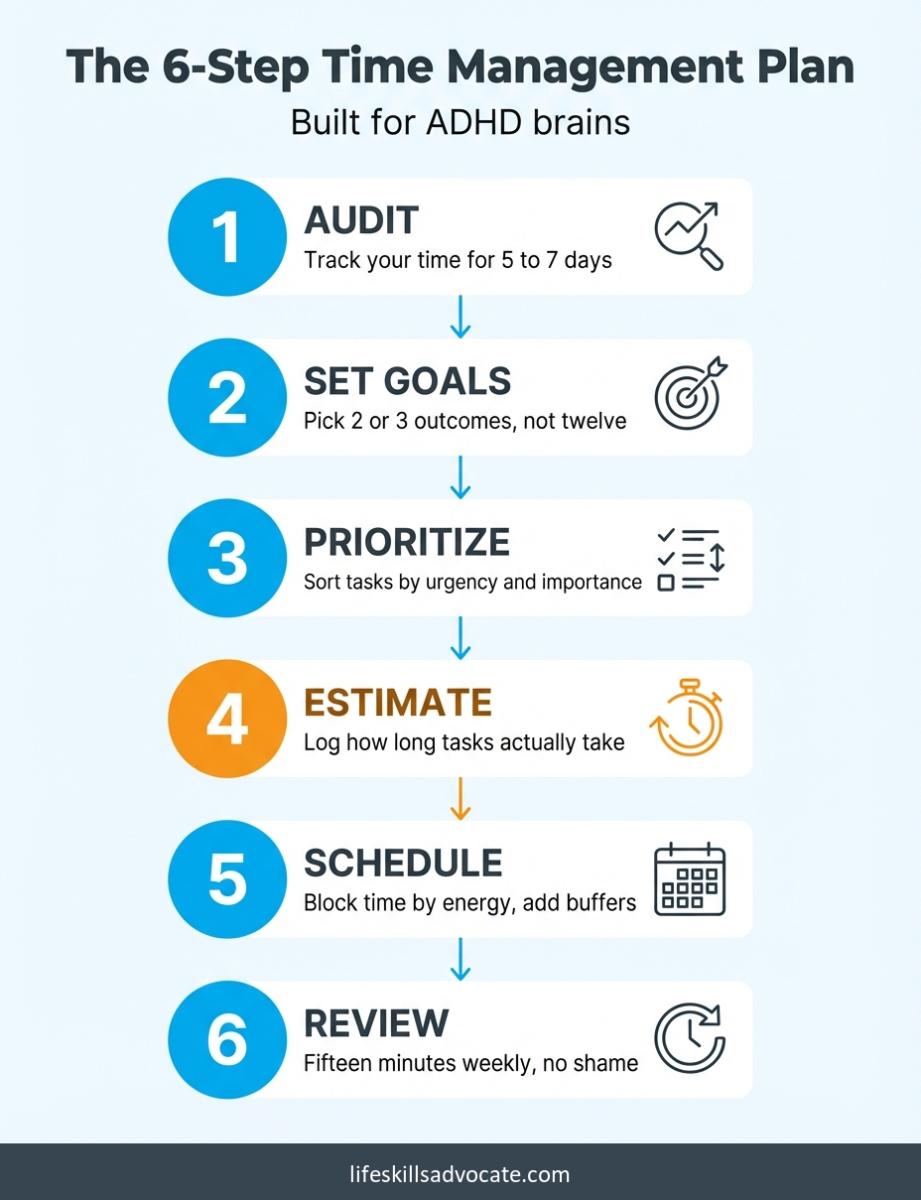
This guide walks through six steps built around the way ADHD and other ND brains actually experience time, with one small adjustment per step so the whole thing does not collapse the first time something runs late.
TL;DR
If your last three attempts collapsed by Wednesday, here is what is worth knowing before you build the fourth.
- A time management plan is a six-step process: audit, set goals, prioritize, estimate, schedule, and review. It is a system, not a single calendar app.
- Generic plans fail neurodivergent brains because they assume you can feel time passing. Many ND adults cannot, and that is the part to design around.
- Building a personal time database (Step 4) is the highest-leverage move: track how long tasks actually take, then plan from that data instead of from optimism.
- Block time by energy first, clock second, and add buffer minutes between blocks before you need them.
- Review weekly. The point of the review is not judgment. It is data for next week’s revision.
What a Time Management Plan Actually Is
A time management plan is a written process for deciding what to do, when to do it, and in what order.
Not a calendar. Not an app.
The calendar and the app are tools the plan uses. The plan is the thinking behind why those tools have anything in them. The missing piece, when previous attempts have collapsed, is usually a process underneath the planner: a repeatable way to translate “everything I have to do” into “what I am actually doing today, and why.” For more on where this fits in the wider set of executive function skills, our basics of executive function and time management is a useful companion read.
Quick Reference: The Six-Step Time Management Plan
| Term or Step | Definition |
|---|---|
| Time management plan | A six-step written process for deciding what to do, when, and in what order, designed to be revised weekly. |
| Step 1: Audit | Track current time use for five to seven days to see where the hours actually go. |
| Step 2: Set goals | Name two or three specific outcomes the plan should serve over the next month. |
| Step 3: Prioritize | Rank tasks by urgency and importance using a fixed frame, such as the Eisenhower Matrix. |
| Step 4: Estimate honestly | Build a personal record of how long tasks actually take, not how long you think they take. |
| Step 5: Schedule with buffers | Block time around priorities with intentional buffer minutes between blocks. |
| Step 6: Review weekly | Set a recurring fifteen-minute review to compare plan to reality and revise. |
Why Generic Time Management Plans Fail Neurodivergent Brains
Most published advice on time management was written for a brain that already has working time perception. The author can feel an hour. Their plans assume the reader can too. When that assumption is wrong, every layer above it collapses.
Three failure modes show up over and over.
You Cannot Budget Time You Cannot Feel
Time blindness is the reduced ability to internally sense time passing. It is well documented in ADHD and shows up across other ND profiles too. When time blindness is in the room, “block out two hours for deep work” is not something you can act on, because there is no internal signal that two hours have passed. There is only “I started,” “I am still doing it,” and the eventual jolt of realizing it has been four hours and the kids need dinner. Time blindness in ADHD is one of the most common reasons a perfectly designed plan stops working on day two.
The 30-Minute Task That Takes 90 Minutes
Most people underestimate how long tasks take. This is called the planning fallacy, first described by Kahneman and Tversky in 1979 and replicated many times since. For ADHD adults the gap between estimated and actual time tends to be wider on average and more persistent across task types. A plan built on optimistic estimates is a plan with hidden debt: by 11 a.m. it is already an hour behind, and that hour has to come from somewhere.
When the Plan Slips, the Whole Plan Dies
Almost every top result for “time management plan” ends at “review and adjust.” None tell you what to do in the middle of a Tuesday afternoon when one task ran ninety minutes long, the next two are now impossible, and the entire shape of the day has gone sideways. Without rules for that exact moment, the default is to abandon the whole thing and call yourself bad at time management. ADDA’s overview of ADHD time blindness describes the self-disappointment that follows as a common and exhausting part of trying to operate on a generic system.
How to Build Your Time Management Plan in Six Steps
Step 1: Audit How You Actually Spend Your Time
Before designing anything, find out where your hours currently go. For five to seven days, write down what you are doing every thirty to sixty minutes. Phone alarms work. A printed log works. The free LSA Time Log Worksheet works for people who want a structured form rather than a blank page.
The audit is not about catching yourself wasting time. It is about getting honest data. Most people are surprised by how much time goes to small interruptions they would have sworn took five minutes, and how often the day looks completely different from what they planned the night before.
At the end of the week, group what you see into rough buckets: focused work, admin and email, transitions, breaks, recovery, and life. Those buckets are the raw material every other step will use.
Step 2: Pick Two or Three Goals, Not Twelve
The instinct after an audit is to fix everything at once. Resist it. A plan with twelve goals is not a plan; it is a list of things you will feel guilty about by Friday.
Pick two or three outcomes the plan needs to serve over the next month. One should be small and concrete (finish the certification module, get to Pilates twice a week). One can be larger (rewrite the resume, finish the apartment cleanout in three weekends). Use the SMART frame if it helps: specific, measurable, action-oriented, relevant, time-bound. The free LSA SMART Goal Setting Worksheet walks through it.
If naming only two or three feels impossible, that is a useful signal. It usually means the rest of the list is not really goals; it is the noise of a brain trying to hold too much without a system to put it down.
Step 3: Prioritize With a Frame, Not With Vibes
“Pick what matters most” is not advice anyone with executive function challenges can act on without a frame. One of the most widely cited frames in popular time management writing is the Eisenhower Matrix, which sorts tasks into four quadrants: urgent and important, important but not urgent, urgent but not important, and neither.
The value of the Eisenhower Matrix is not the categorization itself; it is that the matrix forces a stop. Instead of grabbing the loudest task, you spend two minutes deciding where the task actually belongs. Run a fresh pass once a day, not once a week. The free LSA Eisenhower Matrix worksheet gives you a printable grid.
If categorizing every task starts to feel like its own ritual, stop. The matrix is a sorting tool, not a hobby.
Step 4: Build a Realistic-Time Database
This is the highest-leverage step in the process and the one almost no other guide names. You do not actually know how long your tasks take. You know how long you think they take, which is usually wrong by a factor most people find shocking the first time they measure it.
For two to four weeks, time your recurring tasks. Folding laundry. Replying to a backlog of emails. Drafting a one-page memo. Getting out the door. Use a stopwatch app or a kitchen timer and write the actual minutes next to your original estimate. The free LSA Time Estimation Worksheet includes an “estimate vs. actual” column that turns the planning fallacy into something visible.
A reasonable shortcut while the data is thin: multiply every estimate by 1.5x. The multiplied number lands closer to the truth than the original guess and gives the plan room to breathe. Once a few dozen rows exist, the schedule stops running on optimism, which alone removes one of the biggest reasons plans fall apart on day two.
Step 5: Time-Block by Energy, Then by Clock
Standard time blocking divides the day into rigid clock slots. For a brain that does not feel time well, that approach has a built-in problem: the 9 a.m. slot assumes you arrive at 9 a.m. with the energy 9 a.m. supposedly carries. Many ND adults do not. Some are sharpest at 11 a.m. Others get a second wind at 7 p.m. and would happily do their best work then.
Group your tasks by what they demand: high focus, medium focus, low focus, recovery. Place those groups into the parts of the day where that energy actually shows up for you, not where a productivity blog says they should. Pair high-focus blocks with high-friction tasks. Save low-friction admin for the post-lunch crash. Energy-based time blocking tends to outlast clock-only blocking by weeks.
Whatever shape the blocks take, leave ten to fifteen buffer minutes between them. Buffer time is the difference between a plan that absorbs a five-minute interruption and a plan that detonates because of one. ADDitude’s reporting on ADHD time perception is a useful primer on why external cues like alarms and visible timers do the work that internal time sense is not. For a more detailed walkthrough, our guide to building a daily schedule picks up where this step ends.
Step 6: Review Weekly and Revise Without Shame
Pick a fifteen-minute window once a week, the same day, the same time. Friday afternoon and Sunday evening are both common. The review answers three questions: what did I plan, what actually happened, and what should change next week.
The review is not a moral audit. The plan is supposed to slip. Writing it down is what turns the slipping into information instead of just frustration. After the review, update your time estimates, adjust the goals if needed, and rebuild the next week’s blocks from the data. UW Academic Support’s study-skills guidance frames scheduling and review as the load-bearing habits of any working plan, regardless of format.
When Your Time Management Plan Slips: A Recovery Script
Every plan slips. The question is what you do at 2:14 p.m. on a Tuesday, when one task ran ninety minutes long and the day no longer fits. Decide the answer in advance, while you are calm. By the time you need it, you will be too dysregulated to design it.
A serviceable recovery script:
- Stop and breathe for ninety seconds. The plan is not on fire. You are dysregulated and the plan looks like it is on fire. Those are different problems.
- Ask one question: what is the one thing on today’s list that, if I do nothing else, would make today not a wash? Do that next.
- Move two things to tomorrow without apology. Not three, not five. Two. Anything more is a sign you are punishing yourself for the slip instead of recovering from it.
- Write the slip in the weekly review note now, while it is fresh, so Friday’s review has data instead of guesswork.
That is the whole move. Four steps, no shame, no rebuild from scratch. The plan survives the day.
Frequently Asked Questions
What are the seven steps of an effective time management plan?
Most published frameworks land on six or seven steps. The version we recommend is six: audit, goals, prioritize, estimate, schedule, review. The “seventh step” most articles add is some variant of “delegate,” which is useful in workplaces and less applicable to a personal plan. If you manage a household or a team, treat delegation as Step 6.5 rather than as a separate stage.
What is a good time management plan for someone with ADHD?
One you can rebuild in five minutes after it slips. That usually means fewer goals, generous buffer time, energy-based blocks, and a non-negotiable weekly review. External cues like alarms and visible timers do the work that internal time perception is not doing for you. Skip anything that requires you to remember to use it.
What are the 5 P’s of time management?
Proper Planning Prevents Poor Performance. It is a mnemonic, not a method. Worth knowing if it surfaces in a meeting, not worth building a plan around.
What is the 3-3-3 rule for time management?
Three hours on a most-important task, three shorter tasks, and three maintenance items per day. It is a constraint device that works for some people because it caps how much you let yourself plan, not because three is a magic number. If you have tried it and it did not stick, that is a tool that does not fit your brain, not a personal failure. The same goes for the Pomodoro Technique, the 1-3-5 rule, and most viral productivity mnemonics. They are constraints, not solutions, and the constraint only works to the extent that it matches the day you actually have. If a rule that was supposed to simplify your day adds friction instead, drop it without guilt and try a different shape on Monday.
How long should it take to build a time management plan from scratch?
The design phase takes about ninety minutes, and the hard part is not the design. The hard part is the seven days of audit work that need to happen before the design can be honest, plus the four to six weeks of revision that follow. Anyone selling you a “thirty-minute plan” is selling the design and skipping the work that makes the plan real. So a few hours to draft, a couple of months to know whether it actually works for you. There is no version of this that is fast in the way productivity content usually promises fast.
Next Steps
Pick the smallest of the six steps and commit to it for one week. Audit only. The full plan is not the right starting move; the data is.
- Start a seven-day time audit today. No design, no goals, no blocks. Just write down what you are doing every thirty minutes for one week. The rest gets easier when this exists.
- Download one worksheet, not five. The free LSA Time Estimation Worksheet is the one we would pick first. It targets the Step 4 problem that quietly breaks most plans.
- Read the basics if you have not. Our EF 101 overview of time management is a short read and grounds why each step in this plan exists.
- If plans keep slipping no matter what, get a second pair of eyes. One-on-one executive function coaching with Life Skills Advocate is built around this kind of system design. Coaching is educational and skill-focused, not therapy, and it can help when self-directed iteration has plateaued.
Further Reading
- ADHD Time Blindness – ADDA
- Time Management – UW Academic Support
- How ADHD Warps Time Perception – ADDitude
- Planning Fallacy – Wikipedia (Kahneman and Tversky, 1979)
- EF 101: The Basics of Time Management – Life Skills Advocate
- Time Blindness and ADHD – Life Skills Advocate
- Time Blocking for ADHD – Life Skills Advocate
- The Eisenhower Matrix for Neurodivergent Teens and Adults – Life Skills Advocate
- A Step-by-Step Guide to Building a Daily Schedule – Life Skills Advocate
- Time Log Worksheet – Life Skills Advocate
- SMART Goal Setting Worksheet – Life Skills Advocate
- Eisenhower Matrix Worksheet – Life Skills Advocate
- Time Estimation Worksheet – Life Skills Advocate
- Executive Function Coaching – Life Skills Advocate