
You are sorting through a box of old report cards. Third grade: “doesn’t apply himself.” Fifth grade: “capable of more if he would focus.” A college transcript with one A surrounded by Cs you barely remember earning. A few therapist intake forms that always asked about anxiety, never about attention.
A late ADHD diagnosis usually does not arrive as new information.
It arrives as a folder full of comments you have heard your whole life, suddenly arranged into a pattern.
For me, that landed at 35. For someone else it might land at 28, or 42, or 60. The timing might not change the experience much. What changes is how much of your life you spend reorganizing yourself around the pattern once you have seen it.
TL;DR
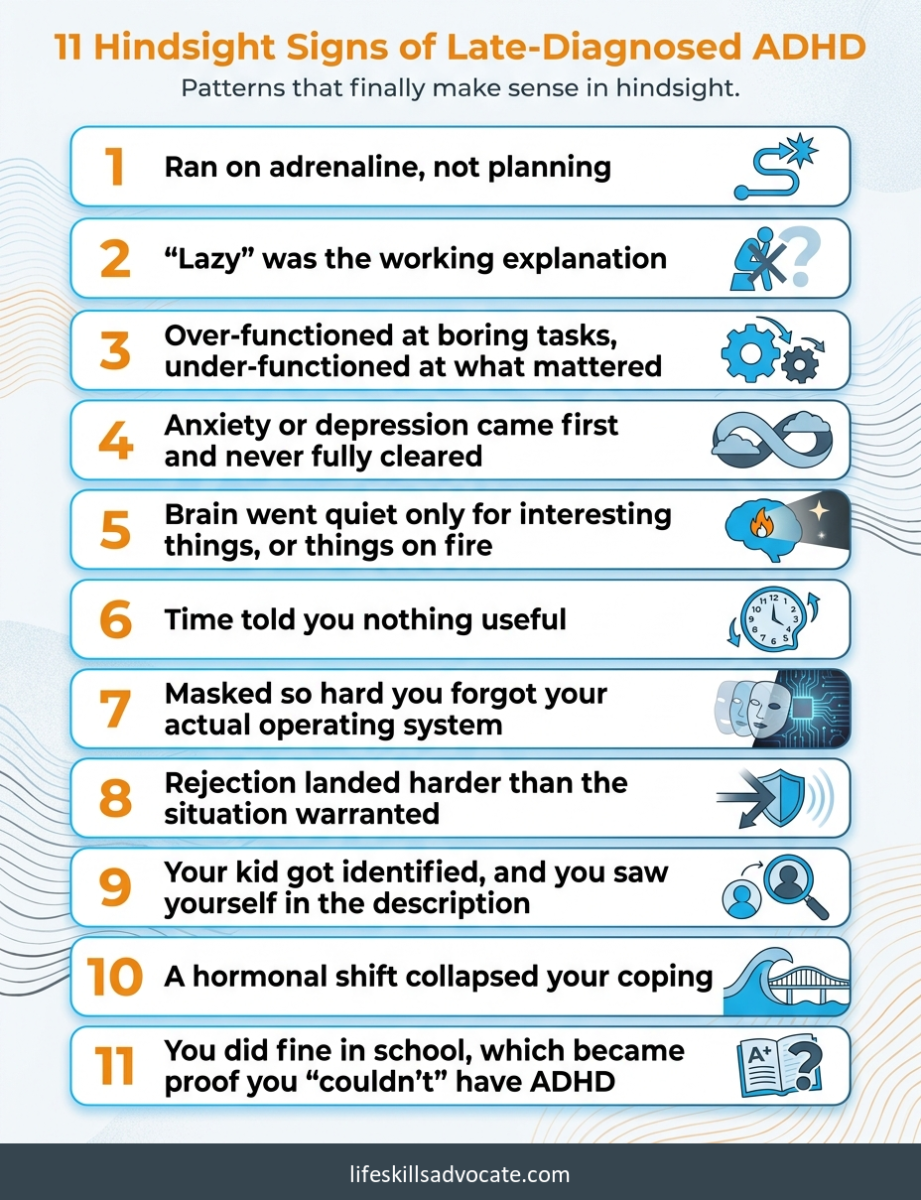
Eleven patterns adults say finally made sense in hindsight once a late ADHD diagnosis was on the table:
- You ran on adrenaline, not planning.
- “Lazy” was the working explanation for almost everything.
- You over-functioned at boring tasks and under-functioned at what mattered.
- Anxiety or depression came first and never fully cleared.
- Your brain went quiet only for interesting things, or things on fire.
- Time told you nothing useful.
- You masked so hard you lost track of your actual operating system.
- Rejection landed harder than the situation warranted.
- Your kid got identified, and you saw yourself in the description.
- A hormonal shift, often perimenopause, collapsed your coping.
- You did fine in school, which became proof you “couldn’t” have ADHD.
This is educational, not diagnostic. Recognizing yourself in a list is not the same as being identified by a qualified professional, and any honest evaluation needs more than a checklist.
Why a late ADHD diagnosis gets missed
Late ADHD diagnosis is not usually a story about the person who got missed. It is a story about the system that was not built to see them.
The diagnostic criteria most evaluators grew up with were built on observations of hyperactive boys in elementary classrooms. The kid who could not sit still. The kid who blurted answers. The kid who lost his homework on the bus. That image trained an entire generation of professionals to recognize one presentation of ADHD: outward, disruptive, and male.
Adults whose ADHD never fit that template were systematically passed over. People with inattentive presentation got labeled daydreamers, then anxious, then depressed. Women in particular are recognized with ADHD on average four to five years later than men, and many are not identified until their 30s, 40s, or 50s, often after their own child gets flagged. Another commonly missed group: AuDHD adults, where co-occurring autism and ADHD frequently mask each other until one identification cracks the other open.
Then there is masking. Years of compensating for an attention system that did not behave the way teachers, bosses, and partners expected eventually produces a version of you who looks fine on paper. The internal cost stays invisible. A 2023 systematic review of ADHD in adult women describes this gap between adult presentations and the childhood-derived criteria as one of the most consistent reasons women’s ADHD goes unrecognized for years.
None of these patterns mean ADHD on their own. Anxiety, depression, sleep deprivation, and burnout can produce overlapping versions of all of them. Recognizing yourself in a list is not the same as a qualified evaluator finding ADHD.
The list is a starting place, not an ending.
11 signs that quietly made sense in hindsight
These patterns come up over and over in late-diagnosed adult writing, on Reddit threads, in therapy intake forms, and in coaching conversations.
Each one can have other explanations. Several of them together, repeated for decades, are usually the part that stops feeling coincidental.
1. You ran on adrenaline, not planning
Nothing got started until the deadline was breathing on your neck. Homework the night before. Tax return at 11:47 PM on April 15. Birthday gift bought on the way to the party. The work itself often got done well, sometimes brilliantly. The only sustainable input was panic. What looked like procrastination from the outside was a brain that could not produce the chemistry of starting without a real, present threat.
2. “Lazy” was the working explanation for almost everything
For thirty years, lazy was the word everyone reached for. Teachers used it. Parents used it. Partners used it. Eventually you started using it about yourself, because it was simpler than explaining a pattern you could not yet name. The label sticks because it has a moral character, which makes it feel like an accountability tool. ADHD does not have that character.
3. You under-functioned at things you cared about, over-functioned at things you did not
The cruelest part of unrecognized ADHD is that effort and outcome do not correlate well. You over-deliver on the boring administrative task because the structure is clear. You blow the meaningful project you have wanted to ship for years because the structure is open and there is nothing to react to. The misalignment looks like a character flaw until you understand the attention mechanism underneath it.
4. Anxiety or depression came first, and never fully cleared
The most common pre-ADHD path for adults is years of working through anxiety, depression, or both, with a therapist or medication. I spent over a decade on that path before anyone asked about attention. The therapy helps. The medication helps. The underlying executive system never gets addressed, because nobody names it. Adults who eventually get identified with ADHD often describe the same shape: anxiety lifted, but the disorganization, the time blindness, and the chronic mid-task abandonment stayed exactly where they were.
5. Your brain went quiet only when something was interesting, or on fire
ADHD attention is not broken. It is interest-driven and threat-driven. The library was unbearable. The deadline at 2 AM was thrilling. The hobby you fell into for six hours had your full focus. The bills you needed to handle for twenty minutes were unreachable. Hyperfocus often gets mistaken for “I am just passionate about that thing” rather than recognized as the same attention pattern running in the only mode where it can engage.
6. Time told you nothing useful
You can tell what time it is. You cannot feel how long forty minutes is. Five-minute tasks took two hours. Two-hour tasks finished in twenty minutes with no memory of the middle. The result was the same: late, behind, with a vague sense that the clock belonged to other people. Adult life keeps presenting time-based demands, and ADHD adults keep meeting them with a sensory system that cannot see them clearly.
7. You masked so hard you forgot what your actual operating system felt like
Masking is the unpaid full-time job underneath the paid one. You overprepared so the meeting would not reveal anything. You worked late on the writeup that should have taken an hour. After enough years of it, the original brain underneath the performance fades into something even you cannot quite locate. This is part of why the so-called “high-functioning” ADHD label is a poor descriptor in adulthood: it measures the output of a successful mask, not the cost.
8. Rejection landed harder than the situation warranted
Many late-identified adults describe the same emotional fingerprint: feedback, real or imagined, hit with a force that did not match the input. A coworker not replying to a message felt like being fired. A friend canceling plans felt like losing the friendship. The pattern goes by rejection-sensitive dysphoria informally. It is not formal ADHD criteria, but it shows up reliably enough as a hindsight marker.
9. Your kid got identified, and you saw yourself in the description
This is the most common late-diagnosis route. The intake form for your kid’s evaluation is, item by item, the description of your own childhood. Adults often arrive at their own ADHD identification by accident, sitting in a chair at a pediatric office reading a checklist about someone else. The APA Monitor on adult ADHD diagnosis describes the rise in late-identified adults reaching evaluation through these kinds of indirect routes.
10. Perimenopause, or any major hormonal shift, collapsed the coping you had built
This one mostly applies to women, and to people whose hormone profile drops estrogen in midlife. The workarounds you built yourself stop working in your late 30s or early 40s. Tasks fall through. Productivity drops. The reasonable assumption is depression. The more accurate one is often that estrogen was quietly supporting your dopamine system the whole time, and as it drops, the ADHD pattern you had been outrunning starts running you instead. This is a major reason why ADHD in women and girls often gets recognized so much later than in men.
11. You did fine in school, which became proof you “couldn’t” have ADHD
The grade-school report cards that said “smart, just disorganized” stop being a warning sign and become a defense. By college, you were managing somehow, and that became evidence. A diagnosis at 35 means living with an internal voice that argues you did not actually have ADHD because you graduated, you have a job, you finished things. School is not a sensitive ADHD test. It rewards the people who can grind through repetition and externally imposed deadlines, which is exactly the environment that inattentive brains can mask in for years before the world demands self-direction.
Holding relief and grief together
Most published writing on late diagnosis treats relief and grief as competing reactions. They are not.
They are the same response, processed through two different time frames.
The relief is about the present. The pattern has a name. The years of effort were not laziness. The internal voice that said “you should have been able to handle this” was wrong, or at least incomplete.
The grief is about the past. The time spent on the wrong explanation. The relationships strained by it. The career decisions made under it. The version of you who could have used the language thirty years sooner, and did not have access to it.
Both are real. Both arrive at the same time. The reason naming both matters is that pieces framing the diagnosis as purely positive feel condescending, and pieces framing it as purely tragic miss what makes it useful. The Colorado Therapy Collective on the hidden grief of late ADHD diagnosis calls integration of both responses the part of the work that moves a late identification from a fact about yourself into a tool you can use.
Late ADHD diagnosis at a glance
| Term or fact | Quick fact | Source |
|---|---|---|
| Late ADHD diagnosis | An ADHD identification made in adulthood, where the underlying pattern was present (but unrecognized) since childhood. ADHD does not develop in adults. | NIMH overview of ADHD |
| Average identification gap, women vs men | Women are identified with ADHD roughly four to five years later than men on average. | ADDA, 2024 |
| Adult ADHD prevalence | About 4.4% of U.S. adults meet criteria for ADHD; recognition rates have climbed faster than underlying prevalence over the past decade. | CDC ADHD Data and Statistics |
| Hindsight pattern | Late-identified adults frequently describe “I thought everyone was like this” once they learn how ADHD actually shows up across adult life. | Synthesized from r/ADHD threads and ADDA |
| Relief and grief coexist | Many adults describe relief and grief as a single integrated response, not competing reactions. Naming both is part of integrating the identification. | Colorado Therapy Collective, 2024 |
Frequently asked questions
Is it worth getting a late ADHD diagnosis?
Yes, for most adults who are seriously considering it. The identification does not change what your brain is, but it does change what you can do about it. Once the pattern has a name, you can stop reorganizing your life around the assumption that you should be able to brute-force it. The relief is real. The grief is also real, because the diagnosis often arrives with an itemized invoice of what unrecognized ADHD cost you, professionally and personally. Adults who say it was not worth it usually mean the process was expensive or the provider did not take adult presentations seriously, and that is a problem with the system, not with knowing. The other quiet benefit: with a formal identification, accommodations at work and school become a much shorter conversation, even if you never end up using them.
How is a late ADHD diagnosis different from being diagnosed as a kid?
The traits are the same. The identity work is different. A child gets ADHD as part of who they are becoming. An adult gets ADHD as a rewrite of who they thought they were, which means going back through decades of misread effort and re-labeling it.
Can you really “miss” ADHD for 40 years?
Yes, especially in inattentive presentations and in people who could mask. The diagnostic criteria were developed from observations of hyperactive children, not from adult presentations. Plenty of people sailed through the parts of childhood that flag ADHD most visibly, like sitting still in a chair and following externally structured school days, then ran aground in the parts of adulthood that demand self-direction. Graduate school. Parenthood. Self-employment. The “high-functioning” or “smart kid” label got applied early and protected the diagnostic gap for decades. The miss is not really about the individual. It is about which presentation the system was trained to see.
What is the “10-3 rule” for ADHD?
It is a productivity heuristic, not a diagnostic term. Ten minutes of focused work, three minutes of break, repeated. Works for some people, not others.
I’m in my 40s and my coping just collapsed. Did I just develop ADHD?
Almost certainly not. ADHD does not appear in adulthood; it has been there the whole time, masked by coping that finally ran out of runway. For women in their 30s and 40s especially, perimenopausal estrogen changes destabilize the workarounds that held things together for decades. The right question is whether your coping quietly stopped working, and why nobody saw the pattern before. Can you actually develop ADHD as an adult walks through the science.
Next steps after a late ADHD diagnosis
The first six weeks are mostly about un-learning who you thought you were. Most of what to do is small, sequenced, and decidedly not heroic.
- Write down the three patterns from this list that hit hardest. That is your starting point. Not a homework assignment, just a reference for what you are now allowed to take seriously.
- A self-administered check is the fastest way to find where the friction lives in your week. LSA’s free executive functioning assessment takes about 15 minutes and produces a working snapshot of your eight executive function skills.
- Decide what kind of support fits the gap, if any. Therapy addresses the emotional weight. Executive function coaching is for the day-to-day skill side: time, task initiation, planning, the things nobody taught you in third grade. They are different jobs and they work well together when both apply.
- One small adjustment is enough for now. The brain that just learned its name is also still adjusting. Pick one piece that feels manageable and start there. Whatever did not get fixed in the first thirty years can wait one more week.
Further reading
- Miss. Diagnosis: A Systematic Review of ADHD in Adult Women – PMC
- Attention-Deficit/Hyperactivity Disorder (ADHD) – NIMH
- ADHD in Women – ADDA
- ADHD Data and Statistics – CDC
- An ADHD Diagnosis in Adulthood Comes With Challenges and Benefits – APA Monitor
- The Hidden Grief of a Late ADHD Diagnosis – Colorado Therapy Collective
- r/ADHD – Reddit
- ADHD Masking: What It Is, What It Costs, and What Actually Helps – Life Skills Advocate
- AuDHD and Executive Function in Daily Life – Life Skills Advocate
- Is High Functioning ADHD a Real Diagnosis? – Life Skills Advocate
- Understanding ADHD in Women and Girls – Life Skills Advocate
- Can You Develop ADHD as an Adult? – Life Skills Advocate
- Free Executive Functioning Assessment – Life Skills Advocate
- Executive Function Coaching – Life Skills Advocate