
You have spent years assuming other people just have more discipline around food. Maybe you cycled through tracking apps, intuitive eating books, and meal-prep systems.
Each one fell apart within a couple of weeks. You chalked it up to a personal failing.
Then someone you love (or you) gets evaluated for ADHD. And a question forms that no one warned you about: what if the eating thing was never about willpower?
The link between ADHD and eating disorders is one of the most reliably replicated overlaps in adult ADHD research, yet almost every article naming the connection stops there. The missing piece, the part that makes the pattern legible, is executive function. The same brain skills that make ADHD hard to live with also shape how food, hunger, and eating show up day to day.
TL;DR
Five questions readers tend to stack when they search how ADHD and eating disorders connect:
- How strong is the link between ADHD and eating disorders?
- Which eating disorders co-occur most often with ADHD, and how does the overlap show up?
- What are the six executive function patterns driving the connection?
- Why does this combination hit late-identified adults so hard, especially women?
- What kinds of support pair appropriately with eating-disorder care?
Life Skills Advocate is an executive function coaching practice. We are not licensed clinicians, dietitians, or eating-disorder specialists, and this article is educational. If you suspect that you or someone you love has an eating disorder, please reach out to the National Eating Disorders Association helpline (1-800-931-2237), ANAD, or a clinician trained in eating-disorder care. Nothing here is a substitute for that care.
A 2016 meta-analysis found adults with ADHD are about 3.82 times more likely to have any eating disorder than adults without ADHD. Binge eating disorder shows the tightest overlap, with an OR of 4.13. Researchers point to dopamine reward, impulsivity, and reduced interoception as the underlying mechanisms.
What the research actually shows about ADHD and eating disorders
The most-cited number on ADHD and eating disorders comes from Nazar’s 2016 meta-analysis. Adults with ADHD had 3.82 times higher odds of any eating disorder than adults without ADHD. The pool covered 4,013 ADHD cases and 29,404 controls. Binge eating disorder showed the tightest coupling at OR 4.13. Bulimia nervosa was also elevated. Anorexia nervosa appeared somewhat elevated, but with wider confidence intervals.
The link runs in the other direction too. Roughly 30% of adults with binge eating disorder also have ADHD. A 2023 minireview estimates that about 20% of children with ADHD develop an eating disorder by early adulthood. That includes binge eating disorder, bulimia, anorexia, and ARFID.
Twin research adds another layer. About 91% of the covariance between ADHD traits and binge eating is genetic. Translated, the two travel together at a constitutional level. Not just at the level of habits or willpower.
None of that means an eating disorder is inevitable for any person with ADHD. Plenty of people with ADHD never develop one. The point of the numbers is to make a pattern visible. When food struggles feel disproportionate to effort, the brain is doing something measurably different.
4 eating disorders that co-occur with ADHD, and how the overlap shows up
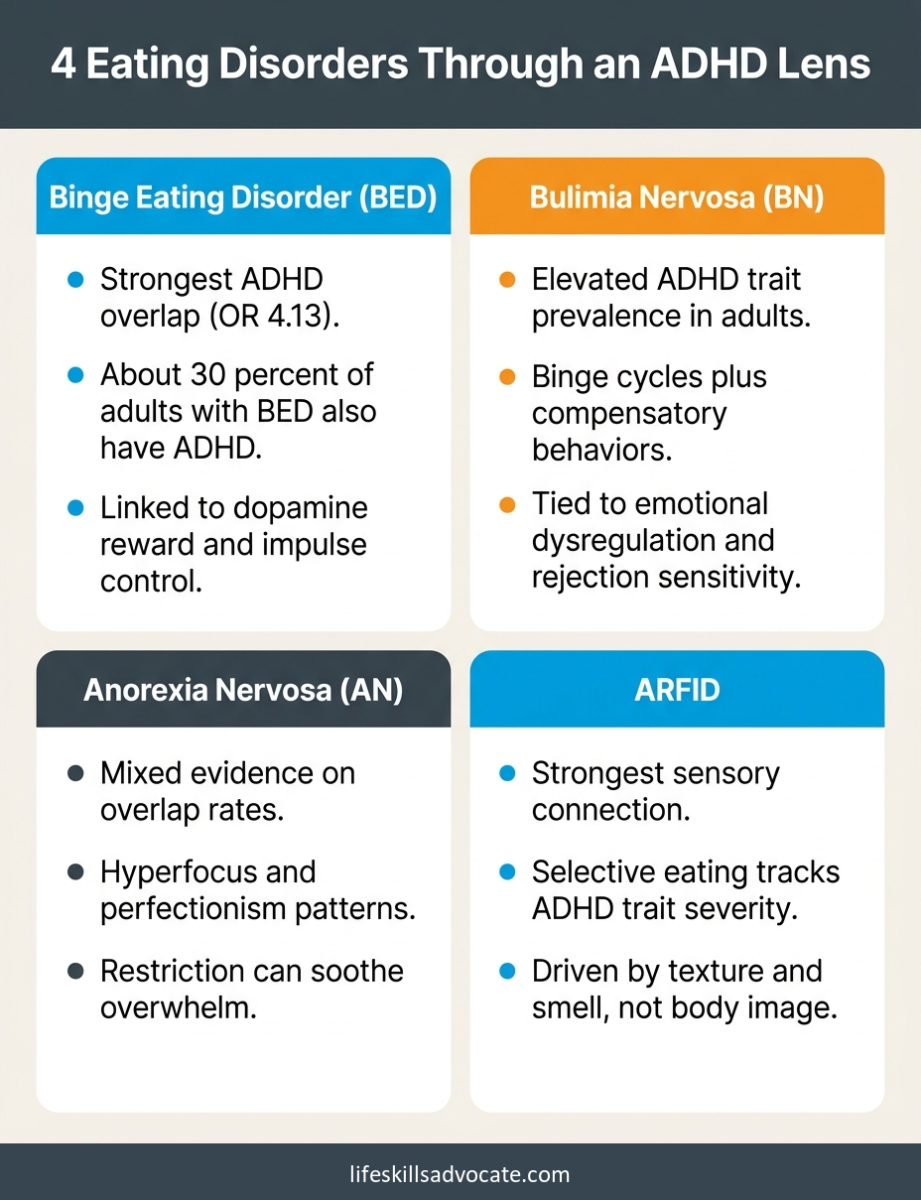
The connection between ADHD and eating disorders is not uniform. Each of the four most-common categories has a different relationship to ADHD, and the daily-life experience looks different depending on which pattern fits.
Binge eating disorder (BED)
BED has the strongest documented overlap with ADHD, at OR 4.13. About 30% of adults with BED also have ADHD. The link is reliable enough that the FDA approved lisdexamfetamine (Vyvanse) specifically for moderate-to-severe BED in adults in 2015. Day to day, this typically looks like skipping meals during the work day because of forgetting or hyperfocus, hitting late-afternoon depletion, then eating past fullness in a way that feels driven rather than chosen. The food is usually hyper-palatable and easy to access. The shame after the fact is the part most people remember.
Bulimia nervosa (BN)
BN appears at elevated rates in ADHD populations. A 2025 scoping review of adult BN and BED found markedly higher ADHD and autism trait prevalence than in the general population. The pattern is binge cycles followed by compensatory behaviors (purging, fasting, over-exercising) meant to undo them. Through an ADHD lens, both the impulsivity that drives the binge and the rule-rigid attempts to neutralize it can reflect emotional dysregulation, especially around rejection sensitivity.
Anorexia nervosa (AN)
AN shows up less consistently than BED or BN in ADHD samples, and the evidence is mixed. When AN does co-occur with ADHD, the overlap tends to involve hyperfocus, perfectionism, and rule-based control of eating as a way to manage overwhelm. Restriction can act as an external structure that the brain finds soothing, even as it harms the body. Effective support has to address the underlying overwhelm, not just the food.
Avoidant/restrictive food intake disorder (ARFID)
ARFID is the eating-disorder category most tied to sensory processing. Recent research suggests it overlaps substantially with both ADHD and autism. A 2025 study on selective eating in children with ADHD documented elevated ARFID-related picky eating and sensory-processing differences, with selective eating tracking ADHD trait severity. The day-to-day picture is narrow, safe-foods-only eating driven by texture, smell, or appearance rather than body image. Many parents and adults with ARFID describe years of being called picky before a sensory or neurodivergent lens finally fit.
6 executive function patterns behind ADHD and eating disorders
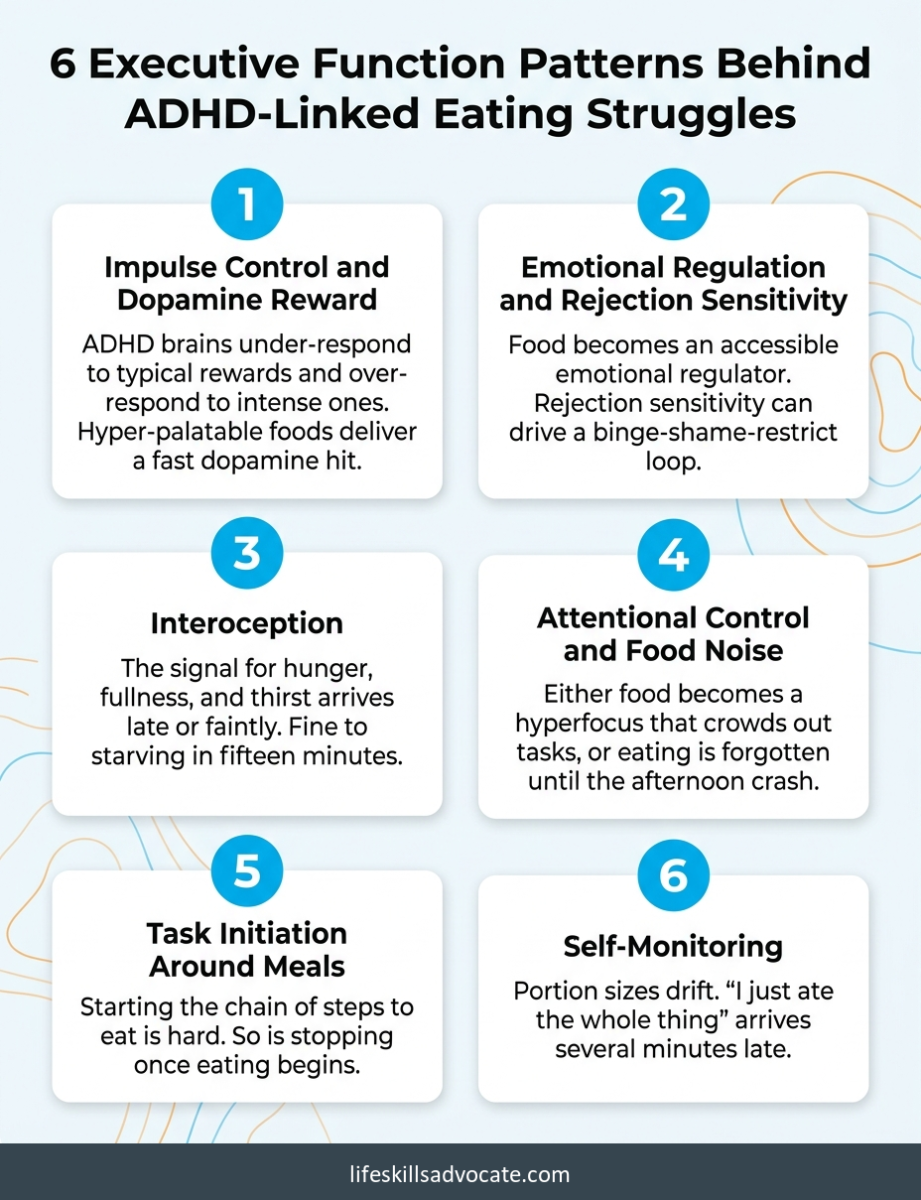
The link between ADHD and eating disorders is not just statistical. Six executive function patterns sit underneath it, and once they are named, the daily-life picture starts to make sense.
1. Impulse control and dopamine reward
ADHD brains tend to under-respond to typical reward signals and over-respond to intense, immediate ones. Imaging research summarized by CHADD shows heightened brain activity in people with high ADHD trait load when they view images of food. Combined with reduced impulse control, the result is a brain that votes yes before the planning system can vote no. This is a different reward curve, not weak willpower.
2. Emotional regulation and rejection sensitivity
Food is one of the most accessible emotional regulators a brain can reach for. When emotional regulation is harder, as it usually is with ADHD, food readily steps into the gap. Adults who experience rejection sensitivity sometimes describe a binge-shame-restrict loop: a perceived slight, a wave of emotion, food as the fastest way to dampen the signal, secondary shame, then rule-rigid attempts to make up for it. The food is not the underlying issue. The unregulated emotional system is.
3. Interoception (hunger and fullness blindness)
Interoception is the body’s ability to register internal signals like hunger, fullness, fatigue, and thirst. In many adults with ADHD, that signal arrives late, faintly, or sometimes not at all. The result is going from fine to starving in fifteen minutes, missing the early-fullness cue, or losing track of whether the last meal was an hour ago or six. ARFID and binge patterns can both trace back to interoceptive differences, even when they look like opposites on the surface.
4. Attentional control and food noise
Attentional control governs what the brain can hold steady, ignore, or shift away from. For some ADHD adults, food becomes a hyperfocus that crowds out other tasks. Others describe the opposite: an entire workday absorbed in a project, with eating forgotten until the afternoon crash. “Food noise,” the persistent intrusive thinking about food and the next meal, shows up in both directions. It is one of the patterns lisdexamfetamine appears to quiet in adults with BED.
5. Task initiation around meals
Eating regularly is a chain of EF steps: notice hunger, decide what to eat, gather ingredients, prepare, eat. Task initiation, the skill that gets a behavior started, is one of the most common ADHD challenges. The chain breaks at the first step, which is why “I know I should eat, I just cannot get myself to” is a recurring refrain. The same dynamic runs in reverse during a binge. Once eating starts, the stop signal can be as hard to access as the start signal was.
6. Self-monitoring and the lost portion
Self-monitoring is the EF skill that lets a person notice their own behavior in the moment. Without it, portion sizes drift, a chip bag empties faster than expected, and the realization that “I just ate the whole thing” arrives several minutes late. This is the subskill most likely to show up in binge episodes, late-night grazing, and the everyday “I did not mean to eat that much” experience. It is also the most responsive to external scaffolding (visual cues, single-serve packaging, structured plates) that does not rely on willpower to work.
Why ADHD and eating disorders hit late-identified adults especially hard
For many adults, the eating disorder showed up first. ADHD came years or decades later, sometimes after a child was evaluated, sometimes after a partner pushed, sometimes after a TikTok video finally named the experience.
This pattern is especially common for women. Research on women with undiagnosed ADHD documents the late-identification sequence. Girls with ADHD are more likely to present with inattentive or internalized traits, which look less loud than the hyperactive presentation common in boys and are frequently missed. Eating disorders, anxiety, and depression frequently get addressed first, sometimes for years, before anyone asks whether ADHD might sit underneath all of them.
The system reinforces the gap. Eating-disorder clinicians often do not screen for ADHD. ADHD prescribers seldom ask about disordered eating history. Teams that integrate both fields are still uncommon. The result is a person who has spent years working very hard on the visible problem without anyone naming the structural one. That is exhausting and demoralizing in a way that compounds, because each round of effort that does not work confirms a story about personal inadequacy that was never the right story.
This article cannot identify anyone. What it can do is hand you a vocabulary. If the eating struggles have always felt disproportionate to effort, and the EF patterns above feel like a description of the inside of your head, that is information worth bringing to a clinician who knows both fields.
What helps alongside eating-disorder care
Nothing here replaces evaluation and care from a clinician trained in eating disorders. Eating disorders carry real medical risk and benefit from a coordinated team: a specialist therapist or psychiatrist, a dietitian who works with neurodivergent adults, and a prescriber who understands both ADHD and eating-disorder considerations.
Three things tend to pair well with that work.
Screening and referrals. The NEDA Find Help directory and ANAD’s resource pages are reliable starting points for locating a specialist. If ADHD has not been formally evaluated yet, an evaluation with someone who also screens for eating disorders matters more than which condition gets named first.
Everyday executive function support. Daily meals are an EF task first. The Neurodivergent-Friendly Cookbook by Chris Hanson and Amy Sippl (BCBA) is built around sensory-friendly meal prep for ND adults and families. The Real-Life Executive Functioning Workbook by Chris Hanson and Amy Sippl includes impulse-control and emotional-regulation chapters that target the EF skills behind these patterns. These are educational supports, not eating-disorder care.
Community and lived experience. First-person accounts from people with both ADHD and an eating-disorder history are one of the highest-leverage non-clinical inputs available. The NEDA essay Dopamine, Not Discipline is a good starting point.
FAQ: ADHD and eating disorders
Is there really a connection between ADHD and eating disorders?
Yes. A 2016 meta-analysis found adults with ADHD are about 3.82 times more likely to have any eating disorder. The link is real, well-documented, and rooted in brain biology, not personal failure.
Do people with ADHD have trouble with eating in everyday life, even without a diagnosed eating disorder?
Often, yes. Many adults with ADHD describe forgetting meals during hyperfocus, then eating past fullness when a meal finally starts. Some swing between under- and over-eating depending on stress, sleep, and dopamine availability. Others restrict food variety because of sensory or texture preferences, what can look like picky eating but actually functions as sensory protection. A subset lose track of hunger and fullness signals altogether, which makes any kind of regular pacing feel impossible. These patterns can run for years without crossing the threshold into a recognized eating disorder. They still deserve attention. Chronic dysregulated eating quietly wears on energy, mood, and sleep, and the fix is usually structural support, not effort. None of this is a moral problem to solve.
Can stimulant medication help with binge eating disorder?
Lisdexamfetamine (Vyvanse) is the only medication the FDA has specifically approved for moderate-to-severe binge eating disorder in adults, partly because the dopamine and impulse-control overlap between ADHD and BED is so consistent. Whether a stimulant is appropriate for any individual is a question for a prescriber who knows the person’s full history. The fact of the approval is informative, not directive.
What are signs that ADHD eating quirks have crossed into disordered eating?
Binge episodes that feel out of control, purging or fasting, rapid weight loss, eating that disrupts daily life, and persistent shame are signals to bring to a specialist.
How do you find a clinician who understands both ADHD and eating disorders?
It depends on what is available where you live. Some integrated programs treat both, but more commonly, a specialist therapist or dietitian and a separate ADHD-aware prescriber communicate as a team. NEDA’s Find Help directory is a starting point. The honest answer is that finding someone who genuinely understands both can take more than one try, and that search itself is part of the work.
Citability block: ADHD and eating disorders at a glance
| Fact | Detail | Source |
|---|---|---|
| Adults with ADHD have 3.82x higher odds of any eating disorder | Meta-analysis pooled 4,013 ADHD cases and 29,404 controls; OR 3.82 (95% CI 2.34-6.24) | Nazar et al., 2016 meta-analysis |
| Binge eating disorder shows the tightest overlap with ADHD | Strongest of all ADHD and eating disorders pairings; OR 4.13 (95% CI 3.00-5.67); about 30% of adults with BED also have ADHD | Nazar et al., 2016 |
| About 20% of children with ADHD develop an eating disorder by early adulthood | Includes binge eating disorder, bulimia, anorexia, and ARFID; pediatric and adolescent samples | Villa et al., 2023 minireview |
| Lisdexamfetamine (Vyvanse) is FDA-approved for adult binge eating disorder | First and only medication specifically approved for moderate-to-severe BED in adults (2015); reflects the dopamine and impulse overlap with ADHD | CHADD on ADHD and binge eating |
| ADHD is linked to elevated ARFID-style selective eating | 2025 study documented elevated ARFID-related picky eating and sensory-processing differences in children with ADHD | Selective Eating and Sensory Sensitivity in Children With ADHD, 2025 |
Where to go from here
A few next steps that tend to be useful once the connection clicks:
- Write down the pattern. Note which of the six EF patterns above describe your experience most closely. That list is useful for a future clinician.
- Call a helpline if eating is currently a concern. NEDA’s helpline (1-800-931-2237) is staffed by trained volunteers, free, and a low-bar way to figure out what kind of support fits.
- Ask whichever clinician you see next about both. If the ADHD evaluator is not asking about eating, raise it. If the eating-disorder clinician is not asking about ADHD, raise that too.
- Build daily-life support that runs on structure, not willpower. Visual meal plans, single-serve portioning, and predictable meal timing all reduce the EF load that the patterns above keep tripping over.
- If executive function coaching for the daily-life pieces would help alongside an eating-disorder team, Life Skills Advocate’s coaching is designed for adults and teens ages 14 and up. Coaching is educational and pairs alongside specialist care, never instead of it.
Further reading
- Nazar et al., systematic review and meta-analysis on ADHD and eating disorders – PubMed (2016)
- Villa et al., ADHD and eating disorders in childhood and adolescence – ScienceDirect (2023)
- Autism, ADHD, and Their Traits in Adults With Bulimia and Binge Eating Disorder – PubMed (2025)
- Selective Eating and Sensory Sensitivity in Children With ADHD – PubMed (2025)
- Brain Reward Response Linked to Binge Eating and ADHD – CHADD
- Adverse experiences of women with undiagnosed ADHD – PMC (2024)
- National Eating Disorders Association (NEDA) – Helpline and Find Help directory
- Eating Disorders and ADHD – ANAD
- Dopamine, Not Discipline: The ADHD-Eating Disorder Link I Was Missing – NEDA
- All About Impulse Control – Life Skills Advocate
- Emotional Regulation and ADHD – Life Skills Advocate
- Handling Rejection Sensitivity in ADHD – Life Skills Advocate
- How to Create a Sensory-Friendly Kitchen – Life Skills Advocate
- The Neurodivergent-Friendly Cookbook – Life Skills Advocate
- Real-Life Executive Functioning Workbook – Life Skills Advocate
- Executive Function Coaching – Life Skills Advocate