
You know exactly what you need to do. The email is half-written, the dishes are stacked, the form is due today. And still, something keeps you pinned in place, like there is an invisible wall between you and the thing you are trying to start.
That stuck feeling has a name a lot of people use: ADHD paralysis. It is the freeze that hits when your brain wants to move and somehow cannot get the engine to turn over. It is not laziness, and it is not that you stopped caring. The clearest proof is how often it shows up for things people genuinely want to do, including the fun ones.
ADHD is a difference in how the brain handles motivation and follow-through, not a flaw in someone’s character. The World Federation of ADHD consensus statement describes it as a condition rooted in brain development, which is why “just try harder” tends to land like advice to run faster on a sprained ankle.
Here is the more useful part.
Paralysis usually shows up in a few recognizable patterns, and once you can name which one has you stuck, the way out gets a lot more specific than “be more disciplined.”
TL;DR
ADHD paralysis is the freeze you hit when executive function buckles under load, and it usually shows up in one of three ways:
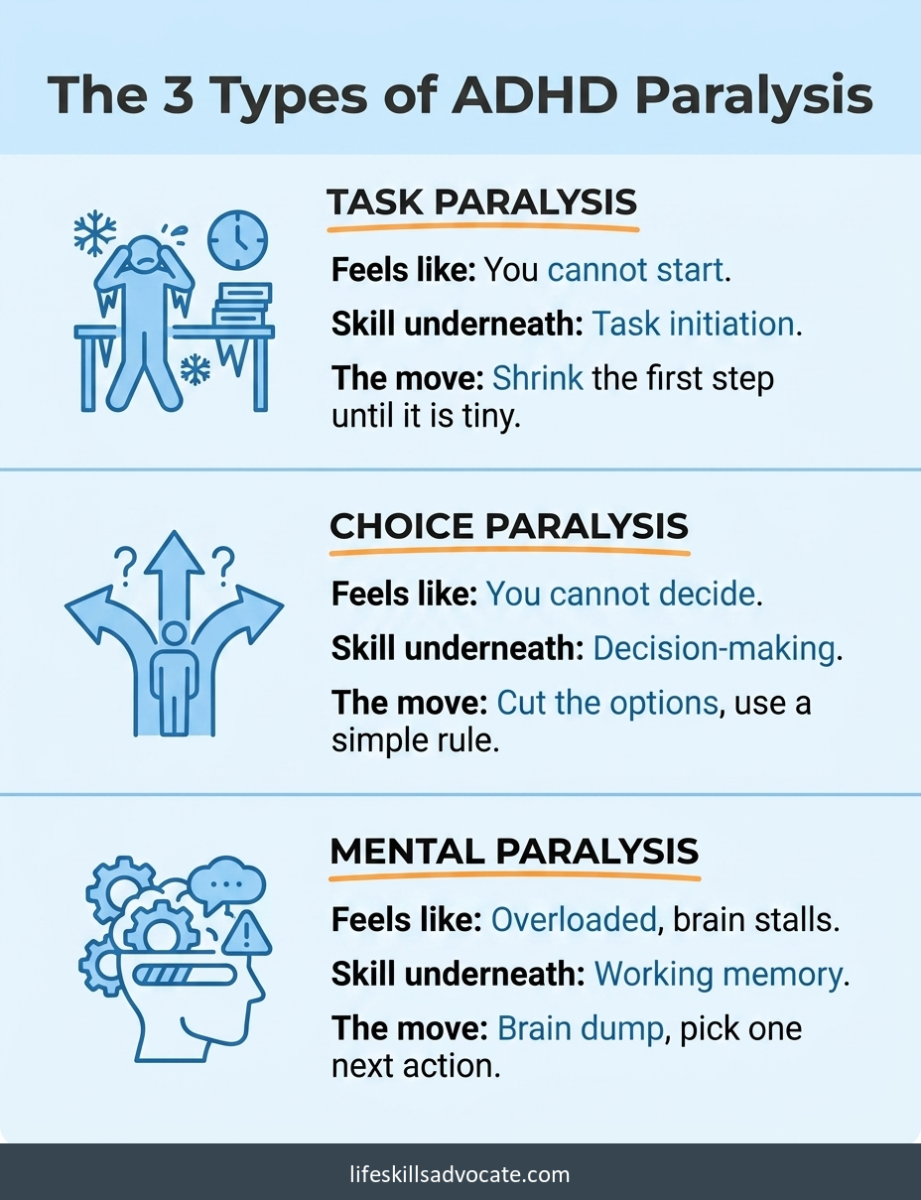
- Task paralysis: you cannot start. Shrink the first step until it is almost too small to bother with.
- Choice paralysis: you cannot decide. Cut the options down and use a simple rule to pick one.
- Mental paralysis: you are overloaded and your brain stalls out, so you empty your head onto paper and choose a single next action.
This is educational, not medical or diagnostic advice. If you are already working on this with a professional, treat it as a supplement to that conversation, not a replacement for it.
What Is ADHD Paralysis?
ADHD paralysis is the experience of being unable to start, decide, or keep going, even when you know what you want and the stakes are clear. It is a real and common experience, but it is worth being clear about one thing: it is a descriptive, community-coined phrase, not a formal diagnosis you will find in a clinician’s manual.
That matters because the label can feel either freeing or scary depending on how it is used. Used well, it gives people language for something that was always invisible. As the Child Mind Institute explains in its overview of ADHD paralysis, the term captures a familiar pattern rather than a separate condition.
People reach for vivid images to describe it. A wall that drops between you and the task. A car with a governor on it: you know it can go faster, you want it to, and it just will not. Mount Everest set down in front of you with no gear and no warning.
Those images are doing real work, because the feeling genuinely is that physical.
ADHD Paralysis vs Executive Dysfunction
This is the question that sends a lot of people searching, so here is the straight answer: ADHD paralysis and executive dysfunction are closely related, but they are not the same thing. Executive function is the set of mental management skills that run the show, things like planning, working memory, flexible thinking, self-control, and task initiation. Executive dysfunction is when those systems are running below the demand placed on them.
Paralysis is often what executive dysfunction feels like in a single moment. When the load gets heavy enough (too much to do, too many choices, too much noise) the system stalls, and the stall is the freeze you feel. So paralysis is not a different problem sitting next to executive dysfunction. It is one of the ways executive dysfunction shows up when it gets overwhelmed.
If you want the bigger picture of how these skills work and where they break down, our guide to the signs of executive dysfunction covers the full set. For this article, the takeaway is simpler: the freeze is a capacity problem under load, not a willpower problem. That single reframe changes which fixes are worth trying.
One caveat before we sort it into types. Real life is messier than any framework. Plenty of stuck moments are a blend, and a hard week can stack all three on top of each other. The types below are a way to find a starting point, not a diagnosis.
The 3 Types of ADHD Paralysis
Most stuck moments fall into one of three patterns. Each one feels different, sits on a different executive function skill, and responds to a different move. Naming yours is the fastest way to stop using a fix that was never built for the problem you actually have.
1. ADHD Task Paralysis
Task paralysis is the can’t-start freeze. You know the task, you may even have done it a hundred times, and you cannot get your body to begin. The skill underneath it is task initiation, the brain’s ability to bridge the gap between intending to act and actually moving.
The move that helps most is to shrink the first step until it is almost too small to count. Not “do the laundry,” but “carry one item to the basket.” Not “write the report,” but “open the document and type the title.” A starting step that small slips under the brain’s alarm, and momentum often follows once you are moving.
Time also goes slippery here, so a free Time Estimation Worksheet can make a task feel less enormous before you start. If this is your most common pattern, our deep dive on task paralysis goes further.
2. ADHD Choice Paralysis
Choice paralysis is the can’t-decide freeze, sometimes called analysis paralysis. Faced with several options, even small ones, your brain loops and stalls instead of picking. The skill underneath is decision-making, which leans hard on working memory and the ability to weigh things without holding every variable at once.
The move here is to make the decision smaller, not smarter. Cut the options down to two or three, then use a quick rule to choose: pick the one you can start soonest, or the one with the lowest stakes, and let “good enough” win. Decisions stack up over a day and quietly drain the tank, which is why working through a Decision Fatigue Audit Worksheet can free up room for the choices that actually matter.
3. ADHD Mental Paralysis
Mental paralysis is the overloaded freeze. Too much has piled into your head at once, and the system crashes the way a computer does with too many tabs open. Everything feels urgent, nothing feels possible, and you may end up frozen and exhausted without having done a thing. The skill underneath is working memory, which has run out of space.
The move is to get it out of your head and onto something external. Empty every loose thought, task, and worry onto paper or a notes app, then circle one item as the single next action. Our free Brain Dump Strategy walks through how to do this without it turning into another overwhelming list. When the overwhelm is the constant state rather than a one-off, our guide to ADHD overwhelm covers more ways to lower the load.
Why the Freeze Happens
The short version: getting started is itself an executive function, and in ADHD that function runs on brain chemistry that works a little differently. Researchers describe executive function as the cognitive control system behind goal-directed action, working memory, and shifting between tasks, all anchored in the prefrontal cortex.
Dopamine is a big part of the story. It helps signal reward and motivation, the internal nudge that says this is worth doing now. In ADHD, that signaling is dysregulated, so the nudge that usually gets a neurotypical brain moving can arrive faint or late.
The wanting is there.
The launch mechanism is what stutters.
This is why the freeze can hit even on tasks you enjoy, and why “trying harder” so often fails. Trying, for a lot of people, means thinking very hard about doing the thing, which burns energy without producing motion. The fixes that work are the ones that lower the demand on a stalled system, not the ones that pile more pressure onto it.
How to Get Unstuck From ADHD Paralysis
There is no single switch that turns paralysis off, but there are reliable ways to lower the load enough that movement becomes possible again. Most of these work best when matched to the type of freeze you are in, so treat the list as a menu, not a checklist.
- Shrink the start. Make the first step so small it feels almost silly. Open the file. Put on one shoe. The point is motion, and the rest tends to follow once you have begun. (Best for task paralysis.)
- Try body doubling. Work alongside another person, in the room or on a video call, even if you are each doing your own thing. The quiet presence of someone else borrows their focus and makes starting easier. (Task and mental paralysis.)
- Move your body first. A short walk, a few stretches, a lap around the kitchen. Physical movement can prime the brain for activation when sitting still has it stuck.
- Externalize the next step. Get the swirl out of your head and onto paper, then pick one thing. A visual countdown timer like the Time Timer can help here too, turning vague time into something you can see. (Best for mental paralysis.)
- Cut the options. When deciding is the wall, reduce the choices to two and use a simple rule to pick. Removing options is often more useful than analyzing them. (Best for choice paralysis.)
- Lower the bar on purpose. Aim for a rough first pass instead of a finished result. Done-badly-then-fixed beats not-started, and perfectionism is one of the quietest causes of the freeze.
- Get outside support. When the pattern is constant and self-help is not moving the needle, working with a coach or another professional can build the systems that make starting routine instead of heroic.
How to Explain It So People Get It
One of the hardest parts of paralysis is not the freeze itself. It is being told you are lazy or “not really trying” by people who mean well and simply cannot see what is happening. That gap is where a lot of shame lives, and it tends to feed the very guilt around procrastination that makes the next task even harder to start.
Having a few simple sentences ready can take some of the heat out of those conversations. The goal is not to win a debate. It is to translate an internal experience into something another person can picture.
For a partner or friend: “When I freeze like this, it is not that I do not want to. My brain has trouble starting, and pressure makes the wall higher, not lower. The thing that actually helps is sitting with me for the first few minutes.”
For a manager or teacher: “I do my best work when a big task is broken into smaller steps with clear first actions. Getting started is the hardest part for me, so a quick check-in at the beginning helps more than a reminder at the deadline.”
For yourself, which is often the conversation that matters most: this is a wiring difference, not a verdict on your worth. Naming the freeze as ADHD paralysis instead of as a personal failing is not an excuse. It is the first accurate description, and accurate descriptions are what point you toward a fix that fits.
What the Research Says
A quick reference you are welcome to quote or share. Each row points to its source.
| Finding | What it means | Source |
|---|---|---|
| ADHD is a condition rooted in brain development, and its executive function differences are not a matter of willpower. | The freeze is a capacity issue, not a character flaw, which is why “try harder” misses. | World Federation of ADHD Consensus Statement (Faraone et al., 2021) |
| Executive function is the cognitive control system behind starting tasks, holding information in mind, and switching between activities. | When that system is overloaded, the result can be the stall people call paralysis. | Friedman & Robbins, Neuropsychopharmacology (2022) |
| Executive dysfunction is when the brain’s management skills, like starting tasks, planning, and focusing, do not run as they should. | It is the broader difficulty underneath the freeze, and ADHD paralysis is one way it shows up under load. | Cleveland Clinic, Executive Dysfunction |
| “ADHD paralysis” is a descriptive, community-used term rather than a formal diagnosis. | It names a familiar pattern of being unable to start, decide, or keep going, not a separate condition. | Child Mind Institute, What Is ADHD Paralysis? |
Frequently Asked Questions
Is ADHD paralysis the same as executive dysfunction?
No, though they are closely linked. Executive dysfunction is the broad picture: the management skills like planning, working memory, and task initiation running below the demand on them. Paralysis is one specific way that shows up, the freeze that happens when the load gets too heavy and the system stalls.
A simple way to hold it: executive dysfunction is the system, and paralysis is what the system does when it is overwhelmed. You can have executive function challenges without being frozen in a given moment, but the freeze almost always traces back to those skills hitting their limit.
The two are not really in competition the way the search phrasing suggests. They describe the same underlying difference at two zoom levels, one wide and one close up.
Is ADHD paralysis a real diagnosis?
It is a real experience but not a formal diagnosis. You will not find it listed in a clinician’s manual. It is a term the community uses to name a pattern the clinical language does not capture well. That does not make the experience any less real.
How is ADHD paralysis different from procrastination?
Ordinary procrastination usually means choosing something more pleasant over the task at hand. ADHD paralysis is different in kind, not just degree. The desire can be fully present, the deadline can be right there, and the start still will not come. It carries a stuck, frozen quality rather than the “I will get to it” feeling of putting something off.
Why can’t I start tasks I actually want to do?
Because task initiation is its own brain function, separate from how much you want or enjoy something. The freeze can hit on a hobby you love just as easily as on a chore you dread, since both require that same launch mechanism to fire. For a lot of people with ADHD, that mechanism is exactly what works unreliably.
It is one of the clearest signs that the issue is wiring, not motivation. If wanting it more is not the lever, then the moves worth trying are the ones that lower the effort to begin, not the ones that add pressure. It is easily one of the most confusing parts to live with.
How do I explain ADHD paralysis to someone who thinks I’m just lazy?
Lead with what it feels like rather than the label, and connect it to what would actually help. Something like: “It is not that I do not want to. My brain has real trouble getting started, and pressure makes that harder, not easier.” Then name the support that works for you, whether that is breaking the task into a small first step or having someone nearby for the first few minutes.
Most people are not trying to be unkind. They simply have no reference for an experience they have never had.
Next Steps
The fastest way to use any of this is to get specific about your own pattern before the next freeze hits, so you already know which move to reach for.
- Name your most common type. Over the next week, notice whether you freeze most on starting, deciding, or overload. That single observation tells you which move above to try first.
- Pick one matched move and pre-decide it. Choose the response that fits your type and write it somewhere you will see it, so the choice is already made when your brain stalls.
- Find out where your executive function skills are strongest and weakest with our free executive functioning assessment. Knowing the underlying skill makes the right fix easier to spot.
- Consider working with a coach. If the freeze is a daily wall, executive function coaching for adults can help build the systems that make starting routine. Coaching is educational and skill-focused, not therapy or medical care, so it fits skill-building rather than mental health treatment.
Further Reading
- World Federation of ADHD International Consensus Statement – Faraone et al., 2021
- Executive Functions and the Prefrontal Cortex – Friedman and Robbins, Neuropsychopharmacology
- Executive Dysfunction – Cleveland Clinic
- What Is ADHD Paralysis? – Child Mind Institute
- Time Timer MOD Visual Timer – Amazon
- Signs of Executive Dysfunction – Life Skills Advocate
- What Is Task Paralysis and How to Combat It – Life Skills Advocate
- ADHD Overwhelm – Life Skills Advocate
- How to Overcome Procrastination Guilt – Life Skills Advocate
- Brain Dump Strategy – Life Skills Advocate
- Decision Fatigue Audit Worksheet – Life Skills Advocate
- Time Estimation Worksheet – Life Skills Advocate
- Free Executive Functioning Assessment – Life Skills Advocate
- Executive Function Coaching for Adults – Life Skills Advocate