
You know what you need to do. The email is three sentences long. The dishes would take ten minutes. You have the time, you have the energy, and you still cannot make yourself start.
That gap, between knowing exactly what to do and being unable to begin, is one of the clearest signs of executive dysfunction. It is not laziness, and it is not a character flaw, though internalized ableism can make it feel like both. It is a problem with the brain’s management system, the part that turns intention into action.
For a lot of neurodivergent adults, this pattern shows up everywhere: the started-but-never-finished projects, the clean-then-chaos cycle, the hours that vanish without much to show for them. Once you can name what is actually happening, it gets a lot easier to work with.
TL;DR
People usually arrive at executive dysfunction with a few questions stacked on top of each other. Here are the ones this guide works through:
- Is what I am experiencing executive dysfunction, or am I just lazy?
- What does executive dysfunction actually look like day to day?
- Why does it get so much worse on some days than others?
- What actually helps when willpower and “just break it into steps” fall flat?
- When is it worth getting an evaluation or more support?
A note before we start: this is educational coaching content, not medical or diagnostic advice. If you are working through this with a professional, treat it as a supplement to that conversation, not a replacement.
What Executive Dysfunction Actually Feels Like
Most explanations start with the brain. The lived version starts somewhere more frustrating: you, sitting still, fully aware of the task, unable to move toward it.
The wanting is there. The doing will not come.
The Gap Between Knowing and Doing
This is the part that surprises people most. Executive dysfunction is rarely a knowledge problem. You usually know what to do, in what order, and why it matters.
What breaks down is the handoff between that knowledge and the first physical action. That is why “have you tried making a list?” lands so badly. The list already exists, often in three places. The missing piece is the start, and a list does not supply it.
Is It Even Real?
Yes, and the doubt itself is part of why it hurts. When a struggle is invisible and comes and goes, it is easy to assume you are making excuses, especially if other people have hinted as much. But the difficulty sits in a real set of brain processes, not in your character.
A useful tell: if you genuinely did not care, the forgetting and the unfinished tasks would not bother you. The fact that they eat at you is a sign the effort was always there.
Executive Dysfunction vs Procrastination
From the outside, the two can look identical. The difference is what sits underneath.
Procrastination is usually about avoiding something unpleasant. You could start, but you would rather not. The other thing is about being unable to start something you actively want to do.
If you have ever been desperate to begin a task and still found yourself frozen, you know the distinction is real. LSA digs into the overlap in its piece on the science of procrastination.
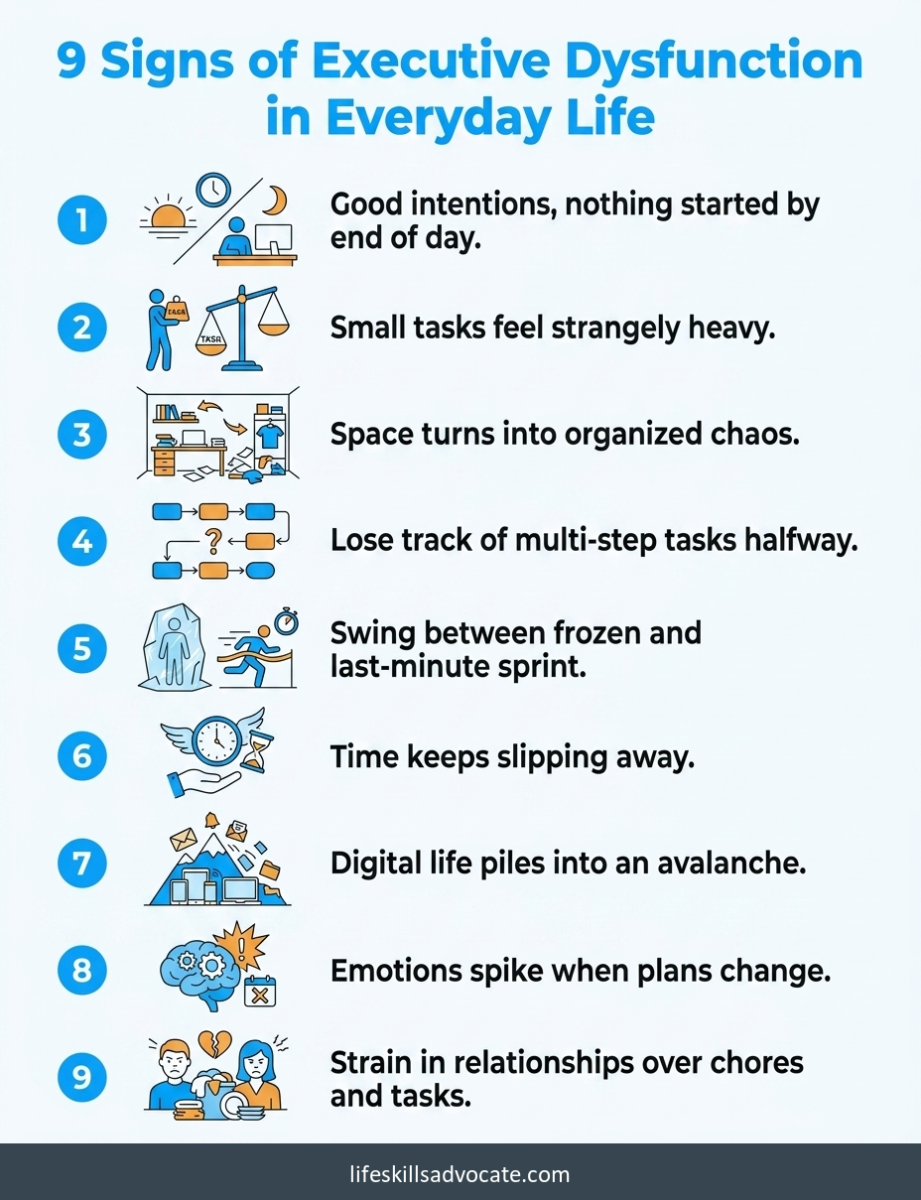
9 Signs of Executive Dysfunction in Everyday Life
It rarely announces itself. It hides inside ordinary moments that look, from the outside, like carelessness or avoidance. Here are nine of the most common signs, drawn from how people actually describe their days.
1. You Start the Day With Good Intentions and End It With Nothing Started
The plan was clear at 8 a.m. By 6 p.m., the list is untouched and you genuinely cannot say where the day went. This is not a motivation problem. The wanting was there the whole time.
What was missing was the bridge between the intention and the first move.
2. Simple Tasks Feel Strangely Heavy, So You Avoid Them for Weeks
Replying to one text. Booking one appointment. Objectively small, and yet the task sits there for days, getting heavier each time you notice it.
The size of the task and the size of the dread rarely match.
3. Your Space Turns Into Organized Chaos, Then Full Clutter
There is a system in there somewhere, or there was. Piles form on every flat surface, and tidying feels like it would take hours even when it would take twenty minutes. The mess is not about not caring. Keeping a space ordered is an ongoing job for the brain, and it is often the first thing to slip.
4. You Lose Track of Multi-Step Tasks Halfway Through
You walk into the kitchen to start dinner, notice the dishes, start those, spot the mail, and forty minutes later dinner has not begun. Holding several steps in mind while acting on them leans on working memory, and when that runs short, tasks stall in the middle.
5. You Swing Between Frozen and Last-Minute Adrenaline
For days, nothing moves. Then a deadline lands and you produce the whole thing overnight in a panic. The adrenaline works, sort of, but it is exhausting and it is not a plan.
The freeze is the system failing to start; the sprint is your body finally forcing the issue.
6. Time Keeps Slipping Away, Even When You Try to Be Careful
You thought it was twenty minutes. It was two hours. Time blindness, a weak felt sense of how much time has passed, makes planning feel like guesswork. A simple time estimation worksheet can help recalibrate how long things actually take.
7. Your Digital Life Feels Like an Avalanche You Cannot Catch Up With
Hundreds of unread emails. Tabs you meant to read. Notifications stacked on notifications. Each one is a tiny open task, and the brain treats the whole pile as one giant unfinished thing, which makes opening the inbox feel like lifting a wall.
8. Emotions Spike Fast When Something Interrupts Your Plan
A small change to the schedule lands like a much bigger deal than it should. Managing the jolt of frustration when plans shift is an executive skill too, and when bandwidth is low, the reaction arrives before you can soften it.
9. Your Relationships Feel Strained Around Chores, School, or Work
The forgotten errand, the half-finished shared project, the thing you promised and did not do. To someone on the outside, it can look like you do not care. The people closest to it often feel the friction first, which adds a layer of guilt on top of the original struggle.
What Causes Executive Dysfunction (ADHD, Autism, and More)
It is best understood as a pattern, not a condition of its own. It is what happens when the brain’s management system runs unreliably, and that system can be knocked around by a lot of different things.
Researchers describe executive function as a family of top-down mental processes the brain uses to plan, focus, hold information in mind, and resist the easy automatic response. When those processes run smoothly, intention turns into action without much thought. When they do not, the gap shows up as the signs above.
The Cleveland Clinic links executive dysfunction to a range of conditions, including ADHD, autism, depression, and OCD. The same outward struggle can have very different roots, which is part of why a single label rarely captures the whole picture.
How It Connects to ADHD
The overlap with ADHD is the strongest one. CHADD notes that trouble with self-regulation sits at the root of many ADHD challenges, and most people with ADHD have significant executive function difficulty as part of the picture.
The reverse is not automatic. Plenty of people struggle here without having ADHD at all, which is why the term is better treated as a description of the difficulty than a stand-in for any one condition.
Beyond ADHD: Autism, Mood, and Temporary Causes
Autistic adults often reach the same wall from a different angle, especially around switching tasks and handling unexpected change. Anxiety and low mood pull from the same limited pool of resources, so a hard mental health stretch usually drags follow-through down with it.
Some causes are temporary. Poor sleep, high stress, illness, and burnout can each knock the system offline for a while. That is exactly why some days feel so much worse than others.
Why Executive Dysfunction Gets Worse on Some Days
It is not a fixed setting. It moves.
Some days you function fine, and other days the same tasks feel impossible. “Why is my executive dysfunction getting worse?” is one of the most common questions people ask, and the short answer is that the brain’s management system runs on resources that come and go.
Sleep is the clearest one. When you are short on rest, your follow-through takes a measurable hit. LSA covers the connection between sleep deprivation and executive function in more depth, but the short version is that the system needs rest to run, and it shows when rest is missing.
Stress, hormonal shifts, illness, grief, and sensory overload can each turn a manageable day into a frozen one. There is also a feedback loop worth naming. When the freeze gets read as laziness, by other people or by you, the shame adds stress, and stress makes the next day harder still. The pattern feeds itself.
Practical Strategies to Work With Executive Dysfunction
So what actually helps? Not willpower, which you have already tried, and not a productivity overhaul you will abandon by Thursday. The moves that work tend to share one feature: they shift the effort out of your head and into something outside it.
Change the Task, Not Your Willpower
Most tasks stall because the first step is still too big or too vague. “Clean the kitchen” is not a step. “Pick up one plate” is.
Shrinking the first action until it feels almost silly is one of the more reliable ways to get unstuck. A brain dump helps here too: emptying every open loop onto paper frees up working memory and makes the next action visible instead of buried. When the task is written down and broken into one physical step, starting gets easier.
Change Your Surroundings to Lower the Friction
Your environment does a lot of the work that willpower cannot. Leave the gym clothes on the floor where you will trip over them. Keep the pill bottle next to the coffee maker. Every step you remove between you and the task is one less place to get stuck.
Time is easier to handle when you can see it. A visual countdown timer like the Time Timer shows the remaining minutes shrinking, which turns an abstract “twenty minutes” into something concrete and helps both with starting and with knowing when to stop.
It makes the passing of time visible, so an abstract “twenty minutes” becomes a red disc you can watch shrink. That visual cue helps both with starting a task and with noticing when to stop.
Best for: Adults with ADHD or time blindness who lose track of time and want a no-screen, silent way to see it. It runs 60 minutes at most, so it suits single work blocks rather than all-day planning.
Borrow Executive Function From Outside Your Own Head
When your own capacity is running low, you can borrow someone else’s. Body doubling, working alongside another person who is doing their own task, gives the brain an external anchor that makes starting and staying with a task easier. It does not require help with the task itself. The presence is the point.
Shared lists, a quick check-in with a friend, or a standing session with a coach all do a version of the same thing. They put part of the management load on a system outside you, where it tends to be steadier than your own day-to-day reserves.
When “Just Break It Into Steps” Doesn’t Help
Plenty of advice online stops at “just break it into smaller steps.” For a lot of people that does not work, and it is worth understanding why. Breaking a task into steps is itself an executive task. If starting is hard because the system is low, a tip that requires that same system to use is going to stall in the same place.
What tends to help instead is lowering the bar and adding a person. Make the first step smaller than feels reasonable, pair it with someone, and drop the standard from “do it well” to “do it badly and finish.” A messy finished task beats a perfect one that never starts. None of this is about trying harder. It is about needing less of the thing that is in short supply.
How to Support Someone Who Has It
Living alongside someone with executive dysfunction can be confusing, especially when the struggle looks like not caring. The most helpful support tends to be practical and judgment-free. The least helpful tends to be advice.
What Support Actually Feels Helpful
The support that lands is usually concrete. Sit nearby while they tackle a dreaded task. Help name the literal first step. Set up a shared calendar or list so the remembering is not all on one person.
LSA has a fuller guide to supporting a partner with executive function challenges if this is a regular dynamic at home.
Common Traps to Avoid
A few things tend to backfire. “Just try harder” lands as “you are not trying,” which is rarely true and always deflating. Taking the task over entirely removes the friction in the moment but chips away at confidence over time.
And treating a missed task as a character flaw turns a brain-based gap into a relationship wound. Assume the effort is there, even when the result is not.
When to Consider an Evaluation or More Support
Is there a point where managing executive dysfunction on your own stops being enough? Usually, yes, and it helps to know roughly where that line sits. If the struggle is steadily affecting your work, your relationships, or your health, it is worth bringing in more support.
That support can mean different things. An evaluation from a qualified professional, using standardized executive function assessment tools, is the route to understanding whether ADHD, autism, or something else is part of the picture. Therapy addresses the mental health side: the anxiety, the low mood, the shame that builds up. Skills-focused coaching is for the day-to-day follow-through, the systems and routines that turn intention into action.
One caveat worth stating plainly: we are an executive function coaching team, not clinicians, so we cannot evaluate or diagnose anyone, and nothing here is a substitute for a real evaluation. What we can speak to is the practical, non-medical side of daily life. If the load is heavy enough to be affecting your safety or your mental health, a licensed professional is the right first call.
What the Research Says About Executive Dysfunction
If you want to point someone else to the basics, here is the research in brief.
:root{–link-color:#00a1ff;–border-color:#e1e5ea;–cell-padding:0.75rem;–font-base:0.95rem;–hover-bg:#f9fbfc;}.table-container{overflow-x:auto;-webkit-overflow-scrolling:touch;margin-bottom:1rem;border:0 !important;}.cmp-table{width:100%;font-size:var(–font-base);table-layout:fixed;border-collapse:separate !important;border-spacing:0;border:0 !important;outline:0 !important;box-shadow:none !important;font-family:inherit;}.cmp-table–citability col.col-finding{width:34%;}.cmp-table–citability col.col-mean{width:40%;}.cmp-table–citability col.col-source{width:26%;}.cmp-table thead th{background:#fafafa;font-weight:600;padding:var(–cell-padding);border:1px solid var(–border-color);text-align:left;line-height:1.45;white-space:normal !important;word-break:keep-all;overflow:hidden;}.cmp-table thead th .technique-note{font-weight:400;font-size:0.85em;}.cmp-table td{padding:var(–cell-padding);border:1px solid var(–border-color);vertical-align:top;background:#fff;line-height:1.55;white-space:normal !important;overflow-wrap:anywhere;word-break:normal;hyphens:auto;overflow:hidden;font-family:inherit;}.cmp-table–citability td>p{margin:0;padding:0;}.cmp-table–citability ol.steps{margin:0;padding-left:1.15rem;font-size:inherit;line-height:inherit;font-family:inherit;list-style-position:outside;}.cmp-table–citability td>p>ol.steps{margin:0;padding-left:1.15rem;}.cmp-table–citability ol.steps li{margin:0 0 0.15rem 0;font-size:inherit;line-height:inherit;font-family:inherit;}.cmp-table tbody tr:hover td{background:var(–hover-bg);}.cmp-table a{color:var(–link-color);}@media (min-width:769px){.cmp-table–citability td::before{content:none;}}@media (max-width:768px){.table-container{overflow-x:visible;}.cmp-table–citability colgroup,.cmp-table–citability thead{display:none;}.cmp-table–citability,.cmp-table–citability tbody{display:block;width:100%;}.cmp-table–citability tr{display:block;margin-bottom:1rem;border:1px solid var(–border-color);border-radius:0.35rem;overflow:hidden;}.cmp-table–citability td{display:block;border-left:0;border-right:0;border-top:0;border-bottom:1px solid var(–border-color);}.cmp-table–citability td:last-child{border-bottom:0;}.cmp-table–citability td::before{content:attr(data-label);display:block;font-weight:600;margin-bottom:0.25rem;color:#5e6a72;}.cmp-table–citability td[data-label=”Finding”]{background:#fafafa;font-weight:600;}.cmp-table–citability td[data-label=”Finding”]::before{font-size:0.8em;text-transform:uppercase;letter-spacing:0.04em;}.cmp-table–citability tbody tr:hover td{background:#fff;}.cmp-table–citability ol.steps{padding-left:1.25rem;}}@media (max-width:480px){.cmp-table{font-size:0.9rem;}}
| Finding | What it means | Source |
|---|---|---|
| Executive function is the brain’s top-down management system (inhibition, working memory, cognitive flexibility). | Higher-order skills like planning and problem-solving are built on it, so when it runs unreliably, knowing what to do does not reliably turn into doing it. | Diamond, 2013 (Annual Review of Psychology) |
| Executive dysfunction is a pattern that appears across many conditions, not a diagnosis on its own. | It is linked to ADHD, autism, depression, and OCD, so the label names the difficulty, not its cause. | Cleveland Clinic, 2022 |
| In ADHD, trouble with self-regulation sits at the root of executive function challenges. | ADHD and executive dysfunction overlap heavily, though you can have executive function struggles without ADHD. | CHADD |
Frequently Asked Questions
Will executive dysfunction ever go away on its own?
It depends on the cause. When it is tied to something temporary, like bad sleep or acute stress, it often eases once that lifts. When it is part of how your brain is wired, it tends to be a long-term feature you learn to work with.
Can medication help with executive dysfunction?
For some people, yes, especially when ADHD is involved. Medication can make the brain’s management system easier to access, which is why it is worth discussing with a prescriber if that fits your situation. It is a personal decision, not a requirement. Medication also does not replace building systems that fit how you work, though for the right person it can make those systems much easier to use.
How do I explain executive dysfunction to someone who thinks I’m lazy?
Start by separating effort from outcome. Laziness means not caring and not trying. What you are describing is the opposite: caring a lot, trying hard, and still getting stuck on the part of the brain that turns intention into action. The wanting was never the problem, which is exactly what makes the lazy label sting.
A concrete comparison can help it land. You might say it is like a TV remote with a dead button: you can see the channel you want, you press, and nothing happens. It is not a willpower gap, it is a wiring gap.
It also helps to give the other person something to read rather than relying on one conversation, because the idea tends to click slowly. If they are open to it, pointing them to a short explainer like this one can do some of the explaining for you.
Do you need a diagnosis to get help with executive dysfunction?
No. You do not need a formal evaluation to start using the everyday approaches that make executive dysfunction easier to manage. A brain dump, a visible timer, body doubling, and a smaller first step all work whether or not you have a label.
An evaluation can be genuinely useful for understanding the bigger picture and for accessing certain accommodations at work or school, and some people find the clarity of a name a relief in itself. But it is not a prerequisite for getting unstuck today, and waiting for one is just lost time.
Putting It Into Practice: Next Steps
Executive dysfunction is most workable when you stop trying to overhaul everything and pick one small lever instead.
- Name your hardest sign. Choose the one from the list above that costs you the most, and aim a single change at just that. Trying to change everything at once is how nothing changes.
- Test one outside support this week. A visible timer, a body-doubling session, a written first step. Pick one and use it for a few days before adding another. If you want something more structured, our comparison of executive functioning curriculum options weighs the programs and books that teach these skills, and our shortlist of ADHD books for adults sorts twelve of them by what you need one for.
- Get a read on your follow-through. The free executive functioning assessment is a no-cost way to see which skills are pulling the most weight.
- Consider working with a coach if the daily follow-through is the sticking point. Executive function coaching for adults is built around exactly that.
Real-Life Executive Functioning Workbook
It is a structured, fillable workbook that walks you through the same skills this article covers, planning, task initiation, working memory, and emotional regulation, one chapter at a time, so the strategies turn into a routine instead of a list you read once.
Best for: Teens through adults, and the parents, coaches, and educators supporting them, who want a guided program to work through rather than scattered tips. It is a digital fillable PDF you work through at your own pace.
Further Reading
- Executive Functions – Adele Diamond, Annual Review of Psychology (2013)
- Executive Dysfunction – Cleveland Clinic
- Executive Function Skills – CHADD
- The Science of Procrastination – Life Skills Advocate
- Sleep Deprivation and Executive Function – Life Skills Advocate
- Supporting a Partner With Executive Functioning Challenges – Life Skills Advocate
- Brain Dump Strategy – Life Skills Advocate
- Time Estimation Worksheet – Life Skills Advocate
- Free Executive Functioning Assessment – Life Skills Advocate
- Executive Function Coaching for Adults – Life Skills Advocate
Thank you! This is so helpful for me.
I will be sharing this site without others. God bless.