
You open a browser tab, search for an executive functioning curriculum, and a dozen options come back that all promise more or less the same thing. Some are school licenses, some are books, and a few never show a price at all. The hard part is not finding options. It is telling them apart.
A teacher filling a study hall, a coach building a plan for one teen, and a parent who wants something that just helps are all reading the same results and needing different things. That is the gap this comparison closes.
Life Skills Advocate sells no curriculum of its own, so we can set the major options side by side and say which one fits a fifth grader, which fits a college student, and which is really a strong book you could start this week.
Most search results are a vendor describing its own product, or a definition that never names a single program. This one names nine, sorts them by who they actually fit, and is clear about what each costs. Start with what these resources even are, because the labels get used loosely.
TL;DR
The right executive functioning curriculum depends on who you are teaching, where, and with what budget. They fall into three groups:
- A curriculum teaches a whole group, an intervention targets the students who need more, and a guidebook is something you adapt yourself. Knowing which category you need narrows the field fast.
- For classrooms and school teams, the licensed programs are SMARTS, Cerebrate, ExQ, Everyday Speech, and Axiom Learning.
- For one learner, a coach, or a parent at the kitchen table, the book-based picks are Unstuck and On Target, Smart but Scattered, HOPS, and a self-guided workbook. Several of the strongest are just a book, so budget rules out less than you might think.
This is educational, not clinical advice. It compares learning resources and does not evaluate or diagnose any individual.
What an Executive Functioning Curriculum Actually Teaches
Before comparing programs, it helps to be clear on what an executive functioning curriculum is teaching in the first place. Executive function is the set of mental skills we use to plan, start a task, hold information in mind, organize the steps, and shift gears when something changes.
Researchers often group the core of it into three skills: working memory, cognitive flexibility, and inhibitory control. At Life Skills Advocate we organize our resources around a broader set of eleven skills, which is the framework our workbook and coaching use rather than a list everyone agrees on. Different programs slice the same territory in different ways, and that is fine.
The point that matters for choosing a curriculum is this: these are skills that can be built with support, not fixed traits a person either has or lacks. A 2011 review in Science by Adele Diamond and Kathleen Lee found that executive function skills in children can be improved through direct practice. They are teachable.
They are also worth teaching. Longitudinal research on self-control, most famously the Dunedin study, links stronger childhood self-regulation to better adult health and financial outcomes, independent of IQ or family income. A curriculum is simply a structured way to do that teaching on purpose instead of hoping it develops on its own. If you want the fuller breakdown first, our guide to what executive functioning is covers each skill in plain terms.
Curriculum vs. Intervention vs. Guidebook: What the Difference Actually Means
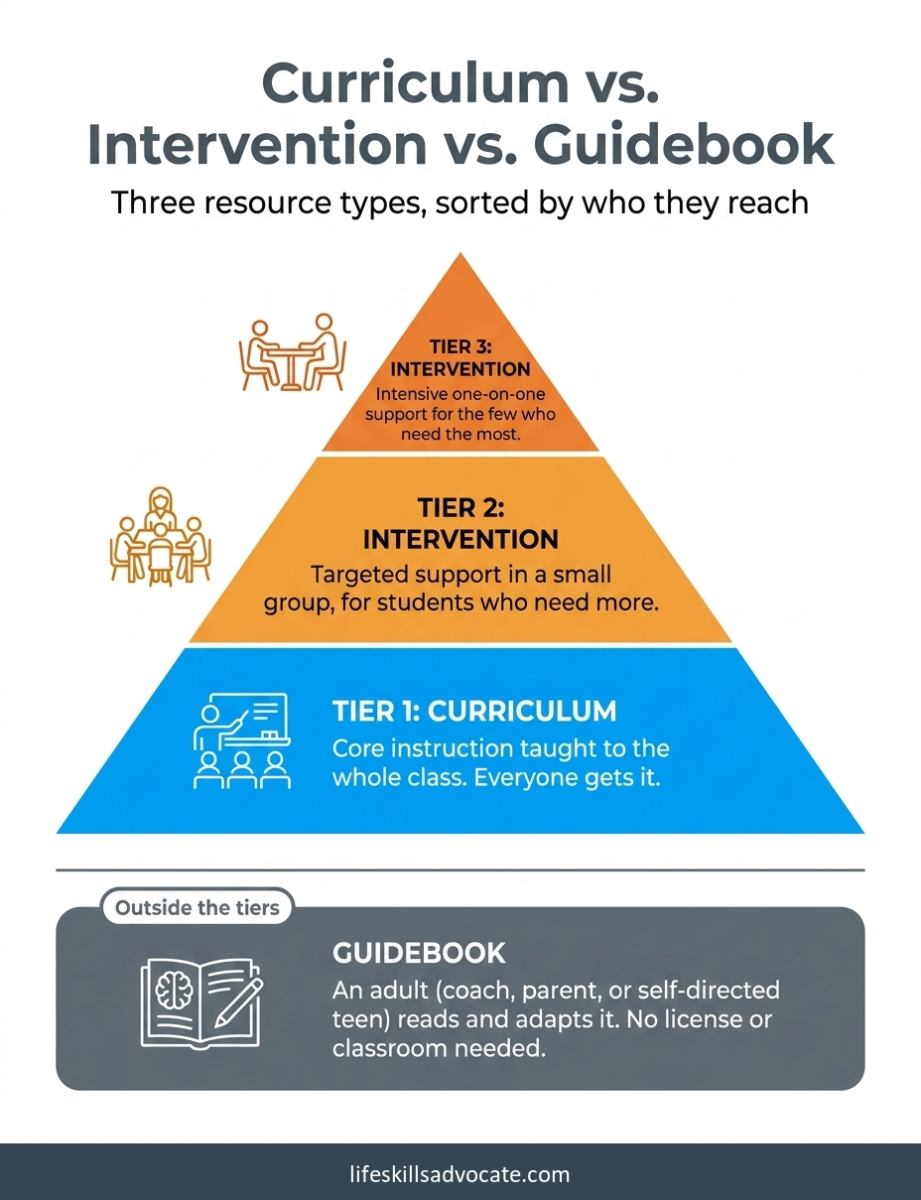
Here is where the shopping gets confusing. The words executive functioning curriculum, intervention, and program get used almost interchangeably, but they point to different jobs. The clearest way to sort them is the tiered model most schools already use, called MTSS, or a Multi-Tiered System of Supports.
A curriculum is Tier 1. It is core instruction meant for everyone in the room, taught on a schedule to a whole class or grade level. SMARTS and Everyday Speech live here.
An intervention is Tier 2 or Tier 3. It is a targeted support for the students who need more than the whole-class lesson gave them, usually delivered in a small group or one on one. HOPS is a good example: a focused plan for the kids who keep losing the homework, not the entire class.
A guidebook sits outside the tier model. It is a resource an adult reads and adapts, whether a coach, a parent, or a self-directed teen. Smart but Scattered and our own workbook fall here, with no license and no classroom required. You take the model and build your own plan from it.
Why does the distinction matter? Because a study-hall teacher running weekly lessons and a parent working with one teenager need different categories entirely. The teacher wants a Tier 1 or Tier 2 program with a scope and sequence. The parent wants a guidebook.
Buying the wrong category is the most common way people end up with an expensive resource that does not fit their setting. Understood’s guide to MTSS and its tiers lays out the full model if you want it.
How to Choose the Right Executive Functioning Curriculum
Once you know which category you need, choosing the right executive functioning curriculum comes down to three questions: how old is the learner, what setting are you in, and what can you actually spend. The comparison table below answers all three at a glance, and the sections after it walk through each one.
| Resource | Type | Best fit | Ages | Cost & access |
|---|---|---|---|---|
| SMARTS | Curriculum | Schools wanting a full, trained program | Grades 1-12 | Annual school license (on request) |
| Cerebrate | Curriculum (platform) | Schools seeking data and targeted instruction | Grades K-12 (four bands) | School or district license (on request) |
| Unstuck and On Target | Curriculum | A teacher or clinician running structured lessons | Ages 8-22 (three editions) | Book (one-time) |
| ExQ | Digital program | Learners who prefer interactive, tech-based practice | Grade 3 to college | Subscription (on request) |
| Everyday Speech | Curriculum (social-EF) | SLPs and social-skills groups | Pre-K to high school | Platform license |
| Axiom Learning | Program (service) | Families or schools wanting EF inside academic support | K-12 | By quote |
| HOPS | Intervention (Tier 2) | A coach or counselor running an organization group | Middle and high school | Book (one-time) |
| Smart but Scattered | Guidebook | Parents and coaches building their own plan | Kids, teens, young adults | Book (one-time) |
| Real-Life Executive Functioning Workbook | Workbook | A self-directed teen or adult, or a coach | Teens through adults | Workbook (one-time) |
Start With Age and Stage
Most of the school-licensed programs are built for a K-12 classroom, which leaves two groups underserved: young adults who have aged out of school supports, and adults who never got executive function instruction and want it now. That gap is real, and it shapes the whole list.
Some options do reach older learners. Unstuck and On Target sells its curriculum in age bands, and the 14-22 edition reaches into young adulthood. Smart but Scattered has a dedicated teen edition and a young-adult one. For adults specifically, our guide to executive function for adults is a better starting point than any K-12 program.
If you are matching a resource to a specific age, a free executive functioning skills by age guide can tell you what to reasonably expect at each stage.
Then Look at the Setting
A curriculum that shines in a trained classroom can be the wrong tool for a kitchen table. Group instruction with teacher training points you toward SMARTS, Everyday Speech, or Axiom. Small-group or one-on-one work with students who need extra support points toward HOPS. A single learner, a coaching relationship, or a homeschool points toward a guidebook or workbook you can open and start.
What It Actually Costs
This is the question vendors are quietest about. The licensed programs (SMARTS, ExQ, Everyday Speech, and Axiom) price by school or annual license, and most keep the number behind a contact or quote form, so a parent buying for one child often cannot even see a price.
The book-based options (Unstuck, Smart but Scattered, HOPS, and our workbook) are a one-time purchase, measured in the price of a book. If cost is the constraint, the do-it-yourself route is not a consolation prize. It is often the most sensible place to start.
The 9 Executive Functioning Curriculum Options, Compared
Here are the eight executive functioning curriculum options in detail, roughly in order from full classroom curricula to targeted interventions to self-guided guidebooks. This is not every product in existence, and one that is right for a self-contained classroom might be wrong for a homeschooling parent, so treat the list as a starting point rather than a ranking.
1. SMARTS (School Curriculum, Grades 1-12)
SMARTS is a research-based executive function curriculum from ResearchILD and Dr. Lynn Meltzer, built for grades 1 through 12 and tiered into elementary, middle, and high school levels. It teaches a named set of skills, goal-setting, cognitive flexibility, organizing and prioritizing, and self-monitoring, and it bundles teacher professional development and progress surveys alongside the lessons.
It is one of the most complete school programs on this list. The tradeoff is that it is built for institutions, so a parent buying for one teen has no obvious entry point, and the annual license price sits behind a contact form rather than a public page.
Best for: schools and districts that want a full, trained-up program running across grade levels.
2. Cerebrate (School Platform, Grades K-12)
Cerebrate is a digital executive function platform combined with a comprehensive curriculum, organized into four grade bands: K-2, 3-4, 5-8, and 9-12. It counts hundreds of lessons across 64 distinct challenges, usable whole-class, in small groups, or one to one, and it reports against executive function IEP goals. Its research page sets out the evidence base for teaching executive function.
It is built around a loop: evaluate, teach, then measure. Educators rate student behaviors to set a baseline across eight executive function areas, pick lessons aimed at the challenges that surface, then track growth in the same system. Cerebrate says students can rate themselves too, and that other adults who know the learner can add a rating. The license also brings a dedicated implementation specialist, self-paced teacher training, scheduled check-in meetings, and a train-the-trainer option.
Best for: a school team that wants evaluation, lessons, progress reporting against IEP goals, and help rolling it out, in one system.
3. Unstuck and On Target (Curriculum for Ages 8 to 22)
Unstuck and On Target is a published, manualized curriculum focused on flexibility, goal-setting, and planning, sold in three age bands so you can match it to the learner. The ages 8 to 11 edition is elementary and skews younger than our core readers, while the ages 11 to 15 and 14 to 22 editions reach teens and young adults (the link goes to the 14 to 22 edition, and the other bands are one click away).
Because it is a book rather than a license, it is far more affordable than the enterprise programs. It does expect a facilitator willing to run the lessons, so it rewards a little prep time.
Best for: a teacher, clinician, or coach who wants a ready-made lesson sequence for a specific age band.
4. ExQ (Digital Program for Home, School, and College)
ExQ, created by Sucheta Kamath, is the newest kind of option here: a digital, adaptive program that teaches executive function through games, error analysis, and metacognitive reflection. It is segmented for home, school, and college use, with a teacher portal and individual EF-profile data, which appeals to learners who engage more with interactive practice than with a paper workbook.
Two limits are worth knowing. It is a single proprietary subscription platform that does not publish a price on its entry page, and its path currently tops out at college rather than continuing into a dedicated adult track.
Best for: home, school, or college learners who do better with interactive, tech-based practice than a workbook.
5. Everyday Speech (Social-EF Curriculum)
Everyday Speech is a video-based curriculum platform that teaches social-emotional and executive function skills together, widely used by speech-language pathologists and social-skills groups from pre-K through high school. Its strength is the library of short video models and the way it ties EF to real social situations.
The thing to know going in is that it centers social communication, so executive function is taught through that lens rather than on its own. If social skills are part of your goal, that framing is a plus; if you want EF on its own, it is a partial fit.
Best for: SLPs and social-skills groups who want EF woven into social-communication lessons.
6. Axiom Learning (EF Built Into Academic Support)
Axiom Learning approaches executive function differently from a boxed curriculum. It is an academic-support and tutoring provider that builds EF coaching into its ongoing work with students, so the skills get taught alongside the actual schoolwork rather than in a separate lesson block.
For families who already want tutoring, folding EF into that support can be efficient. The tradeoff is that it is delivered as a service rather than a curriculum you run yourself, and pricing is arranged by program, so you will be quoted rather than shown a shelf price.
Best for: families or schools that want EF built into ongoing academic support rather than a standalone lesson set.
7. HOPS (A Tier-2 Organization Intervention)
HOPS, short for Homework, Organization, and Planning Skills, is a manualized Tier-2 intervention for middle and high school students, delivered one on one or in small groups by a coach or school counselor. It is evidence-informed and tightly focused: materials management, planner use, and organizing for homework.
That focus is also its boundary. It does not try to be a full executive functioning curriculum, so it works best as the targeted layer for students who need more than the classroom lesson, not as your only resource.
Best for: a coach or counselor running a targeted organization intervention with students who need extra support.
8. Smart but Scattered (Guidebooks for Every Age)
Smart but Scattered, by Peg Dawson and Richard Guare, is the most widely read guidebook series on executive function, and it comes in separate editions for younger kids, for teens, and for young adults who feel stuck (the edition called Smart but Scattered and Stalled). The link above goes to the teen edition.
These are readable, practical books that explain the EF model and hand you the pieces to build a plan. They are guidebooks, not lesson plans, so the design work is yours, which is exactly what some readers want and others do not.
Best for: parents and coaches who want to understand the model and design their own approach for a specific person.
9. The Real-Life Executive Functioning Workbook (The DIY Option)
Our own Real-Life Executive Functioning Workbook, by Chris Hanson and Amy Sippl, belongs on this list as the affordable, self-guided option, and we would rather include it plainly among the alternatives than pretend it is the only answer. It is a practical workbook of exercises across the EF skills, written for teens through adults to work through alone or with a coach.
Because it is a workbook rather than a classroom curriculum, a teacher running a full class program will still want one of the licensed options above. For an individual who wants a low-cost, do-it-yourself plan, it is a direct place to start.
Best for: a self-directed teen or adult, or a coach, who wants a practical, low-cost plan to work through.
How to Start Teaching Executive Function Without Burning Out
Picking an executive functioning curriculum is the easy part. The harder part, and the one teachers and parents mention most, is starting without adding three hours to an already full week. The overwhelm is real, and it is not a sign you are doing anything wrong. It is a sign the job is big, so the trick is to make the first step small.
Pick one skill, not all eleven. Choose the single executive function that causes the most friction, often task initiation or organization, and work on that one for a few weeks before adding another. A whole curriculum can wait behind one concrete routine.
Then build for independence from day one. The most common frustration parents describe is a child who can only do the work when someone is sitting next to them prompting every step. The fix is to fade yourself out on purpose: model the routine, then move to a checklist the student runs, then to a quick check-in. The goal is a plan the learner owns, not a prompt they wait for.
If you want the instructional side in depth, our guide to how to teach executive function skills goes step by step. Educators tracking progress toward IEP targets can pair it with a free IEP goal bank and our study skills IEP goals.
What the Research Says About Teaching Executive Function
The case for teaching executive function on purpose rests on a few well-established findings. Here is the short, sourced version.
| Finding | What it means | Source |
|---|---|---|
| Executive function is the set of skills we use to plan, focus attention, switch gears, and juggle tasks. | Any executive functioning curriculum is, at bottom, teaching some mix of these core skills. | Harvard Center on the Developing Child |
| Executive function skills in children can be improved through direct practice. | These are teachable skills, which is why a structured curriculum can work in the first place. | Diamond & Lee, Science (2011) |
| Stronger childhood self-control is linked to better adult health and financial outcomes. | Teaching these skills early is associated with long-term payoff, though the study is correlational. | Moffitt et al., PNAS (2011) |
| A Tier-1 curriculum serves a whole class; Tier-2 and Tier-3 interventions target students who need more. | The MTSS model is why choosing the right category matters as much as choosing the right product. | Understood, MTSS explained |
Frequently Asked Questions
What’s the difference between an executive functioning curriculum and an intervention?
A curriculum is core instruction for a whole class, Tier 1 in the MTSS model. An intervention is targeted support for the smaller group who need more than the class lesson gave, Tier 2 or Tier 3, usually one on one or in a small group.
Is there a free executive functioning curriculum?
Not really, and it helps to know that going in. The genuinely free material tends to be scattered worksheets and blog posts rather than a full, sequenced program. The licensed curricula charge a school or annual license fee, and most keep the price behind a contact form.
The closest thing to a free or low-cost route is a guidebook or workbook you adapt yourself. A single book is a fraction of a program license, and it puts the same model in your hands. So the real answer is that budget shapes the format more than it rules out executive function instruction altogether.
What’s the best executive functioning curriculum for high school students?
There is no single best one, because it depends on your setting. For a trained classroom or a whole grade level, SMARTS covers high school well. For a small group of students who need targeted help with organization and homework, HOPS is built for exactly that. For a parent or coach working with one teenager, the teen edition of Smart but Scattered or a self-guided workbook is usually a better fit than any licensed program.
Two things push the choice more than the brand name. The first is group size: a whole class or one person decides curriculum versus guidebook before anything else. The second is budget, since a licensed high school program and a twenty-dollar book can teach overlapping skills. Sort those two out first, and the shortlist for any given high schooler usually comes down to one or two options.
Can executive function skills actually be taught?
Yes. A 2011 review in Science found that children’s executive function skills improve with direct practice, and coaching and instruction continue to help into adulthood. These are skills you build with support, not fixed traits.
Which option works for an adult, not a student?
Most of the school programs stop at K-12, which is a real gap for adults who want executive function support after school is over. The book-based options travel better into adulthood: Smart but Scattered and Stalled is written for young adults, and our workbook is written for teens through adults. For a broader starting point, our guide to executive function for adults covers approaches that do not assume a classroom.
Next Steps
The fastest way to choose well is to stop shopping for a minute and get specific about the learner in front of you. A few concrete moves from here:
- Name the one skill that creates the most friction this week, whether that is starting tasks, staying organized, or shifting between activities. That single skill decides more than the brand you pick.
- Let category follow setting. Whole class points to a curriculum, a struggling few to an intervention, and one learner to a guidebook or workbook. Re-read the comparison table with your setting in mind.
- See where the learner actually stands by taking our free executive functioning assessment, which shows which skills to prioritize before you spend anything.
- Bring in help if you want it. Executive function coaching from Life Skills Advocate is educational and skill-focused, a different thing from therapy, and executive function coaching can do the matching and the follow-through with you.
Further Reading
- A Guide to Executive Function – Harvard Center on the Developing Child
- Interventions Shown to Aid Executive Function Development – Diamond & Lee, Science (2011)
- A Gradient of Childhood Self-Control Predicts Health, Wealth, and Public Safety – Moffitt et al., PNAS (2011)
- MTSS: What You Need to Know – Understood
- SMARTS – ResearchILD
- Cerebrate – Lively Minds Institute
- ExQ – Sucheta Kamath
- Everyday Speech – Everyday Speech
- Axiom Learning – Axiom Learning
- Unstuck and On Target – Brookes Publishing
- Smart but Scattered – Peg Dawson and Richard Guare
- The Executive Functions Toolkit for Classroom Teachers – Janet Stowell (primary and intermediate; a parent edition is also available, both posted from New Zealand)
- HOPS: Homework, Organization, and Planning Skills – NASP
- What Executive Functioning Is – Life Skills Advocate
- Executive Function IEP Goals – Life Skills Advocate
- How to Teach Executive Function Skills – Life Skills Advocate
- Executive Function for Adults – Life Skills Advocate
- Study Skills IEP Goals – Life Skills Advocate
- The Real-Life Executive Functioning Workbook – Life Skills Advocate
- Executive Functioning Skills by Age Guide – Life Skills Advocate
- Free IEP Goal Bank – Life Skills Advocate
- Free Executive Functioning Assessment – Life Skills Advocate
- Executive Function Coaching – Life Skills Advocate