
A friend mentions, almost in passing, that their week has been rough. Hours later, you are still carrying it. The mood settled into your chest somewhere around lunch and it has not left, even though nothing in your own day actually went wrong.
If that sounds familiar, the word for it might be hyperempathy: feeling other people’s emotions so strongly that they start to blur with your own. It comes up a lot among autistic and ADHD adults, and it rarely gets named for what it is.
You are not too much, and you are not imagining it.
Most of what gets written about this either treats it as something to be fixed or tells one person’s story and stops there. What follows names the signs plainly, connects them to how neurodivergent brains actually work, and hands you tools that respect the empathy instead of trying to switch it off.
TL;DR
If you have ever left an ordinary conversation feeling wrung out, hyperempathy may be the missing word, and these are the basics worth knowing.
- Hyperempathy means absorbing other people’s emotions strongly enough that they blur with your own.
- It shows up often in autistic and ADHD adults, and it is a wiring difference, not a flaw to fix.
- The 8 signs run from catching a room’s mood the second you walk in to needing real recovery time after being around people.
- What helps: naming whose feeling it actually is, grounding in the moment, building in decompression time, and setting boundaries that protect your empathy instead of shutting it down.
This is educational, not a substitute for working with a professional. If big feelings are something you are sorting through with a therapist or doctor, treat this as a companion to that conversation, not a replacement.
What Hyperempathy Actually Feels Like
Hyperempathy is not a personality quirk you can talk yourself out of. It lands more like a sensory experience: other people’s emotions arrive at the same volume as a sound that is too loud or a clothing tag scratching the back of your neck. You did not choose to turn it up, and you cannot easily turn it down.
People who live with it describe the same things over and over. Emotions that seem to come off the people nearby in waves. A group’s tension that settles over them like a heavy blanket. A friend’s bad day that somehow becomes a knot in their own stomach by dinner. One writer, in a Guardian piece on the daily toll of being a hyper-empath, described carrying strangers’ feelings around like luggage she never agreed to pack.
A lot of what you will find online files this under medical-sounding labels and a tidy list of things to fix. That framing tends to miss what is actually happening. For many neurodivergent adults, the empathy is not broken.
It is turned all the way up.
8 Signs of Hyperempathy
It does not look identical for everyone, but a handful of signs come up again and again. See how many you recognize.
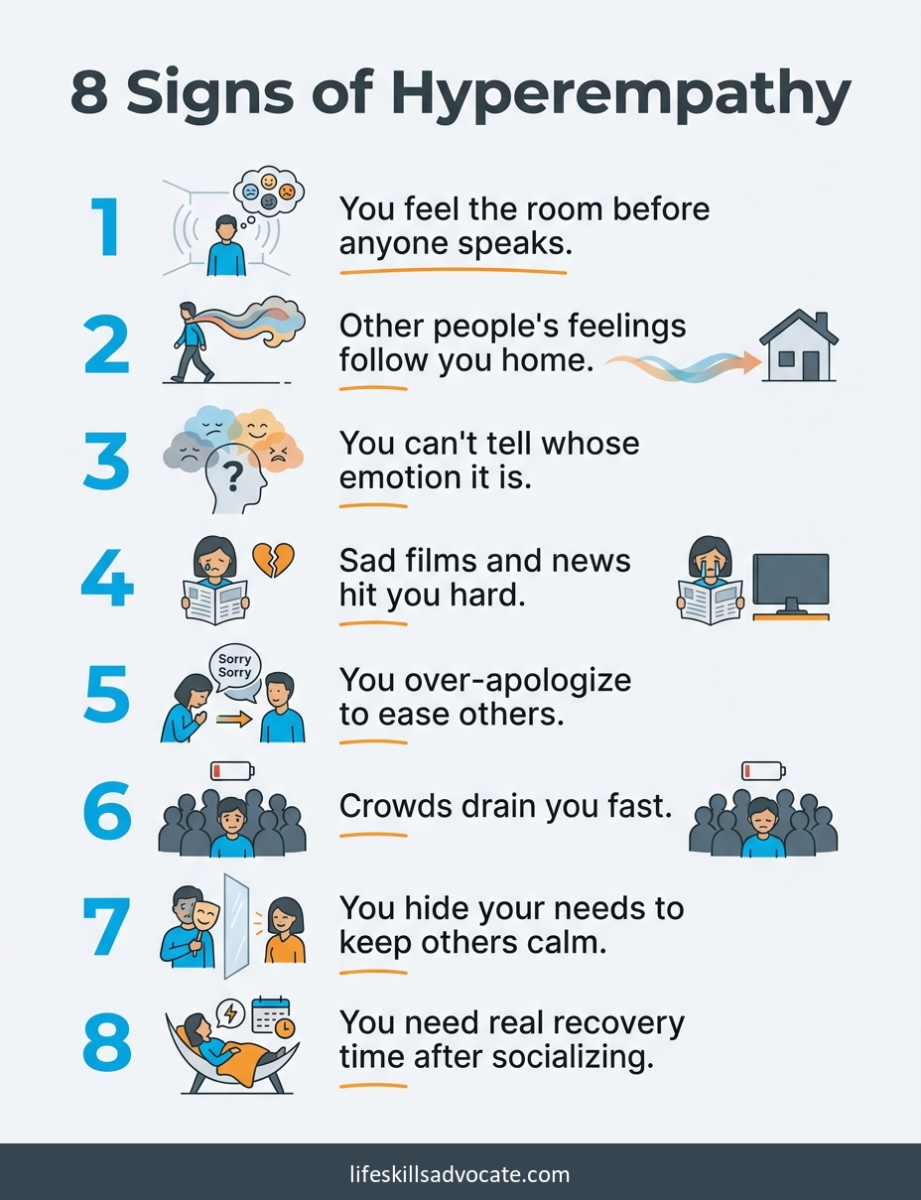
1. You feel the room before anyone says a word. You walk into a space and know within seconds that someone has been crying, or that two people were arguing right before you got there. Nobody told you. You picked it up off the air, and you are already reacting to a mood the people around you have not said out loud yet.
2. Other people’s feelings follow you home. A coworker vents for ten minutes and you are still turning it over at dinner. The feeling does not switch off when the person leaves the room. It can linger in your body for days, long after they have moved on and forgotten the conversation.
3. You cannot always tell whose emotion you are feeling. This is the one that surprises people. When the feelings are this loud, the line between “mine” and “theirs” gets thin. You feel anxious in a meeting and genuinely cannot tell if the anxiety is yours or the other person’s. That blurry self and other boundary sits at the center of all this.
4. A film or a news story can flatten you for the rest of the day. A sad scene, a hard headline, an animal in a commercial, and you are wrecked out of proportion to what just happened on a screen. It is not weakness. The same wiring that absorbs a friend’s mood does not check whether the source is real.
5. You over-apologize and over-fix to make someone else’s discomfort stop. When the people around you are upset, you feel it directly, so making it stop becomes urgent. You apologize for things that were not your fault. You jump in to solve problems nobody handed you. Often that is not people-pleasing on purpose, it is you trying to turn down a feeling in your own body.
6. Busy or tense rooms drain you faster than they seem to drain other people. A crowded party, a packed train, a tense family dinner, and your battery is at zero while everyone else seems fine. Absorbing dozens of emotional signals at once, on top of the regular sensory load, adds up fast. Push past it for too long and a draining day can tip into overwhelm or a meltdown.
7. You hide your own needs to keep everyone else steady. If your mood depends partly on the moods nearby, keeping other people regulated starts to feel like self-protection, so you mask. The National Autistic Society’s guidance on masking describes how draining that constant management is, and masking your own needs this way is a fast track to running on empty.
8. You need real recovery time after being around people. Not a quick breather. Real, lights-low, talk-to-no-one recovery. Time alone after socializing is not antisocial. It is how you put yourself back together after carrying a roomful of feelings that were never yours. Skip it too often and the depletion slowly slides into neurodivergent burnout.
Hyperempathy, Autism, and ADHD
So is hyperempathy an autism thing, an ADHD thing, or something else? The honest answer is that it shows up across all of those, and it pushes back hard on an old myth in the process.
For years, autistic people were described as lacking empathy. Research has been steadily taking that apart. A 2024 study on autistic people’s experience of empathy found that many describe feeling too much, not too little, and that the difference is in how empathy is processed and shown, not whether it exists.
Writing in Psychology Today on autism and empathy, experts make a similar point: what reads from the outside as detachment is often a person overwhelmed by how much they feel. For a deeper look at how autistic empathy actually works, the double empathy problem is a useful frame.
The wiring connects to the rest of the neurodivergent picture. The same sensitivity that turns up the volume on sound, light, and texture appears to do the same with other people’s emotional signals. Interoception, the sense of what is happening inside your own body, is part of it. So is the overlap with rejection sensitivity, which makes other people’s reactions land even harder. It is common in ADHD adults too, often alongside big, fast-moving emotions.
One limit worth naming: the research here is still young, and this is a described experience rather than something with a clean measure, so treat any neat single explanation with a little caution. What is clear is that for a lot of neurodivergent adults, feeling everything is not a character flaw. It is how their nervous system is built.
Hyperempathy, Defined in Five Terms
| Term | What it means |
|---|---|
| Hyperempathy | Feeling other people’s emotions so strongly that they are hard to separate from your own. |
| Self and other boundary | Your sense of where your feelings end and someone else’s begin. It often runs thin here. |
| Emotional contagion | Catching a mood from the people around you, sometimes within seconds, without a word being said. |
| Affective vs. cognitive empathy | Feeling what someone feels versus understanding it. Hyperempathy runs high on the feeling side. |
| Decompression | Deliberate low-stimulation recovery time after an emotionally loud setting. |
What Helps When You Feel Everything
None of this is about caring less. The goal is to stay open without getting flooded, so the empathy stays a strength instead of a daily tax. A few approaches tend to help.
Name whose feeling it is. When a wave hits, pause and ask three quick questions: is this mine, is it theirs, or is it both? Sorting where a feeling came from gives your thinking brain something to do, which lowers the intensity on its own. A tool like the Feel Wheel exercise helps when the feeling is loud but hard to put into words.
Bring the volume down in your body. This lives in the body, so the fastest relief is physical. Slow the exhale until it is longer than the inhale. Press your feet into the floor and name five things you can see. These small grounding moves tell an overloaded nervous system that it is safe to come down a notch.
Build in decompression, not just rest. Scrolling on the couch is rest. Decompression is more deliberate: low light, low sound, low demand, no one needing anything from you for a set stretch of time. After an emotionally loud setting, a planned decompression window does more than an evening of half-distracted downtime.
Set boundaries that protect the empathy. A boundary here is not a wall, and it is not going cold. It is choosing where you spend the feeling. It might mean leaving the party an hour earlier than you “should,” or not watching the news right before bed, or telling a friend you want to hear about the hard thing tomorrow. Boundaries like these are how you get to keep being the person who feels deeply.
Get a second brain in the room. Some of this is easier with help, especially when feeling everything tangles up with planning, follow-through, and day-to-day regulation. That is the overlap between emotional regulation and executive function. It is also where executive function coaching can fit. Coaching is not therapy and does not treat mental health; it is practical, skills-focused work on the systems that keep a sensitive nervous system from getting overrun.
Frequently Asked Questions
Is hyperempathy a sign of autism or ADHD?
It is commonly associated with both, but it is not exclusive to either, and on its own it is not a label for anything. Plenty of people who are neither also experience it. What research increasingly suggests is that the wiring common in autistic and ADHD adults tends to amplify empathy rather than mute it. So it can be one thread in a larger neurodivergent picture, though feeling things deeply does not by itself confirm anything.
What does hyperempathy feel like day to day?
It often feels like carrying other people’s moods in your own body, getting drained fast in crowded or tense rooms, and needing real recovery time after being around people.
Is being an “empath” the same as hyperempathy?
They overlap, but they come from different places. “Empath” usually lives in spiritual or self-help language and gets treated as a fixed identity, while hyperempathy is described more as an experience tied to how a nervous system processes emotion. Whether they mean the same thing really depends on what the speaker is pointing at.
Can you reduce hyperempathy without going numb?
The goal usually is not to reduce the empathy at all, it is to stop drowning in it. Going numb is not the win here, and most people who try to shut the feeling off entirely find it leaks out sideways anyway. The more workable aim is regulation: turning the volume down enough to function while keeping the part of you that connects with people. In practice that looks like naming whose feeling you are holding, grounding in your body when a wave hits, building in decompression after loud settings, and setting boundaries around where the empathy gets spent. None of those switch the empathy off. That is the whole point. Done consistently, they hand you back some choice about when and where you feel things this intensely, without asking you to care less about anyone.
Next Steps
Pick the one sign that made you wince. That is the thread to pull first, because it is the one already costing you the most.
- Name one feeling today that was not yours to carry. Just notice it and set it down. No worksheet required.
- Try the sorting question in real time: the next time a wave hits, stop and ask whose feeling it actually is, and let the Feel Wheel exercise help when the words will not come.
- Watch your recovery pattern for a week. After a big social block, notice what actually brings you down: quiet, movement, a hot shower, no screens. Then protect it.
- Get a clearer read on where this fits. The free executive functioning assessment can show you how emotional regulation lines up with the rest of your executive function.
Further Reading
- Autistic people’s experience of empathy – PMC / NIH
- Autism and Empathy – Psychology Today
- Masking – National Autistic Society
- Confessions of a hyper-empath – The Guardian
- How autistic empathy actually works (the double empathy problem) – Life Skills Advocate
- Rejection sensitivity signs – Life Skills Advocate
- What ADHD masking is – Life Skills Advocate
- Understanding autistic meltdowns – Life Skills Advocate
- Neurodivergent burnout signs and recovery – Life Skills Advocate
- Emotional regulation and executive function – Life Skills Advocate
- Feel Wheel exercise – Life Skills Advocate
- Executive function coaching – Life Skills Advocate
- Free executive functioning assessment – Life Skills Advocate