
It is 12:40 in the morning, the housemate on the other side of the wall is watching something with explosions in it, and you have counted the same four ceiling shadows for an hour.
Somewhere in the second hour, most people start shopping. That is usually where a search for the best white noise machines begins, and nearly every result that comes back assumes the answer is the same for everybody: pick a machine, plug it in, sleep better.
The research does not say that.
A 2024 meta-analysis found white and pink noise gave a small boost to people with ADHD and slightly reduced performance for people with typical attention. Same sound, opposite directions.
So one question is worth two nights of your time before you spend anything. Does sound help you? You can answer that this week, for free, and then buy for your actual room rather than for the review count.
TL;DR
Most buying guides start at which machine to buy. This one starts a step earlier, at whether the best white noise machines will do anything for you:
- A 2024 meta-analysis found white and pink noise gave a small boost to people with ADHD and slightly reduced performance for people with typical attention, so it is worth finding out which way your brain leans.
- You can test that in two nights with a free app, before spending anything.
- If you hear a loop and cannot un-hear it, the SNOOZ Original makes its sound with a real fan, so there is no recording to repeat.
- In a room you share, how finely the volume steps adjust matters far more than how many sounds a machine offers. The Easysleep and the Magicteam give you 32 steps and the BrownNoise gives you 36.
- For a bunk, a dorm move, or anywhere without a spare socket, the Babelio Pocket Mini, the Dreamegg D11 Max and the Yogasleep Rohm all run on their own battery.
- The Color Noise Sound Machine is the highest rated of the nine, and the Hatch Restore 3 is the one to look at if the real obstacle is the phone on your nightstand.
- Run whichever you buy at the lowest volume that covers the noise. Hearing is the one real risk here.
We are executive function coaches, not audiologists or physicians. This is a buying guide and a set of things to try, not medical advice. If sound sensitivity or ringing in your ears is affecting your daily life, that is worth raising with a professional.
Does a White Noise Machine Work for Your Brain?
Sound does something measurable to attention, which is the reason the best white noise machines are worth considering at all. What surprises people is that the effect does not run in the same direction for everybody. If you already know why ADHD makes sleep harder, this is one of the few levers in that picture you can change tonight.
What the Research Found
In August 2024, researchers at Oregon Health and Science University published a systematic review and meta-analysis in the Journal of the American Academy of Child and Adolescent Psychiatry. The OHSU summary of that study covers 13 studies and 335 participants.
Two findings came out of it. White or pink noise improved task performance for children and young adults with ADHD or significant ADHD traits. The same noise slightly reduced performance for people without ADHD or with typical attention.
Size matters as much as direction here. The researchers call the benefit small but statistically significant, which is a real edge rather than a transformation.
Earlier work points the same way. A 2010 study of 51 schoolchildren found background white noise improved recall for inattentive pupils and worsened it for attentive ones. A 2016 study of 30 children found that benefiting from noise correlated with markers of weaker vigilance and inhibition, not only with carrying an ADHD label. Both samples are small, so read them as pointing in a direction rather than settling the question.
Why It Helps Some Brains and Not Others
The working explanation is arousal. An under-aroused attention system runs better with a bit more input coming in from outside, and a bit is the operative phrase, because too little and too much both cost you.
That also accounts for something people report constantly and rarely see written down. The same person can need sound one night and find it unbearable the next.
When thoughts are already racing, more input piles onto the pile. When they are slow and the room is silent, silence is the problem. Same brain, opposite needs, different Tuesday.
If you want a way to check which of those states you are in before reaching for the machine, our free How My Body Pays Attention exercise is a two-page script for noticing what your body is doing right now. It takes about five minutes, and it is most useful on the focus half of this question, where you are trying to work out whether sound is holding your attention or crowding it.
When It Is Worth Skipping
Three groups tend to do better without it.
People with tinnitus are the clearest case. The noise colors can resemble the ringing instead of covering it, and some people report every color making it worse. The Northwell explainer on the noise colors makes a related point, that people with headache conditions often prefer silence, and that misophonia can make particular sounds unbearable.
Second is the group the meta-analysis picked out, people whose attention is already steady, where the effect ran slightly negative. Third is anyone who has tried sound, found it irritating, and kept at it anyway because it gets recommended so widely. Your own two-night result counts for more than the average one.
If sound turns out to be the wrong lever, it is not the only one in the room. Light, temperature, bedding and layout all do work here, and shaping the room itself is often the better place to put the money.
Try It Free for Two Nights Before You Buy
Two nights and a phone will tell you more than any review of the best white noise machines, this one included. The test costs nothing. You can start it tonight.
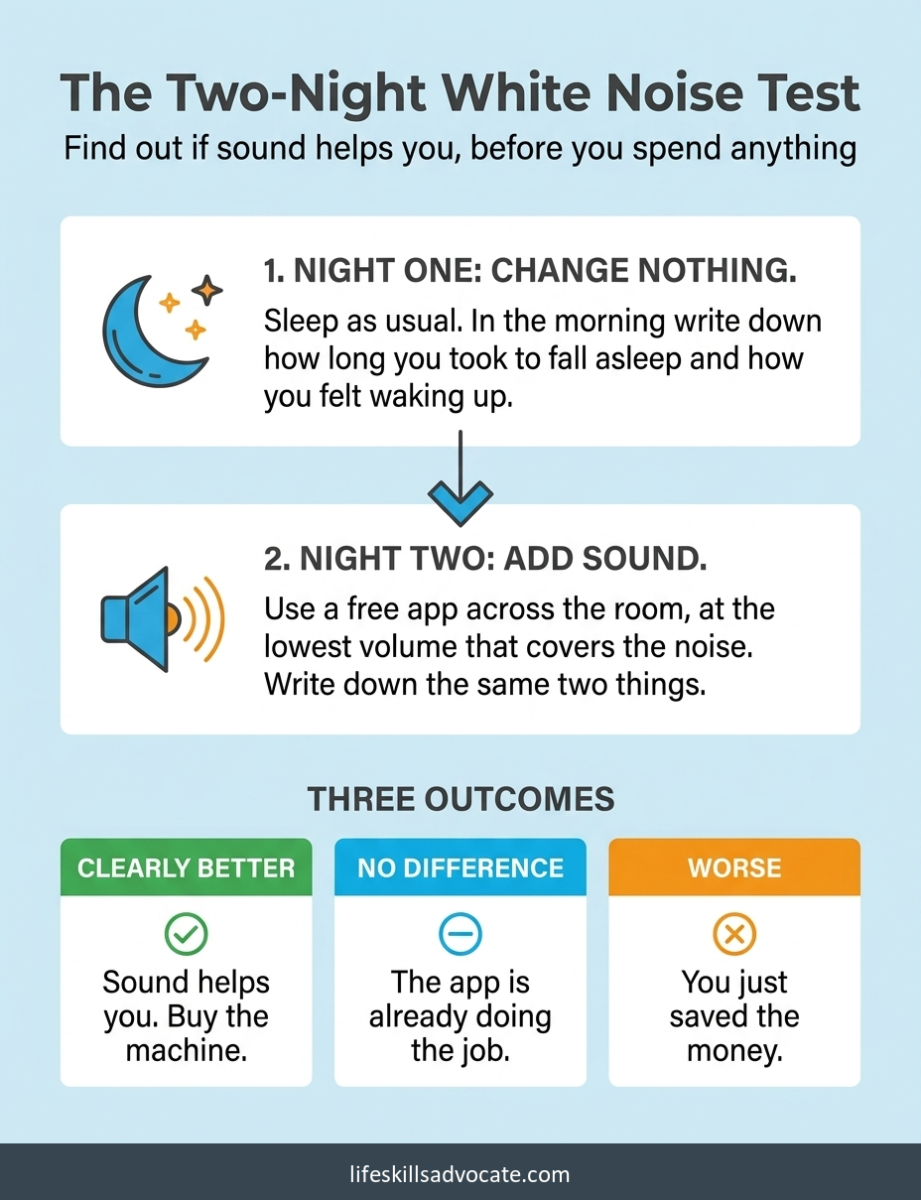
Night one, change nothing. Sleep the way you normally do. In the morning, write down roughly how long it took you to fall asleep and how you felt when you woke.
Night two, add sound. Run white noise from a free app on a phone or an old tablet, placed across the room rather than beside your head, at the lowest volume that covers whatever is bothering you. Write down the same two things.
Run both nights again if they were not comparable. One bad night proves less than you want it to.
Do the same for focus if that is why you are here. One study session in silence, one with sound, same time of day, same kind of task. If your usual setup is a pair of noise cancelling headphones, test those as a third condition, because blocking sound and adding sound are two different jobs and people rarely need both.
The signal you are watching for is small: fell asleep faster, woke less often, held the task longer.
Three outcomes, three answers. Clearly better means go buy the machine. No difference means the app is already doing the job, and a machine mostly buys you a phone-free nightstand. Worse means you just saved sixty dollars and learned something useful about your own brain.
Writing it down beats remembering it, especially at 7am. Our free Sleep Study Activity has a weekly log with columns for bedtime, wake time, total sleep and notes, plus a two-week routine plan if you want to run the trial longer. A teen, an adult, or a parent tracking alongside their kid can all use it as it comes.
What to Look For in the Best White Noise Machines
Sound machines are sold on sound counts, and the count is close to useless. Thirty sounds mostly means thirty things to scroll past at midnight. Four features do the real work when you are choosing among the best white noise machines, and those four are the columns in the table further down.
Sound Type: Which Noise Color to Try First
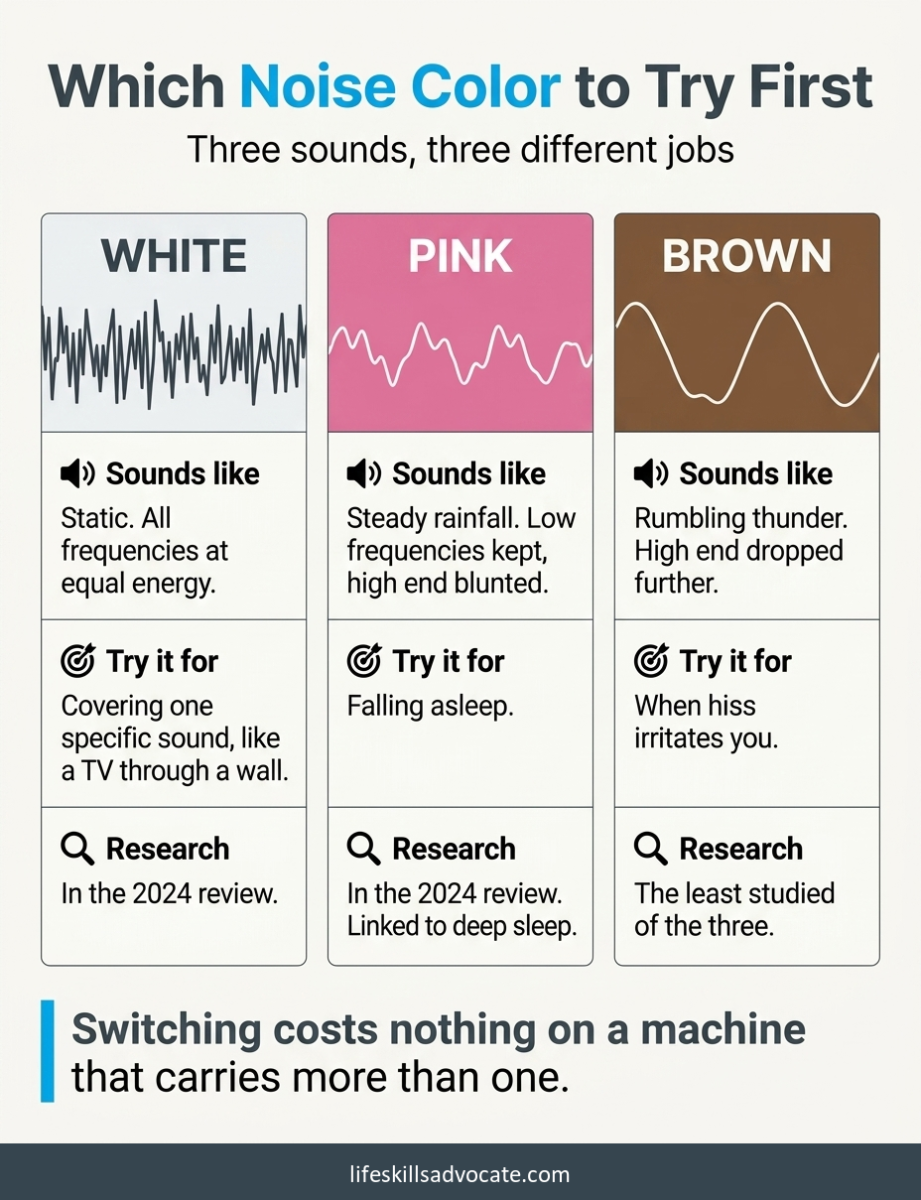
White noise carries all the frequencies your ear can pick up at roughly equal energy, which is why it reads as static. Pink noise keeps the lower frequencies and blunts the high end, so it lands closer to steady rainfall. Brown noise drops the high end further still, which is why Northwell’s explainer compares it to rumbling thunder.
Start with white if you are covering one specific intrusive sound, like a television through a wall. Start with pink for falling asleep, because that is the color with slow-wave sleep research behind it, and it is easier on the ear than white if high frequencies grate on you. Start with brown if hiss irritates you and you want the low end instead. None of that is binding, and switching costs nothing on a machine that carries more than one.
One caveat is worth carrying with you. The meta-analysis tested white and pink; brown is the color that took off online and the one with the least study behind it. If you want the science rather than the sales copy, our piece on how the noise colors differ goes into what has been measured so far.
Looping vs Non-Looping Sound
A recorded machine plays a file and then starts it over. If you notice patterns, and plenty of autistic and ADHD listeners do, you will eventually find the seam. After that you cannot stop finding it.
Read this spec carefully, because the marketing is slippery. An independent tester at No Sleepless Nights timed the audio loops machine by machine and clocked the same bird track anywhere from 7 seconds to nearly 2 minutes depending on the device.
He also notes that white noise and fan tracks are stitched together in a way that makes the loop impossible to time, which is how a machine can be sold as non-looping and still repeat audibly on its nature tracks.
Two ways around it. Stay on the noise and fan tracks rather than the birds and streams, or buy a machine with a real fan inside, where there is no recording to repeat in the first place.
Volume Steps: How Finely It Adjusts
Masking works by lifting the noise floor just above the sound that is bothering you. The useful volume is therefore the lowest one that does the job, not the loudest you can stand, which makes the number of volume steps a more practical spec than the maximum output.
In a room you share, the gap between “I cannot hear it” and “you are keeping me awake” is narrow. Ten steps may not land inside it. Thirty-two usually will.
Power: What Works in a Room You Share
Where a machine draws power decides where it can sit, and where it sits decides whether it works. Mains-powered units are tied to the socket, which in a dorm room is often nowhere near the bed and already occupied by a laptop charger.
A rechargeable machine can go on the far side of the room, hang off a bunk rail, or ride home in a bag at the end of term. Distance buys you something real, too: a machine across the room covers the same intrusive sound at a lower level right beside your ear, which is the direction you want for your hearing and for whoever else is trying to sleep.
How These Nine Machines Compare at a Glance
All nine of the best white noise machines below were checked live on 30 July 2026, and each one was in stock with a working buy button. The first four columns are the four features above, then price and who each machine suits.
| Machine | Sound type | Looping | Volume steps | Power | Price | Best for |
|---|---|---|---|---|---|---|
| SNOOZ Original | Real fan, no recordings | None, mechanical | 10 | Mains | ~$100 | People who hear a loop and cannot un-hear it |
| Easysleep | 25 sounds, includes white, pink and brown | Recorded | 32 | AC or USB | ~$20 | Anyone setting the volume precisely in a shared bedroom |
| BrownNoise BWN-T8 | 30 sounds, 3 brown plus white and pink | Recorded | 36 | Mains | ~$20 | Someone still working out which noise color suits them |
| Magicteam | 20 sounds, sold as non-looping | Recorded, non-looping claimed | 32 | AC or USB | ~$20 | A first machine for someone who would rather not research it |
| Color Noise Sound Machine | 25 sounds, 4 white noise types plus 4 fan | Recorded | 32 | AC or USB | ~$20 | Someone who wants a night light on the same device |
| Yogasleep Rohm | 3 sounds: bright white, deep white, surf | Recorded | Dial, steps not stated | Rechargeable, 24 hrs | ~$20 | Anyone who would otherwise scroll thirty options at bedtime |
| Babelio Pocket Mini | 15 sounds, includes white, pink and brown | Recorded, non-looping claimed | Steps not stated | USB-C rechargeable | ~$16 | Travel and dorm moves, where size decides it |
| Dreamegg D11 Max | 21 sounds | Recorded | Steps not stated | Rechargeable, 1800 mAh | ~$18 | A bunk or desk with no socket within reach |
| Hatch Restore 3 | 80+ sounds through an app | Recorded | App controlled | Mains | ~$170 | Someone whose real obstacle is the phone on the nightstand |
Prices are approximate and can change. Check the current price on each product page before you buy.
The 9 Best White Noise Machines for Teens and Adults
These are the nine best white noise machines for this audience, and every one is adult-capable. Ratings run from 4.3 to 4.7 stars on review bases of roughly 3,000 to 68,000. The order is by job rather than by rank, because the right pick depends on which problem you are solving.
1. SNOOZ Original Smart White Noise Sound Machine
SNOOZ Original has a real fan spinning inside it rather than a speaker playing a file, which settles the looping question by removing it. You twist the side cap to change the tone and there are 10 volume levels. The tradeoff is real: the auto-off timer lives in the app, not on the machine, and at around $100 it costs roughly five times what the recorded units do.
Best for: people who have heard a loop restart and cannot stop hearing it.
2. Easysleep Sound Machine
Easysleep gives you 32 volume steps, which is the spec that matters most when someone else is asleep four feet away, plus 25 sounds that include brown, pink, blue and white noise and four fan tracks. It runs on AC or USB and carries five sleep timers and a dimmable night light. The speaker is the weak point; it lacks bass next to the pricier machines.
Best for: anyone who needs to sit the volume just above a roommate’s noise without going over.
3. BrownNoise BWN-T8 Sound Machine
BrownNoise BWN-T8 is the one machine here that carries all three of the colors worth trying: three brown noise tracks, white, pink, and two fan sounds inside a 30-sound library. With 36 volume levels it also has the finest adjustment of the nine. It is mains-powered only, so it stays where the socket is.
Best for: someone who wants to compare white, pink and brown without buying three machines.
4. Magicteam Sound Machine
Magicteam is the most-reviewed machine in this lineup by a distance, with roughly 68,000 ratings behind its 4.5 stars, and it covers the basics well: 20 sounds sold as non-looping, 32 volume levels, AC or USB power, memory for your last setting. Treat the non-looping label as applying to the noise and fan tracks rather than the nature ones, since independent testing found short repeats in bird and stream recordings across this price band.
Best for: a first machine, when you would rather buy the safe option and stop thinking about it.
5. Color Noise Sound Machine
Color Noise Sound Machine is the highest rated of the nine at 4.7 stars, with 25 sounds, 32 volume levels, five timers and a 10-color night light with adjustable brightness. Worth knowing before you buy: the colors in the name are the night light’s, not the noise. The sound library runs to four white noise variants and four fan sounds rather than a pink and brown set.
Best for: a bedside setup where the light matters as much as the sound.
6. Yogasleep Rohm Portable White Noise Sound Machine
Yogasleep Rohm offers three sounds, and that reads as a weakness on a spec sheet while being the point of the thing. Bright white noise, deep white noise, gentle surf, one volume dial, nothing to browse at midnight. It is 3.5 inches across, weighs 3.8 ounces and runs up to 24 hours on a charge.
Best for: anyone whose bedtime routine collapses the moment there is a menu to scroll.
7. Babelio Pocket Mini White Noise Sound Machine
Babelio Pocket Mini is a 1.89-inch cube with 15 sounds in it, including white, pink and brown noise, and it charges over USB-C with 30-minute, 60-minute and unlimited timer options. It also remembers your last setting, which saves a decision every night. It is the cheapest machine here at around $16, and independent testing clocked its bird loop at 15 seconds, one of the shortest measured, so stay on the noise tracks with this one.
Best for: a reader who needs the same sound in a dorm, at home, and in a hotel.
8. Dreamegg D11 Max Portable Noise Machine
Dreamegg D11 Max is built around its battery: 1,800 mAh, which the maker puts at more than three times what most pocket machines carry, and enough to run overnight and into the next day on one charge. There are 21 sounds, a child lock, memory and timers, and a lanyard loop for hanging it off a rail or a bag.
Best for: a top bunk, a shared room, or any spot where the nearest socket is across the room.
9. Hatch Restore 3 Sunrise Alarm Clock and Sound Machine
Hatch Restore 3 is the only pick that handles the getting-out-of-bed half of the problem, with a sunrise alarm light, 80-plus sleep sounds and a screen-free wind-down routine that gives the phone a reason to stay out of the bedroom. Two things to weigh: at about $170 it is by far the priciest here, and the premium content sits behind a Hatch+ subscription that costs $5.99 a month or $59.99 a year after a 30-day trial.
Best for: someone whose wind-down keeps getting eaten by the phone on the nightstand.
Using Your Machine Safely and Well
The best white noise machines can all run far louder than you need them to, and that is where the only real risk in this category lives.
Set the Volume Low and Leave It There
Joel Nigg, who led the OHSU meta-analysis, is direct about the hazard: damage to hearing is a significant risk if volumes are not carefully monitored, and young people already tend to run headphones louder than they should. The Northwell piece lands in the same place and recommends the minimum effective volume.
A workable rule: turn the machine up until the sound you are trying to cover stops pulling your attention, then stop. If you can still hold a conversation over it without raising your voice, you are in a sensible range. If it is the loudest thing in the room, it is too loud.
The independent tester who measured these machines found most of them capable of over 60 decibels and some approaching 80, and reached the same conclusion from the other end: use the minimum setting that gets the effect you need.
Where to Put It
Across the room beats beside your pillow. Same masking, lower level at your ear, and the machine covers the doorway or the shared wall the sound is coming through rather than just your head.
If you share the room, put it between the two beds rather than next to either one, and agree the setting before lights out instead of adjusting it at 2am.
What We Still Do Not Know
Quite a lot, and the gaps sit in the evidence rather than in the products. The OHSU team says the effects of frequent long-term use on children’s developing attention are unknown, and that guidance for professionals would need more data than currently exists.
The studies also skew young and small. The meta-analysis covered children and college-age young adults, so an adult in their forties is extrapolating from it. None of this work was run specifically on autistic adults either, which is a real gap given how many of the people asking this question are autistic.
Northwell’s own specialist puts it about as directly as anyone: popular use of the noise colors has outstripped the research behind them.
What the Research Says About White Noise
| Finding | What it means | Source |
|---|---|---|
| A 2024 systematic review and meta-analysis of 13 studies (335 participants) found white or pink noise improved cognitive performance for children and young adults with ADHD or significant ADHD traits. | The best white noise machines are a low-cost support worth trying if you have ADHD, though the effect is modest rather than transformative. | Nigg et al., JAACAP, 2024 (via OHSU) |
| The same 2024 analysis found white or pink noise slightly reduced cognitive performance for people without ADHD or with normal attention. | Noise is not universally helpful. The effect runs in opposite directions depending on the listener. | Nigg et al., JAACAP, 2024 (via OHSU) |
| In a 2010 study of 51 schoolchildren, background white noise improved recall for inattentive pupils and worsened it for attentive ones. | The split shows up in classrooms as well as labs, though the sample is small. | Soderlund et al., Behavioral and Brain Functions, 2010 |
| The lead author of the 2024 analysis names damage to hearing as the significant risk if noise volumes are not carefully monitored. | Run it at the lowest volume that masks the noise, not the loudest you can tolerate. | Nigg, OHSU, 2024 |
| Across 20 machines tested in 2025, measured maximum output ran from roughly 55 to 80 decibels, and timed loops on the same nature track ranged from 7 seconds to nearly 2 minutes. | Loop length and maximum volume vary widely between machines at similar prices, so both are worth checking before buying. | No Sleepless Nights, updated September 2025 |
Frequently Asked Questions
Is it okay to sleep with a white noise machine every night?
For most adults, yes, with one condition attached: volume. The researchers behind the 2024 meta-analysis name hearing damage as the significant risk, and it is the only risk in this category with real evidence behind it. Keep the machine at the lowest level that covers the sound you are masking, and keep it away from your pillow.
The caveat is about the long run rather than any single night. The OHSU team says the effects of frequent long-term use on children’s developing attention are not yet known, which is why they stop short of recommending guidance for professionals. That is a gap in the research, not a warning.
Some people set a timer for an hour instead of running it until morning, so the sound is not doing all the work of getting them to sleep. If running it all night already works for you, no evidence says you need to change it.
Do the best white noise machines actually work, or is it placebo?
They work for some brains and mildly work against others, and that is the finding people rarely hear. In the 2024 meta-analysis, white and pink noise improved task performance for participants with ADHD and slightly reduced it for participants with typical attention. The same pattern showed up in a 2010 classroom study and again in 2016 work that tied the benefit to weaker vigilance and inhibition.
So the effect is real and measured. It is also small, which is exactly why it is easy to doubt your own experience.
That leaves you roughly where the research does. Nothing tells you from the outside which group you are in, and an average across 335 people cannot speak to your Tuesday night. Run the test and believe your own result.
Which of the best white noise machines works in a shared room or dorm?
Two specs decide it, and neither is the sound count. The first is how finely the volume adjusts, because the gap between inaudible to you and audible to your roommate is narrow. The Easysleep gives you 32 steps to land inside it.
The second is power. Dorm sockets are rarely near the bed, and a machine you cannot place properly is a machine you end up putting on the pillow. The Dreamegg D11 Max runs off its own battery for a top bunk, and the Babelio Pocket Mini packs down small enough for the move home.
Which noise color is best for sleep?
Pink has the most direct support for sleep specifically, since research links it to the slow brainwaves of deep sleep. White suits covering one particular intrusive sound, like a television through a wall. Brown is what people reach for when hiss irritates them, though it is the least studied of the three.
If you would rather test than guess, the BrownNoise BWN-T8 carries all three on one device.
What white noise is best for tinnitus?
This sits outside our lane, so the short version. Some people with tinnitus find broadband sound useful for masking. Others find the colors resemble the ringing and make it worse. Which camp you land in is not something a buying guide can predict, and an audiologist can.
Do I need a machine, or is a free app enough?
Start with the app. If it works, a machine mostly buys you a phone-free nightstand and a physical dial.
Next Steps
The two-night test is the only step here that has to come first, because every other decision on this page depends on what it tells you.
- Run the test this week with an app you already have. No purchase, no signup, two nights and a note on your phone.
- Log it properly using the free Sleep Study Activity, which has the bedtime, wake time and total sleep columns already laid out.
- If sound helps, pick from the best white noise machines by your room, not by review count. Shared bedroom means volume steps. No socket near the bed means a battery. Loop sensitivity means a real fan.
- If sleep and routine are the bigger problem, and the machine is one small piece of it, executive function coaching works on the routine itself. It is skill-building and educational rather than therapy, so it fits the “I know what to do and cannot make it happen” gap rather than a mental health concern.
Further Reading
- White, Pink Noise Improve Focus for Children With ADHD – Oregon Health and Science University
- The Effects of Background White Noise on Memory Performance in Inattentive School Children – Soderlund et al., Behavioral and Brain Functions
- Neuropsychological and Neurophysiological Benefits From White Noise in Children With and Without ADHD – Baijot et al., Behavioral and Brain Functions
- The Full Spectrum of Colored Noise – The Well by Northwell
- The Best White Noise Machines: I Compare 20 – No Sleepless Nights
- Can Different Color Noise Help With Executive Functioning Skills? – Life Skills Advocate
- The Connection Between Trouble Sleeping and ADHD – Life Skills Advocate
- How to Create a Sensory-Friendly Environment at Home – Life Skills Advocate
- 8 Best Noise Cancelling Headphones for ADHD and Sensory Overload – Life Skills Advocate
- Sleep Study Activity – Life Skills Advocate free resource
- How My Body Pays Attention Exercise – Life Skills Advocate free resource
- Executive Function Coaching for Adults – Life Skills Advocate