
You have read the same sentence four times, your foot is drumming under the desk, and the chair you are sitting in has started to feel like part of the problem. For a lot of neurodivergent teens and adults, staying planted in a standard chair is its own small battle, and a ball you can bounce and shift on sounds like relief.
A stability ball chair, also sold as a balance, exercise, or yoga ball chair, turns sitting into low-grade movement. For some restless brains, that movement genuinely helps focus. The complication is that the marketing around these chairs promises far more than that, and the real answer to “does it work” depends a lot on who you are and how you use it.
So this guide does two things the product pages will not. It lays out what the research actually supports and what it does not, then recommends six ball chairs worth your money, sized and spec’d so you can match one to your body and your desk.
TL;DR
A ball chair can help a restless brain settle into work, as long as you know what it can and cannot do:
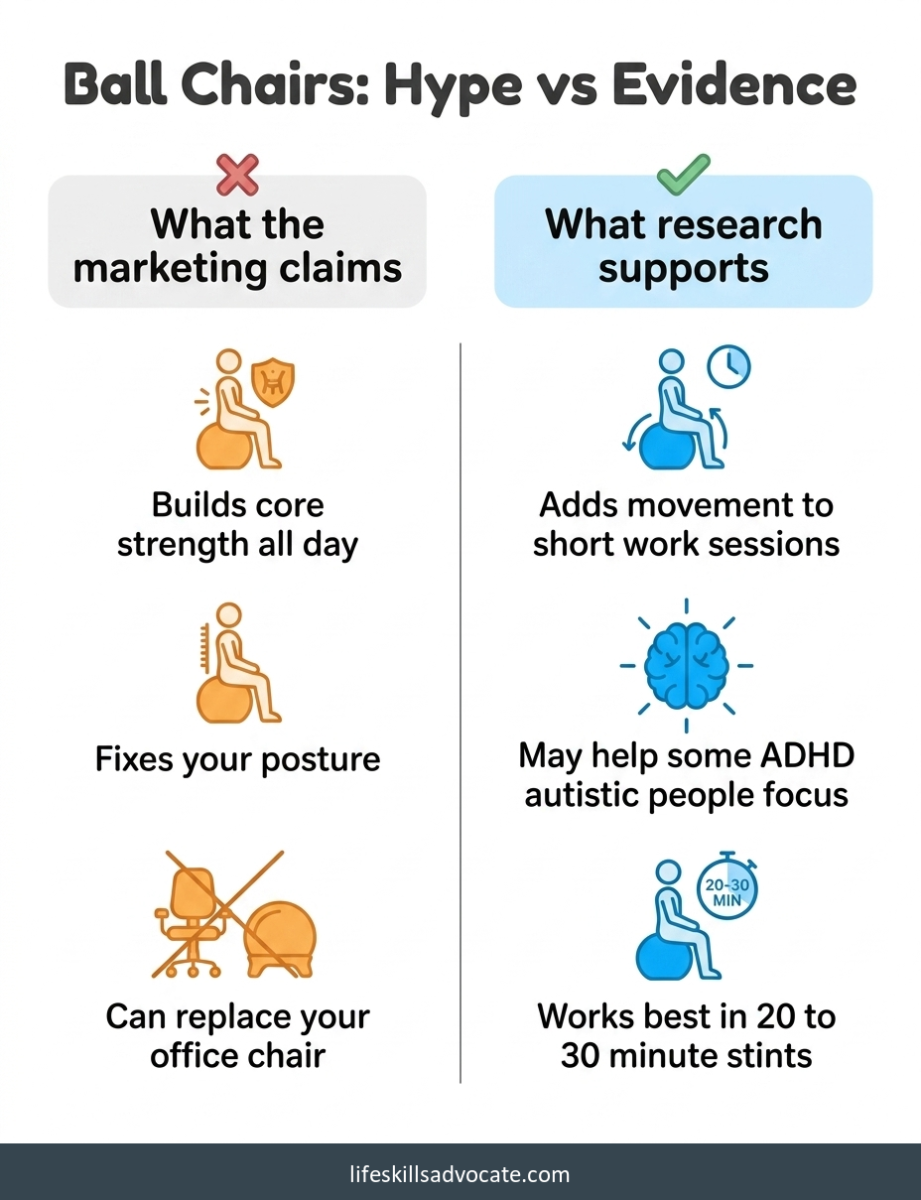
- The research does not back the “builds your core” or “fixes your posture” claims for all-day sitting, and a ball can feel less comfortable over a long stretch.
- Where it earns its keep is short bursts of movement that help some people with ADHD or autism stay on task. It distracts others, so it is worth testing cheaply first.
- Our six stability ball chair picks run from a roughly $20 starter kit to a $110 chair with a real backrest, each with clear specs for size, weight limit, and what comes in the box.
- How to use one well: short stints, the right ball size for your height, and swapping back to a supportive chair when your back asks for it.
This guide is educational and reflects an executive function coaching perspective, not medical advice. If back pain is the reason you are shopping, talk with a physical therapist or doctor first.
Do Stability Ball Chairs Really Work? What the Research Says
Here is the uncomfortable part for the marketing copy: the biggest promises printed on a stability ball chair box are the ones research does not support. When researchers put people on a ball for an hour of desk work and compared it to a normal office chair, the ball did not meaningfully improve posture or “engage the core,” and people reported feeling more uncomfortable, not less.
That is the finding from a 2006 study in the journal Human Factors, where 14 adults sat on both a stability ball and an office chair. The ball produced only small changes in muscle activation, slightly worse pelvic posture, and significantly more perceived discomfort. The authors concluded that using a ball for prolonged sitting “may not be advantageous.”
The ergonomics guidance lines up with that. Cornell’s ergonomics researchers note that a ball lacks back, lumbar, and arm support and should not replace a good office chair full time. In other words, a ball chair is not a posture cure or an all-day throne. It is a way to add movement to short stretches of sitting.
So why include ball chairs at all? Because for one specific job, the evidence points the other way, and that is the part no shopping page mentions.
Here is the evidence at a glance, so you can check the sources yourself:
| Finding | What it means | Source |
|---|---|---|
| A ball chair does not build core strength or fix posture for all-day sitting. | In a controlled study, an hour on a ball changed little versus a chair and felt more uncomfortable. | Gregory, Dunk & Callaghan, 2006 |
| A ball should not replace your office chair full time. | It has no back, lumbar, or arm support, so it works best in short bouts, not eight-hour days. | Cornell CUergo |
| Movement seating can help some kids stay on task. | In a 2015 classroom study, on-task behavior rose from 50% on standard chairs to 85% on therapy balls. | Ketcham & Burgoyne, 2015 |
| A therapy ball can sharpen attention markers in children with ADHD. | Kids reacted faster and showed better attention signals on a ball than on a chair. | Wu et al., 2012 |
Who a Stability Ball Chair Really Helps (and How It Helps Focus)
If a stability ball chair does so little for posture, why do some people swear by it? Because posture was never the point. The reader a ball chair actually serves is the one whose brain gets bored and restless when the body goes still.
Small, constant movement gives an understimulated nervous system something to do, which can free up attention for the task in front of you. That is the same logic behind a lot of fidget tools for regulation and behind why movement can be regulating rather than disruptive.
The classroom research backs this up for kids: on-task behavior rose sharply when elementary students swapped chairs for therapy balls, and a separate study of children with ADHD found faster reaction times and better attention markers on a ball.
The real limit here is age. Most of the strong on-task evidence comes from children in short classroom sessions, so an adult reading this should treat the focus benefit as promising rather than proven. Teachers and OTs can borrow the same idea by offering a ball to a specific student who needs to move, not swapping out the whole room, which pairs well with broader classroom design that supports executive functioning.
There is also a split worth naming. On forums like Reddit, some people say the ball is the thing that finally lets them settle in and work. Others say the bouncing itself became the distraction, and they got more done once they switched back to a normal chair. Movement helps some brains focus and pulls others off task, and you cannot tell which one you are from a product review.
That is why the cheapest useful step is to notice how your own attention behaves before you spend anything. Our free How My Body Pays Attention exercise is a short, body-based script for spotting when you focus and when you drift, and it works on any seat.
If movement clearly helps you concentrate, a ball chair is worth a look. If it does not, you just saved yourself the purchase. For the non-chair options, our guide to sensory regulation covers the rest of the toolkit.
What to Look for in a Stability Ball Chair
Once you have decided a stability ball chair is worth trying, four specs decide whether it fits your body and your desk. Get these right and the chair works. Get them wrong and it ends up in a closet.
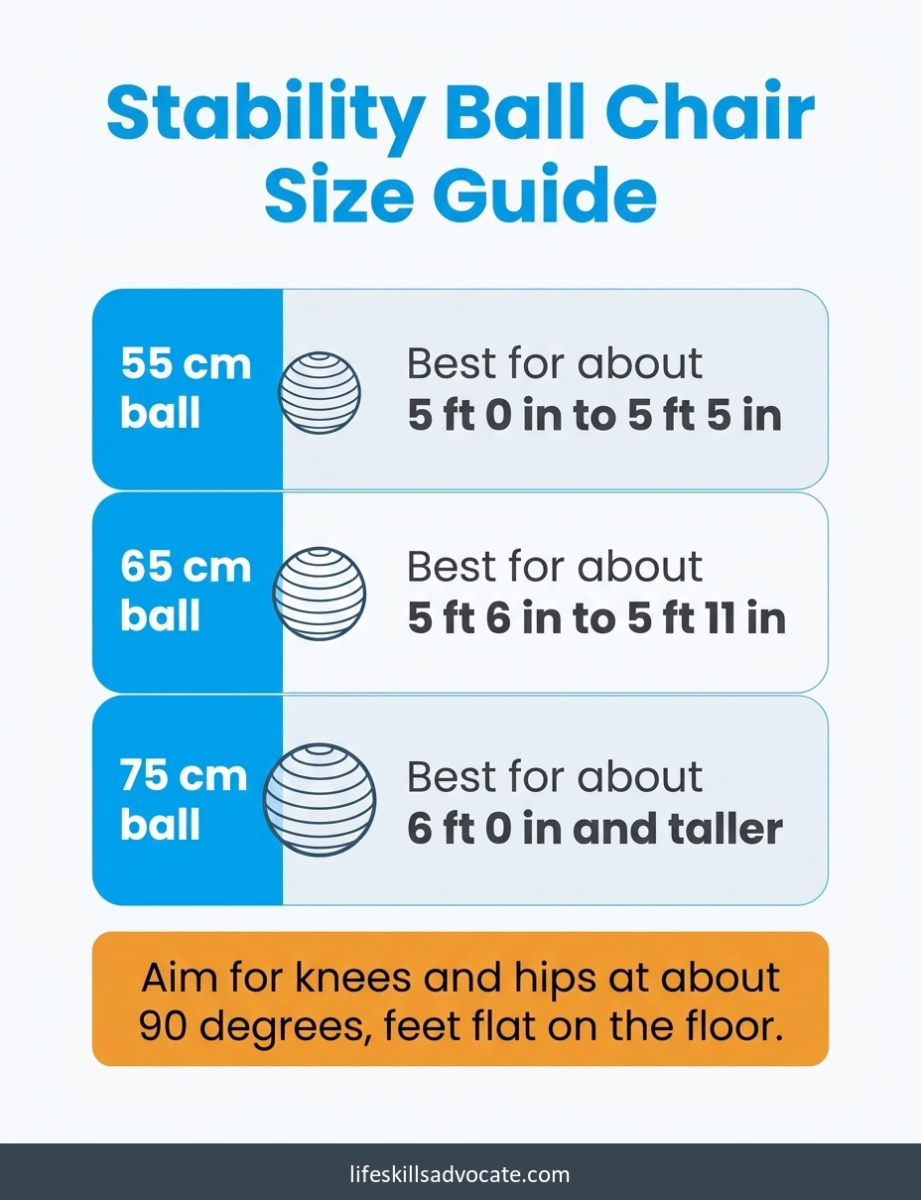
- Ball size by height. The ball should let your knees and hips sit near 90 degrees with your feet flat. As a rough guide, a 55cm ball suits about 5’0″ to 5’5″, a 65cm ball fits 5’6″ to 5’11”, and a 75cm ball works for 6’0″ and up. Too small folds you up; too large leaves your feet dangling.
- Weight limit. Most quality balls are rated to 300 pounds or more, but a few framed chairs are rated lower, so check the number against your own weight.
- Anti-burst rating. An anti-burst ball deflates slowly if it is punctured instead of popping out from under you. At a desk, that is worth paying for.
- Base and pump. A ring base or frame stops the ball rolling away when you stand, and a pump gets it to the right height on day one. Some chairs add wheels or a backrest, which changes the feel more than the specs suggest.
6 Best Stability Ball Chairs for Focus and Active Sitting
Every pick below is a real, in-stock ball chair built for adult and teen bodies, sourced by price, weight limit, and what actually comes in the box. Here they are side by side, then in detail.
| Chair | Ball size / fit | Weight limit | Anti-burst | Base + pump | Back support | Best for | Price |
|---|---|---|---|---|---|---|---|
| Gaiam Essentials Ball & Base Kit | 65 cm (5’6″-5’11”) | 300 lb | Yes | Ring base + pump | None | Anyone testing active sitting on a tight budget | ~$20 |
| Mantra Sports Yoga Ball Chair | Round ball, size unlisted | 330 lb | Yes | Base + pump | None | Bigger adults who want a plain, sturdy ball | ~$30 |
| ProBody Pilates Yoga Ball Chair | 65 cm (5’6″-6’0″) | 330 lb | Yes | Base + bands + pump | None | People who want to stretch or work out at the desk | ~$37 |
| Trideer Ball Chair with Bands | 65 cm (5’3″-5’10”) | 330 lb | Yes | Base + bands + pump | None | Restless sitters who like extra movement built in | ~$40 |
| Gaiam Classic Backless Ball Chair | 52 cm (5’0″-5’11”) | 300 lb | Not stated | Wheeled frame + pump | None | Shorter desks and people who roll between spots | ~$76 |
| Champion Sports FitPro Ball Chair | ~50 cm frame (one size) | ~200 lb | Not stated | Wheeled frame + pump | Backrest | People who need a backrest and casters, under ~200 lb | ~$113 |
Prices are approximate and can change often on Amazon, so check the current price on each product page before you buy.
1. Gaiam Essentials Balance Ball & Base Kit
Gaiam Essentials Balance Ball & Base Kit is the cheapest way to find out whether active sitting works for you. For around twenty dollars you get a 65cm anti-burst ball resting in an inflatable ring so it will not roll off, plus a pump. There is no frame and no backrest, so the first few days ask your core to wake up, and you can lift the ball out to use it on the floor.
Best for: people who want to test active sitting before spending real money.
2. Mantra Sports Yoga Ball Chair
Mantra Sports Yoga Ball Chair is a plain, sturdy round ball on a base, rated to 330 pounds with an anti-slip surface so you are not sliding around. Mantra does not publish the ball diameter, so height fit is a bit of a guess, but the higher weight limit and grippy texture make it a solid everyday pick. Like most on this list, there is no back to lean on.
Best for: bigger adults who want a no-frills ball with a high weight limit.
3. ProBody Pilates Yoga Ball Chair
ProBody Pilates Yoga Ball Chair comes with the most in the box: a 65cm anti-burst ball, a base, two resistance bands, and a pump, plus a lifetime burst guarantee from the maker. If part of the appeal is moving more during the day, the bands let you stretch or work your arms without leaving your seat. It is still a backless ball, so this is active sitting, not lumbar support.
Best for: people who want to stretch or squeeze in movement at the desk.
4. Trideer Exercise Ball Chair with Base and Resistance Bands
Trideer Exercise Ball Chair with Base and Resistance Bands is a well-reviewed 65cm anti-burst ball on a stability base, bundled with bands for the same move-while-you-sit idea as the ProBody. Trideer’s honeycomb ball deflates slowly rather than popping if it is punctured, which is reassuring at a desk. The listing mentions “back support,” but that refers to posture, not a seat back, so read it plainly: there is no backrest here.
Best for: restless sitters who want extra movement built into the chair.
5. Gaiam Classic Backless Balance Ball Chair
Gaiam Classic Backless Balance Ball Chair sets the ball inside a rolling frame with locking casters, so it moves with you between the desk and the printer while keeping you upright with nothing to slouch into. The 52cm ball suits people roughly five foot to five foot eleven at standard-height desks. It costs more than a bare ball because you are paying for the frame and wheels, and Gaiam does not list an anti-burst rating on this model.
Best for: shorter desks and people who like to roll between spots.
6. Champion Sports FitPro Balance Ball Chair
Champion Sports FitPro Balance Ball Chair is the only pick here with a real backrest, a ball held in a tall wheeled frame with a sculpted back and locking casters. If a fully backless ball sounds like too much, this is the easiest way in. Two caveats to weigh: it is the priciest at around $113, and its roughly 200-pound weight limit sits well below the 300-to-330-pound balls above, so heavier sitters should choose one of those instead.
Best for: people who want a backrest and wheels, and who are under about 200 pounds.
Ball Chair vs Wobble Stool vs Cushion: Is It Even the Right Form for You?
A stability ball chair is one way to add movement to sitting, not the only way. Before you commit, it helps to see where it lands next to the two most common alternatives.
| Option | Type of movement | Back support | Best for |
|---|---|---|---|
| Ball chair | Bounce and full-seat wobble | None (except framed models) | People who want the most movement and do not mind no back |
| Wobble stool | Tilt and lean, feet stay grounded | None | People who want movement plus a stable footing |
| Wobble cushion | Small wiggle on the seat you already own | Keeps your current chair’s back | People who want to test movement for under $20 without a new chair |
If you are not sure a ball is the right shape for your body or your work, a wobble cushion on your existing chair is the lowest-risk way to try active sitting. For a wider look at seating built for restless focus, our roundup of the best chairs for ADHD covers stools, kneeling chairs, and supportive options a ball cannot replace.
How to Use a Ball Chair Well (and How Long to Sit on It)
The research points to one clear rule for a stability ball chair: it is for short bouts, not marathons. The discomfort people report tends to build over long stretches, which is exactly when a ball stops helping.
A reasonable rhythm is 20 to 30 minutes on the ball, then a switch back to a supportive chair when your back or hips start to complain. Think of it as one seating option you rotate through during the day, not your only chair.
A few habits make it work better:
- Inflate to the right height so your knees and hips sit near 90 degrees with your feet flat. An under-inflated ball drops you too low.
- Keep both feet on the floor for stability, especially in the first week while your body adjusts.
- Pair it with a timer. A simple work timer cues you to move, stretch, or swap chairs before discomfort sets in.
- Start short. Twenty minutes on day one beats three hours that leave you sore and swearing off the whole idea.
Who a Stability Ball Chair Isn’t Right For
A stability ball chair is a niche tool, and there are people it genuinely does not suit. Being clear about that is part of recommending it well.
Skip it, or check with a professional first, if you have active low-back pain. A ball offers no lumbar support, and the ergonomics research found more discomfort, not less, over sustained sitting. A physical therapist can tell you whether active seating helps or aggravates your specific situation.
It is also a poor fit if you need all-day supported desk seating. If your work keeps you at a screen for eight hours, your main chair needs a real back and lumbar support, and a ball can be a short movement break within that day, not the whole setup. And if balance or fall risk is a concern, a backless ball on a hard floor may not be the safe choice a framed chair or wobble cushion would be.
FAQ
Will a stability ball chair help me focus or just distract me?
It depends on your brain, and there is no way to know until you try. For some people, the low-grade movement gives a restless mind something to do, so the rest of their attention can land on the task. For others, the bouncing becomes the thing they pay attention to, and they work better back in a normal chair. Test it cheaply first, and watch whether your work gets easier or just bouncier.
How long should you sit on a ball chair?
Short bouts, roughly 20 to 30 minutes, then switch back to a supportive chair. A ball works best as one seating option you rotate through the day, not your all-day chair.
What size stability ball chair do I need?
Match the ball to your height so your knees and hips rest near 90 degrees. A 55cm ball suits about 5’0″ to 5’5″, a 65cm ball fits roughly 5’6″ to 5’11”, and a 75cm ball works for 6’0″ and taller. Wrong size is the most common regret, so measure before you buy.
Are ball chairs good for ADHD?
For some people with ADHD, yes, in the specific sense that movement can support attention. In a study of children with ADHD, kids showed faster reaction times and better attention markers on a therapy ball than on a chair. Broader classroom research also found on-task behavior rose when students used balls instead of chairs, though that study was not specific to ADHD.
The leading explanation is that small, steady movement gives an understimulated brain something to do, which frees up focus for the actual work.
The catch is that most of that research is in kids, over short sessions, so an adult should treat it as a promising option to test rather than a guarantee. It also does not help everyone, since the same movement that steadies one person pulls another off task. A ball chair is a low-cost thing to try, not a treatment.
Is a ball chair better than a wobble stool or cushion?
Not better, just different. A ball gives the most movement and no back support, a wobble stool adds movement while keeping your feet grounded, and a wobble cushion adds a small wiggle to the chair you already own for the least money. If you are unsure, start with a cushion.
Next Steps
If a ball chair sounds worth trying, start small and let your own experience decide.
- Try before you buy. Use a plain exercise ball or a wobble cushion you already have for a few days and see whether your focus improves or just your bounce count.
- Size it right. Measure your desk height and match the ball to your height before ordering, so it fits on day one.
- Notice what actually helps. Track a couple of work sessions on and off the ball, so you are buying based on your attention, not the marketing.
- Build the system around it. A chair is a tool, not a plan. If focus and follow-through are the deeper challenge, executive function coaching for adults helps build the routines a ball chair can only nudge. Coaching is skill-building and practical, not mental health treatment.
Further Reading
- Stability Ball Versus Office Chair: Muscle Activation and Lumbar Posture – Gregory, Dunk & Callaghan, Human Factors (2006)
- How Ergonomic Are Ball Chairs? – Cornell University Ergonomics (CUergo)
- Observation of Classroom Performance Using Therapy Balls as a Substitute for Chairs – Ketcham & Burgoyne (2015)
- Influence of Therapy Ball Seats on Attentional Ability in Children with ADHD – Wu et al., Journal of Physical Therapy Science (2012)
- 9 Best Chairs for ADHD – Life Skills Advocate
- Fidget Tools for Regulation – Life Skills Advocate
- Sensory Regulation Strategies – Life Skills Advocate
- ADHD Stimming Explained – Life Skills Advocate
- Classroom Design Supports Executive Functioning – Life Skills Advocate
- How My Body Pays Attention Exercise – Life Skills Advocate
- Executive Function Coaching for Adults – Life Skills Advocate