
You have read the same sentence four times. Somewhere around the third read, your knee started bouncing, or you rolled the chair back a few inches, or you tucked one foot up under you without deciding to.
Your body is trying to do something.
The question is whether your chair is helping it or fighting it. Most “best chairs for ADHD” lists skip that question and hand you a ranked pile of products instead. The right seat actually depends on what your particular nervous system is asking for: some ADHD bodies focus best when they can move, others settle only when something holds them still, and a few do better not sitting at all.
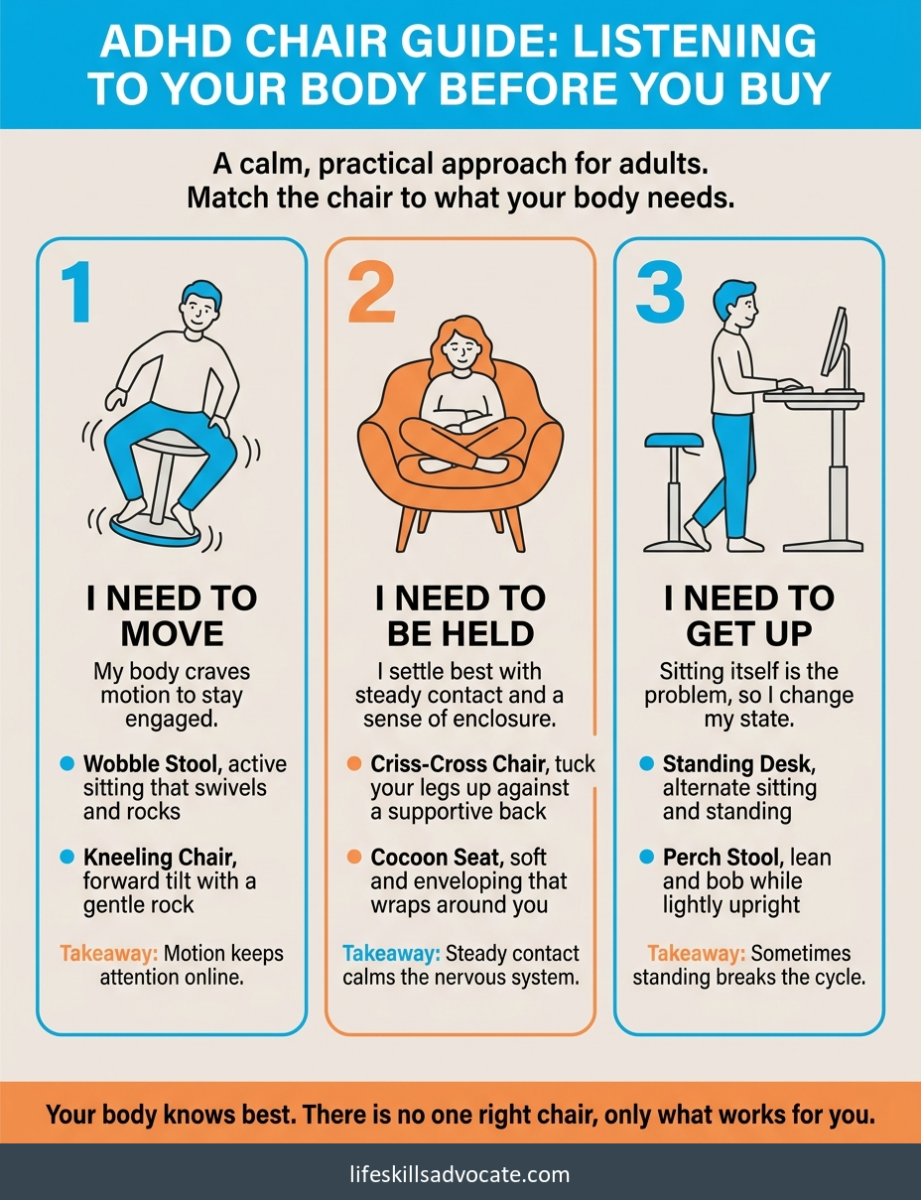
So this guide is organized around your body, not a leaderboard. Movement is not a flaw to suppress; for a lot of adults with ADHD, a little motion is what keeps attention online, and a 2019 study of adults with ADHD found a single bout of exercise sharpened their attention and processing speed. The nine picks below sort into three plain questions: do you need to move, to be held, or to get up?
TL;DR: The Best Chairs for ADHD, Matched to Your Body
The best chairs for ADHD sort into three groups, depending on whether your body wants to move, to be held, or to stand. Here is the top pick in each, plus who it fits.
- If your body needs to move, active-sitting seats like wobble stools and kneeling chairs give restless energy somewhere to go. The strongest mover is the Backerz wobble stool, a full-sized seat that swivels and rocks.
- If your body wants to tuck in, criss-cross seats and a soft cocoon let you fold up and downshift. The most position-flexible is the viral Pipersong; the one that truly holds you is the high-backed Vingli.
- If sitting itself is the problem, a standing or perch stool keeps you upright and lightly moving. The proven option there is the Songmics standing stool.
- Nine picks in total across the three groups, with a comparison table and a “what to skip” section so you are not buying on hype.
One note before the picks: this is buyer guidance from an executive function coaching team, not medical advice. A chair can support how you focus, but it does not replace working with a professional on the underlying skills.
Can a Chair Actually Help You Focus?
A chair will not focus for you. What the best chairs for ADHD do instead is change the background hum your body makes while you work, and that hum matters more than most product pages admit.
Here is what the research actually shows. A 2025 meta-analysis of eleven trials found that physical activity improved working memory in children with ADHD, with moderate-intensity movement helping most, and the adult exercise research points the same way.
None of those studies put anyone in a chair.
They measured workouts, not wobble stools, so the line from “movement helps attention” to “this seat helps your attention” is a fair inference, not a proven result.
The pressure side works much the same. When researchers applied steady deep-pressure input, physiological arousal dropped, and even in healthy adults, gentle skin pressure blunted the body’s reaction to sudden noise. Lower arousal tends to free up attention, because a system that is not bracing has more room for the task at hand.
So the mechanism is real and the chair link is a synthesis: movement and steady contact both shift arousal, arousal shapes attention, and a seat is one easy way to deliver a little of either. Full, weighted deep pressure is more than a desk chair gives, but an enclosing seat offers a lighter version. That is why the urge to fidget is worth working with instead of against. Treat any chair as a support for focus, not a source of it.
What Is Your Body Actually Asking For?
Before you compare a single ADHD chair, it helps to figure out which of three things your body is after when you sit down to work. People differ here in a measurable way. Dunn’s widely used model sorts us into four sensory-processing patterns, and the short version for seating is that some bodies seek input while others get overwhelmed by it.
That sorts into three plain asks.
“I need to move.” This is the sensory-seeking body. A little vestibular and proprioceptive input, the gentle feedback of rocking, swiveling, or balancing, keeps arousal in the zone where attention holds, so the need to move stops hijacking the task. Wobble stools, kneeling chairs, and standing stools all answer this ask.
“I need to be held.” This body settles under steady contact. A snug, enclosing shape acts as constant calming input, which lowers the background buzz and leaves more working memory for what is in front of you. High-backed chairs and soft, enveloping seats answer this one, and so do off-the-chair calming techniques for adults with ADHD when the seat alone is not enough.
“I need to get up.” Sometimes sitting is the problem, full stop. A standing or perch setup keeps you upright and lightly moving instead of forcing a posture your body keeps rejecting.
Most people lean toward one ask but borrow from another on a hard day. Name your main one and you have already cut the list from nine chairs down to about three.
The 9 Best Chairs for ADHD, Side by Side
Here are all nine of the best chairs for ADHD, grouped by the three asks, so you can match one to your body and your budget in a few seconds. Prices move around on Amazon, so the dollar signs are ballpark bands, not exact tags.
| Best Chairs for ADHD | What your body gets | Movement | Best for | Price band |
|---|---|---|---|---|
| Backerz Standing Desk Wobble Stool | Movement | Swivel and rock | Movers who want a proven, full-sized stool | $$ |
| ERGO COLLECT Wobble Stool | Movement | Controlled wobble | Larger bodies who need a 440 lb-rated mover | $$ |
| TopJob Boba Wobble Stool | Movement | Tilt and wobble | Adults who want a wobble stool, not a kids’ one | $ |
| NYPOT Kneeling Chair | Movement | Forward tilt, rock | Movers who want gentle rocking, not balancing | $$ |
| Pipersong Meditation Chair | Movement + tuck-in | Criss-cross, swivel footrest | Position-shifters who will add a cushion | $$$ |
| Vingli Cloud Criss-Cross Chair | Being held | Cross-legged, padded | Criss-cross sitters who want padding | $$ |
| AtHope Cross-Legged Office Chair | Movement + tuck-in | Criss-cross, swivel footrest | Position-shifters on a budget | $ |
| Ningering Giant Cloud Lounge | Envelopment | None (reset seat) | Over-responsive systems needing a soft landing spot | $$ |
| Songmics Standing Stool | Standing | Lean and bob | Standing-desk users who want a proven standing stool | $ |
Bands are rough: $ is budget, $$ is mid-range, $$$ is premium. Full verdicts, downsides included, are below.
If Your Body Needs to Move: Wobble and Kneel
These active-sitting picks are the best chairs for ADHD when your body wants to keep moving.
They keep a little motion available, so restless energy has somewhere to go that is not your phone.
1. Backerz Standing Desk Wobble Stool
The Backerz standing desk wobble stool is our best mover, the seat we would point most restless adults toward first. It swivels a full turn and rocks in any direction, so your body can shift while your eyes stay on the work, and it adjusts from 21 to 31 inches to suit a sitting or a standing desk. At a rated 300 pounds it is built for grown bodies, not a scaled-up kids’ stool.
The catch: the average sits at 4.0 stars, the same honest middle as the Songmics below, though it earns that score across 760 ratings, the deepest track record of the adult wobble stools we looked at.
Best for: movers who want a proven, full-sized stool rather than a thinly reviewed gamble.
2. ERGO COLLECT Wobble Stool
If you are a larger or heavier person and most active seats feel built for someone smaller, the ERGO COLLECT wobble stool is the one sized for you. It is rated to 440 pounds, well above the usual cap, and its 14.4-inch cushioned seat gives more room than the narrow criss-cross seats further down this list. A gentle, controlled wobble keeps a little motion going without turning into a balance workout.
The catch: it is new, with only 18 ratings so far, so treat the early 4.8-star average as promising rather than proven, and it tops out at 27.5 inches, which suits a standard desk but not a tall standing desk.
Best for: bigger bodies who want a sturdy mover that actually fits.
3. TopJob Boba Wobble Stool
The TopJob Boba wobble stool is the sturdier, more premium build among the movers: made for grown bodies, height-adjustable, and able to tilt in any direction.
The catch: its track record is thin, about 34 ratings on a recent listing, so durability is still an unknown, and it tops out at 25.4 inches, which is short for very tall users or a tall standing desk.
Best for: adults who want a well-made wobble stool and do not mind being an early reviewer.
4. NYPOT Ergonomic Kneeling Chair
The NYPOT kneeling chair tips you forward and opens your hips, and its curved base lets you rock gently as you work, so you get movement without the balance demand of a backless wobble stool. It earns a 4.3-star average across more than 700 ratings.
The catch: kneeling suits some bodies and not others, since it can bother knees or circulation, and the 250-pound capacity sits below the roughly 300-pound office-chair norm, with some larger users finding the frame less steady.
Best for: movers who want gentle rocking and a forward, open posture, not a balance challenge.
Chairs That Let You Tuck In: Criss-Cross and Cocoon
When folding your legs up is what settles you, these are the best chairs for ADHD to reach for.
They are not all the same. Two let you shift and swivel while you tuck in, one really holds you with a tall padded back, and the last is a soft cocoon for resetting between focus blocks.
5. Pipersong Meditation Chair
The Pipersong meditation chair is the one you have seen all over TikTok, and it earns some of the hype. You can sit criss-cross, side-saddle, or feet-up, switch positions all day, and spin the footrest while you think, which makes it the most position-flexible seat here. It is a mover in criss-cross clothing, not a seat that holds you still.
The catch: the seat is firm and genuinely narrow, about 17.5 inches across, so larger frames feel boxed in and many owners add a cushion (the brand’s own answer for bigger bodies is the pricier Venti model, around $349). Its capacity tops out at 250 pounds, there are scattered reports of wheels or hardware failing, and reviewers at Wirecutter tested it and left it out of their guide. It is the priciest pick on the list.
Best for: position-shifters who run smaller and will pad the seat themselves.
6. Vingli Cloud Criss-Cross Chair
Padded where the Pipersong is firm, the Vingli cloud criss-cross chair pairs a soft, cushioned base for cross-legged sitting with a tall padded back, so it is the one chair in this group that actually holds you rather than just letting you perch and shift. It has a proven history of 500-plus reviews.
The catch: you lose the Pipersong’s tricks, with no spinning footrest and less position variety, and the 4.2-star average has the usual low marks.
Best for: criss-cross sitters who want a supportive back to settle into rather than gadgets.
7. AtHope Cross-Legged Office Chair
The AtHope cross-legged chair is the budget take on the Pipersong: the same idea, a wheeled office chair with a 360-degree swivel footrest you can spin to sit criss-cross, kneel, or stretch, with a little lumbar support behind you, for a lot less money. It has 700-plus ratings behind it.
The catch: you feel the lower price. The build is more basic than the Pipersong’s, the seat is snug at about 17.7 by 15.5 inches, and the 275-pound capacity is on the lower side.
Best for: position-shifters who want the Pipersong’s setup on a budget and run average-sized.
8. Ningering Giant Cloud Lounge
The Ningering giant cloud lounge comes with an asterisk: it is not a desk chair. It is the soft, sink-in seat you put beside the desk for a reset between focus blocks, a memory-foam cloud that wraps around you when your system needs to downshift more than it needs posture. Think cocoon, not deep pressure: it surrounds you with softness rather than pressing back the way a weighted blanket would.
The catch: you do not work at it, the review base is small at around 30 ratings on a new product, and at roughly 23.5 inches tall it sits low, so a deep, soft seat can be hard to climb out of on a low-energy day. If you want firm, weighted pressure, a bean bag or weighted option does more.
Best for: over-responsive systems that need a soft landing spot to settle between tasks.
When Sitting Is the Problem: Stand or Perch
For some people, the best chair for ADHD is no chair at all, because sitting itself is what fights their focus.
9. Songmics Standing Stool
When that is the case, the Songmics standing stool lets you lean and bob at a standing desk instead of locking into a seat, and it adjusts from about 23.6 to 33.3 inches, tall enough for most standing setups. Its review base is the largest here, 1,700-plus ratings, so you know what you are getting.
The catch: the 4.0-star average is the lowest in this group, with some assembly and wobble gripes.
Best for: standing-desk users who want a proven, basic standing stool.
What to Skip When You Shop for an ADHD Chair
A few popular buys look like ADHD chairs and mostly are not. They are not bad products; they just tend to answer a different need than focus, for the reasons below.
- A bare stability ball. The plain no-base exercise ball is the classic active-seating buy, but a 2021 review of stability-ball chairs found benefits varied a lot by person, and unframed balls scored worst because people end up rolling and bouncing instead of working. If the ball still appeals to you, get a framed version, like the ones in our guide to balance ball chairs, rather than a naked ball.
- Buying on hype. The most common mistake is grabbing whatever chair is going viral without checking your own ask first. A held-body buying a wobble stool, or a mover buying a containment seat, will be uncomfortable no matter how good the reviews looked.
- Gaming chairs sold as focus aids. A reclining gaming chair locks you into one position with a racing-stripe sticker. There is no movement and no pressure benefit, and the “ADHD” label is marketing.
- A bean bag as your main work seat. A bean bag makes a fine reset corner, which is why we keep a whole bean bag chairs roundup, but it is too low and too soft for sustained desk work.
Match the seat to your body, not to the trend.
The Research on Chairs and ADHD, at a Glance
If you want the evidence behind the best chairs for ADHD in one place, here is what the research supports and what it does not.
| What the research supports | Detail | Source |
|---|---|---|
| Movement supports attention | A 2025 meta-analysis of 11 trials found physical activity improved working memory in children with ADHD, with moderate intensity helping most. | Sun et al., 2025 |
| Adults with ADHD benefit too | After a single bout of aerobic exercise, adults with ADHD improved attention and processing speed (2019). | Fritz et al., 2019 |
| Deep pressure lowers arousal | Deep-pressure input measurably reduced physiological arousal in a 2022 study. | Afif et al., 2022 |
| Sensory profiles differ | Dunn’s model defines four sensory-processing patterns: seeking, avoiding, sensitivity, and registration (2022 review). | Lane et al., 2022 |
| Why the best chairs for ADHD vary by person | Active-seating evidence is mixed: a 2021 study of stability-ball chairs found benefits varied by person, and plain balls showed low social validity. The best chairs for ADHD are matched to the body, not ranked. | Seliner et al., 2021 |
Frequently Asked Questions About Chairs for ADHD
Can the Wrong Chair Make Focus Worse?
Yes, and it is the part most lists skip. A seat that demands active balance, like a backless ball or a wobble stool, asks your core to work the entire time you sit. For a body with low muscle tone, chronic pain, or balance differences, that constant demand pulls attention toward staying upright and away from the task. The answer is not more movement; it is the right amount for your particular body, which for a lot of people turns out to be a stable, perfectly ordinary seat after all.
Are the Best Chairs for ADHD Worth Buying?
A chair can help, but not the way “ADHD chair” marketing implies. What a good seat does is steady your arousal level, the background state that makes attention easier or harder to hold. It supports how you regulate; it does not erase ADHD or do the focusing for you. The bigger levers are sleep, movement, interest in the work itself, and the systems you build around a task, and a chair quietly supports those rather than standing in for them. So one is worth the money if it removes a specific friction you can actually feel, and a waste if you are hoping the seat alone will carry your focus, which it cannot do on its own.
Which Are the Best Chairs for ADHD if You Sit All Day?
There is no single answer, and anyone who names one without asking about your body is guessing. Start with what you actually notice in your body when you sit down to work.
If you focus better while moving, an active seat like the Backerz wobble stool keeps low-level motion available without taking over the task. If you settle only when you can tuck in, a criss-cross seat like the Vingli or the position-flexible Pipersong fits better, as long as you make peace with the Pipersong’s firm seat. If sitting itself is the struggle, a perch stool at a standing desk may beat any chair you could buy.
Then look past the seat entirely. Screen height, lighting, background noise, and whether the room even lets you move will shape your focus as much as the chair underneath you does.
Do Wobble Chairs and Active Seating Actually Work?
The answer is genuinely mixed. Active seating helps some people stay engaged, and the movement research leans that way, but the same 2021 review of stability-ball chairs found the benefit varied widely from one person to the next. Plain bouncy balls scored worst, because users drifted into rolling around instead of working. Worth a try if you suspect you are a mover, with no promise it sticks.
What About Chairs for a Child With ADHD?
This guide is written for teens and adults, so the picks run adult-sized. The same three asks apply to a younger child, but check the seat height and weight rating first, since most of these chairs will simply be too big for a smaller frame.
Next Steps
The right chair for ADHD is the easy thing to buy and the easy thing to overthink. Here is how to spend the next twenty minutes so the money actually lands well.
- Name your ask before you open a single tab. Decide which of the three you are, a mover, a tuck-in, or someone who should not be sitting. That one call narrows nine chairs to two or three.
- The cheapest test comes first. Before buying a criss-cross seat, sit cross-legged on a firm cushion for a day and see if tucking in helps; before a wobble stool, notice whether a little rocking or swiveling keeps you on task. Your body will tell you more than the reviews will.
- Focus is a skill, not a seat. A chair supports attentional control but does not build it, so it is worth checking where attention actually breaks down. Our free executive functioning assessment is a low-effort place to start.
- Go deeper if focus is the real bottleneck. The Real-Life Executive Functioning Workbook walks through the follow-through habits a chair can only prop up.
- A person in your corner helps too. If the desk is one piece of a bigger focus puzzle, working with an executive function coaching team can help you build the routines around it.
You do not have to buy anything today. The first move costs nothing: name which of the three asks is yours, and the rest gets a lot simpler.
Further Reading
- How exercise affects attention in adults with ADHD – Fritz et al., 2019
- Physical activity and working memory in children with ADHD – Sun et al., 2025
- Deep pressure and physiological arousal – Afif et al., 2022
- Skin pressure and the body’s stress response in adults – Inada, 2015
- Sensory-processing patterns and Dunn’s model – Lane et al., 2022
- Stability-ball chairs and mixed active-seating evidence – Seliner et al., 2021
- Why Do I Fidget So Much? – Life Skills Advocate
- Calming Techniques for Adults With ADHD – Life Skills Advocate
- 8 Best Balance Ball Chairs – Life Skills Advocate
- Best Bean Bag Chairs – Life Skills Advocate
- Free Executive Functioning Assessment – Life Skills Advocate
- Real-Life Executive Functioning Workbook – Life Skills Advocate
- Executive Function Coaching for Adults – Life Skills Advocate