
You sit down at your desk with one task. Forty minutes later, you have answered three emails, started a different project, googled something unrelated, and the original task is still open on your screen.
You sit down at your desk with one task. Forty minutes later, your shoulders are around your ears, you keep glancing at the door, and you cannot remember the last paragraph you just read. The original task is still open on your screen.
Same surface. Same outcome. Two different things happening underneath.
The question of ADHD or trauma comes up often in coaching practice, especially for adults who received an ADHD identification later in life and started wondering whether what they assumed was ADHD might be something else, or something more. Telling them apart in daily life is harder than most articles make it sound, and easier than it looks once you know where to watch.
That is what this is for. Not a quiz, not a checklist: a look at how each pattern actually behaves during ordinary days.
TL;DR
The short version, before the daily-life specifics:
- ADHD and trauma can look identical on the surface (same focus problems, same emotional swings, same memory blanks), but the underlying mechanisms differ in ways that affect what actually helps.
- ADHD is neurodevelopmental and consistent across contexts. Trauma-driven patterns are usually context-dependent: they spike around triggers and ease in safe settings.
- Both can coexist. Up to 17% of trauma-exposed children meet ADHD criteria, and adults with ADHD report childhood adversity at higher rates than peers.
- If standard ADHD or trauma support is not landing the way your prescriber or therapist expected, that is information to bring back to them, not a self-identification.
- Below: 7 daily-life differences from coaching practice (trigger pattern, sleep, memory shape, emotional baseline, feedback response, body cues, and medication response), plus a side-by-side mechanism table you can screenshot.
A note before we go further: this is educational content, written from an executive function coaching perspective. We are not clinicians, and nothing here is a substitute for evaluation by a licensed professional. If you suspect ADHD, trauma, or both are shaping your daily life, talk with someone qualified who can do a proper assessment.
Why ADHD or Trauma Gets Confused (and Why It Matters)
Telling ADHD or trauma apart is hard because they share enough surface features that even experienced clinicians slow down and look twice. Attention drifts. Emotions arrive bigger than expected. Memory holes appear in routine tasks. Sleep stops being restful. The body cannot settle.
Two different mechanisms can produce that picture. ADHD is a neurodevelopmental wiring difference that affects how the brain regulates attention, working memory, and emotional intensity. Trauma is what happens after the nervous system has been overwhelmed by something it could not protect itself from at the time. The brain learns to keep scanning for danger, and that scanning eats the same attention and memory bandwidth ADHD already taxes.
The reason it matters: misnaming the cause leads to mismatched support. If a focus problem is driven by trauma, a productivity app probably will not help. If the focus problem is driven by ADHD, white-knuckling through a yoga retreat will not either. Recognizing which one is in the room is the difference between approaches that land and approaches that bounce.
Research has caught up to what coaches and therapists see anecdotally. A 2017 study by Vrijsen and colleagues found childhood trauma and negatively biased memory predict ADHD-like patterns in adults without a formal ADHD identification. That does not mean trauma causes ADHD. The two can produce a similar surface picture. We covered the regulation side of that picture separately in emotional dysregulation in ADHD.
What ADHD Looks Like Day to Day
Before sorting ADHD or trauma, it helps to look at each pattern on its own. ADHD in adults rarely looks like the kid-bouncing-in-a-chair caricature. It usually looks like a long quiet erosion of self-trust. You start the email. You get to the third sentence. A different tab catches your eye and twenty minutes later you have no memory of what you were saying. The original draft is still waiting.
Time runs strangely. Either it disappears (the two-hour hyperfocus you swore would be twenty minutes) or it crawls (the four-minute task that feels like an hour). Attention does not allocate evenly across the things you actually need to do, and “boring but important” suffers most. The 11 executive functioning skills all take a hit, but task initiation and working memory are usually the loudest.
Emotional intensity runs through the same brain that regulates attention. When the regulator is taxed, emotions arrive louder and stay longer. A small slight from a coworker lands like a personal verdict. A delayed text becomes a story about being unloved. That intensity is not someone being dramatic; it is the baseline running hot.
The distractibility shows up across most contexts (work, hobbies, conversations, the grocery store), time blindness makes planning feel like guessing, and the restlessness does not feel like fear, just like the engine needs to run somewhere. None of this is a moral failing. It is what happens when the executive function system runs with a different operating manual.
What Trauma Looks Like Day to Day
The trauma side of the ADHD or trauma question often looks like ADHD with a backstage door. The focus problems, the emotional spikes, and the memory gaps are all there, but they have a relationship with context that ADHD does not.
Take focus. You can write for two hours at the coffee shop where you have been working all week. The new client meeting on Friday, where the boss-figure reminds you of someone, is when you blank. Same brain, different setting, different result. ADHD does not usually behave that selectively.
The nervous system is doing something specific in those moments: scanning for threat. The technical term is hypervigilance, and according to the Child Mind Institute, trauma patterns like difficulty concentrating and being easily startled can mimic ADHD because both pull attention off the task and onto the environment. The mechanism is different; the output, on a bad day, looks similar.
Memory is the other place the two diverge. Trauma-pattern gaps cluster around specific reminders. You can recall the entire week before a difficult event in detail and lose the day of it. Dissociation, a temporary disconnect between thought, feeling, and body, produces the “I know I was there but it is fuzzy now” experience. Other trauma patterns less typical of ADHD on its own: nightmares, startle reactions to sounds, and avoidance of specific places or people without clear logical reason.
ADHD or Trauma: Key Facts at a Glance
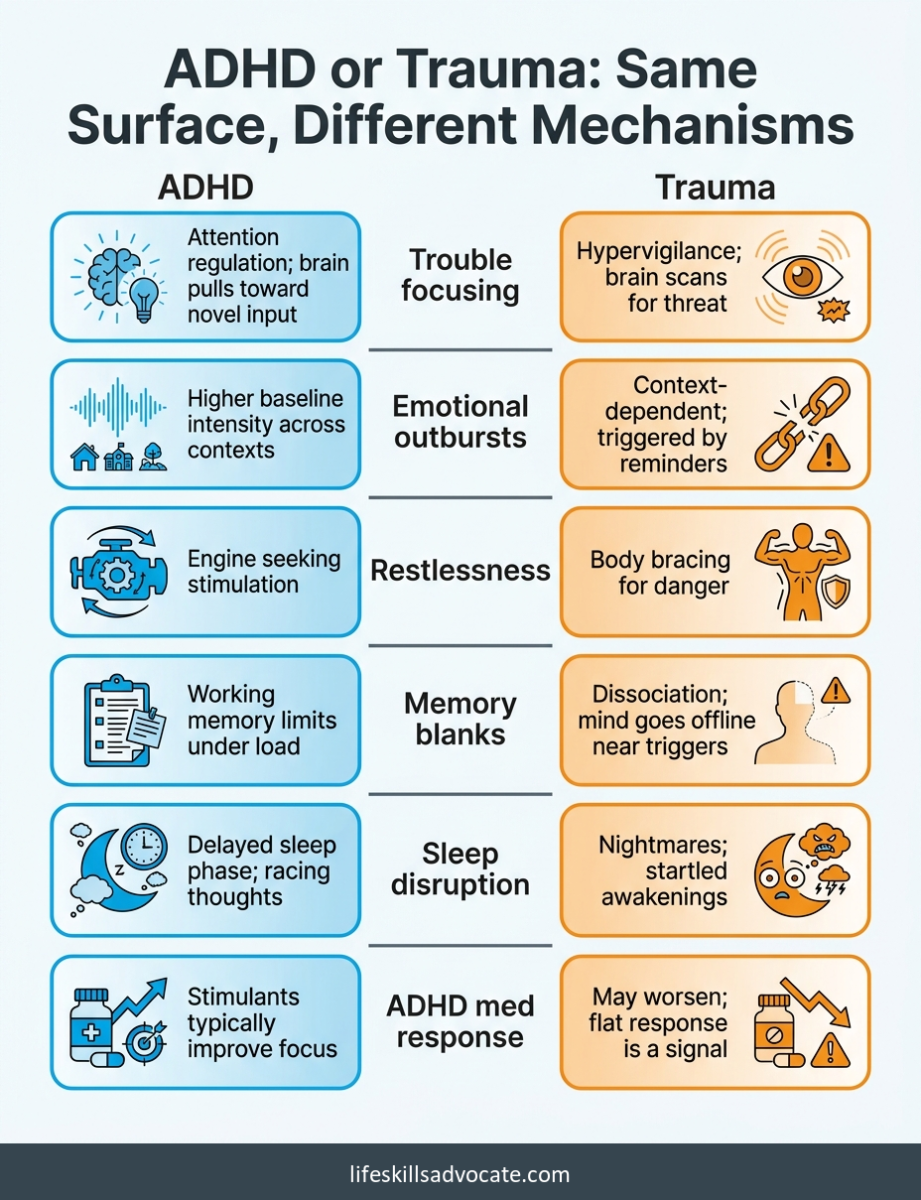
The mechanism contrasts below summarize what is happening underneath the same surface in ADHD or trauma.
| ADHD or trauma trait | ADHD mechanism | Trauma mechanism |
|---|---|---|
| Trouble focusing | Attention regulation is the issue: the brain pulls toward novel input and drifts on low-interest tasks. | Hypervigilance: the brain is scanning for threat, attention is on the environment, not the task. |
| Emotional outbursts | Baseline regulation is harder; reactions are intense across most contexts. | Context-dependent: specific triggers reactivate threat memories, with calm in between. |
| Restlessness | Hyperactivity: the motor system seeks stimulation, the internal engine runs fast. | Fight-or-flight activation: the body braces for danger, sometimes including startle reactions. |
| Memory blanks | Working memory limits: information drops out under load, especially when distracted. | Dissociation or trauma-avoidance: the mind goes offline near triggers as a protective response. |
| Sleep disruption | Delayed sleep phase, racing thoughts at night, time-blindness around bedtime. | Nightmares, intrusive memories, startled awakenings, and hypervigilant arousal. |
| Response to standard ADHD medication | Stimulants typically improve focus and reduce restlessness. | Stimulants may worsen hypervigilance, anxiety, or sleep; a flat or worse response is a signal worth bringing to your prescriber. |
The 7 Daily-Life Differences Most Articles Miss
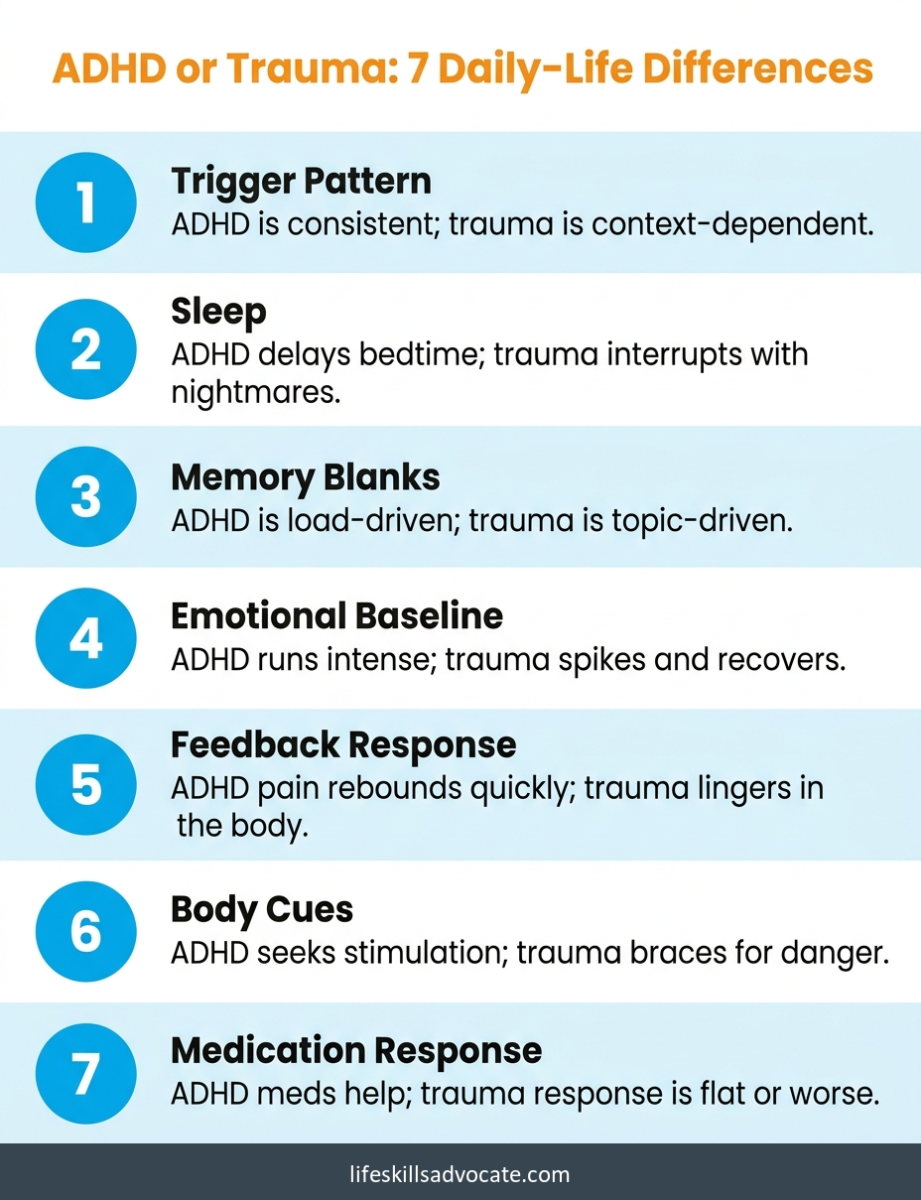
If the mechanisms behind ADHD or trauma differ, the daily-life signals should differ too. Here are seven that show up most often when both populations are being coached under one roof. None of these is a self-identification on its own. Patterns, not verdicts.
1. The Trigger Pattern: Consistent vs Context-Dependent
ADHD distractibility is roughly the same in every setting. You can lose focus at home, at work, at the dentist, on a hike. The terrain does not change the experience much.
Trauma-driven distraction spikes in particular settings: places that resemble the original event, people who remind you of someone difficult, situations with a power imbalance. The same person might focus fine alone in their bedroom and lose all attention in a meeting with their manager. That selectivity is information.
If your focus problems do not care where you are or who you are with, the pattern leans ADHD. If they cluster predictably around certain places or people, the pattern leans toward a trauma response. Both can layer together. Spread observations across a week or two and bring the pattern (not the conclusion) to a clinician.
2. Sleep: Delayed Sleep Phase vs Nightmares and Startle
Sleep is where the two patterns diverge in texture, even when both produce exhaustion.
ADHD sleep usually looks like trouble getting to bed and trouble waking up. The night feels too short, the morning feels too early, and racing thoughts at 1 a.m. are a common refrain. The natural rhythm has settled a few hours later than the world prefers (often called delayed sleep phase).
Trauma-pattern sleep looks different from the inside. Nightmares show up, often with content the dreamer recognizes. So do startled awakenings that feel like coming up out of cold water. The body wakes alert and braced, not groggy. Hypervigilance does not switch off when the lights do.
Plenty of people have a mix: ADHD-pattern sleep onset, trauma-pattern middle-of-the-night wakeups. The texture of how sleep breaks down (delayed vs interrupted, calm vs braced) points toward a different kind of support for each.
3. The Shape of Memory Blanks: Working Memory vs Dissociation
Both populations forget things. The shape of the forgetting differs.
ADHD memory blanks are short-term, load-dependent, and everywhere. You walked into the room and forgot why. You closed the tab and lost what you were doing. The information was there ten seconds ago and now it is gone, regardless of whether the day has been hard or easy.
Trauma memory blanks have a relationship with content. A specific subject is brought up and the room feels slightly far away. A person describes an event and parts of it are clear while others are fog. That is dissociation, and it clusters around material the nervous system is protecting itself from.
The same person can have both: ADHD-pattern blanks for the grocery list, trauma-pattern blanks for the conversation with a particular family member. If memory feels random and load-driven, the pattern leans ADHD. If it feels topic-driven and avoids specific material, the pattern leans toward a trauma response.
4. Emotional Baseline: Always Intense vs Spike-and-Recover
Emotional intensity is the trait that overlaps most loudly, which makes the underlying shape the most useful thing to watch.
ADHD emotional intensity is usually a baseline state. The dial is set higher across the board. Happiness is more vivid, frustration is more biting, embarrassment lasts longer, joy is bigger, and most of this happens whether or not anything has happened. Adults with ADHD often describe living one or two steps closer to every emotion than most people around them.
Trauma-pattern emotion is more often spike-and-recover. The baseline can be flat or even numb, and then a trigger sets off a sharp activation that subsides into calm again. Some clinicians describe trauma emotion as event-driven, where ADHD emotion is more terrain-driven.
A useful question for a clinician or coach: across the last two weeks, was the emotional intensity present roughly all the time, or did it cluster around identifiable events? “All the time” leans ADHD. “Around specific things” leans trauma. “Both, depending on the week” is also normal and worth naming honestly.
5. How You React to Feedback: RSD-Style Pain vs Trauma-Trigger Activation
Feedback is where many adults first start wondering whether something else is going on.
ADHD often comes with rejection sensitive dysphoria, a pattern where even mild criticism lands as an outsized emotional blow. The pain is real, intense, and usually short-lived once the person can process it.
Trauma-driven feedback reactions look different. The first response is body-level: heart rate climbs, throat tightens, words leave. The reaction can persist long after the conversation has ended, and may include withdrawing from the person, replaying the exchange for hours, or experiencing a flashback to an earlier moment when a similar comment landed in a much more dangerous setting.
Useful distinguishing question: after the initial reaction, does your body settle within a couple of hours, or does the experience continue to occupy you for days? Quick rebound with intense feeling is more typical of ADHD-pattern RSD. Slower rebound with body-level activation is more typical of a trauma response.
6. What Your Body Does: Restlessness vs Bracing
Watch the body, not just the brain.
ADHD restlessness has a quality of seeking stimulation. The leg bounces because the engine needs to run somewhere. The hands fidget. The pacing happens during phone calls, video calls, deep thinking. The body is looking for input, and the input feels good when it arrives.
Trauma-driven activation looks more like bracing. Shoulders pull up toward the ears. The jaw locks. The chest tightens. Movements may pause altogether, freezing into stillness, before the next round of activation. Startle responses to sounds, sudden touches, or unexpected presence are part of the body’s threat scan.
Adults with mixed presentations sometimes describe their body as “either bouncing or braced, rarely settled.” The body cue is one of the more reliable signals because it is harder to mask than thought or speech.
7. How You Respond to Standard ADHD Medication: Improvement vs Flat-or-Worse
The last sign carries the most weight on its own, though it requires you to have already tried a medication trial under a prescriber’s care.
If a properly-dosed stimulant produces recognizable improvement (clearer focus, calmer body, less internal noise), that points strongly toward ADHD doing the lead work. The medication is targeting the right system.
If the same medication produces a flat response, or worse, makes things feel jumpier or more anxious, that result is worth bringing back. Some clinicians have noted that when trauma is producing ADHD-looking patterns, the standard medication response is flat or worse, which lines up with the same pattern in adults.
What we do not want this to become: the conclusion that if meds did not work, you must have trauma instead. A flat response can mean wrong dose, wrong formulation, a co-occurring condition louder than ADHD, life-context changes that did not get accounted for, or a trauma response running underneath. The medication response is one data point in a longer conversation, not a verdict. Bring the experience back to your prescriber.
Where ADHD and Trauma Overlap (and Why It Matters)
Naming seven differences does not mean ADHD and trauma never share territory. They share quite a lot.
Both can produce emotional dysregulation. Both can scramble working memory. Both can wreck sleep. Both can leave a person feeling like their attention belongs to something other than what they are trying to do. The shared output is exactly why disambiguation in daily life is hard.
A 2025 NIH study looking at adults with ADHD found they exhibit more pronounced emotional dysregulation AND report higher rates of childhood maltreatment than healthy controls. The risk runs in both directions: ADHD raises the odds of exposure to traumatic experiences (impulsive choices, environmental chaos, social difficulties), and trauma exposure may intensify ADHD-pattern functioning that was already present.
Many adults arriving at the disambiguation question already have both patterns layered. The seven differences above are not for sorting people into bins. They are for noticing which pattern is louder at a given moment.
Can You Have Both ADHD and Trauma?
Yes. “ADHD or trauma” is often the wrong framing because both can coexist. Frequently.
The ADHD advocacy organization CHADD notes that adults with ADHD report PTSD at significantly higher rates than the general population, and children with ADHD who experience trauma are more likely than non-ADHD peers to develop PTSD afterward. The pathways are still being worked out, but the elevated overlap is well established.
Common combined patterns:
- Consistent baseline attention struggles (ADHD layer) plus situational shutdowns in specific places or with specific people (trauma layer).
- Persistent emotional intensity with trigger-driven activation spikes on top.
- Standard ADHD medication that helps somewhat but never lands the full expected improvement.
- Therapy that addresses the trauma layer well but leaves the EF gaps untouched.
When only one layer gets attention, the untreated layer keeps making the treated layer harder to manage. ADHD impulsivity can sabotage trauma work; untreated trauma hypervigilance can blunt ADHD medication. Adults who do well usually end up with support that addresses both, on different tracks.
How to Tell If It’s ADHD or Trauma Right Now
This article is not a quiz, but there are patterns worth noticing if you are trying to figure out whether ADHD or trauma is doing the louder work this week. Four observations to bring to a clinician or coach, in this order:
- Context-dependence. Are your hardest patterns spread evenly across your week, or do they cluster around particular places, people, or situations? Track for two weeks before answering.
- Medication response, if applicable. If you have tried a properly-dosed ADHD medication, did it produce the expected improvement, a flat response, or something worse? This is one of the clearest single signals.
- Developmental history. Were ADHD-pattern signals present in childhood (school reports, parent observations, early restlessness or distractibility), or did things sharpen significantly after a particular life chapter?
- Body-level reactivity. What does your body do under stress: seek movement, or freeze and brace?
None of these is conclusive alone. A qualified evaluator looks at all of them, along with family history, sleep, mood, and the timeline of when various patterns intensified. If anxiety is also in the mix, we walked the same kind of pattern in ADHD or anxiety.
The honest scope limit: we cannot tell you which is driving your week. We can tell you the questions worth asking.
Practical Support When ADHD and Trauma Show Up Together
If both ADHD and trauma patterns are in the room, support layered well looks different from support stacked on top of itself.
Trauma-informed therapy works on the nervous system: regulating arousal, processing material the brain has been protecting itself from, building safety into the body’s baseline. That is the right setting for the trauma layer. Executive function coaching works on the skill layer: building systems that hold up when working memory wobbles, designing routines that survive a hard day, and pacing energy across a week so the EF tank does not run empty.
The two are not interchangeable. Coaching is not therapy; therapy is not coaching. When both layers need work, the two run in parallel.
What Happened to You? Conversations on Trauma, Resilience, and Healing
Bruce Perry and Oprah Winfrey make the same move this article does, from “what’s wrong with me” to “what happened to me,” and explain in plain language how a nervous system learns to scan for threat. If the daily-life patterns above sounded familiar, it is one of the more approachable ways to understand the trauma layer without trying to self-diagnose.
Best for: adults early in the “is this trauma?” question who want to understand the nervous-system side before, or alongside, talking to a therapist. It is a self-understanding read, not a substitute for trauma-informed therapy.
Somatic regulation tools serve both populations. A short body-scan exercise can ground a person who is dissociating, and the same tool can help an ADHD-pattern restless body settle for a few minutes of focused work. Different jobs, same exercise. We have written about pacing for energy gaps in neurodivergent burnout patterns and about stress management skills for ND learners for readers who want to keep going on the layered-support angle.
Frequently Asked Questions
Can trauma cause ADHD?
No. ADHD is a neurodevelopmental condition you are born with. But trauma can produce ADHD-looking patterns, and trauma in childhood can intensify ADHD that was already present. The Child Mind Institute is clear on the distinction.
Is it ADHD or trauma (or CPTSD)? How can I tell?
Two patterns to bring to a clinician. First, whether your focus and emotional patterns are consistent across most situations (more ADHD-like) or spike around specific reminders, places, or people (more trauma-pattern). Second, how your body responded to standard ADHD medication, if you have tried it. Neither is diagnostic on its own. It is the combination a good clinician reads, alongside developmental history and family context.
Do people with ADHD handle trauma differently?
Research suggests yes. The emotional dysregulation common in ADHD can mean traumatic events have a larger immediate impact and longer-lasting ripples. ADHD also raises exposure risk to traumatic situations in the first place. None of this means ADHD makes someone weaker; it means the support stack may need both layers.
My ADHD meds stopped working. Does that mean it is trauma instead?
Not necessarily, and “trauma instead” is rarely how clinicians actually think about it. A flat or worsened response to standard ADHD medication is one data point worth bringing back to your prescriber, alongside life-context changes, sleep patterns, and whether anything has shifted in your sense of safety over the same period of time. Sometimes the medication was never quite right for your particular system. Sometimes a co-occurring condition that was there all along is now louder than the ADHD pattern. Sometimes a dose or formulation needs a tune that has not been considered yet. The honest answer: this is information, not an identification, and the prescriber who has been seeing you over time is better positioned than the internet to put what you are noticing in context.
Can ADHD or trauma be identified from a daily-life article?
No, and that is intentional. Articles like this one help you notice patterns and bring better questions to an evaluation. The actual identification takes a qualified clinician who can rule out other conditions, look at developmental history, and watch how patterns behave across contexts. If you came here looking for certainty, the most useful certainty we can offer is this: a clinician’s hour is worth more than any internet quiz.
Next Steps
If this article surfaced a pattern you have been sitting on, three concrete moves from here:
- Run the Free Executive Functioning Assessment when you have twelve quiet minutes. It surfaces where your EF gaps are showing up, which is useful information regardless of whether ADHD, trauma, or both are doing the work underneath.
- Bring the patterns, not the conclusion. The sentences from the seven differences above, written down for the conversation, are more useful to a clinician than any verdict you arrive at on your own.
- If both layers are in the mix: talk with us about EF coaching alongside (not instead of) trauma-informed therapy. The skill layer and the nervous-system layer work best when they run in parallel.
Further Reading
- Is It ADHD or Trauma? – Child Mind Institute
- Vrijsen et al. (2017): Childhood Trauma Predicts ADHD-like Patterns in Adults – PMC / NIH
- 2025 NIH Study on Adult ADHD, Emotional Dysregulation, and Childhood Maltreatment – PMC / NIH
- ADHD, PTSD, or Both? – CHADD
- ADHD or Anxiety: The Daily-Life Differences Most Articles Skip – Life Skills Advocate
- Emotional Regulation in ADHD: What You Need to Know – Life Skills Advocate
- Rejection Sensitive Dysphoria Signs – Life Skills Advocate
- 11 Executive Functioning Skills – Life Skills Advocate
- Neurodivergent Burnout: Signs and Recovery – Life Skills Advocate
- Teaching Stress Management to Neurodivergent Learners – Life Skills Advocate
- Body Scan Mindfulness Activity – Life Skills Advocate
- Free Executive Functioning Assessment – Life Skills Advocate
- Executive Function Coaching – Life Skills Advocate