
Most people searching “ADHD or anxiety” aren’t looking for a textbook comparison. They’re trying to figure out what’s actually going on inside their own head, because the two can feel maddeningly similar from the inside. Restlessness, trouble focusing, racing thoughts, sleep that won’t cooperate. The overlap is real, and it makes the question harder to answer than it should be.
This article won’t hand you a quiz or pretend you can sort this out from a checklist. What it will do is walk through the daily-life differences between ADHD and anxiety, explain why they overlap as much as they do, and address the reality that a lot of people are dealing with both at the same time.
TL;DR
Whether it’s ADHD or anxiety (or both), telling them apart matters for getting the right support.
- ADHD affects focus even when you’re calm. Anxiety disrupts focus when worry takes over.
- They share several daily experiences: restlessness, racing thoughts, trouble concentrating, and sleep problems.
- About half of adults with ADHD also have an anxiety condition. It’s one of the most common combinations.
- ADHD can generate anxiety through executive function challenges like missed deadlines, lost items, and social mistakes, but anxiety can also exist independently alongside ADHD.
- Getting a thorough evaluation that covers both is the most useful first step.
This article is educational, not a substitute for professional evaluation. If you’re working with a provider, use this alongside that conversation, not instead of it.
What ADHD or Anxiety Actually Looks Like Day to Day
Figuring out whether it’s ADHD or anxiety starts with knowing what each one feels like, not what it looks like on a clinical checklist. The textbook descriptions are fine for professionals, but they’re not particularly useful when you’re trying to figure out why your Tuesday afternoon fell apart.
The ADHD Side
ADHD shows up as a consistent pattern of executive dysfunction in daily life: difficulty starting tasks, losing track of time, jumping between activities without finishing any of them. The focus difficulty isn’t tied to stress or worry. It’s there on good days too. You might sit down to work on something you genuinely want to do and still find your attention pulled sideways every few minutes. Time gets away from you in ways that don’t match your intentions. You planned to spend twenty minutes on something and an hour has passed, or you’ve been staring at a screen for ten minutes without actually reading anything on it. The pattern is consistent enough that it doesn’t depend on your mood or stress level to show up.
The inattentive side of ADHD is especially tricky here because it doesn’t always look like the stereotypical “can’t sit still” picture. It can look like staring at a screen without taking anything in, losing the thread of a conversation midway through, or walking into a room and completely forgetting why you’re there.
The Anxiety Side
Anxiety creates its own kind of focus problem, but the engine underneath is different. The attention difficulty comes from worry, not from distractibility. Your brain is concentrating. It’s just concentrating on something threatening: the email you haven’t replied to, the meeting you’re underprepared for, the possibility that you said the wrong thing last week.
Anxiety also tends to come with physical tension that ADHD doesn’t typically produce on its own. Tight shoulders, clenched jaw, stomach in knots. The restlessness that comes with anxiety often feels like you can’t relax, not like you need more stimulation.
The same afternoon can look identical from the outside, whether it’s ADHD or anxiety driving it. Somebody sitting at their desk getting nothing done. But the internal experience is completely different.
Where ADHD and Anxiety Overlap (and Why It Matters)
ADHD or anxiety? The daily experiences overlap so much that even professionals sometimes struggle to tell them apart. That’s not a flaw in the evaluation process. It’s a reflection of how much genuine overlap exists between the two conditions.
Both can produce restlessness, difficulty concentrating, racing thoughts, irritability, and sleep disruption. Both can make it hard to start tasks, follow through on commitments, and feel settled in your own skin. If you’ve ever filled out a screening questionnaire and thought “this could be either one,” you’re not wrong. Research confirms that adult ADHD self-report scales have limited ability to distinguish ADHD from anxiety, precisely because the overlap in daily experience is that significant.
This gets more complicated for women and anyone whose ADHD leans inattentive. A 2023 systematic review found that women with ADHD are disproportionately evaluated for anxiety rather than ADHD, partly because inattentive ADHD tends to produce internalizing experiences (difficulty concentrating, feeling overwhelmed, avoiding tasks) rather than the visible hyperactivity that’s easier to spot. The result is that some people spend years getting support for anxiety that never fully resolves, because the underlying ADHD hasn’t been identified.
The overlap also creates a particular kind of ADHD mental paralysis where the two conditions feed each other. ADHD-related executive function struggles generate genuine worry, and that worry then makes the executive function problems worse. If that feedback loop sounds familiar, it’s worth paying attention to.
How to Tell If It’s ADHD or Anxiety
So if ADHD and anxiety look this similar, how do you actually start telling them apart?
There’s no single test, but there are patterns worth noticing. None of these are definitive on their own, and they’re not a replacement for professional evaluation. But they can help you understand your own experience more clearly.
| Daily Scenario | When It Might Be ADHD | When It Might Be Anxiety | When It Might Be Both |
|---|---|---|---|
| You can't focus at work | Your mind wanders even when you're not stressed. You jump between tasks or zone out on calm days. | Focus breaks down when worry kicks in. On low-stress days, concentration is fine. | You lose focus constantly, but it gets noticeably worse when deadlines pile up or something goes wrong. |
| You feel restless | You need movement or stimulation. Sitting still feels boring, not threatening. | You feel wound up or on edge. The restlessness comes with physical tension. | You can't sit still and you can't relax. The need for stimulation and the tension coexist. |
| Your thoughts race | Thoughts jump from topic to topic without landing anywhere. | Thoughts loop on the same feared outcome over and over. | Thoughts jump around, but they keep circling back to whatever you're most worried about. |
| You avoid a task | The task feels boring or overwhelming to start. You put it off even when nothing bad will happen. | You avoid the task because you're afraid of doing it wrong or being judged. | You can't start because it's boring and because you're dreading the outcome. |
| Sleep is a problem | Your brain won't turn off. You're thinking about everything and nothing. | You can't sleep because you're replaying the day or worrying about tomorrow. | Your brain is both scattered and worried. You'd need to solve both to actually rest. |
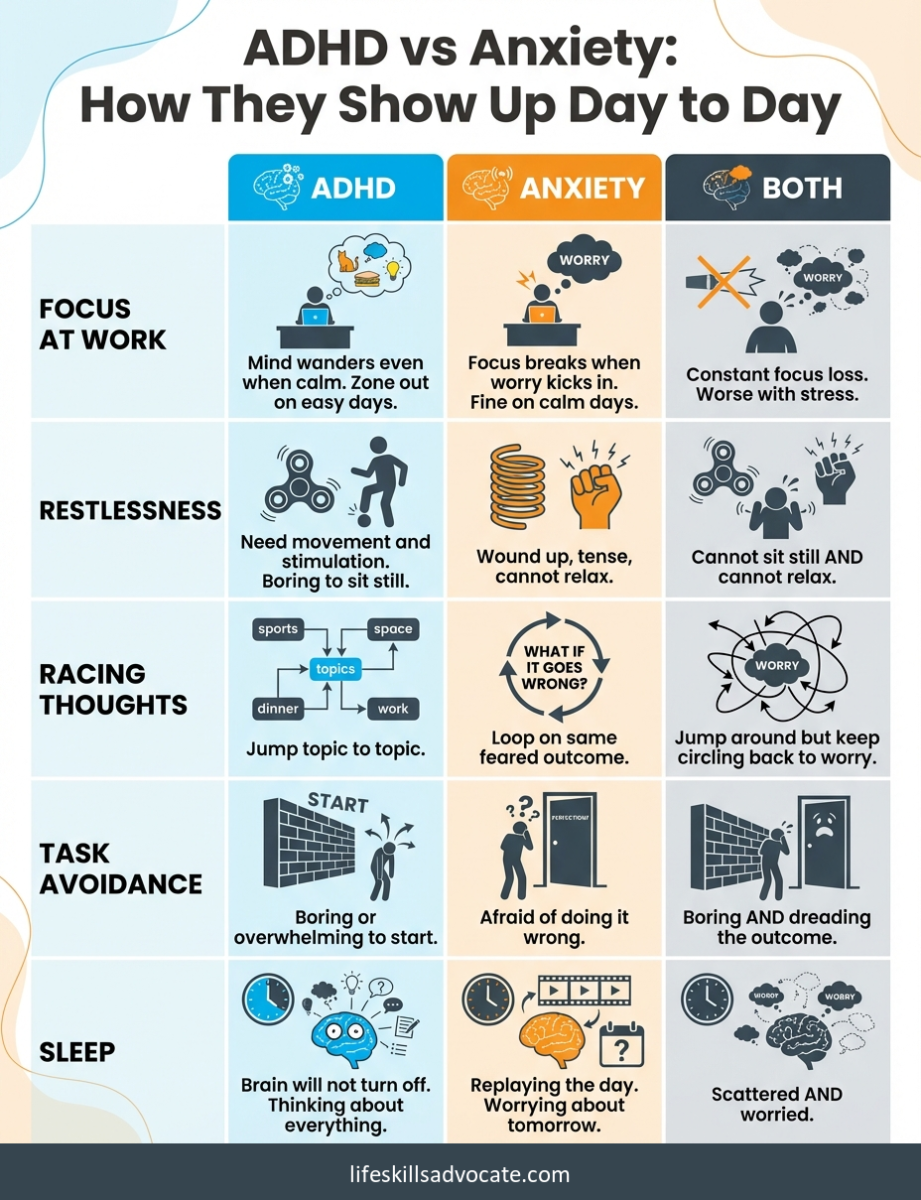
One useful question to sit with: does the focus problem persist even when the worry goes away? If you’ve had stretches where anxiety was low and focus was still a struggle, that points more toward ADHD being part of the picture. If focus sharpens noticeably when things are calm, anxiety may be the primary driver.
These are patterns to notice, not boxes to check. The lines between ADHD and anxiety are genuinely blurry in real life, and anyone who tells you it’s simple to sort out is overselling their framework.
ADHD or Anxiety: Key Facts
| Fact | Detail | Source |
|---|---|---|
| Co-occurrence in adults | Approximately 47% of adults with ADHD also experience an anxiety condition | Frontiers in Psychiatry review, 2025 |
| Co-occurrence in teens and children | Up to 50% of young people with ADHD also meet criteria for an anxiety condition | Children's Mercy, 2024 |
| Misidentification risk | Women with ADHD are disproportionately evaluated for anxiety instead of ADHD | PMC systematic review, 2023 |
| Screening difficulty | Adult ADHD self-report scales show limited ability to distinguish ADHD from anxiety in adults who have both | Alarachi et al., 2024 |
| Shared daily experiences | Whether it's ADHD or anxiety, restlessness, difficulty concentrating, and racing thoughts can appear in both conditions | ADDA |
Can You Have Both ADHD and Anxiety?
When people ask “is it ADHD or anxiety,” the answer is often “both.” When the second condition is OCD rather than anxiety, the same overlap takes a different shape; we walk through the daily-life patterns of having both ADHD and OCD separately. Research consistently shows that about half of adults with ADHD also experience a co-occurring anxiety condition, and a separate subset of adults with ADHD also live with ADHD and bipolar together. Among all the conditions that show up alongside ADHD, anxiety is one of the most frequent.
But “having both” isn’t one simple situation. There are two different pathways, and knowing which one applies to you changes what kind of support actually helps.
How ADHD Can Generate Anxiety
This is the pathway that doesn’t get enough attention. Executive function challenges, the kind that come with ADHD (working memory gaps, difficulty planning, trouble with follow-through), create a steady stream of real-world problems. You miss a deadline not because you forgot about it, but because you couldn’t sequence the steps to get it done. You lose something important again. You say the wrong thing in a conversation because your brain moved faster than your filter.
Each of those moments generates genuine worry, and it can feed into the kind of ADHD shame spiral that makes the next attempt feel even harder. Over time, the worry starts showing up in advance. You begin dreading situations because you know your executive function might let you down. A 2022 study in Frontiers in Psychiatry found evidence that executive function deficits mediate the relationship between ADHD traits and anxiety, meaning the EF struggles aren’t just correlated with anxiety. They may be part of what drives it.
The result is a feedback loop. ADHD creates situations that generate anxiety, and that anxiety then taxes the same executive function resources that are already strained. Both conditions make the other one louder. This pattern is one of the more exhausting parts of having both at once, and it’s also one of the reasons why addressing only the anxiety without looking at the ADHD underneath often doesn’t fully resolve things. When ADHD is properly identified and supported, the anxiety that was downstream of it often improves significantly.
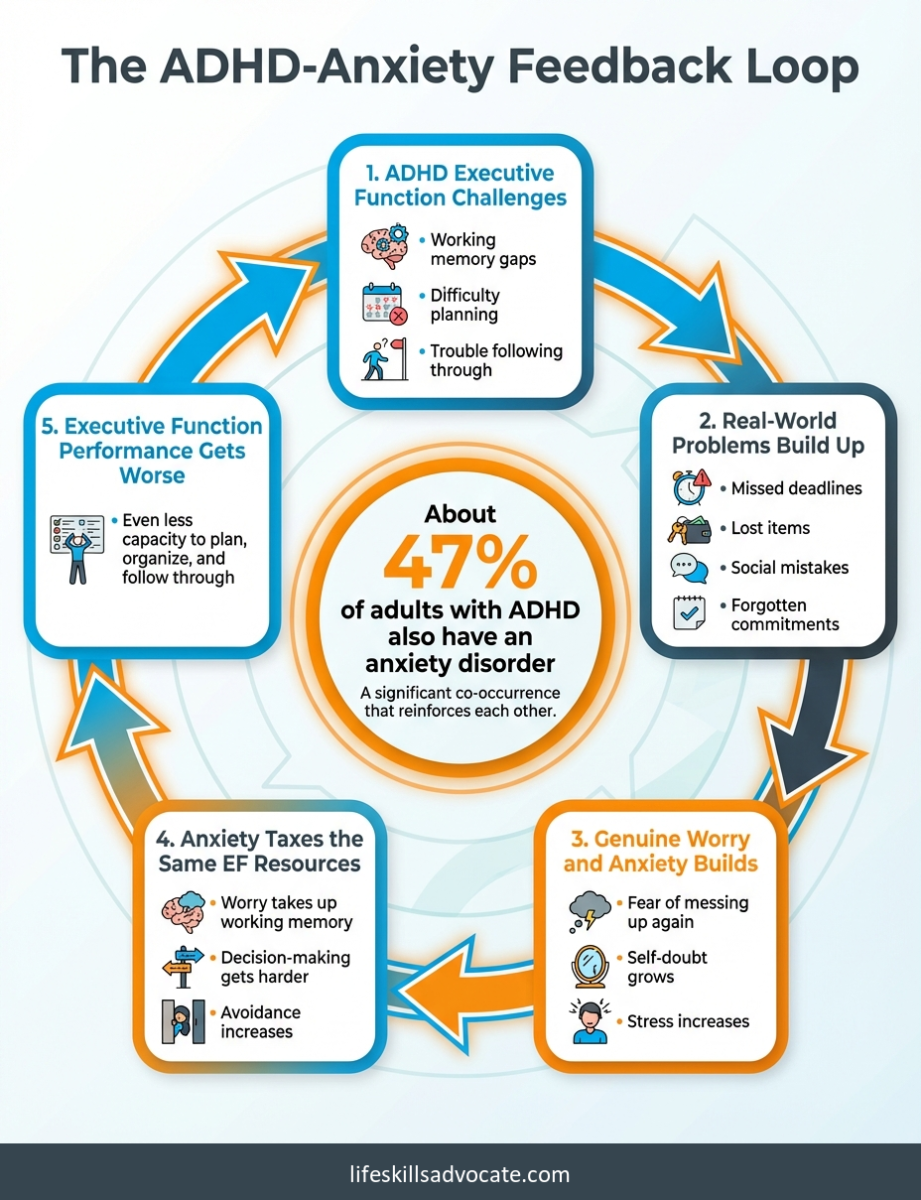
The second pathway is simpler: some people have ADHD and anxiety as two separate, independent conditions that happen to coexist. The anxiety isn’t generated by ADHD. It’s just there alongside it. In that case, both need their own kind of support.
Practical Support When ADHD and Anxiety Show Up Together
When both ADHD and anxiety are in the picture, the most common mistake is addressing only the piece that got identified first.
If anxiety was recognized first (as it often is), the support usually focuses on managing worry: therapy, relaxation approaches, possibly medication for anxiety. That can help. But if ADHD is also present, the executive function challenges that generate the worry are still running in the background. The cycle continues.
Getting the Right Evaluation
If you suspect both ADHD and anxiety might be part of your picture, the most useful step is a professional evaluation that specifically covers both. Not just a general screening, but one where you describe both sets of experiences: the focus problems, the worry, the executive function struggles, the physical tension. Bring specifics. The more concrete you can be about when and how these patterns show up, the more useful the evaluation becomes.
Types of support that may help, depending on what’s going on:
- Therapy (especially CBT) for anxiety-specific patterns like worry cycles, avoidance, and physical tension
- Executive function coaching for ADHD-related skill-building: task initiation, planning, follow-through, and the practical systems that reduce the situations generating anxiety in the first place
- Calming approaches designed for ADHD brains, which work differently from standard relaxation advice because they account for the need for stimulation
- Medication conversations with a prescriber who understands the interaction between ADHD and anxiety, because stimulants help some people’s anxiety and worsen others’
On the physical side, some people find that a simple tactile tool like a handheld fidget roller gives their hands something to do during meetings or focused work. It won’t fix the underlying condition, but it can take the edge off the restlessness that both ADHD and anxiety produce.
The distinction between coaching and therapy matters here. Coaching is educational and skill-focused. It helps with the executive function side: building systems, developing routines, working through the practical barriers. Therapy addresses mental health directly. They serve different purposes, and for people dealing with both ADHD and anxiety, sometimes both are useful.
Frequently Asked Questions
Do I have ADHD or anxiety?
There’s no way to know from an article alone, but there’s a pattern worth noticing. If focus problems show up even on calm, low-stress days when nothing particular is worrying you, that points more toward ADHD being part of the picture. If concentration breaks down mainly when anxiety is high and sharpens when things settle, anxiety is more likely the primary factor. It can also be both, which is actually one of the most common combinations. About half of adults with ADHD also have an anxiety condition. A professional evaluation that covers both is the clearest next step.
Could ADHD or anxiety be mistaken for the other?
Yes, in both directions. Inattentive ADHD in particular produces internalizing experiences like difficulty concentrating, feeling overwhelmed, and avoiding tasks. From the outside, these look a lot like anxiety. A 2023 systematic review found that women with ADHD are disproportionately evaluated for anxiety or depression instead of ADHD. The pattern is especially common for adults who weren’t identified as children, because by adulthood the coping habits and secondary anxiety have had years to build up. Going the other direction, severe anxiety can produce focus problems, task avoidance, and executive function difficulties that look very much like ADHD, particularly during high-stress periods. If support for one condition isn’t resolving everything, it may be worth asking whether the other is also part of the picture.
Can anxiety make you feel like you have ADHD?
Yes. Anxiety taxes working memory and makes it harder to organize thoughts, start tasks, or follow through on plans. Those executive function difficulties can feel very similar to ADHD. The key difference: if focus and follow-through improve noticeably when anxiety is well-managed, anxiety is more likely the primary factor. If the focus problems persist regardless of how calm or anxious you feel, ADHD may also be present.
Does ADHD medication help with anxiety?
Sometimes. When anxiety is driven by ADHD-related executive function struggles, addressing the ADHD can reduce it. But stimulant medication can also increase anxiety for some people. This is genuinely individual and a conversation worth having with your prescriber.
Why does having ADHD or anxiety make the other one worse?
They draw on overlapping executive function resources: working memory, attention regulation, and cognitive flexibility. When anxiety uses those resources for worry, there’s less available for the ADHD brain to work with. When ADHD creates real-world problems, anxiety has more to worry about. There isn’t a clean explanation for exactly how they interact, which is part of what makes this combination frustrating.
Worth naming once more: what looks like anxiety after a critical comment, or depression in the hours after a tough interaction, is often rejection sensitive dysphoria getting misread for years before the pattern finally has a name. For the physical side of winding down, a weighted stuffed animal for anxiety gives some people a portable anchor.
Next Steps
If you’ve been going back and forth between “is it ADHD or anxiety,” the most useful thing you can do is stop trying to figure it out alone.
- Notice your patterns. Write down the specific situations where you struggle most with focus, worry, or restlessness. Pay attention to whether the difficulty shows up on calm days too, or only when anxiety is high. That information is more useful to a professional than any self-assessment quiz.
- Bring both sets of experiences to an evaluation. If you’ve only ever been asked about one, bring up the other. Mention the focus problems and the worry. Mention the executive function struggles and the physical tension. The more complete the picture, the better the evaluation.
- Identify where your executive function gaps are. Take the free executive functioning assessment to get a clearer picture of which EF skills are hardest for you right now. That information is useful regardless of whether ADHD, anxiety, or both turns out to be the answer.
- Consider structured support for the EF side. If executive function challenges are part of your picture, executive function coaching can help you build the practical systems and skills that reduce the situations generating anxiety in the first place.
Further Reading
- Adult ADHD and Comorbid Anxiety and Depressive Disorders: A Review of Etiology and Treatment – Frontiers in Psychiatry, 2025
- Miss. Diagnosis: A Systematic Review of ADHD in Adult Women – PMC, 2023
- Executive Functions Mediate the Association Between ADHD Symptoms and Anxiety – Frontiers in Psychiatry, 2022
- Are We Measuring ADHD or Anxiety? Examining Factor Structure and Discriminant Validity of the Adult ADHD Self-Report Scale – Alarachi et al., 2024
- The Difference Between ADHD vs. Anxiety in Adults – ADDA
- When ADHD and Anxiety Coexist – CHADD
- Mental Health: Is It Anxiety or ADHD? – Children’s Mercy, 2024
- 9 Clear Signs of Executive Dysfunction and Practical Ways to Work With It – Life Skills Advocate
- 10 Practical Ways to Manage ADHD Mental Paralysis – Life Skills Advocate
- How to Break the ADHD Shame Spiral – Life Skills Advocate
- Evidence-Based ADHD Calming Techniques for Adults – Life Skills Advocate
- Free Executive Functioning Assessment – Life Skills Advocate
- Executive Function Coaching – Life Skills Advocate