
If your learner finds organization, time management, or focus difficult, school and social life can take extra energy. You are not alone, and there are practical ways to make each day feel more manageable.
Often the missing piece is not more effort. It is the right set of executive functioning accommodations, the changes to how a student learns and shows what they know that remove a barrier instead of working around it. Getting those accommodations in place is a process, and it is one you can learn.
Maybe you are just starting to notice these struggles, or maybe you have already begun the problem-solving process. Either way, the step-by-step approach below is meant to help you feel more confident and prepared to support your learner, including what to say when a school hesitates.
TL;DR
Executive functioning accommodations are changes that remove barriers so your learner can show what they actually know. Getting them follows a process you can work through:
- What executive functioning challenges look like at school, and how to spot them
- The four kinds of accommodations, from presentation to timing, plus other supports
- An 8-step process to request and set up a plan, from identifying barriers to monitoring what works
- Your learner’s rights under IDEA (an IEP) and Section 504 (a 504 plan)
- What to say when a school pushes back, and how to build your learner’s own self-advocacy
This is educational, not legal or medical advice. Every school district runs its own process, so treat this as a map and confirm the specifics with your learner’s school team.
What Executive Functioning Is (and Why School Can Feel Harder)
Executive functioning skills are the mental processes that help us plan, organize, remember, manage time, control impulses, shift between tasks, and handle emotions. At Life Skills Advocate, we group these into eleven areas. Other frameworks split them differently, so treat this as the set our resources use rather than the one list everyone agrees on:
- Planning: figuring out the steps needed to reach a goal
- Time management: using time wisely and sensing how it affects you and others
- Task initiation: starting tasks without needing reminders or prompts
- Organization: building and keeping systems to track things
- Problem-solving: finding different ways through a tough problem
- Cognitive flexibility: adjusting your thinking when things change
- Working memory: holding information in mind and using it later
- Emotional control: managing feelings, comfortable or not, across situations
- Impulse control: pausing to think before acting
- Attentional control: focusing on what matters and tuning out distractions
- Self-monitoring: noticing your own behavior and adjusting as needed
These skills develop over time, and they show up in school, work, and daily life. Executive function differences are common in people with ADHD and in many autistic people, and they can also relate to anxiety, depression, brain injury, trauma, or learning differences.
It helps to know roughly what to expect at each stage, so our guide to executive function skills by age is a useful reference when you are trying to tell an ordinary rough patch from a real gap.
Because every learner is different, supports work best when they are individualized. If you are still not sure whether what you are seeing points to an executive function gap, the signs of executive dysfunction are a good place to start before you talk to the school.
What Are Executive Functioning Accommodations?
As Understood explains in its overview of accommodations, they are changes to how students learn and get their work done. Executive functioning accommodations are meant to remove barriers and make it more equitable for a student to learn and show what they know.
They change the how, not the what: the learning goal stays the same, and the path to it gets clearer. That distinction matters, so it is worth understanding the difference between accommodations and modifications before a meeting, because schools treat them differently.
Accommodations usually address one of four kinds of barriers, plus a set of general supports:
- Presentation (how information is given): audiobooks instead of printed text, larger print or fewer items per page to reduce overload, a copy of the teacher’s notes, dictating answers to a scribe or recording responses, and written or visual step-by-step instructions.
- Task completion (how work gets done): breaking projects and tests into smaller chunks, frequent breaks during work or testing, and tools like spellcheckers, text-to-speech, speech-to-text, or a calculator.
- Learning and working environment (where work happens): a lower-stimulus room, preferred seating such as near the teacher to cut distractions, adjustable lighting and sensory tools, and testing in a small group instead of the whole class.
- Timing and scheduling (how long it takes): extra time to finish work, chunked tests, scheduling tests at the student’s best time of day, and limiting the number of tests on one day.
- Other executive functioning supports: timers and alarms to manage time, a planner or binder and folder system to organize schoolwork, and permission to keep materials close at hand.
8 Steps to Request Executive Functioning Accommodations at School
Requesting and setting up executive functioning accommodations can be long and confusing. The steps below are a step-by-step guide for families exploring these supports at school. Every district runs it a little differently, so some of this will look different where you are, but the overall path is the same.
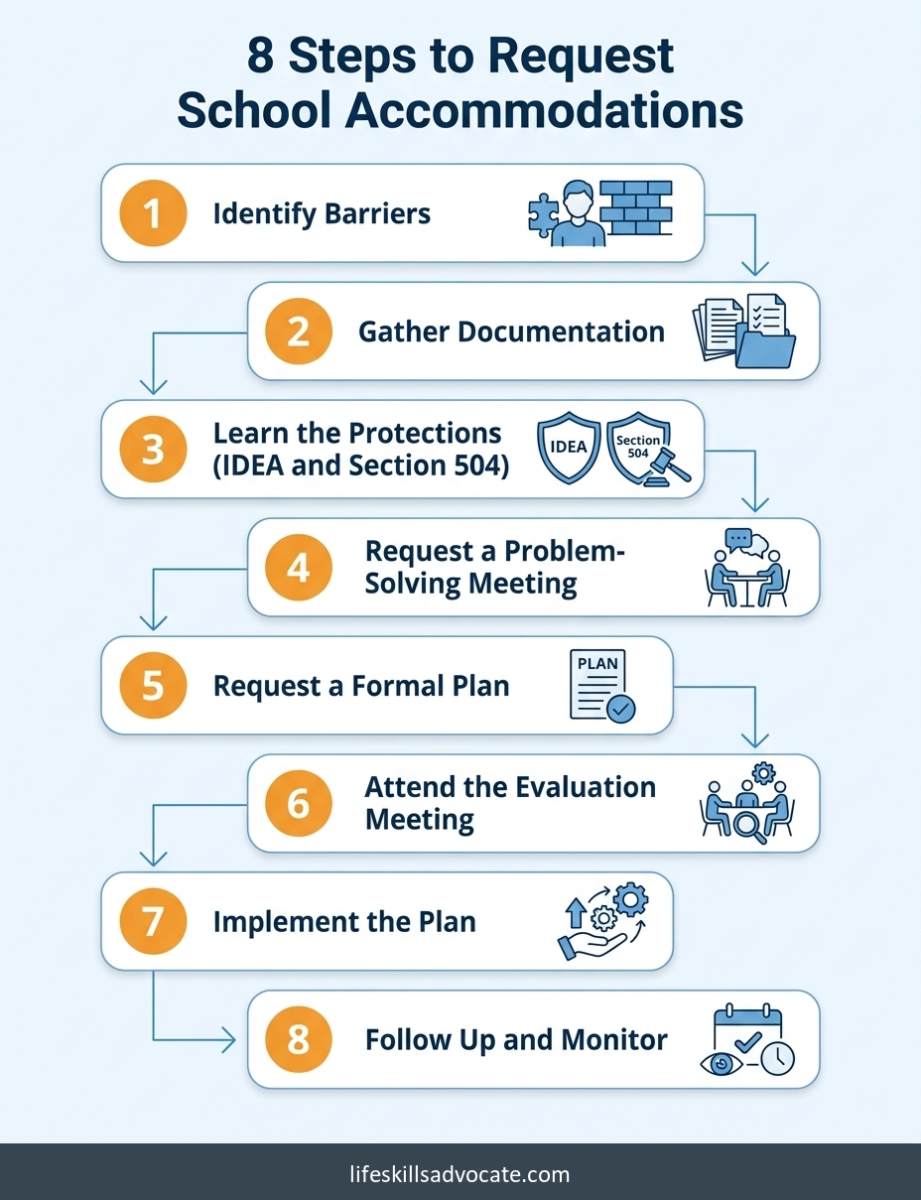
Here is a fast overview before the details:
- Identify barriers. Notice what makes learning, participation, or finishing work harder for your learner.
- Gather documentation. Collect evaluations, teacher notes, work samples, and records that show patterns.
- Learn the protections. Understand your learner’s rights under IDEA (an IEP) and Section 504 (a 504 plan).
- Request a problem-solving meeting. Share concerns with school staff and explore supports.
- Request a formal plan. If needed, ask for an evaluation for an IEP or a 504 plan.
- Attend the evaluation meeting. Review results, share input, and discuss eligibility.
- Implement the plan. Work with teachers so supports are consistently in place.
- Follow up and monitor. Keep communication open, track progress, and adjust as needed.
Step 1: Identify Barriers
Before you ask for accommodations, name the barriers. What makes learning, finishing work, or joining in class harder for your learner? Executive functioning challenges look different for every student, so accommodations have to be individualized. Knowing your learner’s specific sticking points helps you and the school team choose supports that actually fit.
Step 2: Gather Documentation
Collect a range of documents. Together they show the team how school feels for your learner and which supports might help. Useful records include:
- Evaluations from outside providers and medical notes
- Teacher observations or reports
- Samples of classwork or homework
- Progress-monitoring data and report cards
- Emails with teachers or administrators, and any office-referral history
The more detailed and varied your documentation, the better the team understands your child’s needs. A structured starting point helps here: our free executive functioning assessment walks through all eleven skill areas and gives you a written snapshot of strengths and sticking points you can bring to a meeting.
Step 3: Learn Your Learner’s Protections
Knowing your child’s legal rights is the backbone of good advocacy. Students with executive functioning challenges may qualify for protections under the Individuals with Disabilities Education Act (IDEA) or Section 504 of the Rehabilitation Act.
- IDEA: students who qualify under one of the 14 disability categories and need specialized instruction receive special education services through an Individualized Education Program (IEP). The IEP guides teachers and service providers in supporting access to grade-level expectations.
- Section 504: this protects students with a physical or mental impairment that substantially limits one or more major life activities. A student can have a record of the condition, such as a diagnosis, or be regarded as having it (suspected but not yet identified).
If you are weighing the two, our comparison of an IEP versus a 504 plan lays out how they differ in intensity and process. Families can request an evaluation for special education or a 504 plan at any time, which starts the school’s procedures. Both routes include accommodating your child’s needs. If test anxiety or worry is part of the picture, a 504 plan for anxiety shows how these protections can cover more than academics.
Step 4: Request a Problem-Solving Meeting
Every district has its own way of handling concerns. Asking for a meeting with school staff is a solid way to share your worries and start working toward solutions. Whatever comes of that meeting, you keep the right to request an evaluation for special education or through Section 504. Schools sometimes suggest trying support through a Multi-Tiered System of Supports (MTSS) first, but if a disability is suspected, the Child Find mandate requires them to identify and support your child.
Step 5: Request a Formal Accommodation Plan
Depending on how the last step went, you may decide to formally request an evaluation for accommodations. Send this request to your child’s school administrator, who will route it to the right person. The evaluation timeline is set by your state’s law, so ask about the projected timeline, and complete any executive function rating scales and interviews promptly as an active participant.
Step 6: Attend the Evaluation Meeting
This meeting is your chance to review assessment results, share concerns, and work with the team to decide eligibility for accommodations or special education services. Bring your documentation and your questions. If the procedures feel overwhelming, it can help to bring a trusted person: another family member, a friend with experience in education, or a hired advocate.
Step 7: Implement the Accommodation Plan
Once the plan is developed and approved, the work shifts to putting it into practice. That means working closely with teachers and staff so the accommodations show up consistently in the classroom and on assessments. Reinforce the same supports at home, and keep communication open so small issues get caught early. Clear, measurable goals make this easier to track, and our bank of executive functioning IEP goals can help the team write ones worth measuring.
Step 8: Follow Up and Monitor Effectiveness
After the accommodations are in place, follow up and watch how well they work. Stay in regular contact with teachers, counselors, and support staff, and take notes on improvements or ongoing difficulties in academics or behavior. If something is not working for your learner, ask for adjustments. There is always some problem-solving as a new plan settles in, so keep your eye on the goal: supporting your learner.
Building Your Learner’s Self-Advocacy Skills
Parents and educators do a lot of the early work to secure executive functioning accommodations. Over the long run, though, one of the most valuable skills a student can build is self-advocacy: being able to describe what they need, why they need it, and how it helps them learn best. It strengthens independence and confidence, and it is one of the “power skills” in the free Adulting Like a Champ Workbook, our life-skills workbook for teens and young adults.
Students can start practicing self-advocacy in a few concrete ways:
- Use clear, assertive language. Instead of hinting and hoping someone notices, direct phrasing works better:
- “I learn best when directions are written down.”
- “I need more time on tests so I can show what I know.”
- “I get overwhelmed when I have too many steps at once. Can we break this down?”
- Practice the wording ahead of time. Students often feel more confident after rehearsing what they want to say, whether in front of a mirror, on a short video, or with a trusted adult.
- Describe challenges without shame. Both the school and the student benefit when a learner can explain their experience plainly:
- “When I have to switch between tasks quickly, I lose my focus.”
- “I get stuck getting started, but reminders or checklists really help.”
- Take part in meetings when it fits. When a meeting keeps stalling, our guide to the four kinds of special education help can tell you whether a special education advocate is worth bringing in. Whether it is a quick check-in with a teacher or part of a 504 or IEP meeting, encouraging students to share needs in their own words builds confidence and helps the school understand how to support them. When deciding how and when your learner joins, weigh the purpose of the meeting and their readiness so it stays a positive experience.
What assertive self-advocacy sounds like in practice is worth modeling out loud, and our assertive communication examples give teens ready phrasing to borrow. For a fuller walkthrough, our guide to practicing real-world self-advocacy shows how to build the skill step by step. Self-advocacy turns accommodations from something done for a student into something done with them, which sets up smoother transitions through middle school, high school, college, and adulthood.
Keep a Communication Log
A record of your contact with school staff is a simple way to stay organized. It tracks conversations, meetings, and decisions, so details do not get lost, patterns are easier to spot, and everyone stays accountable. Understood.org offers a free school communication log you can use this school year.
Learners can benefit from being active participants in problem-solving and in IEP or 504 meetings too. Our guide to self-advocacy IEP goals shows how a plan can build that skill on purpose, and remember that students are the experts on their own experience: they offer real insight into the barriers they hit in class.
What If Your Learner Has Good Grades?
Passing grades do not close the door on executive functioning accommodations. Students with executive function challenges and learning differences can do well academically while still facing real barriers in their social or emotional functioning at school.
An evaluation exists to find the presence and extent of difficulties across academic, social, and emotional areas, and to figure out which barriers can be removed. Grades are one signal, not the whole picture, so a strong report card is not a reason to skip the conversation.
What If the School Pushes Back?
Even when the need for executive functioning accommodations is clear, families and students can still meet hesitation or resistance. Pushback does not automatically mean no. Often it is an invitation to clarify, restate the need, or work together toward an alternative. Assertive communication is what helps families stay grounded, confident, and collaborative in those moments. Here are five common pushbacks and ways to respond:
| If the school says… | You can respond… |
|---|---|
| “We’ve never done that before.” | “I understand it may be new. Here’s why this support is necessary for my student’s learning and participation.” Then restate the request clearly. |
| “Other students don’t get this.” | “Accommodations are based on individual needs. This support helps remove a barrier so my student can access learning like everyone else.” |
| “We don’t have the time or staff for that.” | “What options are available that address this challenge? I’m open to creative solutions that still meet the need.” |
| “Your student just needs to try harder.” | “This isn’t about effort. Executive functioning differences are neurological. These executive functioning accommodations give my student access to learning, not an unfair advantage.” |
| They agree, but with hesitation, and don’t follow through. | “Let’s set a quick check-in date to make sure this support is in place and working. How about next week?” |
Assertive Communication Workbook
A gamified, student-friendly workbook of fill-in-the-blank assertive scripts, built around the same calm, clear phrasing your learner needs to speak up for accommodations and hold a boundary when a school hesitates.
Best for: a teen or young adult who wants to rehearse these scripts in a structured, low-pressure way (a $15 printable, separate from the free Adulting Like a Champ Workbook).
Executive Functioning Accommodations: Key Facts to Cite
The rules behind executive functioning accommodations come from federal law and the organizations that interpret it. Here are the facts families lean on most, with sources you can quote or bring to a meeting.
| Finding | What it means | Source |
|---|---|---|
| IDEA covers students who qualify under one of 14 disability categories and need specialized instruction. | These students receive special education services through an IEP, which guides how teachers support access to grade-level work. | U.S. Department of Education, About IDEA (2025) |
| Section 504 protects students whose impairment substantially limits a major life activity. | A student can get a 504 plan of executive functioning accommodations even without an IEP, and even if the condition is only suspected. | U.S. Department of Education, Section 504 FAQ (2025) |
| The Child Find mandate requires schools to identify and evaluate students suspected of having a disability. | A school cannot wait for a student to fail; if a disability is suspected, it must act, even during MTSS. | Wrightslaw, The Child Find Mandate (2019) |
| Passing grades do not disqualify a student from a 504 plan or an IEP. | Eligibility weighs impact across academic, social, and emotional functioning, not grades alone. | Wrightslaw, Passing Grades and Eligibility (2023) |
| Families can request an evaluation for an IEP or a 504 plan at any time. | A written request starts the school’s evaluation procedures on a timeline set by state law. | Center for Parent Information and Resources (2022) |
Frequently Asked Questions
What are executive functioning accommodations in school?
They are changes to how a student learns and shows what they know, chosen to remove a specific barrier rather than lower the expectation. For executive function challenges, common ones include extra time on tests, breaking large assignments into steps, a copy of the teacher’s notes, a lower-stimulus space for testing, and tools like text-to-speech or a planner system. The learning goal stays the same, and the path to it gets clearer.
The right mix depends on the student. Two learners with the same diagnosis can need very different supports, which is why a good plan starts from that one student’s barriers instead of a standard checklist. That is also why the first move is naming what actually gets in the way, rather than picking supports off a list before anyone has looked closely.
What are the four types of accommodations?
They usually fall into four groups: presentation (how information is given), task completion (how work gets done), environment (where work happens), and timing or scheduling (how long it takes). Many plans add general supports too, like timers, planners, and organizing systems.
What is a 504 plan for executive functioning?
A 504 plan is a set of accommodations for a student whose impairment substantially limits a major life activity, provided under Section 504 of the Rehabilitation Act. For executive functioning, it might grant extra time, chunked assignments, or a quieter testing space, without the specialized instruction an IEP provides. It is often the lighter-touch route, and a student can qualify even when the condition is suspected rather than formally identified.
Can my learner qualify for accommodations if they have good grades?
Sometimes, yes. Grades are only one measure, and a student can hold a solid GPA while spending far more energy than peers to get there, or while struggling socially and emotionally in ways a report card never shows. Eligibility looks at impact across academic, social, and emotional functioning, not grades alone, and the Child Find rule means a school cannot wait for a student to fail before it acts.
Whether a specific student qualifies still comes down to the evaluation and the team’s judgment. A strong transcript is a reason to ask the question carefully, not a reason to skip it.
How long does it take to get executive functioning accommodations?
It depends on your state and your district. Once you put a request for an evaluation in writing, the school works within a legal timeline set by state law, and a 504 plan often moves faster than a full IEP evaluation. Ask about the projected timeline up front, return your rating scales and interviews promptly, and keep your own dated notes so nothing quietly stalls.
Next Steps
The hardest part is usually the first move, so pick the one that matches where you are today.
- Name the top barrier. Write down the single executive function challenge that costs your learner the most at school right now. That is what your first request should target.
- Build your file. Start a folder of work samples, teacher emails, and report cards, and add a written snapshot from the free executive functioning assessment so the team sees patterns, not just one bad week.
- Put the request in writing. A short email to the school administrator asking for an evaluation starts the clock and creates a record.
- Grow the self-advocacy skill. If EF challenges show up at home as well as school, executive function coaching is one option for building these skills day to day. Coaching is educational and skills-focused, which is different from therapy for mental health, and neither one replaces the school plan.
Further Reading
- About IDEA – U.S. Department of Education
- Section 504 Frequently Asked Questions – U.S. Department of Education
- Categories of Disability Under Part B of IDEA – Center for Parent Information and Resources
- The Child Find Mandate – Wrightslaw
- Are Kids With Passing Grades Eligible for 504 Plans and IEPs? – Wrightslaw
- Accommodations: What They Are and How They Work – Understood
- Download: School Communication Log – Understood
- Executive Function Skills by Age – Life Skills Advocate
- Signs of Executive Dysfunction – Life Skills Advocate
- Accommodations vs. Modifications – Life Skills Advocate
- IEP vs. 504 Plan – Life Skills Advocate
- 504 Plan for Anxiety – Life Skills Advocate
- Executive Functioning IEP Goals – Life Skills Advocate
- Self-Advocacy IEP Goals – Life Skills Advocate
- Assertive Communication Examples – Life Skills Advocate
- Practicing Real-World Self-Advocacy – Life Skills Advocate
- Free Executive Functioning Assessment – Life Skills Advocate
- Executive Function Coaching for High School Students – Life Skills Advocate
- Adulting Like a Champ Workbook (free) – Life Skills Advocate
- Assertive Communication Workbook – Life Skills Advocate