
You are sitting in an IEP meeting, and something is not adding up. The goals sound vague. A service you were promised last spring never showed up. Everyone at the table is polite, but you leave wondering whether you missed something you were supposed to catch.
Somewhere around that point, most parents of a neurodivergent teen start typing the same thing into a search bar: do we need a special education advocate? And right behind it, the harder question, because there are at least four different kinds of help sold under overlapping names, and no one lays them out side by side.
The names overlap, the prices are all over the place, and no one lays the options out side by side, so most parents guess. This guide is the side-by-side, including the free option most people never hear about, so you can tell which kind of help fits before you spend a dollar.
TL;DR
If you are staring down a hard IEP meeting and weighing whether to bring in outside help, here is the short version of your options:
- A special education advocate is a non-lawyer who preps with you and sits in the meeting; anyone can use the title, so you vet them yourself.
- An IEP coach overlaps heavily with an advocate but leans toward teaching you to run the meetings on your own.
- An executive function coach works with your teen on skills and self-advocacy, not with the school’s paperwork.
- An attorney is the only one who can legally represent you in a formal dispute.
- Advocates commonly run about $100 to $200 an hour, and your state’s free Parent Center is the place to start.
This is educational, not legal advice. Special education rules vary by state and by situation, so confirm the specifics with your state Parent Center or an attorney.
What a Special Education Advocate Actually Does
A special education advocate is not a lawyer, and that catches a lot of parents off guard. An advocate is a non-lawyer who knows the special education process well and stands beside you in it: reviewing records, helping you prep, and joining the IEP meeting as your invited expert.
Federal law makes room for that seat. Under 34 CFR 300.321(a)(6), the IEP team can include anyone the parent chooses who has “knowledge or special expertise” about the child. An advocate is often that person.
Day to day, the work usually looks like this:
- Reading the current IEP, evaluations, and progress data, then flagging what is missing or vague.
- Helping you request an evaluation, or an independent evaluation at public expense when you disagree with the school’s.
- Prepping you before the meeting and sitting with you during it.
- Pushing on services, placement, or goals that do not match what your teen needs.
Advocates often come from inside the system: former special education teachers, school psychologists, or district compliance staff. That background is where their value lives, because a lot of what happens in an IEP meeting is fluent in a language most parents were never taught.
There is a hard limit, though. An advocate can attend mediation and file a complaint with your state education agency or the Office for Civil Rights, but they cannot legally represent you in a due process hearing or in court. When your situation crosses into a formal legal fight, that is a lawyer’s job, not an advocate’s.
It also helps to know how an IEP differs from a 504 plan, because the plan your child has changes what an advocate can push for.
Advocate, IEP Coach, EF Coach, or Attorney: Which Help Do You Need?
The real question is usually not “should I hire a special education advocate” but “which of four kinds of help do we actually need right now?” Each role does a different job, and the names get used so loosely that families end up paying for one thing while expecting another.
Here is how the four compare.
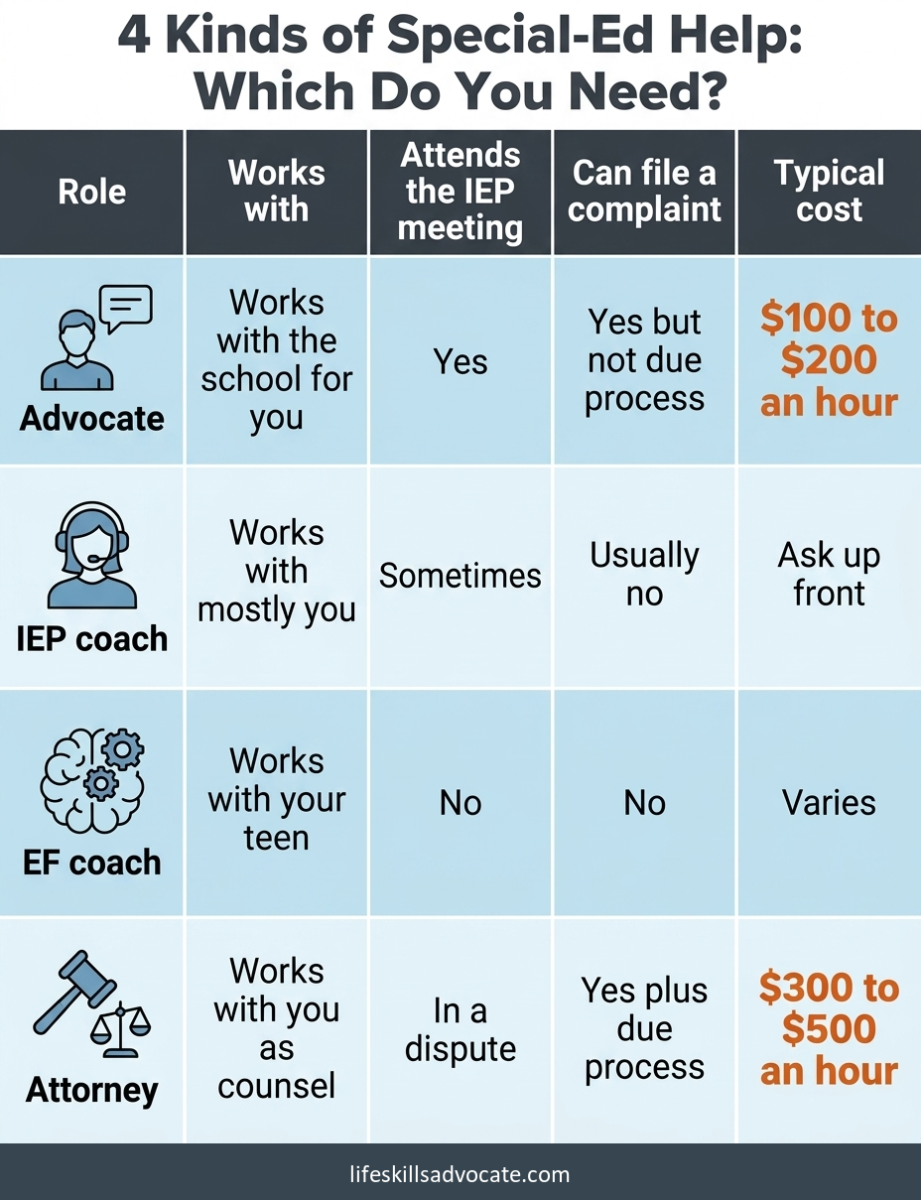
| Role | Works with | Attends IEP meetings? | Can file complaints or due process? | Licensed? | Typical US cost | Best for |
|---|---|---|---|---|---|---|
| Special education advocate | The school, on your behalf | Yes, as your invited expert | Can file state or civil-rights complaints; cannot represent you in due process | No, the title is unregulated | About $100 to $200 per hour | Parents who want a knowledgeable person at the table but have no formal legal fight yet |
| IEP coach | Mostly you, the parent | Sometimes; many do not | Usually not; most avoid complaints | No standard, unregulated | Priced like advocacy consulting; ask up front | Parents who want to learn to run the meetings themselves over time |
| Executive function coach | Your teen or young adult | No | No | No, this is coaching, not a legal role | Varies by provider | Families whose real gap is the student’s own skills and self-advocacy |
| Special education attorney | You, as legal counsel | Yes, when a dispute is active | Yes; represents you in mediation, due process, and court | Yes, a licensed lawyer | About $300 to $500 per hour | Families facing a formal legal dispute or a non-responsive district |
A quick way to narrow it down:
- If you mostly need someone to explain the process and help you prep, a free Parent Center or an IEP coach may be enough.
- If you want an experienced person sitting beside you at the table, that is an advocate.
- If the school has denied an evaluation, ignored the IEP, or written goals no one can measure, an advocate can push on it.
- If you are heading into mediation, a formal complaint, or due process, that is attorney territory.
- If the real gap is your teen’s own skills, like starting work, tracking assignments, or speaking up for themselves, that is an executive function coach.
Is an “IEP Coach” the Same as an Advocate?
Mostly, on paper, yes, and that is worth saying plainly because no one else does. “Special education advocate” and “IEP coach” are both unregulated titles. There is no license, no board, and no set standard for either one, so a person can adopt whichever label they like.
The real difference tends to be behavioral, not official:
- An advocate is more likely to attend the meeting with you and, if it comes to it, file a complaint.
- An IEP coach leans toward teaching you the process so you can run future meetings yourself, and most coaches steer clear of formal complaints or mediation.
Because the titles are not regulated, the label on someone’s website tells you very little. What matters is what they actually do, what they have done before, and what they charge, which is exactly what the vetting questions further down are for.
What a Special Education Advocate Costs
Most special education advocates in the US charge somewhere between $100 and $200 an hour, with higher rates, roughly $250 to $300, in expensive metro areas. A typical case runs about 10 to 15 hours of work once you add up records review, prep, and meeting time, which lands most families in the $1,000 to $3,000 range. Complex cases cost more.
Attorneys sit higher, commonly $300 to $500 an hour, and many ask for a retainer up front. The trade-off is that only a lawyer can represent you in a due process hearing, and if you prevail, a court may order the district to pay your reasonable attorney’s fees.
The number that actually matters is not any single figure. It is hours times rate. That is why an “advocate costs $X” answer never exists, and why the same advocate can cost one family $600 and another $3,000 depending on how tangled the case is.
The one price we will not quote is the IEP coach’s, because no clean published range exists. Coaching of this kind is usually priced like advocacy consulting, so the safest move is to ask for the rate up front rather than trust a number you read online, including this one. Reddit parents comparing notes report figures from a few hundred dollars to several thousand for what sounds like similar work, which is exactly the confusion an up-front rate conversation prevents.
The Free Option Most Parents Miss
Before you pay anyone, there is a step almost no search result puts first. Every US state has at least one federally funded Parent Training and Information Center, and there are roughly 100 of them nationwide. They are free.
These centers exist to help families understand the special education process, prepare for meetings, and learn their rights under the law. You can find yours through the Center for Parent Information and Resources directory. Think of the whole landscape as a ladder, and climb only as far as your situation actually requires:
- Start free. Your state Parent Center, at no cost, when you need to understand the process, prep, and know your rights.
- Move to a paid advocate when there is a real dispute, a denied service, or a district that will not respond, and you want an experienced person at the table.
- Bring in an attorney when it becomes a formal legal matter: due process, a filed complaint, or a hard deadline.
Parent Centers usually will not attend the meeting or manage your case, which is the real limit of the free option. But for a lot of families, the free prep is genuinely enough, and knowing that up front can save you a bill you did not need to pay.
When It Is Worth Hiring a Special Education Advocate
How do you know it is time to bring in an advocate rather than keep going on your own? The triggers below skew toward the teen and young-adult years, because that is where the stakes change and where a lot of generic advice stops being useful.
It is worth getting help when:
- The school denied an evaluation you think your teen needs.
- Transition planning should be underway (it starts by age 16 under federal law, earlier in some states) and no one has raised it.
- The IEP goals are vague, or you cannot tell whether anyone is measuring them.
- Services that are written into the plan are not actually happening.
- Your teen is close to aging out and you are not sure the plan reflects real independence skills.
- Meetings have turned tense, and you want a steady, informed person beside you so you can keep the working relationship with the school.
- You have raised the same concern twice and nothing has changed.
That last one is the pattern parents describe most. A concern raised once can be an oversight. The same concern raised twice, with no movement, is usually the sign that you want someone in the room who knows exactly which lever to pull.
Before you decide, it is worth trying one meeting well-prepared on your own, since many families find they can hold their ground once they walk in with the right questions. Our free IEP meeting questions worksheet gives you a structured set to bring.
For parents who want to go deeper on doing it themselves, Wrightslaw: From Emotions to Advocacy is the standard parent guide to the special education process and the law behind it. And if the sticking point is the goals, it helps to see what strong, measurable executive function IEP goals look like so you know what to ask for.
How to Find and Vet a Qualified Advocate
Because the title is not licensed, the vetting is on you, and that is not a knock on advocates. It simply means there is no board doing the screening for you, so a few direct questions do the job instead. Start your search through your state Parent Center, a local special education parent group, or Understood’s guide to finding an advocate, then interview two or three before you commit.
Take these questions into any consult with an advocate or a coach:
- What do you charge, and do you offer a free first consultation?
- Which services are included, exactly (records review, meeting prep, attending the meeting, requesting evaluations, filing complaints)?
- How many years have you worked in special education, and in what role?
- What ages and grade levels do you work with most?
- Do you hold any training or credential, such as SEAT through COPAA, or a certification from NSEAI or NASET?
- Do you work in person, virtually, or both?
- Can I speak with a parent you have worked with, or read independent reviews?
A confident advocate will answer all of these without getting defensive. The one answer worth listening hard for is experience: someone who has spent years inside special education, and can say specifically what they have handled, is a very different hire from someone who adopted the title last year.
Where an Executive Function Coach Fits
There is a fourth kind of help that no advocacy page ever mentions, and it solves a different problem entirely. An advocate changes the paperwork and the services. An executive function coach works with the student to change their own capability, so the plan on paper turns into skills your teen can actually use: planning, task initiation, organization, and speaking up for what they need.
Plenty of families need both, for different jobs. An advocate makes sure the accommodations are in the IEP; a coach helps your teen learn to advocate for those accommodations and use them once they are there.
This is the lane Life Skills Advocate works in, and it is worth being clear about the boundary: we are an executive function coaching company, not an advocacy or legal service. We do not sit at IEP tables to negotiate services or file complaints.
What we help with is the skill-building and meeting-prep side, through executive function coaching, the Comprehensive IEP Goal Bank for parents prepping goals, and Advocate360, an AI-assisted tool for organizing the work of getting ready. If your teen also needs executive functioning accommodations at school, that is where the two lanes meet.
Key Facts About Special Education Advocates
If you want the load-bearing facts in one place to quote, share, or take into a meeting, here they are with sources.
| Finding | What it means | Source |
|---|---|---|
| Anyone can call themselves a “special education advocate”; the title is not licensed or certified | Vet experience and training yourself, because there is no board to do it for you | Understood |
| An advocate can join the IEP team as an invited expert at the parent’s discretion | You have the legal right to bring one to the table | 34 CFR 300.321(a)(6) |
| Every state has a free, federally funded Parent Training and Information Center (about 100 nationwide) | You may not need to pay anyone yet | Center for Parent Information and Resources |
| Advocates commonly charge about $100 to $200 per hour (up to $250 to $300 in metro areas); attorneys about $300 to $500 (US, 2026, directional) | Budget by hours times rate; a typical advocate case is roughly 10 to 15 hours | FindParentAdvocates |
| Advocate training programs exist (for example SEAT through COPAA), even though no state license does | Judge an advocate by their training and experience, since there is no board to check | Wrightslaw |
Frequently Asked Questions
What does a special education advocate do?
A special education advocate reviews your child’s records, helps you prepare for the IEP meeting, and attends it as your invited expert to push for the right evaluations, goals, and services. They are not lawyers and cannot represent you in a due process hearing.
How much does a special education advocate cost?
Most advocates in the US charge about $100 to $200 an hour, rising to $250 to $300 in higher-cost metro areas. A typical case runs roughly 10 to 15 hours once you include records review, prep, and meeting time, so many families spend somewhere in the $1,000 to $3,000 range.
Attorneys cost more, commonly $300 to $500 an hour, and an IEP coach has no clean published rate at all, so ask for it up front.
The straight answer is that there is no flat price. What you pay is hours times rate, and the number of hours depends entirely on how complicated your situation turns out to be. Two families can hire the same advocate and pay very different totals.
Do I need a special education advocate or an attorney?
It depends on whether your situation is a disagreement or a legal dispute. An advocate is the right fit when you want a knowledgeable person at the IEP table to press for evaluations, goals, or services and there is no formal legal fight yet. An attorney is for when you are heading into mediation, filing a complaint, or entering a due process hearing, because only a lawyer can legally represent you there.
Is an IEP coach the same as a special education advocate?
Not officially, and neither title is regulated, so the line is blurry. In practice, an advocate is more likely to attend the meeting and file complaints, while an IEP coach leans toward teaching you to handle the process yourself. Their duties overlap heavily, and anyone can use either label, so judge the person by their experience and services, not the word on their website.
Does Life Skills Advocate provide special education advocates?
No. Despite the name, we are an executive function coaching company, not an advocacy or legal service. We help with the skill-building and IEP-prep side, not formal advocacy at the table. If you need an advocate, your state Parent Center is the place to start.
Next Steps
The families who feel least overwhelmed are usually the ones who figured out which single problem they were solving before they hired anyone. Here is how to get there.
- Start with the free option. Look up your state’s Parent Center and see what its no-cost help covers before you pay for anything.
- Write the actual problem in one sentence. A denied evaluation, goals no one measures, missing services, or an upcoming transition. The sentence usually tells you which of the four kinds of help you need.
- Practice the self-advocacy piece at home. If your teen will be at the table, walking through real-world self-advocacy beforehand costs nothing and changes how the meeting goes.
- If the gap is skills, not paperwork, a free executive functioning assessment is a low-stakes way to see where your teen’s real friction is before deciding on support.
Further Reading
- Find Your Parent Center – Center for Parent Information and Resources
- 34 CFR 300.321: IEP Team – Electronic Code of Federal Regulations
- 34 CFR 300.502: Independent Educational Evaluation – Electronic Code of Federal Regulations
- How to Find a Special Education Advocate – Understood
- What Special Education Advocates Do – Wrightslaw
- How Much a Special Education Advocate Costs – FindParentAdvocates
- Wrightslaw: From Emotions to Advocacy – Peter and Pamela Wright
- IEP vs. 504 Plan – Life Skills Advocate
- Executive Functioning Accommodations in School – Life Skills Advocate
- Measurable Executive Function IEP Goals – Life Skills Advocate
- IEP Meeting Questions Worksheet – Life Skills Advocate
- Self-Advocacy IEP Goals – Life Skills Advocate
- Practicing Real-World Self-Advocacy – Life Skills Advocate
- Executive Function Coaching – Life Skills Advocate
- IEP Goal Bank – Life Skills Advocate
- Advocate360 – Life Skills Advocate
- Free Executive Functioning Assessment – Life Skills Advocate