
Your teen has a 504 plan for anxiety, and on paper it looks like a win. There is a pass to leave class whenever the panic rises, permission to skip presentations, and a standing exemption from reading aloud.
The distress drops almost the moment the plan is in place.
Then a few months pass. The leaving spreads to more classes, and the list of things your teen will not do has quietly grown. That second part is what most 504 plan anxiety guides skip.
A 504 plan for anxiety can lower the barriers that keep an anxious teen from learning, or it can hand out exemptions that feel like relief now and cost coping skills later. The line between the two is thin, and it lives in the details of how each accommodation is written.
Anxiety is common at this age. National survey data from the NIMH on anxiety in adolescents puts the lifetime share of US teens who have dealt with an anxiety condition at close to a third, and for plenty of them it is serious enough to disrupt school. So the real question is not whether the anxiety is real or the support fair. It is which supports help a teen keep growing, and which ones quietly shrink their world.
TL;DR
This is the short version of the questions parents stack up when they search 504 plan anxiety, and where each one lands in this guide:
- Does anxiety qualify? Often yes. If it substantially limits a major life activity like learning or concentrating, Section 504 can require accommodations.
- What is the catch? The most popular accommodations, the ones that let a teen skip or escape, can ease distress today while leaving the avoidance pattern in place.
- What works better? Accommodations that lower the barrier while keeping your teen in the skill: a break with a return time, advance notice plus an alternative format, a daily check-in.
- What about college? A 504 does not follow your teen past high school, so the self-advocacy has to start now.
This is educational, not a clinical evaluation or a substitute for working with your teen’s doctor or therapist. Use it alongside that care, not instead of it.
Does Anxiety Qualify for a 504 Plan?
Often, yes. A 504 plan for anxiety becomes an option when the anxiety substantially limits a major life activity, and both learning and concentrating count. That is the standard the U.S. Department of Education lays out in its Office for Civil Rights fact sheet on anxiety and Section 504, published in 2024.
The practical version: if your teen’s anxiety is regularly getting in the way of paying attention, finishing work, taking tests, or even getting through the school doors, the school has reason to evaluate them. A clinician’s letter helps. The fact sheet is clear, though, that a school can recognize a student’s anxiety without demanding a stack of paperwork first.
Qualifying does not require a crisis.
Plenty of anxious teens look fine on the outside and are quietly white-knuckling every class. The question is impact, not how visible the struggle is. If you are still sorting out whether what you see is anxiety, attention, or both, our breakdown of the daily-life differences between ADHD and anxiety can help you describe the pattern before the meeting.
Is a 504 Plan or an IEP Right for Your Teen’s Anxiety?
Here is the one-minute version. A 504 plan removes barriers through accommodations, which are changes to how your teen accesses the same general education everyone else gets. An IEP goes further, adding specially designed instruction and measurable goals for a student who needs the curriculum itself adjusted. Most anxious teens who are keeping up academically fit the 504 lane.
The wrinkle for anxiety is that one word can mean two different things. An accommodation changes the conditions, like extra time or a quieter room. A modification changes the expectation itself, like less material or easier material.
For anxiety, you almost always want accommodations, not modifications. Lowering the academic bar tends to confirm a teen’s fear that they could not have handled it. We go deeper on that line in our guide to accommodations versus modifications, and if you are still choosing between the two plans, start with how an IEP differs from a 504.
The Avoidance Trap: Why the Obvious Accommodations Backfire
Avoidance is the most natural response to anxiety, and it is the trap most 504 plan anxiety accommodations fall into. When something feels threatening and you escape it, the fear drops fast, which teaches the brain that escaping worked. The relief is real. The lesson it quietly reinforces is that the situation really was too much to handle.
Repeat that loop across a semester and the anxiety does not shrink. It widens its territory.
This matters because the most-requested anxiety accommodations are escape hatches: a pass to leave any time, a blanket exemption from presentations, permission to skip group work. None is wrong on its own. As an open-ended exemption, though, each one removes the very situation the teen needs repeated, lower-stakes practice with.
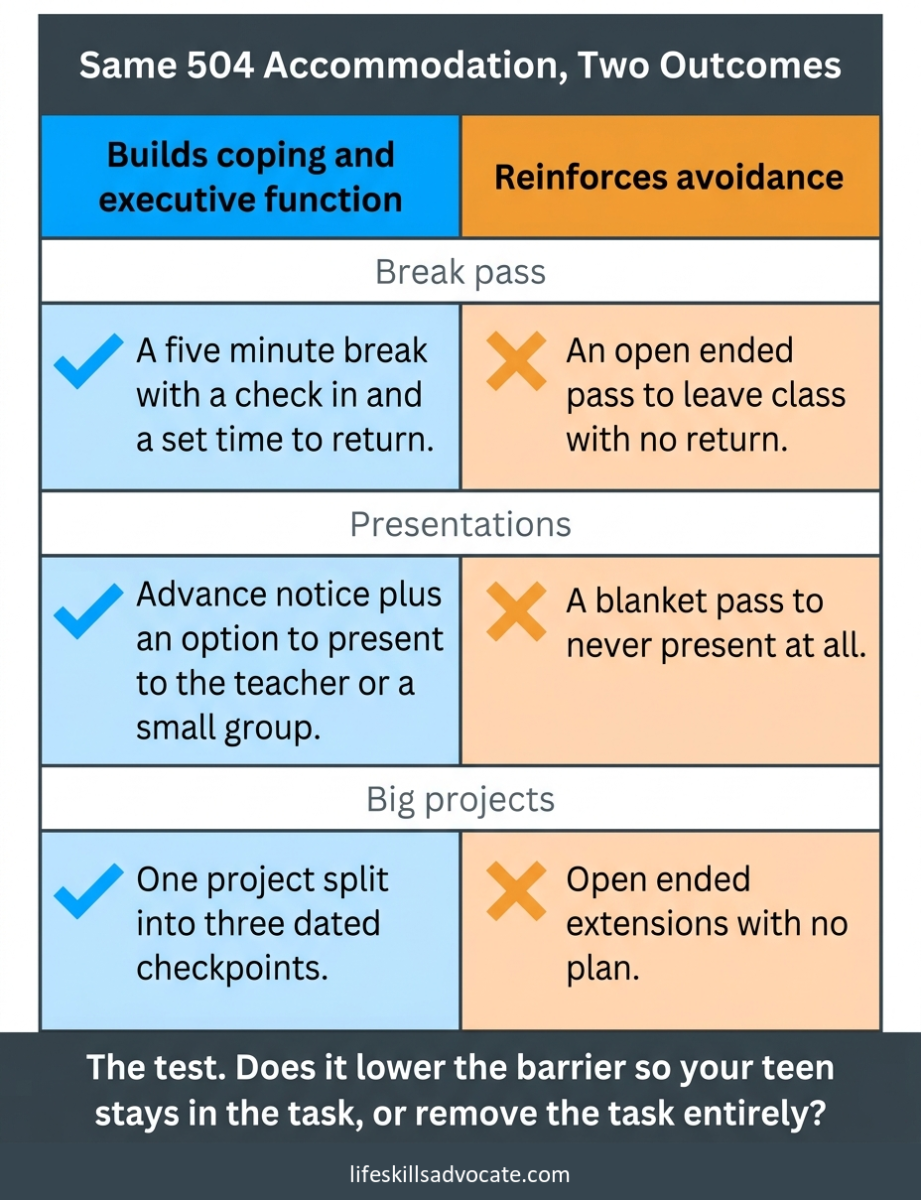
The test that sorts the good from the risky: does this accommodation lower the barrier so my teen can stay in the task, or does it remove the task entirely? A break pass with a five-minute timer and a return plan keeps them in the room. A break pass with no return keeps them in the hallway.
Same accommodation on paper, opposite effect on the skill underneath.
That skill is usually an executive function one, because anxiety hits task initiation, working memory, and emotional regulation first. Our overview of emotional regulation and executive functioning unpacks why those two move together.
To be fair to the escape hatch: in an acute moment, getting a panicking teen out of the room is the right call, and no parent should have to ration that. The goal is not to delete relief. It is to write each accommodation so the relief comes with a way back in.
12 Anxiety Accommodations for a 504 Plan That Build Coping and Executive Function
These twelve accommodations show up most often for anxious high schoolers, grouped by what they do. The 504 plan anxiety accommodations below follow one pattern: each names the executive function skill it protects, then gets written so it lowers the barrier without removing the task. The wording in the second half of each item is the part that keeps it honest.
Testing and performance
- Extended time on tests and quizzes. Protects working memory and processing under pressure, which anxiety floods first. Keep it skill-building by giving time to think, not an open-ended window that turns every test into a multi-day event.
- A separate, low-distraction testing space. Protects attention regulation by removing the racing-against-the-room feeling. Your teen still takes the same test, just somewhere the noise of forty other pencils is not stacking onto the worry.
- Advance notice and an alternative format for presentations. Protects planning and emotional regulation by removing the ambush, not the assignment. Presenting to the teacher alone, to a small group, or by recording keeps the skill on the table; a blanket “never has to present” quietly takes it off.
Daily regulation and breaks
- A break pass with a check-in and a return time. This is the single accommodation where the avoidance trap lives or dies. It protects emotional regulation when it comes with a destination and a time to come back, usually around five minutes. Written without a return, it becomes a standing exit.
- A designated calm space to actually use the break. Gives the break somewhere to land, like the counselor’s office or a quiet corner, so settling becomes the point rather than wandering the halls. Pair it with the break pass above.
- Permission to use specific coping tools. Water, a fidget, headphones between tasks. Protects self-regulation by giving the body something to do with the adrenaline, and naming the exact tools in the plan stops teachers from treating each one as a daily negotiation.
Workload and task initiation
- Big assignments broken into checkpoints. Protects task initiation, which is often the first thing anxiety freezes. A large project is a wall; three dated checkpoints are a staircase. The work stays the same size, but it stops being one terrifying block.
- A short, pre-arranged extension option on major projects. Protects planning by giving a release valve your teen requests in advance, not a blanket pass to turn everything in late. The advance-request part is the skill: it teaches them to see the crunch coming. Our task initiation tips for high schoolers pair well with this one at home.
- Extra transition time between classes. Protects the shifting skill, the mental gear-change anxiety makes sticky. A few extra minutes in a crowded hallway can be the difference between making it to class and turning around.
Communication and re-entry
- A daily check-in with one trusted adult. The people who work with anxious students tend to rank this above any testing tweak, and for good reason. Two minutes with a counselor or a chosen teacher protects working memory and emotional regulation by catching the spiral early, before it eats a whole class.
- A written re-entry plan after an absence. Protects task initiation at the exact moment it is weakest, the morning back after a hard day or a missed week. Knowing precisely what to hand in and who to see removes the dread of walking in blind.
- A quiet signal between teen and teacher. A small agreed-on cue, a card on the desk or a hand sign, that says “I need a second” without a public announcement. It protects emotional regulation and communication, and it often reduces how often the full break pass gets used at all.
No list fits every teen. What steadies one student keeps another stuck, and a plan that works in tenth grade may need real changes by twelfth. Treat these twelve as a menu to choose from with your teen, not a set to install all at once.
How to Request a 504 Plan for Anxiety
Requesting a 504 plan anxiety evaluation is mostly a paperwork-and-meeting process, and it moves faster when you walk in organized. Start with a short written request to the school’s 504 coordinator or counselor asking for an evaluation, and put it in email so there is a date attached.
Bring documentation, but do not assume a doctor’s note settles it. A clinician’s letter describing how anxiety affects your teen at school is strong support, weighed alongside grades, attendance, and teacher observations. A note that just says “please give accommodations” carries less weight than one that explains the impact in concrete terms.
The most useful thing you can do in the meeting is make every accommodation specific and observable. “Break as needed” is the kind of vague line that turns into the avoidance trap. “A five-minute break in the counseling office, up to twice per class period, with a check-in on return” is something a teacher can actually follow and a team can actually review.
Loop your teen in, too.
A high schooler who helped choose their own accommodations is far more likely to use them as intended, and our guide to advocating for executive functioning accommodations in school gives you language for that conversation.
Keeping the Plan Honest
A 504 plan anxiety document is not set-and-forget. The same accommodation can be a bridge in September and a crutch by February, so the team’s job is to keep asking one question at each review: is this improving access, or is it hiding the barrier?
You can usually feel the answer. If your teen is using a break to settle and then returning to work, the accommodation is doing its job. If the breaks are getting longer and more frequent and the return is fading, the plan is rewarding the escape.
That is not a failure.
It is data, and it means it is time to tighten the wording or add a return step.
The long-term move is fading supports as the coping grows, the same way you would loosen training wheels. A plan that looks identical in ninth grade and twelfth grade has not kept up with the teen. Build a step into each annual review where you and your teen name one accommodation they might be ready to step down, and one skill they want to keep working on outside the plan.
What Changes When Your Teen Reaches College
Here is the part the K-12 accommodations lists almost never mention: a 504 plan for anxiety does not transfer to college. There is no system that carries the plan forward and no school staff who go looking to set it up. As Capital University’s college-readiness hub explains, the plan simply ends at graduation.
What replaces it is a different legal world. K-12 runs on Section 504 with the school driving the process. Higher education runs on the Americans with Disabilities Act, and the burden flips entirely onto the student.
Your teen has to find the disability services office, disclose, provide their own documentation, and ask for each accommodation themselves. Washington’s PAVE explainer on moving from IDEA to the ADA lays out that handoff in detail.
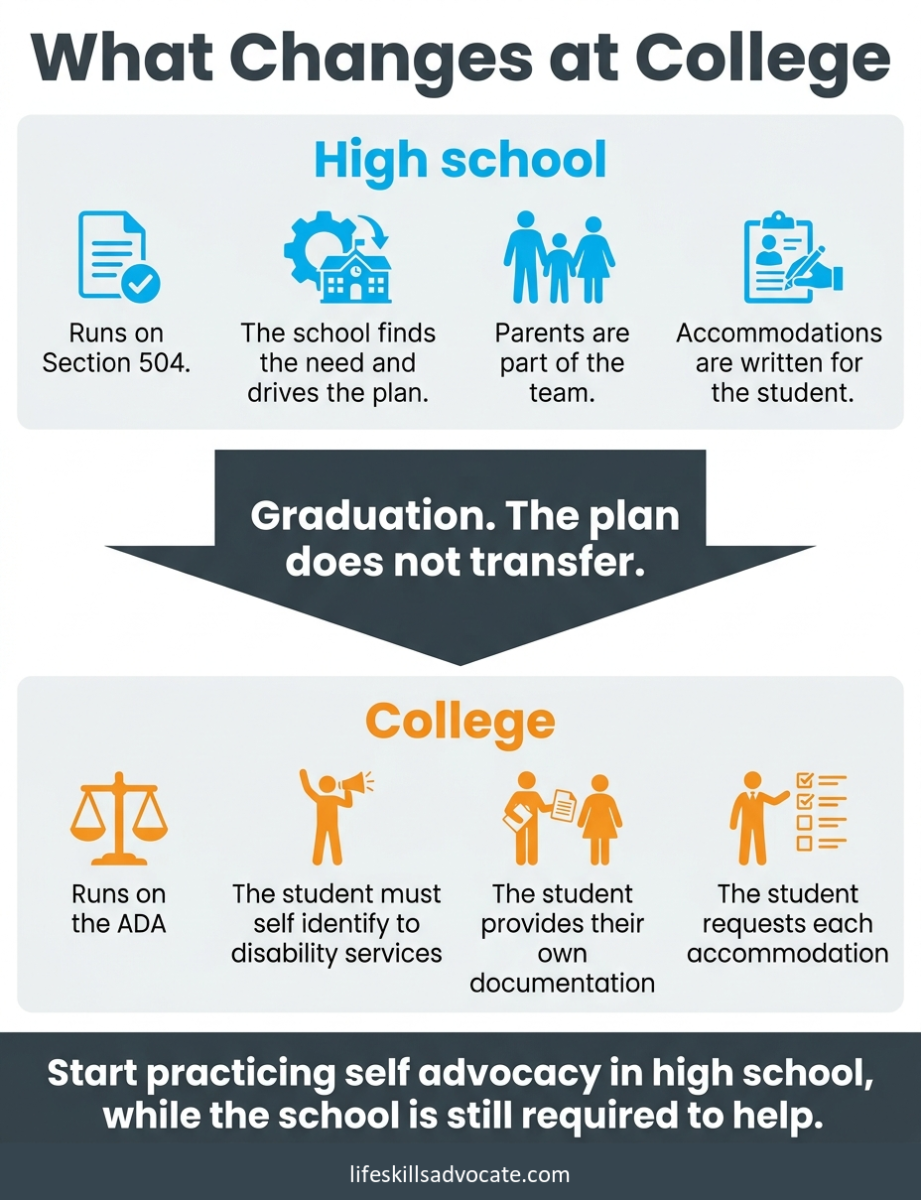
This is the strongest argument for writing the high school plan around skills rather than exemptions. A teen who spent four years escaping presentations and never learned to ask for what they need arrives on campus with neither the coping nor the self-advocacy. Practicing the ask now, in the safety of a school that is required to help, is the whole point. Our guide to practicing real-world self-advocacy is built for exactly this stretch of the road.
Quick Facts: 504 Plan Anxiety
| Fact | Detail | Source |
|---|---|---|
| Anxiety can qualify a student for a 504 plan. | A 504 plan anxiety request can require accommodations when the anxiety substantially limits a major life activity such as learning or concentrating (2024). | U.S. Dept. of Education, OCR |
| Anxiety is common in US teens. | About 31.9% of adolescents ages 13 to 18 have had an anxiety condition; among those teens, an estimated 8.3% had severe impairment (NCS-A survey). | NIMH |
| Common, school-approved accommodations exist. | Examples named by the federal fact sheet include extended testing time in a reduced-distraction setting (2024). | U.S. Dept. of Education, OCR |
| The plan ends at high school. | 504 plans do not transfer to college; students must self-identify to disability services under the ADA and request accommodations themselves. | Capital University |
FAQ: 504 Plan Anxiety
Is there a downside to having a 504 plan for anxiety?
It depends entirely on how the accommodations are written. A 504 plan for anxiety has no academic downside. It does not appear on transcripts or affect college admissions, and it gives a teen real legal protection.
The subtler risk shows up later: a plan built mostly from escape hatches can ease distress while the avoidance underneath keeps growing, so the teen reaches graduation less able to handle stress than when they started. That is an argument for writing the plan carefully, not for skipping it.
Does anxiety qualify for a 504 plan?
Often, yes, when the anxiety substantially limits a major life activity such as learning or concentrating. Impact is the test, not how visible the struggle looks from the outside.
Can the school refuse a 504 plan your teen’s doctor recommended?
Yes. A doctor’s recommendation does not force the school’s hand on its own. The 504 team makes the eligibility decision, based on whether the anxiety substantially limits a major life activity at school. A doctor’s note is evidence in that decision, not a verdict. If the team declines and you disagree, you have options. You can ask for the specific data behind the decision, request a fuller evaluation, and use the district’s dispute process. In practice, a well-documented letter that ties the anxiety to concrete classroom impact, paired with teacher observations pointing the same way, is rarely turned down. Where families hit walls, it is usually because the documentation stayed general and never showed how the anxiety lands during the school day.
504 plan or IEP for anxiety, which does my teen need?
Most anxious teens who are keeping up with the curriculum need a 504 plan, which adjusts how they access general education. An IEP is for students who also need the instruction itself specially designed, with measurable goals. If your teen’s grades are holding but anxiety is the obstacle, the 504 is usually the right fit. Our IEP versus 504 explainer walks through the edge cases.
Does a 504 plan for anxiety follow your teen to college?
No. The plan ends at high school graduation, and college runs on the ADA, where your teen has to self-identify to disability services and request accommodations on their own.
Next Steps
The fastest way to tell whether a 504 plan anxiety setup is pulling its weight is to stop looking at the document and start watching the pattern: is your teen using each support to stay in the work, or to get out of it? A few concrete moves from here.
- Pick one accommodation to re-word before the next review. Find the vaguest line in the current plan and rewrite it with a return step and a number, the way the break-pass item above does. You can draft this today, no meeting required.
- Map each accommodation to the skill underneath. Write the one executive function each support is meant to protect. The ones you cannot map are often the escape hatches worth a second look.
- Get a baseline on where executive function is actually breaking down with the free executive functioning assessment, so the plan targets the real bottleneck instead of guessing.
- Hand your teen one part of the next 504 meeting. Even reading one accommodation aloud and saying whether it helps is self-advocacy practice they will need in college.
Where Coaching Fits
A 504 plan handles access, and a therapist handles the anxiety itself. Neither one teaches the day-to-day executive function skills, the starting, the planning, the self-regulation, that the plan is meant to protect.
That gap is where executive function coaching tends to fit. It is educational and skills-focused, not mental health care, so it sits alongside your teen’s therapy rather than replacing it. If the accommodations keep sliding toward avoidance, executive function coaching can work directly on the coping and self-advocacy a 504 cannot deliver on its own.
Further Reading
- Section 504 Protections for Students With Anxiety Disorders – U.S. Department of Education, Office for Civil Rights
- Any Anxiety Disorder: Statistics – National Institute of Mental Health
- Will My 504 Plan or IEP Transfer to College? – Capital University
- Transitioning Rights and Accommodations From IDEA to ADA and 504 – PAVE
- IEP Explained: How It Differs From a 504 – Life Skills Advocate
- Accommodations vs Modifications for IEPs and 504 Plans – Life Skills Advocate
- How to Advocate for Executive Functioning Accommodations in School – Life Skills Advocate
- Practicing Real-World Self-Advocacy – Life Skills Advocate
- ADHD or Anxiety: The Daily-Life Differences – Life Skills Advocate
- 5 Task Initiation Strategies for High School Students – Life Skills Advocate
- Emotional Regulation and Executive Functioning – Life Skills Advocate
- Free Executive Functioning Assessment – Life Skills Advocate
- Executive Function Coaching – Life Skills Advocate