
You have a coach quote sitting in your inbox at $220 per session, a brain-training app you bought two months ago and never opened, a book a friend recommended that you haven’t ordered, and a psychologist’s office you keep meaning to call. None of it has happened.
Adults shopping for executive function training programs for adults run into the same wall: every category sells itself as the answer, no comparison is neutral, and the actual evidence base sits behind marketing copy. We compared nine real programs across four categories so you can match a format to your situation and pick one you will actually finish.
Each program below is described by what it is, who it tends to fit, and what the published evidence does and does not support. No rankings. No “best overall.” A few honest scope notes you would otherwise have to dig for yourself.
TL;DR
Nine real executive function training programs for adults, sorted by what they actually are:
- Brain-training apps for daily skill drills with mixed evidence on real-world transfer: BrainHQ (most-studied option), CogniFit, and CogMed (working-memory specific)
- EF coaching services for weekly accountability and skill structure: Life Skills Advocate Coaching and Beyond BookSmart’s WorkSmart program for adults
- Clinical executive function training for adults whose EF challenges overlap with anxiety, OCD, or trauma: Manhattan Psychology Group as a representative example of the clinical model
- Self-paced books and online courses for adults who learn through structured reading: Smart But Scattered Guide to Success for Adults, the Real-Life Executive Functioning Workbook, and Brain Cog Coach’s 10-module online course
- The best program is the one you will actually finish. Match the format to your budget and your need for accountability, not the marketing
Information here is for general education and reflects publicly available program details as of 2026. It does not replace medical, psychological, or financial advice. Pricing, features, and availability change. Verify with each provider before enrolling.
Does Executive Function Training Actually Work for Adults?
Before we get into specific executive function training programs for adults, the obvious question: does any of this work? The honest answer is mixed.
The foundational reference on EF, Diamond’s 2013 review in Annual Review of Psychology, identifies three core processes: working memory, inhibitory control, and cognitive flexibility. Adults can improve performance on tasks that train these processes. How broadly those improvements transfer to daily life is the live question.
The Good News: Real, Modest Improvements Are Possible
Beyond cognitive training, lifestyle factors carry the strongest evidence for adult executive function. Harvard’s Center on the Developing Child guide to executive function emphasizes the substrate any training program is built on: sleep, stress regulation, and physical activity. Regular moderate exercise (a mix of aerobic and resistance work, 30 to 45 minutes three to five times a week) produces consistent gains in attention, working memory, and cognitive flexibility for adults across the literature. Computerized cognitive training shows smaller, more variable effects on the tasks it directly trains. Adult EF coaching has limited but consistent small-study evidence for improved self-reported organization and task completion.
The Catch: Trained Skills Don’t Transfer as Widely as Marketing Suggests
A 2023 review of cognitive training research highlights what researchers call the far-transfer problem. Practicing a working-memory game makes you better at that game and somewhat better at similar tasks. The gains rarely generalize to everyday situations like remembering appointments, finishing a project, or sticking to a budget. This applies to most brain-training apps. The training works on its narrow target. It does not turn into a different brain.
The Biggest Predictor: Whether You Actually Do the Program
Engagement and adherence predict outcomes far more than which platform you picked. A research-validated program you abandon in week three will not outperform a less-studied program you actually finish.
Drop-out rates for self-paced cognitive apps in the general adult population often exceed 60% within the first 90 days.
Rates among adults with ADHD tend to be similar.
Key takeaways:
- Exercise has the strongest evidence base for adult EF. Any training program is competing with what a daily walk could do.
- Brain-training apps improve the skill they train. Transfer to real-world function is limited.
- Adherence beats platform choice. Pick something you will use.
Key Executive Function Terms (Quick Reference)
Four executive function skills do most of the heavy lifting across the executive function training programs for adults below. The Cleveland Clinic’s overview of executive function describes the same set as the core building blocks. Quick definitions for orientation:
| EF Term | Definition |
|---|---|
| Working memory | Holds information actively in your head: the phone number, the next three steps, what you walked into the room for. |
| Inhibitory control | Stops the impulse to act on a thought, feeling, or distraction before you have decided whether to follow it. |
| Cognitive flexibility | Lets you switch between tasks, perspectives, or strategies when the original approach is not working. |
| Task initiation | Bridges the gap between knowing what to do and actually starting. The hardest single EF skill for many ADHD adults. |
Brain-Training Apps (Category 1 of 4)
Brain-training apps are the most-searched and most-skeptically-received form of executive function training for adults. Three platforms account for most of the legitimate research base: BrainHQ, CogniFit, and CogMed. A fourth, Lumosity, sits at the edge of the category as a reference point with a complicated history.
BrainHQ: Largest Peer-Reviewed Research Base
BrainHQ, developed by Posit Science, was one of only two consumer brain-training platforms (alongside CogniFit) whose efficacy claims met the highest evidence tier, at least two well-designed randomized controlled trials, in a review of the field published in The Conversation. Posit Science reports hundreds of published studies on BrainHQ, with new studies added each year. The platform offers more than two dozen exercises across attention, brain speed, memory, people skills, intelligence, and navigation.
- Format: web and mobile, daily 20 to 30 minute sessions.
- Cost: about $14 per month or $96 per year.
- Best fit: adults who want the most-studied option, are willing to commit to daily practice, and find structured drills satisfying rather than tedious.
- What the research does not show: strong far-transfer to job performance or independent living outcomes. The skills you build are the skills you trained.
CogniFit: Broader Cognitive Skills Coverage
CogniFit covers a wider span of cognitive domains (around 23 skills including planning, divided attention, and short-term memory) and includes assessments alongside training. Its research base is smaller than BrainHQ’s but covers peer-reviewed work on ADHD, traumatic brain injury recovery, and cognitive aging.
- Format: web and mobile, personalized program after an initial 30-minute assessment.
- Cost: $19.99 per month or about $119.99 per year for Premium.
- Best fit: adults who want an upfront assessment to ground their training and value variety across cognitive domains over depth in any one.
CogMed: Working Memory, Clinician-Administered
CogMed is the most clinically focused option in this category. Developed by Dr. Torkel Klingberg at the Karolinska Institute, it targets working memory through a standard 25-session protocol (5 sessions per week for 5 weeks, each session about 50 minutes, adjustable down to 25 or 35 minutes) traditionally administered by a trained coach or clinician. The published research base focuses on attention and working-memory outcomes for children with ADHD, with a smaller but growing adult literature.
- Format: structured five-week intensive, typically clinician-administered.
- Cost: varies by provider; usually several hundred dollars when delivered through a clinician.
- Best fit: adults with documented working-memory challenges who want a short, supervised, time-limited intervention.
A Note on Lumosity
Lumosity is often the first brain-training app adults try.
In 2016, the FTC settled charges against Lumos Labs for $2 million over advertising claims about Lumosity’s cognitive benefits. The platform is still available, and its published research record is smaller than BrainHQ’s or CogMed’s. If Lumosity is the option you would actually use, that adherence advantage matters. Just calibrate expectations against what the published studies do and do not show.
Executive Function Coaching Services (Category 2 of 4)
Coaching is the most structured human-to-human form of executive function training programs for adults and the most expensive on a per-session basis. For a per-hour comparison across providers, see our guide to executive function coaching cost. What you are buying is a weekly meeting with a trained coach, a goal-setting framework, accountability between sessions, and skill-building targeted at your real life rather than a generic curriculum.
What EF Coaching Actually Does
A typical adult EF coaching engagement runs 6 to 12 months, with weekly 45 to 60 minute sessions (LSA’s are 50 minutes). Coaches work alongside you on the gap between what you intend to do and what gets done: starting tasks, managing time, organizing systems, breaking projects down, building habits that survive low-energy weeks. Coaching is not therapy. It does not address mental health diagnoses or trauma. Many adults pair the two, with a therapist handling internal work and a coach handling the operational layer.
Life Skills Advocate Coaching
Life Skills Advocate offers one-on-one virtual executive function coaching for neurodivergent teens and adults (ages 14 and up), delivered by a small team of trained coaches. The coaching model is goal-driven and skill-focused, with progress tracked across the typical EF subskills (planning, task initiation, working memory, emotional regulation, time management).
- Format: virtual, weekly 50-minute sessions.
- Cost: $220 per session, with multi-session packages available.
- Best fit: neurodivergent teens and adults (14+) who want consistent weekly accountability and personalized skill-building with a coach. Engagement typically starts with a free Discovery call.
If you are interested in becoming an EF coach rather than hiring one, our overview of executive function coach certification programs covers what to look for in a training pathway.
Beyond BookSmart (WorkSmart Coaching for Adults)
Beyond BookSmart runs an adult-focused coaching service called WorkSmart Coaching. Sessions are weekly and one-on-one, with a stated focus on EF skill development for adults handling work demands, graduate school, or major life transitions. Coaching outcomes are measured using the ESQ-R (Executive Skills Questionnaire-Revised), a research-validated revision of the executive skills questionnaire created by Peg Dawson and Richard Guare, the authors of the Smart But Scattered series.
- Format: virtual, weekly sessions.
- Cost: not publicly listed; quote-based by inquiry.
- Best fit: adults who want a coaching model that incorporates the Dawson and Guare assessment framework and prefer a larger coaching organization.
Evidence Base for Adult EF Coaching
The research base on adult EF coaching is small but consistent. Ahmann and colleagues’ 2018 descriptive review (Journal of Postsecondary Education and Disability) examined 19 ADHD coaching studies and found consistent improvements in executive functioning, self-confidence, and well-being. The evidence is strongest for adherence-related outcomes: people who finished coaching reported real changes. It is weakest for placebo-controlled comparisons, since most studies are pre/post or against waitlist control.
Cost is real.
The category fits adults who genuinely cannot drive change alone and find external accountability worth the price.
Clinical Executive Function Training (Category 3 of 4)
What’s the difference between hiring an EF coach and working with a psychologist who specializes in executive function training programs for adults? The difference usually comes down to whether mental health is part of what’s driving the EF challenges. Clinical EF training is delivered by licensed psychologists or therapists, integrates cognitive-behavioral techniques alongside skill-building, and operates within a clinical relationship.
How Clinical EF Training Differs From Coaching
Clinical EF training can address co-occurring anxiety, depression, OCD, or trauma at the same time as the EF work. Coaches cannot. Clinical settings can also support a diagnostic evaluation if one has not happened yet, while coaches cannot diagnose. The trade-off is cost and scarcity: licensed clinicians who specialize in EF training are rarer and more expensive than EF coaches, and the model fits adults whose EF challenges are entangled with other mental health concerns.
Manhattan Psychology Group as a Representative Example
Manhattan Psychology Group, based in New York with multiple locations, offers individual EF training for adults as one service within a broader clinical practice that includes ADHD evaluations, neuropsychological testing, and CBT. The EF training program is goal-oriented and structured, delivered by licensed clinicians, and integrated with the practice’s other services. It illustrates what the clinical model looks like when EF work is embedded inside a larger therapeutic context.
- Format: in-person (NYC area) or virtual.
- Cost: typically out-of-pocket; specialty psychology practices like this are often out-of-network. Verify insurance and reimbursement options directly with the practice.
- Best fit: adults whose EF challenges co-occur with anxiety, OCD, depression, or trauma, or who want diagnostic evaluation alongside training.
Finding Clinical EF Support in Your Area
Most adults will not have a Manhattan Psychology Group equivalent in their city.
The model exists in most metropolitan areas under different names.
Search for “adult ADHD psychologist [your city]” or “executive function therapy [your city]” and look for practices that explicitly offer EF training, not just diagnosis. Psychology Today’s therapist directory lets you filter by specialty, including ADHD and executive function challenges. Coverage varies; many specialty practices are out-of-network, though clients can often submit for partial reimbursement.
Self-Paced Books and Online Courses (Category 4 of 4)
If coaching is the most expensive end of the executive function training programs for adults spectrum, self-paced books and online courses are the entry point. The trade-off is no accountability between sessions and no one to adjust the plan when your week falls apart. The advantage is total flexibility, low cost, and zero scheduling overhead.
Smart But Scattered Guide to Success for Adults (Dawson and Guare)
The Smart But Scattered series by Peg Dawson and Richard Guare is one of the most widely-used adult EF frameworks in the coaching field. The adult-focused volume, Smart but Scattered Guide to Success: How to Use Your Brain’s Executive Skills to Keep Up, Stay Calm, and Get Organized at Work and at Home, walks through identifying your EF strengths and weaknesses, then provides practical scripts and systems for the weak ones.
- Format: print or Kindle, around 300 pages.
- Cost: about $20.
- Best fit: adults who learn well through structured reading, want a self-assessment built in, and prefer a framework over a step-by-step curriculum.
Real-Life Executive Functioning Workbook (Hanson and Sippl)
The Real-Life Executive Functioning Workbook by Chris Hanson and Amy Sippl (BCBA) is a digital workbook covering the eight core EF skills with exercises, worksheets, and practical examples. It has sold over 3,000 copies since launch and is used by adults working independently, parents of teens, and clinicians delivering EF support to clients.
- Format: digital PDF workbook (printable at home).
- Cost: $79.
- Best fit: adults who prefer to write through exercises rather than read about concepts, and clinicians who want pre-built worksheets to use with clients.
Brain Cog Coach 10-Module Online Course
Brain Cog Coach offers a 10-module self-paced online course developed by Mary Turos, an executive function coach who describes her approach as drawing on neuroscience, psychology, and mindfulness research. Turos has been an educator since 1991. Modules cover the major EF subskills with video instruction, worksheets, and self-paced exercises.
- Format: online course, self-paced video plus worksheets.
- Cost: available through the Brain Cog Coach registration portal (not listed on the public site).
- Best fit: adults who want a structured curriculum with video instruction and prefer a neuroscience-and-mindfulness framing of EF skills.
At a Glance: 9 Executive Function Training Programs for Adults Compared
The table below summarizes all nine programs side by side. Use it as a quick scan before reading the decision frame in the next section.
| Program | Category | Format | Cost | Best For |
|---|---|---|---|---|
| BrainHQ | Brain-training app | Self-paced, daily 20 to 30 min | ~$14/mo | Most-studied option for adults willing to drill daily |
| CogniFit | Brain-training app | Self-paced with initial assessment | ~$20/mo | Breadth of cognitive skills with built-in assessment |
| CogMed | Brain-training app | 5-week clinician-administered intensive | Several hundred $ via clinician | Documented working-memory challenges |
| LSA Coaching | EF coaching | Weekly 50-min virtual sessions | $220/session | Neurodivergent teens and adults (14+) who want weekly accountability and personalized coaching |
| Beyond BookSmart (WorkSmart) | EF coaching | Weekly virtual sessions | Quote-based | Adults who want assessment-based coaching from a larger organization with a deep coach roster |
| Manhattan Psychology Group | Clinical EF training | In-person (NYC) or virtual | Out-of-pocket; quote-based | EF challenges co-occurring with anxiety, OCD, or trauma |
| Smart But Scattered Guide (Dawson and Guare) | Self-paced book | Print/Kindle, ~300 pages | ~$20 | Structured-reading learners with budget limits |
| Real-Life EF Workbook (Hanson and Sippl) | Self-paced workbook | Digital PDF workbook | $79 | Adults who learn through writing and worksheets |
| Brain Cog Coach 10-Module Course | Self-paced online course | Self-paced video and worksheets | Via booking portal | Neuroscience-and-mindfulness curriculum with video instruction |
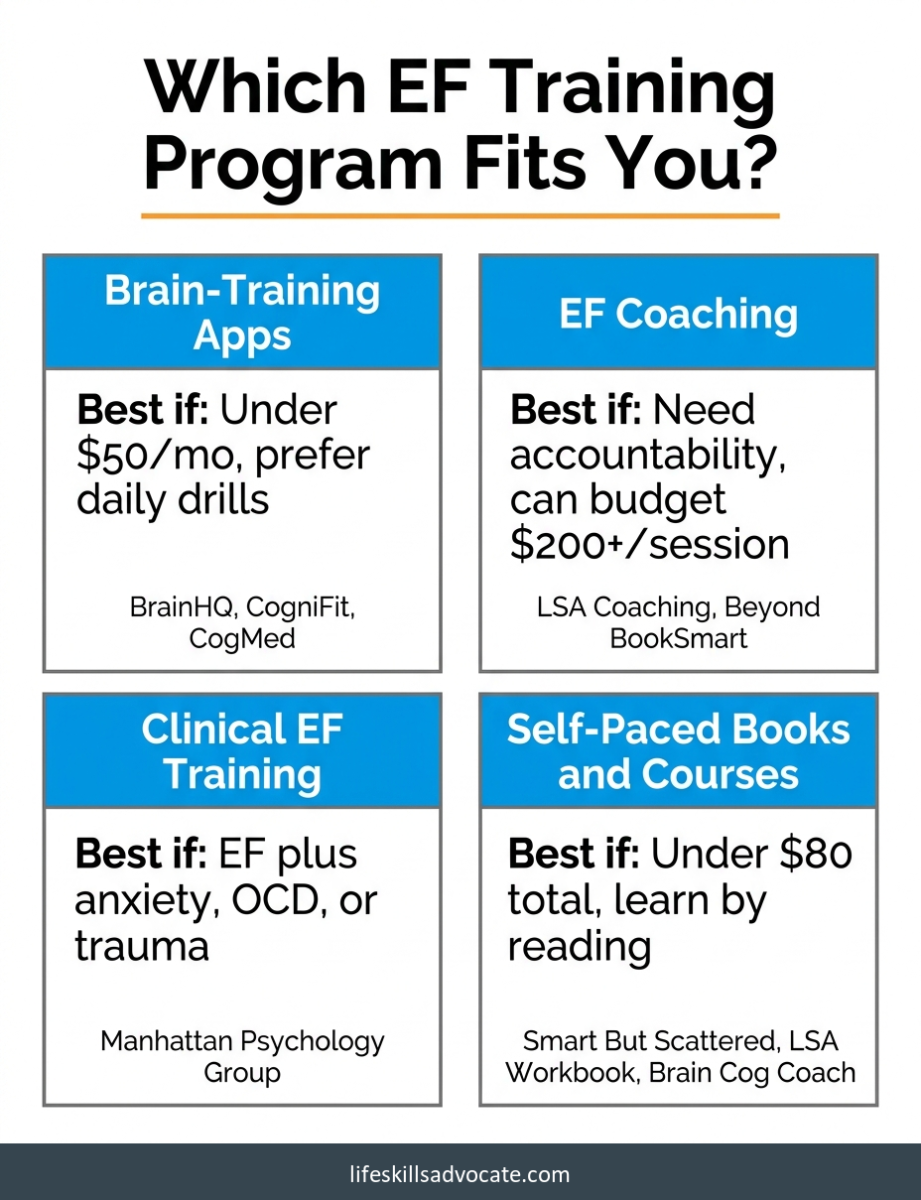
How to Choose an Executive Function Training Program
Nine executive function training programs for adults is too many to pick from cold. Four honest questions get you to one category, and from there the choice is usually obvious.
- What is your budget? If the answer is under $50 a month, brain-training apps or self-paced books are your category. Coaching (commonly $200+ per session) and clinical training (typically out-of-pocket) require a larger commitment.
- How much accountability do you need? If you have tried self-help books, apps, or willpower and bounced off them, accountability is your blocker. Coaching is the strongest accountability format. Clinical EF training is the second strongest. Apps and self-paced courses have none built in. A third option is pairing a low-cost option with an accountability partner.
- How much does evidence matter to you? If you want the most-studied option in each category: BrainHQ for apps, CogMed specifically for working memory, the Smart But Scattered framework for self-paced study, and EF coaching generally (small but consistent evidence). If you are comfortable with newer or less-studied options, your shortlist expands considerably.
- Is mental health part of the picture? If anxiety, depression, OCD, trauma, or active ADHD treatment is in the mix, clinical EF training is the right category. Coaches cannot address mental health concerns. If you are not sure where your gaps actually sit, our free executive functioning assessment can help clarify before you commit to any program.
One honest scope note: this frame narrows nine programs to one category. It does not predict whether a specific program will work for you. That depends on adherence, fit with the coach or platform, and life circumstances no comparison table can model.
Frequently Asked Questions About Executive Function Training Programs for Adults
Do executive function training programs for adults actually work?
Qualified yes. Adults can build specific EF skills through coaching, structured cognitive training, clinical work, and self-paced study. The research is strongest for physical exercise, moderate for working-memory training, and limited but consistent for adult coaching. The catch is that gains rarely transfer as broadly as marketing suggests, and the biggest predictor of whether a program “works” is whether you actually finish it.
What’s the difference between executive function coaching and brain-training apps?
EF coaching is human-to-human accountability and skill-building targeted at your actual life: starting tasks, organizing systems, building habits that survive bad weeks. Brain-training apps are computerized drills targeted at narrow cognitive skills like working memory or processing speed.
Coaching costs more per hour, requires less daily time, and produces gains in real-life function. Apps cost less, require more daily time, and produce gains mostly in the skills they directly train.
Many adults stack the two.
How much do executive function training programs for adults cost?
Costs span a wide range. Brain-training apps run $10 to $20 a month. Self-paced books cost $20 to $80. EF coaching typically runs $150 to $300 per session weekly. Clinical EF training is the most expensive category and often hits $200 to $400 per session out-of-pocket, since it is rarely covered. Some adults assemble a hybrid stack: a workbook for self-study, a brain-training app for daily practice, and quarterly clinical check-ins.
Will insurance cover any of this?
Brain-training apps and coaching are typically not covered. Clinical EF training delivered by a licensed psychologist may be partially covered if billed under a covered diagnosis, but most specialty practices are out-of-network. Check with your insurer before assuming.
Can I use my FSA or HSA to pay for executive function training?
Sometimes, with paperwork. EF coaching is often reimbursable when it is prescribed for an underlying medical condition like ADHD or autism, which usually requires a Letter of Medical Necessity from a physician or psychologist. Clinical EF training delivered by a licensed psychologist bills as a medical service and is more straightforwardly eligible. Brain-training apps and self-paced books typically are not. Plan rules vary; check with your FSA or HSA administrator first. Our financial aid page includes an FSA checklist specific to LSA Coaching.
What if I tried one of these and bounced off it?
That is the most common outcome in this category and not a reflection of you. Drop-out rates for self-paced cognitive apps in the general adult population often exceed 60% in the first 90 days. The fix is usually a different format, not a different program. Bounced off a self-paced app? Coaching might give you the missing accountability. Bounced off coaching? A peer-group or community format may work better. Bounced off a workbook? Video-based learning may fit how you absorb new material. The lesson is not “I am bad at this.” Usually it is “self-paced was wrong for me,” or “I needed the diagnostic piece before the skill piece.” Whichever it turns out to be, that is information for picking the next one.
Next Steps With Executive Function Training Programs for Adults
If you have made it this far, you have already done the hardest part: deciding the category.
- Pick a category. Use the decision frame above. Brain-training apps, EF coaching, clinical EF training, or self-paced books and courses.
- Choose the specific program within that category that fits your timeline and budget. The comparison table above is your shortlist.
- Commit to eight weeks before evaluating. Cognitive training, coaching, and self-paced systems all need at least that much runway to know whether they are working. Quitting at week three is what produces the 60% drop-out rate.
- If coaching matched your needs, book a free Discovery call to talk through fit before committing to a package.
- For the day-to-day habits underneath any program, read our existing guide on how to improve executive function in adults. The category-level approaches in that piece support whichever program you pick.
Further Reading
- Executive Functions (Annual Review of Psychology, Diamond 2013) – PubMed Central
- Why does cognitive training not transfer? (2023 review) – PubMed Central
- A Descriptive Review of ADHD Coaching Research (Ahmann et al., 2018) – Journal of Postsecondary Education and Disability
- Guide to Executive Function – Center on the Developing Child, Harvard University
- Executive Function – Cleveland Clinic
- Some brain training programs are backed by evidence – The Conversation
- Lumosity to pay $2 million to settle FTC advertising charges – Federal Trade Commission
- Executive Functioning Training for Adults – Manhattan Psychology Group
- BrainHQ – Posit Science
- CogniFit – Cognitive training platform
- CogMed Working Memory Training – Pearson
- WorkSmart Coaching for Adults – Beyond BookSmart
- Adult Executive Function Online Course – Brain Cog Coach
- Smart but Scattered Guide to Success for Adults by Peg Dawson and Richard Guare (affiliate link)
- Improve Executive Function In Adults: A Realistic Guide – Life Skills Advocate
- Best Executive Function Coach Certification Programs – Life Skills Advocate
- Executive Function Coaching – Life Skills Advocate
- Real-Life Executive Functioning Workbook – Life Skills Advocate
- Free Executive Functioning Assessment – Life Skills Advocate
- Financial Aid for Executive Function Coaching – Life Skills Advocate
- Book a Discovery Call – Life Skills Advocate