
The meeting with HR is on the calendar for Thursday. You asked for it, or your manager suggested it, and between now and then you are supposed to arrive with a list of what would help. The cursor blinks in an empty document.
That blank page is the real obstacle with ADHD workplace accommodations, and it is not a knowledge problem. Lists of accommodations are easy to find. Working out which two or three of them match what is going wrong in your specific job, in words your employer can act on, is the part where people stall.
The sorting principle that makes it tractable is to start from the executive function that is breaking down, not from the type of change you want. Someone who loses the thread of verbal instructions in a meeting needs something different from someone who cannot get started on a large project, even though both tend to be handed the same advice about a quieter desk.
Everything below is sorted that way, and each one comes with wording you could say out loud.
TL;DR
The useful question is not which accommodations exist, it is which ones are yours, how to ask for them, and what happens in the weeks afterward:
- Twelve accommodations, sorted by which executive function is breaking down: time and deadlines, starting and finishing, remembering what was said, focus and interruptions, feedback and emotional load, and where and when you work.
- You can often request ADHD workplace accommodations without naming ADHD. Documentation that describes the condition in more general terms may be enough.
- If you do name it, your employer has to keep that information confidential, including from your co-workers.
- Asking early beats asking at breaking point, because an employer does not have to excuse performance that has already slipped.
- Being offered something different from what you asked for is not a refusal. Where several options would work, the employer picks.
- If you would rather not disclose at all, there is a tier of changes that needs no request, and it sits on the federal government’s own list.
This walks through published federal guidance so you know what it says. It is not legal advice, and the EEOC notes that its own guidance does not have the force and effect of law, so talk to an employment lawyer if something has already gone wrong.
Why ADHD Accommodations at Work Usually Get Asked for Too Late
Most people ask for ADHD workplace accommodations at the worst possible moment, because the request feels like it needs justifying, and nothing justifies it as plainly as a problem that has already happened.
That instinct runs backwards.
According to the EEOC’s guidance on mental health conditions at work, you may ask for an accommodation at any time. And because an employer does not have to excuse performance that has already slipped, asking before problems appear is generally the stronger position. Which is a difficult thing to read if you are arriving here from the burnout end of that curve.
It is still worth knowing, because the earlier the conversation happens, the more it reads as setup rather than as damage control.
There is a second trap, and the Job Accommodation Network names it directly. JAN’s page on ADHD and the ADA notes that someone who takes work home or stays late to finish is often given more responsibility or a heavier workload, because they appear to be able to get their work done.
Coping without saying anything gets rewarded with more of what is not working.
One more piece of context helps the conversation land. Executive function develops on its own timeline, and a commonly cited rule of thumb holds that someone’s ADHD executive age runs roughly 30% behind their chronological age. Whether or not that figure is precise, the shape of it explains why a capable adult can need structure a colleague does not.
If you had an IEP or a 504 plan, you may remember that accommodations worked differently at school, where the school carried the duty to work out what you needed.
At work that reverses. Nobody is going to run an evaluation on your behalf, which is why the sorting question below carries so much weight.
12 ADHD Workplace Accommodations, Sorted by What Is Breaking Down
The question is not “what are the ADHD workplace accommodations,” it is “which part of my job falls apart, and what change would hold it up.” Those produce different answers. The first gets you a list of twenty things; the second gets you two you can defend in a meeting.
Both JAN and the EEOC organize their own material closer to the second shape. JAN groups accommodations by limitation rather than by category of change, using headings like hyperactivity and impulsivity, focus and concentration, and time management. Its companion publication, Accommodation Solutions: Executive Functioning Deficits, sorts them by time management, memory, concentration, prioritization and attendance.
That maps closely onto the eleven executive function skills LSA’s resources use, which is the frame below. It is the set we work from rather than a universally agreed list, and other frameworks divide them differently.
Sorting by limitation has a second benefit. JAN’s executive functioning publication notes that these limitations turn up across ADHD, autism, learning disabilities and brain injuries alike, so an AuDHD reader whose picture includes both does not have to work out which list is theirs.
Find your row first, then read the group it belongs to.
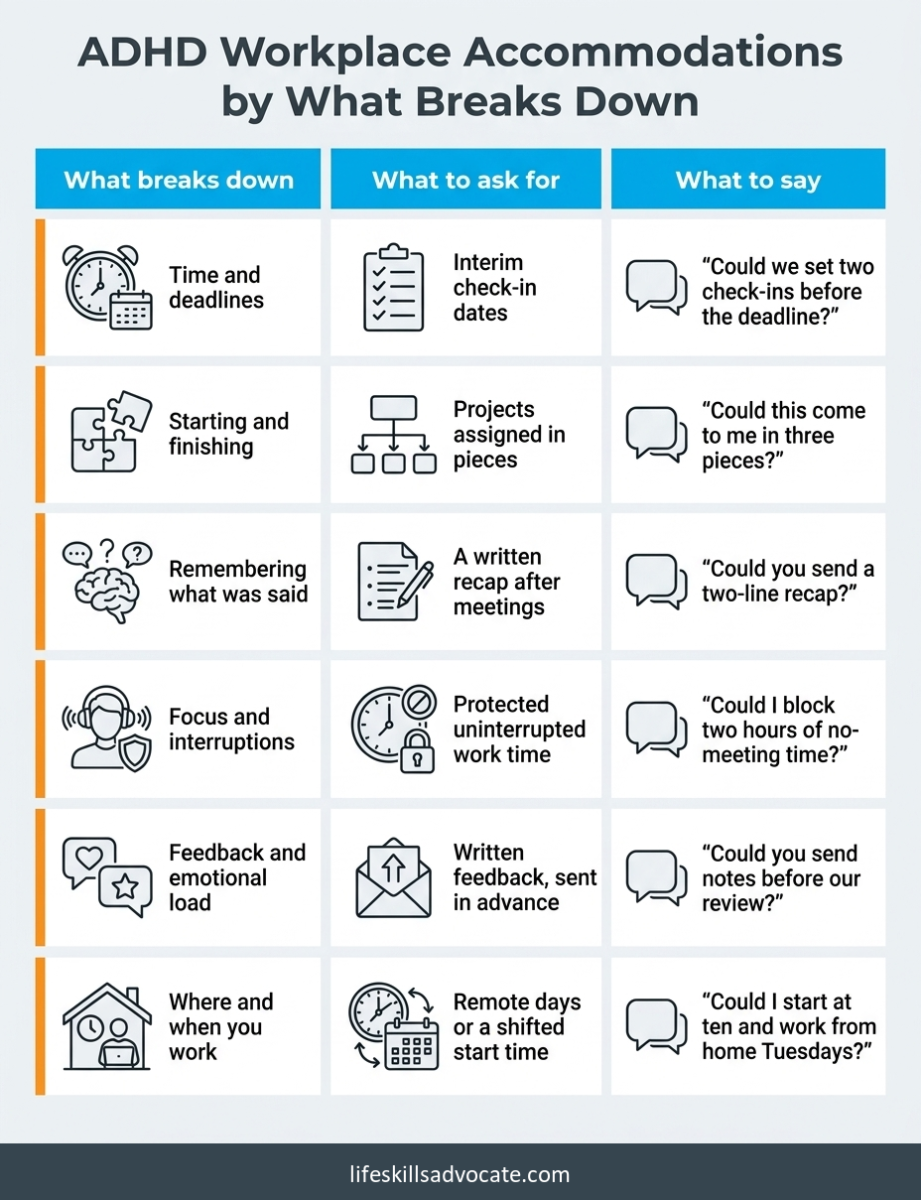
| What breaks down | What to ask for | How to say it |
|---|---|---|
| Time and deadlines | Interim check-in dates instead of one final deadline | “Could we set two check-in dates before the deadline instead of one at the end?” |
| Starting and finishing | Large projects assigned to you in pieces | “Could this be assigned to me in three pieces rather than as one project?” |
| Remembering what was said | A written recap after verbal instructions | “Could you send a two-line recap after we talk, so I’m working from the same version you are?” |
| Focus and interruptions | Protected work time and a quieter spot to sit | “Could I block two hours a day as no-meeting time, and move desks away from the kitchen?” |
| Feedback and emotional load | Feedback in writing, in private, before the conversation | “Could you send written notes ahead of our review, so I’ve had time to read them?” |
| Where and when you work | Remote days, or a shifted start and finish time | “Could I start at ten and finish at six, and work from home on Tuesdays?” |
If no row is obviously yours, that is a normal starting position. The answer is two weeks of data.
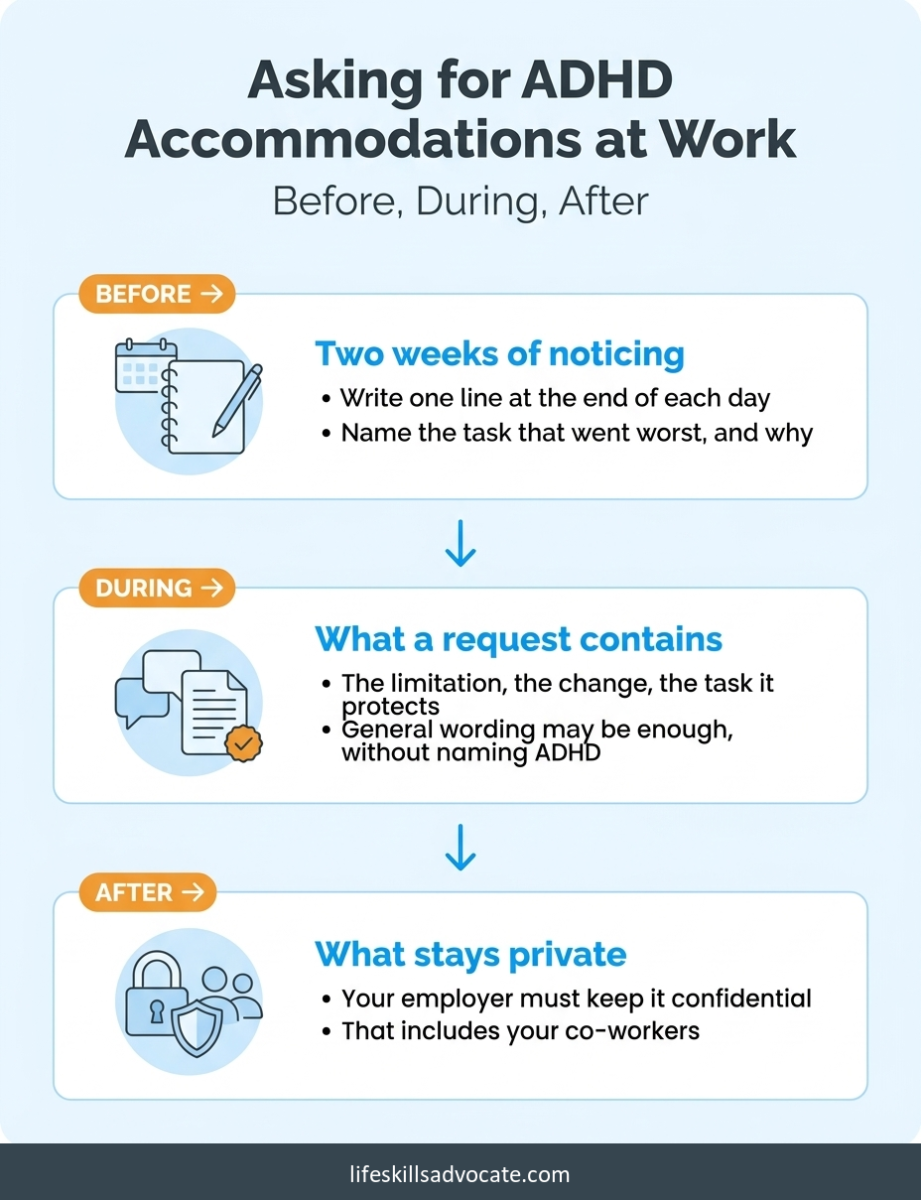
At the end of each working day, write one line naming the task that went worst and what specifically went wrong with it. A two-week time log makes that easier to keep.
This matters more than it sounds. The EEOC says your employer may ask you to put a request in writing, and to describe how the condition affects your work. Two weeks of notes is how you get to that description without inventing it on the spot.
The twelve below are drawn from JAN’s ADHD material, so the examples are ADHD-specific even though the sorting is not. If your own picture includes autism or dyslexia alongside ADHD, or you are sorting this out for a mixed team, the wider set of work accommodations for neurodivergent employees covers the same ground with a broader frame.
Time and Deadlines
Time blindness is not poor planning.
It is difficulty feeling time pass, which means a deadline three weeks out and a deadline tomorrow can register with roughly the same urgency until the afternoon before.
- Interim check-in dates instead of one final deadline. JAN’s time-management list includes dividing large assignments into chunks and using a calendar to emphasize due dates. Two agreed dates before the real one turn an invisible three-week runway into something you can feel.
- Someone else setting the priority order when several things are urgent at once. JAN lists assistance with prioritization on its ADHD page, and allowing a supervisor to assign the order of tasks on the executive functioning page. Small ask, unusually high return.
Lateness belongs in this group, and it is the ask people are most reluctant to raise. JAN puts flexible scheduling and a modified break schedule under attendance, so a shifted start time is a recognized accommodation rather than a favor.
Punctuality standards do not disappear. JAN says plainly that getting to work on time stays the employee’s responsibility. A start time matched to when you can reliably arrive is a different thing from an exemption.
Starting and Finishing
Task initiation breaks on size rather than on interest. A project described as one object can be genuinely impossible to begin while every one of its parts is easy.
- Large assignments handed over in pieces, assigned separately rather than as one block. JAN’s executive functioning list includes dividing large assignments into small tasks, and assigning a new project only once the previous one is complete.
- A named mentor or accountability partner for short regular check-ins. Both JAN lists include assigning a mentor. The version that works is brief and scheduled, not a standing invitation to ask for help.
Remembering What Was Said
Working memory is the reason a meeting can be fully understood in the room and most of it gone by mid-afternoon.
- A written recap after verbal instructions. The EEOC names written instructions from a supervisor who does not usually provide them as an example of a reasonable accommodation, and JAN lists providing minutes of meetings and trainings. Two lines in a message is usually enough.
- Permission to record meetings. JAN’s executive functioning page lists allowing use of a recorder. People often pair this with asking for captions on video calls, and it tends to be one of the easier requests to get agreed, because it costs the employer nothing.
Focus and Interruptions
Attentional control is not willpower, and an open-plan floor is a hostile setting for it.
This group is both the most commonly granted and the most commonly paid for out of pocket.
- A private or quieter workspace, or a desk moved away from the noisiest part of the floor. JAN lists providing a private workspace, and relocating or redesigning a workspace to cut audible and visual distraction.
- Noise-cancelling headphones, or a white-noise machine where headphones are impractical. Both sit on JAN’s own product list for attentiveness and concentration, which is the part worth knowing: these are accommodations an employer can be asked to provide, not only things to buy yourself.
- Protected uninterrupted work time, with non-essential duties moved elsewhere. JAN lists uninterrupted work time and minimizing marginal functions so the employee can focus on essential job duties. Borrow the phrase “marginal functions”; it is the language the ADA framework already uses.
Feedback and Emotional Load
Rejection sensitivity makes a routine review land harder than anyone intended, and the cost is usually paid in the hours afterward rather than in the meeting itself.
- Feedback in writing, in private, and ahead of the conversation rather than inside it. JAN’s guidance is to adjust the method of communication to suit the employee, and to identify areas for improvement fairly and consistently. Reading the notes first means arriving able to discuss them.
Where and When You Work
This group carries the most weight and the most risk, because remote work is the accommodation people want most and the one most often withdrawn.
- Remote or hybrid days, or a shifted schedule. The EEOC names permission to work from home and specific shift assignments among its examples, and JAN lists working from home under hyperactivity, concentration and attendance alike. Tie the request to the thing it solves, because “I work better at home” is harder to act on than “I need two uninterrupted days to get the writing done.”
- An executive function or ADHD coach. JAN lists providing an ADHD coach among its general accommodations for ADHD, and using a job coach under organization and prioritization. More on that further down, because almost nobody knows it is on the list.
How to Request ADHD Workplace Accommodations
You ask.
That is the whole mechanism for ADHD workplace accommodations, and it is less formal than most people expect. The EEOC’s instruction is to tell a supervisor, HR manager, or other appropriate person that you need a change at work because of a medical condition.
No particular form, no magic wording, and no requirement to have an accommodation in mind before you start, though the guidance notes you can ask for something specific. Asking for something specific is usually better, which is what the sorted list above was for.
Who to Tell, and What a Request Has to Contain
A request becomes a request when it connects a change you want to a condition.
“I would like to work from home on Tuesdays” is a preference. “I would like to work from home on Tuesdays because of a condition that affects my concentration” starts the process the ADA describes.
From there, the EEOC says your employer may ask you to put the request in writing and generally describe your condition and how it affects your work. It may also ask for a letter from your health care provider confirming that you have a condition and need an accommodation because of it.
What follows is meant to be a conversation rather than a verdict. Where an accommodation would let you do your job, the guidance says your employer must provide one unless doing so involves significant difficulty or expense.
The Documentation Question
Most of the fear in this process lives here, and some of it is misplaced. A provider letter does not have to be a dossier. The EEOC publishes a short document for exactly this moment: The Mental Health Provider’s Role in a Client’s Request for a Reasonable Accommodation at Work. Take it to an appointment so your provider knows what the employer needs.
That answers a complaint which comes up again and again: people reach the accommodation conversation having been told by their own support team that it had no specific suggestions to offer.
Whether ADHD meets the legal standard is a separate question from whether your employer will agree to a change. JAN is explicit that the ADA contains no definitive list of conditions that count, and that coverage turns on whether an impairment substantially limits a major life activity. We take whether ADHD counts as a disability apart properly in its own piece.
Asking Without Naming ADHD
This is the fact that changes the calculation for a lot of people, and it is rarely stated. The EEOC says that if you do not want your employer to know your specific condition, it may be enough to provide documentation that describes the condition more generally.
Two versions of the same request:
Specific. “I have ADHD. I am requesting written follow-ups after meetings, and two protected hours a day of uninterrupted work time.”
General. “I have a condition that affects my concentration and short-term recall. I am requesting written follow-ups after meetings, and two protected hours a day of uninterrupted work time.”
The second version asks for identical things. Note the word the guidance uses, though: general documentation may be enough, not will be. Your employer and your provider both have a say in what satisfies it.
The protection around all of this is narrower in one respect than it sounds, and wider in another. An employer is only allowed to ask medical questions in four situations, and asking for an accommodation is one of them. Outside those four, the guidance says you can keep your condition private in most situations.
One limit worth stating plainly: everything above is US federal law. State law can add to it, a union contract can change the route entirely, and readers in the UK, Ireland, Canada and Australia sit under different frameworks, where the equivalent is often called reasonable adjustments rather than reasonable accommodations. This article does not cover those.
If you have not been hired yet, the calculation is different enough that it is worth reading up separately before talking about it in an interview.
The Weeks After You Ask
The part of ADHD workplace accommodations people are least prepared for is not the request. It is the month that follows it, when the accommodation is in place and something about how you are treated has shifted a few degrees.
What Your Employer Must Keep to Itself
If you disclose, that information is confidential. The EEOC states that if you do talk about your condition, the employer cannot discriminate against you and must keep the information confidential, even from co-workers. The guidance adds that if you wish to discuss your condition with colleagues, you may choose to do so.
Read that twice if your worry has been that telling HR means telling the team.
It does not. Whether anyone else knows is your call rather than your manager’s, and if it has already happened without your say, that is a separate problem with a name.
When the Check-Ins Will Not Stop
Here is the pattern the peer accounts keep describing. The accommodation gets approved. Results stay fine. And then every one-to-one opens with a version of “how are your accommodations going,” until the standing subject of the relationship has become your limitations rather than your work.
Most of the time this is well meant. It is also wearing, and it tends to continue until something closes the loop. Four short lines that do that:
- “They’re working. I’ll flag it if that changes.”
- “All good on that front. Can we use this time for the handover instead?”
- “Settled, thanks. Nothing needed there.”
- “If it’s useful, I can put a one-line update in my weekly note rather than covering it here.”
The common thread is answering as settled rather than as open. A question asked out of care will keep being asked for as long as the answer sounds like an invitation to keep asking.
None of which makes the social cost imaginary. Some people find the conversation shifts permanently onto what they cannot do, and a fair number of accounts describe being passed over afterward. The legal rules are real, and so is that.
When the Answer Is a Different Accommodation, or No
Being offered something other than what you asked for is not a refusal. It reads like one, and that misreading is where a lot of ADHD workplace accommodations requests die.
The EEOC is direct about it: if more than one accommodation would work, the employer can choose which one to give you. A swap is the process working as designed rather than a rejection of it. The question to ask is whether the substitute solves the same problem, and where it does not, to say so and keep the conversation going instead of treating it as finished.
A real refusal looks different.
It is a denial of any workable change at all, usually on the grounds that providing one would involve significant difficulty or expense for the employer.
Two further things the guidance says plainly. Your employer cannot legally fire you, or refuse to hire or promote you, because you asked for a reasonable accommodation or because you need one, and it cannot charge you for the cost of it.
And the clock is short.
If you believe your rights have been violated, a charge must be filed within 180 days of the alleged violation to take further legal action. That rises to 300 days where a state or local employment discrimination law also covers the employer.
An arrangement can also be reopened later rather than refused up front. Where a change stops working for the business, or the job itself changes shape, employers do revisit what was agreed, which is one reason to keep your own written record of what was granted and when.
Knowing the rule and having it honored are two different experiences. The rule is what gives you somewhere to stand. It does not guarantee the ground holds.
Changes You Can Make Without Telling Anyone
What if you have weighed it up and the answer is no, you are not disclosing? That is a legitimate place to land, and a real share of ADHD workplace accommodations need no disclosure at all.
JAN publishes self-directed ideas alongside the employer-side ones, under the heading “Strategies for the Individual with the disability.” That placement matters as much as the content: working on your own setup is part of the official framing, not a workaround for people who could not face the conversation.
Its list runs to the practical. Keeping keys, phone and glasses in one place. Preparing the next day’s work the night before. Writing checklists, putting reminders where you will see them, and turning off notifications.
A visual countdown timer on the desk, like the Time Timer Home MOD, does more for elapsed-time awareness than a phone alarm, because it is visible without having to be checked.
Prioritizing is the one worth a tool.
JAN’s employer-side version is assistance with prioritization. The self-directed equivalent is running your own week through the Eisenhower Matrix before it starts, sorting what is urgent from what merely feels urgent.
Plenty of requests also carry no disclosure at all. A standing desk, a quieter corner, captions on a call, written notes after a meeting, a different chair. A reasonable manager grants those without asking why, and we have a wider set of ideas for managing ADHD at work day to day that assumes no formal arrangement.
Over-ear active noise cancellation at the value end of the range. Buying your own pair is the self-accommodation that comes up again and again in peer accounts of ADHD at work, because it needs no request, no form and no conversation.
Best for: Someone in an open-plan office who would rather solve the noise this week than wait on an approval. One caution: some ADHD and autistic adults report a pressure sensation from active noise cancellation that they cannot tolerate, and an open-ear bone-conduction pair is the alternative there.
If the pressure problem is yours, our roundup of noise cancelling headphones sorts the types by sensory profile, open-ear pairs included.
Be clear-eyed about which is which, though.
Asking for a formal schedule change, protected no-meeting time, or a reduced duty list tends to prompt the question of why. At that point you are back in the earlier conversation with less preparation. Things that look disclosure-free are not always.
Coaching Is on the Accommodation List
An ADHD coach sits on the federal government’s own list of ADHD workplace accommodations. JAN names providing an ADHD coach among its general accommodations, lists using a job coach under organization and prioritization, and names a job coach again under hyperactivity and impulsivity, to teach and reinforce techniques.
That is the claim, and it stops there. Whether a given employer would fund one is a different question, and we have no basis for saying how often they do.
It is worth naming because it widens what you can put in a request. Where the breakdown is in the executive function work itself rather than in the setting, a quieter desk will not touch it. Executive function coaching is educational and skills-focused, working out which systems hold up for your brain and your job. It is not mental health care and it does not stand in for therapy where therapy is what is needed.
What the Rules Say About ADHD Workplace Accommodations
Six published rules worth having to hand. Both source pages were retrieved in October 2026 and neither carries a revision date in its markup, so they are cited as current guidance rather than to a publication year.
| Finding | What it means | Source |
|---|---|---|
| The ADA contains no definitive list of conditions that count as disabilities | Whether ADHD qualifies is decided case by case, on whether an impairment substantially limits a major life activity | Job Accommodation Network |
| A disclosed condition must be kept confidential, even from co-workers | Telling your team is your decision, not your employer’s | EEOC |
| Documentation describing a condition more generally may be enough | You can often request ADHD workplace accommodations without naming ADHD | EEOC |
| Where more than one accommodation would work, the employer can choose which one to give you | Being offered something different from what you asked for is not a refusal | EEOC |
| An ADHD coach appears on JAN’s own list of accommodations for ADHD | Coaching is something you can request, not only something you buy | Job Accommodation Network |
| A discrimination charge must be filed within 180 days, or 300 days where state or local law also covers the employer | If it goes wrong, the window to act is short | EEOC |
Frequently Asked Questions
Can I Get ADHD Workplace Accommodations Without Telling My Employer I Have ADHD?
Often, yes.
EEOC guidance says that if you do not want your employer to know your specific condition, documentation describing it more generally may be enough, so a request can name the limitation and the change you want without naming ADHD.
What you cannot do is get a formal accommodation while saying nothing at all. Asking for one is itself one of the four situations in which an employer may ask medical questions.
The other three are after a job offer but before you start, during affirmative action for people with disabilities, and where there is objective evidence you may be unable to do the job. Outside those four, you can keep your condition private in most situations.
What Are Reasonable Adjustments for ADHD at Work?
Reasonable adjustments and reasonable accommodations mean roughly the same thing in different places.
“Reasonable adjustments” is the UK term: gov.uk’s guidance on disability rights at work says an employer has to make them under the Equality Act 2010. “Reasonable accommodation” is the US term, from the ADA. The practical lists overlap heavily: adjusted hours, written instructions, a quieter workspace, remote days.
The legal routes are not interchangeable, though. This article describes the US framework, so if you are under the Equality Act or a Canadian or Australian equivalent, check your own jurisdiction’s process first.
What Is the 30% Rule in ADHD?
It is a rule of thumb rather than a measurement: the idea that executive function runs roughly 30% behind someone’s chronological age. Our piece on how executive age works covers where it comes from.
Can My Employer Fire Me for Asking for ADHD Workplace Accommodations?
No.
EEOC guidance states that your employer cannot legally fire you, or refuse to hire or promote you, because you asked for a reasonable accommodation or because you need one, and cannot charge you for its cost. Retaliating against you for contacting the agency or filing a charge is also unlawful.
Both things are true at once, though. The rule is clear, and the peer accounts are full of people who believe asking cost them a promotion, a remote arrangement, or the job, in ways that are hard to prove and expensive to contest.
If you think something has gone wrong, the window is short: 180 days from the alleged violation, or 300 where state or local law also covers your employer.
Whether that is long enough to decide something this consequential is a fair question, and we do not have a satisfying answer to it.
What If My Manager Keeps Bringing My Accommodations Up in Every One-to-One?
Answer it as closed rather than as open. “They’re working, I’ll flag it if that changes” ends the thread in a way that “yeah, pretty good so far, I think” does not. Your employer is not required to keep checking in, and nothing stops you asking for those updates to move into your weekly note instead. Most managers take the hint.
Next Steps
The first step toward ADHD workplace accommodations is not the conversation. It is the two weeks of noticing that turns “work is hard right now” into the specific description your employer is allowed to ask you for.
- Write one line at the end of each day for the next two weeks naming the task that went worst and what went wrong with it. No tool required, though the time log keeps it tidier.
- Two rows from the map above, picked to match what the log shows, drafted as a single paragraph: the limitation, the change, and the task it protects.
- Read JAN’s own list for your kind of job before the meeting. Walking in with a second and third option is what turns a declined first ask into a swap rather than a dead end.
- If the breakdown is in the executive function work itself rather than in your surroundings, executive function coaching is built for that, and JAN lists it as something you can request.
Further Reading
- Attention Deficit/Hyperactivity Disorder (ADHD) and the Americans with Disabilities Act – Job Accommodation Network
- Accommodation Solutions for Individuals with Executive Functioning Deficits – Job Accommodation Network
- Depression, PTSD, and Other Mental Health Conditions in the Workplace: Your Legal Rights – U.S. Equal Employment Opportunity Commission
- The Mental Health Provider’s Role in a Client’s Request for a Reasonable Accommodation at Work – U.S. Equal Employment Opportunity Commission
- Disability Rights: Employment – GOV.UK
- Is ADHD a Disability? – Life Skills Advocate
- 20 Essential Work Accommodations for Neurodivergent Employees – Life Skills Advocate
- ADHD and Executive Age – Life Skills Advocate
- 14 Tips for Managing ADHD and Neurodivergence at Work – Life Skills Advocate
- 8 Best Noise Cancelling Headphones for ADHD and Sensory Overload – Life Skills Advocate
- Neurodivergent Interview Tips – Life Skills Advocate
- Executive Functioning Accommodations in School – Life Skills Advocate
- Executive Function Coaching for Work and Career – Life Skills Advocate
- Time Log Worksheet – Life Skills Advocate
- Eisenhower Matrix Template – Life Skills Advocate