
Your 12-year-old forgot to bring their homework home again. Your smart, capable kid, the one who can walk you through Minecraft redstone circuits in technical detail, somehow cannot remember to check their backpack before leaving school.
That gap, between what someone knows and what they can reliably do in the moment, is exactly what the concept of ADHD executive age is trying to name. People with ADHD develop self-regulation skills on a slower timeline than neurotypical peers. Dr. Russell Barkley puts the average delay at roughly 30%, which means the executive function skills a 10-year-old with ADHD relies on for planning, impulse control, and time management may be closer to those of a 7-year-old. That number says nothing about intelligence. It says something specific about the brain’s project management system and why it sometimes fails at moments that should feel simple.
TL;DR
- ADHD executive age describes the developmental gap between a person’s chronological age and the maturity of their executive function skills (planning, impulse control, emotional regulation, and time management).
- The 30% rule: Dr. Russell Barkley estimates that people with ADHD are roughly 30% behind neurotypical peers in self-regulation, so a 10-year-old with ADHD might have executive function closer to a 7-year-old.
- Brain imaging research (Shaw et al., 2007) found a roughly 3-year delay in cortical maturation in children with ADHD, most pronounced in the prefrontal cortex.
- The 30% is an average estimate, not a precision measurement. Individual variation is wide, and the gap looks different depending on which executive function skill you are looking at.
- Intelligence is a separate question entirely. Executive age says nothing about thinking ability, creativity, or what someone knows.
- Executive function skills can improve. The brain stays adaptable, and the right supports make a real difference at any age.
A quick note before we get into it: this is educational content, not medical or diagnostic advice. If ADHD is something you are actively working through with a clinician, use this as context for those conversations, not a substitute for them.
What Is ADHD Executive Age?
Most parents and adults asking about executive age are really asking something more specific: why does someone who is clearly capable keep failing at things that seem so simple? The concept has a name and a reasonably practical answer.
ADHD executive age describes the gap between a person’s chronological age and the developmental level of their executive function skills, the mental tools that help you plan, get started on tasks, manage time, control impulses, regulate emotions, and hold information in working memory. These are sometimes called the “project manager” skills of the brain. They live primarily in the prefrontal cortex, which is one of the last brain regions to fully mature.
For people with ADHD, these skills develop on a slower timeline. Not because something is fundamentally wrong, but because the brain’s self-regulation system is following a different developmental schedule. Understanding where a person falls on that schedule, and how it compares to the typical executive function development timeline, changes what kinds of supports actually make sense.
Where the 30% Figure Comes From
Barkley’s 30% figure circulates widely in ADHD communities, often without much context about where it came from or what it is measuring. Worth understanding both.
The figure comes from Dr. Russell Barkley, one of the most widely cited ADHD researchers, and appears in his clinical lectures and parent-facing materials as an estimate: people with ADHD are roughly 30% behind neurotypical peers in executive functioning and self-regulation. The math is simple. Take a person’s age and subtract 30%. A 10-year-old with ADHD might have executive function skills closer to a 7-year-old. A 15-year-old might manage time and impulses more like a 10- or 11-year-old. A 20-year-old heading into independent living might be working with the self-regulation capacity of a 14-year-old.
Two things are worth holding onto before applying that math too literally. First, this is a clinical rule of thumb, not a diagnostic tool. The delay varies by person and by skill area. Someone might show a bigger gap in emotional regulation and a smaller one in working memory, or the reverse. Second, the 30% applies specifically to self-regulation. It says nothing about intelligence, creativity, or knowledge.
ADHD Executive Age Chart
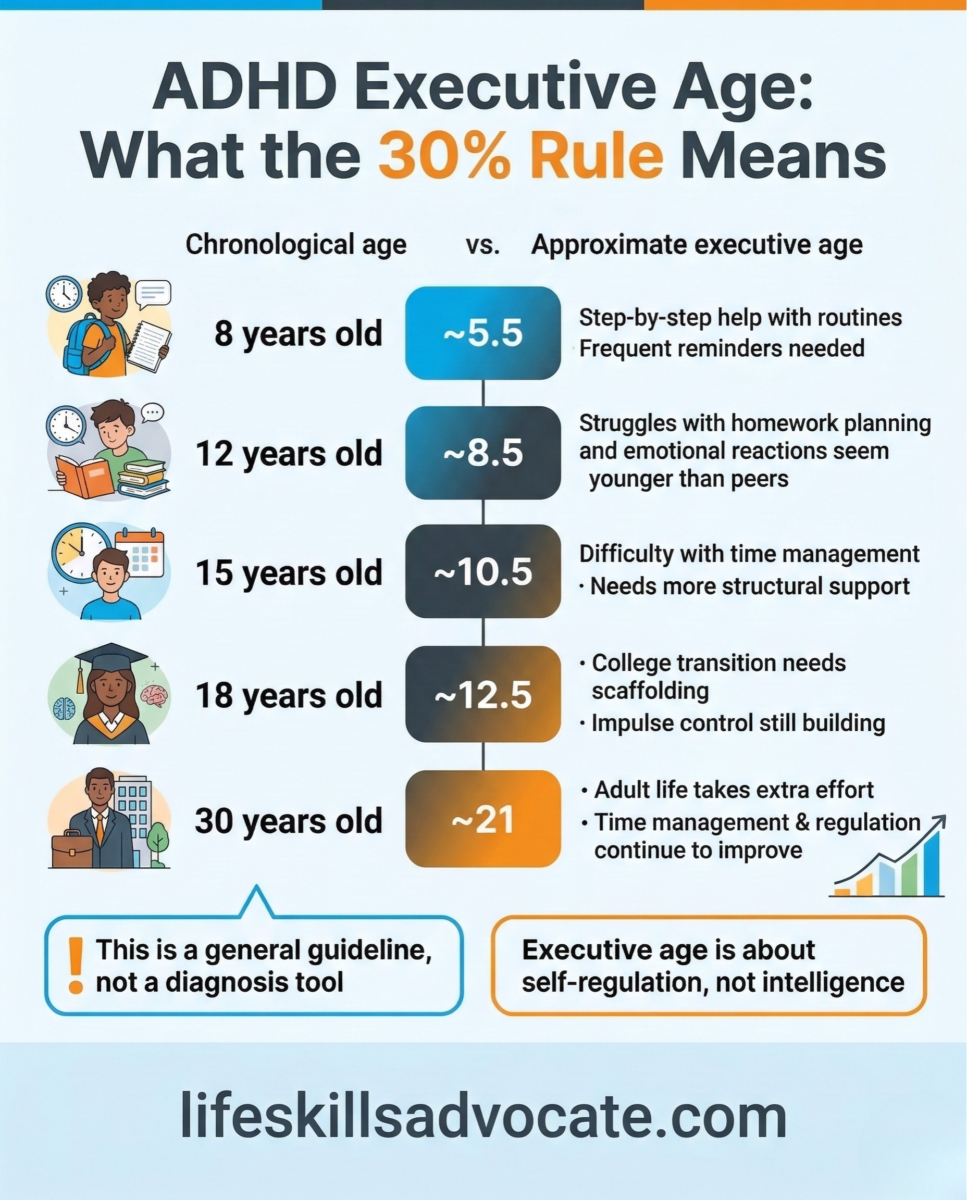
The table below shows approximate executive ages based on the 30% guideline, along with what you might commonly see at each stage. These are rough estimates for general orientation, not precision measurements, and the range of individual variation is wide.
| Chronological Age | Approximate Executive Age (30% Rule) | What This Often Looks Like | Source |
|---|---|---|---|
| 8 | ~5.5 | Needs step-by-step help with routines; frequent reminders to stay on task | Barkley, EF and Self-Regulation |
| 12 | ~8.5 | Struggles with homework planning; emotional reactions may seem younger than peers | Barkley, EF and Self-Regulation |
| 15 | ~10.5 | Difficulty managing time independently; may need more structure than same-age peers | Barkley, EF and Self-Regulation |
| 18 | ~12.5 | College transition may need more scaffolding; impulse control still developing | Barkley, EF and Self-Regulation |
| 30 | ~21 | Time management and emotional regulation may still require more effort than expected | Barkley, EF and Self-Regulation |
The Science Behind the 30% Rule
The 30% figure shows up constantly in ADHD circles, which has given it a precision it does not quite deserve. The underlying research is solid. The way the number travels is less so.
Shaw and colleagues at the National Institute of Mental Health ran MRI scans on 223 children with ADHD and 223 typically developing controls, tracking cortical thickness at over 40,000 points in the brain. Children with ADHD followed the same general developmental pattern as their peers, but on a delayed schedule. On average, they reached peak cortical thickness about 3 years later (median age 10.5 vs. 7.5). The delay was most pronounced in prefrontal regions involved in attention, planning, and impulse control. In the middle prefrontal cortex, the lag reached as much as 5 years.
Both of those numbers point in the same direction.
Researchers have since described this pattern as “delay, not deviance.” The ADHD brain appears to follow the same maturational path as a neurotypical brain, just on a slower schedule. That framing also carries a note of cautious optimism: if the trajectory is essentially normal and the pace is what differs, many people may eventually develop stronger executive function skills, even if the timeline looks different from what they expected.
A 2013 study by Berger and colleagues published in Frontiers in Human Neuroscience added a behavioral dimension. Using cognitive performance tests with over 900 children, the researchers found that ADHD children’s scores matched those of typically developing peers who were 1 to 3 years younger, with the delay more noticeable in older children.
What these studies do not tell you is where any specific child falls within that range. The 30% figure is Barkley’s clinical estimate, not a value measured in a single study. It aligns broadly with the neuroimaging and cognitive research, but treat it as a rough guide. Some children show a much smaller gap; some show a larger one. The same child may sit at very different points depending on whether you are looking at working memory, emotional regulation, or task initiation.
Where People Tend to Get This Wrong
A parent once told me she had shown her son the 30% chart and explained that his “executive age” was a few years behind his chronological age. He was furious. She had not meant it as an insult, but the concept had slipped from a useful framework into something that felt like a label about his whole self. That happens a lot with this idea.
The math is useful. The conclusions sometimes drawn from it are not.
Intelligence and executive function are different things entirely. A child with ADHD may be intellectually gifted and still struggle to turn in homework, manage their morning routine, or regulate their emotions when plans change. As ADHD specialist Ryan Wexelblatt has pointed out, parents often base expectations on their child’s impressive verbal reasoning, then get frustrated when follow-through does not match. That gap between what a child knows and what they can consistently do is the executive function piece, and it is a common source of confusion in families with ADHD. In my coaching work, I have watched parents have a genuine shift when they finally see these as two separate systems. The frustration does not disappear, but it changes shape.
The brain remains adaptable. For adults working on this specifically, our guide to improving executive function covers a layered approach that starts from where most adults actually are, not where they think they should be by now. Delayed development is not the same as stopped development.
Calibrating support to where someone is developmentally is not the same as lowering expectations. The goal is not to talk down to a teenager or remove all challenge. It is to match expectations and supports to the developmental level actually in play, so the person can build from where they are instead of constantly falling short of where they think they should be. High standards and structural support are not opposites.
And if you are wondering whether what you are seeing points toward a formal evaluation, recognizing what executive dysfunction looks like in daily life is a practical place to start. Executive age charts are useful mental models. They are not clinical tools.
Does the 30% Rule Apply to Adults?
The year gap does not shrink as people age. What changes is what that gap means in daily life.
A 10-year-old with ADHD and a 7-year-old without ADHD are in genuinely different developmental worlds. A 40-year-old with ADHD and a 28-year-old without ADHD are both getting through adult life with adult-level knowledge and experience behind them. The raw math, about 12 years in that example, sounds alarming until you think about what both people are actually doing day to day.
That said, executive function differences do not simply vanish. Many adults with ADHD describe ongoing challenges with time management, organization, emotional regulation under stress, and following through on plans that require multiple steps over days or weeks. These are not character flaws. They reflect a self-regulation system that needs more external structure than average, which is a different framing than “this person is just not trying hard enough.”
I have heard adults describe real relief at finally having a framework that matches their actual experience, rather than one that keeps comparing them to a version of themselves they could never quite become.
Whether that reframe leads anywhere useful depends entirely on what you do with it.
Taking Charge of Adult ADHD (2nd Edition)
This is Russell Barkley’s own guide, from the researcher behind the 30% rule this article is built on. It turns the executive-age idea into concrete routines for managing time, memory, and follow-through, with the science explained in plain terms.
Best for: Adults with ADHD who want the framework’s originator walking them through how to work with the delay day to day. It is written for adults; for a younger child, pair the ideas with age-appropriate supports.
How to Use Executive Age in Daily Life
So what do you actually do with this information?
The biggest practical shift for most families and adults is moving from “Why can’t they just do it?” to “What support would make this doable?” That single question tends to reduce a significant amount of friction on both sides.
At Home
One of the most common things I hear from parents after we talk through executive age is some version of: “I’ve been expecting a 13-year-old and getting an 8-year-old, and I thought something was wrong with both of us.” That is usually the beginning of something more useful.
- Break tasks into visible steps. Instead of “clean your room,” try “pick up the clothes on the floor, then put your books on the shelf.” Smaller chunks reduce working memory load. For more on getting started, our guide to impulse control for teens covers several approaches worth pairing with this one.
- Visual checklists, visual timers, and routines posted on the wall are not crutches. They are the scaffolding that helps someone build skills over time. The goal is to gradually fade those supports as skills develop, not remove them prematurely because it feels like the person “should not need them anymore.”
- If your 13-year-old with ADHD has an executive age closer to 9 or 10, it makes sense that they still need help with multi-step routines. Meeting them where they are is not giving up on them.
(Parents push back on keeping supports in place constantly. The worry is that leaving supports in indefinitely means a kid will never develop independence. In my experience, pulling support before the skill is there tends to set things back further than leaving it in place a bit longer. Support, practice, fade.)
At School and College Transitions
Middle school is when I start hearing from most families for the first time. Not because things suddenly got worse, but because the environment stopped compensating quietly for them. Every grade level adds complexity, and the informal supports that used to paper over the gap start to fail more visibly.
- Extended time on tests, visual schedules, breaking assignments into smaller checkpoints, and regular check-ins with a teacher or counselor can all help close the gap between what a student knows and what they can independently execute. Our time management guide for teens covers approaches worth pairing with school accommodations.
- Plan for extra support around the college transition. A 19-year-old with ADHD may be managing time and planning at closer to a 16-year-old’s level. Sending them to handle their own schedule, meals, laundry, and coursework all at once is a lot. A lighter first-semester course load, a gap semester, or ongoing coaching through the transition is not coddling. It is planning for a known challenge.
(The September of freshman year is the one I hear about most often, usually around week three. It is a very specific kind of hard.)
At Work
Open-plan offices, vague priorities, back-to-back meetings, and sprawling to-do lists create friction for most people. For ADHD brains, they tend to create quite a bit more. Recognizing the mismatch is the first step toward doing something about it.
Digital reminders and timers, a short daily task list rather than a sprawling weekly one, flexible arrangements when possible, and roles that lean into strengths like creative problem-solving or urgency-driven work all help.
(One addition worth trying before optimizing a whole system: decide what the one non-negotiable task is for today. That single decision takes an enormous amount of cognitive load off. The rest of the list becomes context, not pressure.)
For a fuller look at specific adjustments worth trying, our guide to work accommodations for neurodivergent employees covers options that tend to make the most practical difference.
Frequently Asked Questions
What is the mental age of a person with ADHD?
“Mental age” is the wrong frame here. ADHD executive age describes self-regulation development, not intelligence or thinking ability. A person with ADHD may be intellectually advanced while their executive function lags behind their chronological age. They are separate systems.
Does ADHD get better with age?
For many people, yes. The prefrontal cortex continues to mature into the mid-to-late 20s, and many people with ADHD see real improvements in executive function during that window. Hyperactivity often decreases with age. Challenges with attention, time management, and emotional regulation tend to shift in how they show up rather than disappearing entirely. Most adults with ADHD find that the right supports and clearer self-understanding make a substantial difference, though what “better” looks like varies considerably from person to person. It rarely means “no longer ADHD.” The brain matures; the underlying architecture is still ADHD.
Can executive function skills improve?
Yes. The brain remains adaptable throughout life, and executive function is more changeable than most people expect. Structural supports (routines, reminders, visual tools) paired with targeted practice make the biggest difference. Coaching and sometimes medication help too. Progress in one skill area does not automatically transfer to others, and the timeline is unpredictable. The direction, though, is usually forward.
Can the 30% rule be used against someone?
Yes, and that is worth taking seriously. The 30% framework was designed to help parents, educators, and adults set more accurate expectations and identify appropriate support. Used clumsily, it becomes a label. Something a child hears as “your brain is younger than everyone else’s,” which is both inaccurate and discouraging. It can also be used to lower the bar in patronizing ways, or to dismiss a person’s frustration by explaining away their experience with a number.
The figure is a calibration tool for the adults in someone’s life. It was never meant to be explained to a child as a fact about their brain. How a concept gets communicated matters as much as the concept itself. Whether the people using it are actually doing that part well is a harder question than the math.
How is ADHD executive age different from emotional maturity?
There is significant overlap, but they are not the same thing. Executive age describes skills like planning, time management, and impulse control. Emotional maturity is broader, covering perspective-taking, empathy, and relational skills. A person with ADHD might have strong empathy and still struggle to regulate the intensity of their emotional reactions when something goes wrong. For most people with ADHD, the two challenges travel together, which is part of why the gap can feel larger than 30% in emotionally charged moments. Where the line falls between them for any individual is not always clear, even to clinicians.
Next Steps
A framework is only useful if it changes something concrete. Pick one thing from this list, make it specific enough to actually do, and start there.
- Pick one book rather than five. Our shortlist covers which ADHD book to start with and how to finish it, sorted by what you want one for.
- The free executive functioning assessment (or the online version) at Life Skills Advocate can help identify which EF skills are creating the most friction right now. That is a useful starting point before deciding where to put energy.
- Pick one skill area, not the whole list. Task initiation, time management, and emotional regulation are different problems with different approaches. Trying to address all of them at once is usually how nothing changes.
- If executive function challenges are creating significant friction at school, work, or home, executive function coaching provides structured support and accountability. Life Skills Advocate’s coaching is skills-focused and neurodivergent-led, not therapy, and not a replacement for medical care.
- Write down the one executive function skill that creates the most friction in your week. That is the place to start, not the whole list.
Further Reading
- Executive function skills by age – Age-by-age developmental milestones for executive function, with context for understanding how the ADHD timeline compares.
- Signs of executive dysfunction – A guide to recognizing executive dysfunction in daily life, with practical approaches for working with it rather than against it.
- Improve executive function in adults – A layered approach to strengthening executive function through foundations, external supports, and skill practice.
- Impulse control for teens – Options for building impulse control skills in teens and young adults with ADHD.
- Time management for teens – Concrete time management ideas to pair with school accommodations and home routines.
- Work accommodations for neurodivergent employees – Specific adjustments for adults with ADHD navigating the workplace.
- Executive function coaching – Overview of Life Skills Advocate’s skills-focused, neurodivergent-led coaching.
- Free executive functioning assessment – A self-assessment to help identify which EF skills are strongest and which could use more support.
- Shaw et al. (2007), PNAS – Landmark NIMH brain imaging study documenting cortical maturation delay in ADHD.
- Berger et al. (2013), Frontiers in Human Neuroscience – Study finding ADHD children’s cognitive performance matched peers 1 to 3 years younger.
- Barkley, Executive Functioning and Self-Regulation in ADHD – Expert overview of the relationship between executive function, self-regulation, and ADHD.
- NIMH press summary of Shaw et al. (2007) – Plain-language summary of the cortical maturation delay findings.
- ADDitude: Your ADHD Child’s Real Age – Clinical perspective on why cognitive ability and executive function maturity are often mismatched in children with ADHD.