
It is one in the afternoon and the bedroom door is still shut. The dishes from two nights ago are still in the sink. You love this person more than almost anyone, and a word you do not want to think keeps surfacing anyway: lazy.
That word does a lot of damage, and it is almost always wrong. “Failure to launch syndrome” is the phrase people reach for when a young adult stalls on the way to independence. Still living at home, not working or studying much, somehow stuck in place while the calendar keeps moving.
There is a calmer and more accurate way to read this, and it changes what you do next. It is not a recognized condition, it is rarely about character, and for a lot of neurodivergent young adults there are specific, workable reasons sitting underneath the stuckness. Those reasons are where real support starts.
TL;DR
The short version of what most parents and young adults need to hear about “failure to launch,” before anyone reaches for a boot camp or a lecture:
- “Failure to launch syndrome” is an informal label, not a condition you can be diagnosed with. It names a pattern, not a personal defect.
- Living at home in your twenties is now common in the US, and on its own it is not a failure. What matters is movement and dignity, not the address.
- For neurodivergent young adults, getting stuck is usually about executive function load, anxiety, and avoidance feeding each other, not a missing work ethic.
- Five calmer ways to help: get curious about what is actually blocking them, shrink the next step, trade rescuing for building the skill, drop the laziness story, and bring in support that fits.
A note before we get into it: this is educational, not a clinical evaluation or a replacement for working with a qualified professional. If your family is already working with a therapist or doctor, use this alongside that conversation, not instead of it.
What Is “Failure to Launch Syndrome,” Really?
“Failure to launch syndrome” is an informal, non-medical term for a young adult who is having trouble moving into independent adult life and stays highly dependent on their parents. It is not a recognized condition, and it does not appear in the manual professionals use to identify mental health conditions. It is a description, borrowed loosely from a 2006 movie, that stuck.
That distinction matters more than it looks. A label that sounds like a condition invites people to treat the young adult as broken and go hunting for an intervention. A description invites a better question: what is actually getting in the way here?
What People Usually Mean by It
When families use the phrase, they are usually pointing at some mix of the following. None of these are character flaws, and most have reasons behind them.
- Not in school or work, and not visibly moving toward either
- Days and nights flipped, or very little structure to the day
- Avoiding the concrete steps toward independence: job applications, driving, appointments, paperwork
- Leaning on parents for tasks that same-age peers tend to handle
- Real distress or shutdown when independence comes up in conversation
That last one does a lot of quiet work. When a topic reliably produces distress, that is rarely the look of someone who does not care. It is more often the look of someone who cares and feels overwhelmed.
Where the Term Comes From, and Why It Is Contested
The phrase entered everyday use through pop culture, not research, and the criticism of it has grown alongside the searches. The objection is simple. “Failure” puts the whole problem inside the young person and treats a stalled transition as a verdict on who they are. It skips over executive function, mental health, and an economy that genuinely shifted under this generation.
We use the phrase here because it is what people search and the fastest way to find each other. We do not use it as a diagnosis, because it is not one.
Is “Failure to Launch Syndrome” a Real Condition?
No. Failure to launch syndrome is not a clinical condition, and it is not something a professional can formally identify the way they would ADHD, autism, or an anxiety condition. According to the Child Mind Institute’s overview of failure to launch, the term is a popular-culture label for a young adult who lives at home and stays highly dependent on their parents, not an entry in the diagnostic manual.
What is real is the pattern underneath it. A young adult who cannot get traction is usually dealing with something nameable: executive function challenges, anxiety or low mood, a learning difference, autistic burnout, or some combination. Those are the things a professional can actually identify and support.
So the first useful move is almost never a motivational push. It is figuring out which of those real, specific things is in play, because the support for anxiety looks nothing like the support for a task-initiation gap, even when the outside picture, a closed door at noon, looks identical.
When Living at Home Is Not a Failure
Part of what makes failure to launch feel like an emergency is a story about how adulthood is supposed to go. Move out at eighteen, never move back, figure it all out fast. That story was never very accurate, and it does not match the current numbers at all.
In 2024, about 32.5% of US adults ages 18 to 34 lived in a parent’s home, according to US Census Bureau data on the living arrangements of adults. Among 25-to-34-year-olds, close to one in five still live with a parent. This is not a small fringe of people who failed. It is a large, normal share of a generation responding to real conditions.
Those conditions are not subtle. Total US student loan debt sat around $1.84 trillion at the end of 2025, per the Federal Reserve’s report on US household finances, and rents in many cities have outpaced entry-level wages. A young adult who stays home to avoid drowning in debt is making a defensible call, not refusing to grow up.
Here is the honest version, though. Living at home is not automatically healthy and not automatically a problem. The same address can hold a young adult who is saving and slowly stepping up, and one who has not left their room in three weeks.
The question is never the location. It is whether there is movement, and whether the arrangement keeps the young person’s dignity intact.
Why Neurodivergent Young Adults Hit “Failure to Launch”
For neurodivergent young adults, failure to launch is rarely a willpower story. It is an executive function story, an anxiety story, and a story about how support can accidentally keep someone stuck.
Pull those three apart and it stops looking like a character problem.
Executive Function Is the Engine, and It Runs Differently
Executive function is the set of mental skills that turn an intention into an action: getting started, planning, holding steps in mind, switching tasks, regulating emotion along the way. For ADHD and autistic young adults, several of these run differently, which means the gap between “I should apply for that job” and actually doing it can be enormous even when the desire is completely real.
That is why “just send the application” lands so badly. Sending an application is not one action. You have to find the posting again. You have to parse what it actually wants. You update a document and write something flattering about yourself. You fight the dread the whole time. And you keep all of it in order without losing the thread, which a brain with a task-initiation and working-memory gap meets as a wall, not a to-do item.
The wanting is there.
The on-ramp is missing. Our piece on how executive functioning builds a foundation for daily living skills walks through how these skills feed the ordinary independence tasks everyone assumes are automatic.
Anxiety, Low Mood, and Avoidance Feed Each Other
The mental health load on this age group is heavy and well documented. Young adults ages 18 to 25 have the highest rate of any mental illness of any US adult age group, 36.2% in 2023, according to SAMHSA’s National Survey on Drug Use and Health. Roughly one in three.
Anxiety and avoidance form a loop. A task feels threatening, so it gets put off, which brings relief, which teaches the brain that avoiding worked, which makes the task feel bigger next time. Run that loop for months and a young adult can end up genuinely unable to start things they are capable of doing. From the outside it reads as not trying. From the inside it is closer to being frozen.
The Accommodation Trap
Here is the hardest one, because it implicates the people doing everything right. When a young adult is anxious and avoidant, parents step in. They make the call, handle the form, let the missed obligation slide to keep the peace. Each move is loving. Researchers call this pattern family accommodation, and over time it can quietly reinforce the very avoidance everyone wants to shrink.
The mechanism is not mysterious. Every time the scary task gets handled by someone else, the young adult never finds out they could survive it. The fear stays intact, and the dependence deepens.
A parent-based approach called Supportive Parenting for Anxious Childhood Emotions, or SPACE, was built around this exact loop. In a 2021 case study in Cognitive and Behavioral Practice, clinicians paired it with a young adult’s own therapy specifically to head off failure to launch, reducing accommodation gradually while keeping the relationship warm.
The way out is not to yank support away. It is to step back slowly and on purpose, in a way the young adult can see coming, so the difficulty rises a little at a time instead of all at once.
The Ground Actually Did Shift
Some of the stuckness is just an accurate reading of the environment. This generation is carrying record debt, facing housing costs their parents did not, and entering adulthood through a mental health support system stretched thin. A neurodivergent young adult feels every one of those pressures with an extra layer of executive function and sensory load on top.
And the squeeze is not abstract. A tank of gas, a one-bedroom, a regular grocery run: all up, and not by a little, while entry-level pay mostly stayed put. So “just move out and figure it out” is less tough love than bad arithmetic. A young adult who runs that math and balks is not being lazy. They are being accurate.
None of that puts independence off the table. It means the path is steeper than the old story admits, and pretending otherwise just adds shame to an already heavy load.
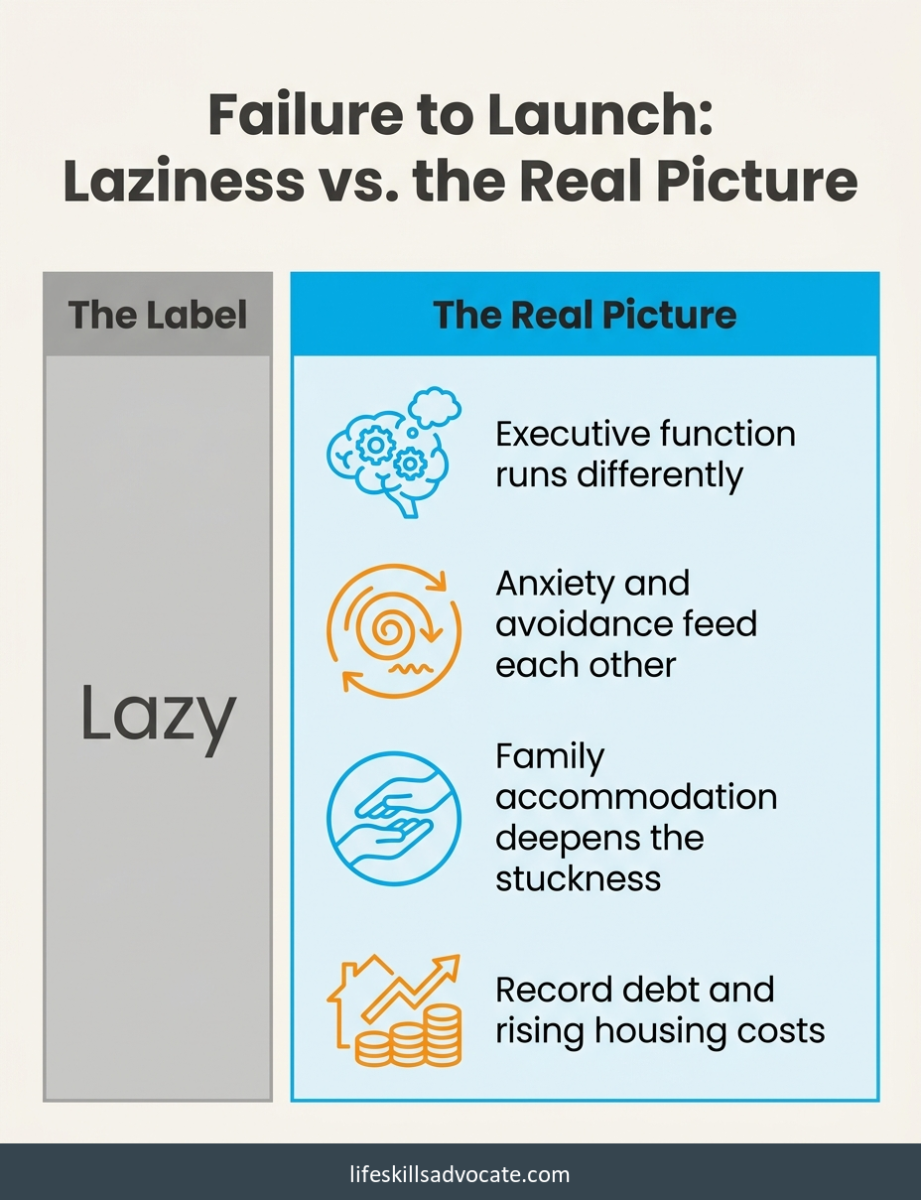
What the “Failure to Launch” Reframe Looks Like at a Glance
If you take one thing from this article to quote, screenshot, or read aloud to someone who still thinks the answer is tough love, make it this. The label says one thing about failure to launch; the evidence says another.
:root{–link-color:#00a1ff;–border-color:#e1e5ea;–cell-padding:0.75rem;–font-base:0.95rem;–hover-bg:#f9fbfc;}.table-container{overflow-x:auto;-webkit-overflow-scrolling:touch;margin-bottom:1rem;border:0 !important;}.cmp-table{width:100%;font-size:var(–font-base);table-layout:fixed;border-collapse:separate !important;border-spacing:0;border:0 !important;outline:0 !important;box-shadow:none !important;font-family:inherit;}.cmp-table–ftl-facts col.col-fact{width:40%;}.cmp-table–ftl-facts col.col-detail{width:38%;}.cmp-table–ftl-facts col.col-source{width:22%;}.cmp-table thead th{background:#fafafa;font-weight:600;padding:var(–cell-padding);border:1px solid var(–border-color);text-align:left;line-height:1.45;white-space:normal !important;word-break:keep-all;overflow:hidden;}.cmp-table thead th .technique-note{font-weight:400;font-size:0.85em;}.cmp-table td{padding:var(–cell-padding);border:1px solid var(–border-color);vertical-align:top;background:#fff;line-height:1.55;white-space:normal !important;overflow-wrap:anywhere;word-break:normal;hyphens:auto;overflow:hidden;font-family:inherit;}.cmp-table–ftl-facts td>p{margin:0;padding:0;}.cmp-table–ftl-facts ol.steps{margin:0;padding-left:1.15rem;font-size:inherit;line-height:inherit;font-family:inherit;list-style-position:outside;}.cmp-table–ftl-facts td>p>ol.steps{margin:0;padding-left:1.15rem;}.cmp-table–ftl-facts ol.steps li{margin:0 0 0.15rem 0;font-size:inherit;line-height:inherit;font-family:inherit;}.cmp-table tbody tr:hover td{background:var(–hover-bg);}.cmp-table a{color:var(–link-color);}@media (min-width:769px){.cmp-table–ftl-facts td::before{content:none;}}@media (max-width:768px){.table-container{overflow-x:visible;}.cmp-table–ftl-facts colgroup,.cmp-table–ftl-facts thead{display:none;}.cmp-table–ftl-facts,.cmp-table–ftl-facts tbody{display:block;width:100%;}.cmp-table–ftl-facts tr{display:block;margin-bottom:1rem;border:1px solid var(–border-color);border-radius:0.35rem;overflow:hidden;}.cmp-table–ftl-facts td{display:block;border-left:0;border-right:0;border-top:0;border-bottom:1px solid var(–border-color);}.cmp-table–ftl-facts td:last-child{border-bottom:0;}.cmp-table–ftl-facts td::before{content:attr(data-label);display:block;font-weight:600;margin-bottom:0.25rem;color:#5e6a72;}.cmp-table–ftl-facts td[data-label=”Fact about failure to launch syndrome”]{background:#fafafa;font-weight:600;}.cmp-table–ftl-facts td[data-label=”Fact about failure to launch syndrome”]::before{font-size:0.8em;text-transform:uppercase;letter-spacing:0.04em;}.cmp-table–ftl-facts tbody tr:hover td{background:#fff;}.cmp-table–ftl-facts ol.steps{padding-left:1.25rem;}}@media (max-width:480px){.cmp-table{font-size:0.9rem;}}
| Fact about failure to launch syndrome | Detail and year | Source |
|---|---|---|
| It is an informal label, not a condition you can be diagnosed with | Not in the diagnostic manual; a popular-culture term (2024) | Child Mind Institute |
| Living with parents in young adulthood is common, not rare | About 32.5% of US adults ages 18-34 lived in a parent’s home (2024) | US Census Bureau |
| Young adults carry the heaviest mental health load of any adult age group | 36.2% of adults 18-25 had any mental illness (2023) | SAMHSA NSDUH |
| The economic ground really did shift under this generation | Total US student loan debt was about $1.84 trillion (end of 2025) | Federal Reserve |
| Stepping in for an anxious young adult can deepen the stuckness | Family accommodation tends to reinforce avoidance over time (2021) | Cognitive and Behavioral Practice |
A Note for Parents Who Feel Like You Failed
Before any of the five steps, this. If your kid is stuck in failure to launch, you did not cause it by loving them too much or too little, and the panic you feel at one in the afternoon is not proof of anything except that you care.
Parents of stuck young adults tend to carry a private, grinding guilt: I should have pushed harder, I pushed too hard, everyone else’s kid figured it out. Most of that is noise. Neurodivergence, mental health, and an economy you did not design are doing the heavy lifting here, and none of them respond to a parent flogging themselves at night.
What helps your young adult most is a parent who is steady, not frantic.
That is genuinely good news, because steady is something you can practice, even on the hard afternoons.
5 Ways to Support a Young Adult Through Failure to Launch
These are not a sequence to march through, and they are not a fix. They are five shifts that tend to help a young adult stuck in failure to launch, drawn from how executive function coaching actually works. Pick the one that fits your family this week and start there.
1. Get Curious About What Is Actually in the Way
Before you assume the problem is motivation, find out what the wall is made of. Sit down without an agenda and ask, gently, what the hard part is when they think about looking for work. Then listen without fixing.
You are listening for the specific blocker. “I don’t know how to even start a resume” is a skills gap. “I get sick to my stomach imagining the interview” is anxiety. “I open the laptop and forty minutes vanish and I have done nothing” is executive function. Each points to a completely different kind of help, and you cannot pick the right support until you know which one you are looking at.
2. Make the Next Step Smaller Than Feels Reasonable
When a young adult is frozen, the standard-sized next step is the problem. “Apply for jobs” is too big. So is “update your resume.” A brain stuck in avoidance needs a step so small it feels almost silly to refuse.
That might be “open the document and add today’s date, then close it.” Or “we look at one posting together for ten minutes, and you do not have to apply to anything.” Break the freeze; do not chase fast progress.
Momentum on a tiny thing beats paralysis on a big thing, and once the freeze cracks, the next step gets easier to find. Our rundown of ways building executive functioning supports daily living skills is full of these shrink-the-step moves.
3. Trade Rescuing for Building the Skill
This is the accommodation trap in reverse, and it is the hardest shift on the list. When you catch yourself about to do the hard thing for them, pause and ask whether you can do it alongside them instead, or coach them through it once so they can do it next time.
Sit next to them while they make the call, rather than making it. Walk through the form together the first time, then hand them the second one. Lower the difficulty, do not remove it, because removing it is exactly what keeps the fear alive.
If your young adult is in or near college, our guide to executive functioning for college students has concrete versions you can borrow.
4. Drop the Laziness Story and Protect Their Dignity
A young adult who is stuck almost always believes the worst version of themselves already. They do not need you to confirm it. The “lazy” frame, even when it leaks out in a sigh or an aside to your partner, lands as “you are a disappointment,” and shame is a terrible fuel for change. It drives people further into the room, not out of it.
Protecting dignity is practical, not just kind. Talk about the specific challenge (“starting things is hard for you right now”) instead of the character (“you don’t try”). Notice the small efforts out loud. Treat them like a capable person hitting a hard patch, because that is what they are.
5. Bring In the Kind of Support That Fits
You are not supposed to be the therapist, coach, job counselor, and parent all at once, and trying to be is part of what burns families out. Different stuck looks need different help.
If the core problem is mental health, deep depression, panic, an eating issue, that points toward a therapist or doctor. If the core problem is the skills and systems of getting started and following through, that is where executive function coaching fits, including executive function coaching built for young adults in exactly this transition. Often it is both, working in parallel.
Failure to Launch (Mark McConville, Ph.D.)
Written by a clinical psychologist who works with stuck young adults, it reframes failure to launch as a developmental transition that stalled, not a character flaw, and gives parents concrete ways to support the move toward independence without rescuing or pushing too hard.
Best for: Parents of a young adult who has stalled on the way to independence and want a steadying, practical framework. It is parent-facing; the young adult themselves may connect more with the coaching and self-directed steps above.
If You Are the Young Adult Who Feels Stuck
If you found this article yourself, not because a parent sent it, that already says something “failure to launch” does not. People who have genuinely given up do not search for a way through at midnight. You are looking, which means part of you is still in this.
A few things that tend to help when you are the one inside it:
- Name the actual wall. Not “I’m lazy,” which explains nothing and just hurts. The useful version is specific: starting is hard, the dread is loud, the steps blur together. You can work on “I freeze when I open the laptop.” You cannot work on “lazy.”
- Shrink the step until it is almost embarrassing. Two minutes, one tiny action, permission to stop after. The goal this week is to interrupt the freeze, not overhaul your life.
- Borrow someone else’s structure. Body doubling (doing a task while someone is simply present), a standing check-in, a coach. Outsourcing the starting energy is legitimate, not cheating.
- Separate the economy from your worth. Some of what you feel is debt, rent, and a hard market, not evidence that you are broken.
You do not need the whole map.
You need the next small handhold.
When It Is Time to Bring In More Support
Most of the time, the slow, shrink-the-step approach is the right call and failure to launch eases with patience. Sometimes it is worth bringing in outside help sooner, and it helps to know the difference between coaching and therapy before you go looking.
Lean toward a therapist or doctor first if you see signs that point to mental health rather than skills: a young adult withdrawing almost completely, talking about hopelessness, not eating or sleeping in any normal pattern, using substances to cope, or showing any sign of self-harm. That is a moment for a professional, and if there is any safety concern, a moment for urgent help, not a blog post.
Coaching is a different tool for a different job. Executive function coaching is educational and skills-focused. It is not mental health treatment, and a good coach will say so and refer out when something clinical is in the foreground.
What coaching does well is the practical machinery of getting unstuck: building routines, breaking tasks down, and practicing the starting and following-through that executive function makes hard. Our guide to executive function coaching lays out what it is and is not, so you can tell whether it fits what your family is dealing with.
Many stuck young adults benefit from both at once, a therapist holding the mental health piece and a coach holding the skills piece. You do not have to choose. You have to match the help to the actual barrier.
Frequently Asked Questions About Failure to Launch Syndrome
Is failure to launch syndrome a real diagnosis?
No. Failure to launch syndrome is an informal label, not a condition in the diagnostic manual professionals use. It names a pattern without explaining the cause, which is what actually matters.
What are the signs of failure to launch syndrome in young adults?
People usually mean some mix of these: not in school or work and not moving toward either, very little daily structure, avoiding the concrete steps toward independence like job applications or appointments, relying on parents for things peers handle, and visible distress when independence comes up.
Read these as signals rather than failings. Each one tends to point at a specific underlying cause, whether that is an executive function gap, anxiety, or low mood, and that cause is where useful support actually starts.
Two young adults can show the same outside picture, a closed door and a flipped sleep schedule, for completely different reasons, and the support that helps one would do nothing for the other. The signs are a starting point for questions, not a checklist that proves anything. They describe the surface; the workable problem usually sits one layer down.
What parenting style causes failure to launch?
There is no single style to blame, and blame is mostly the wrong lens. One pattern is worth knowing, though: family accommodation, where parents repeatedly step in to handle what a young adult finds overwhelming. Each move is loving, but consistently removing the hard thing can teach a young adult that they cannot handle it, which deepens avoidance. The fix is not guilt. It is gradually and visibly stepping back so difficulty rises a little at a time, ideally with support, since this is genuinely hard to do alone.
Are neurodivergent young adults more likely to experience failure to launch?
They can be, because the transition to independence leans heavily on executive function, and ADHD and autistic young adults often run several of those skills differently. Task initiation, planning, working memory, and emotional regulation all shape whether an intention becomes an action. Add the higher rates of anxiety and the extra sensory load many neurodivergent adults carry, and ordinary independence tasks get harder. It is a load problem, not a motivation gap, and load problems respond to the right support.
How is coaching different from therapy for someone who is stuck?
Therapy addresses mental health: depression, anxiety, trauma. Executive function coaching is educational and skills-focused, helping with getting started, planning, and following through. The simplest test: if the main barrier is how someone feels, start with therapy; if it is doing what they already want to do, coaching fits. Many do best with both.
Next Steps
The most useful thing you can do this week is small enough to actually happen. Pick one move and let the rest wait.
- Have the curious conversation. One low-pressure talk where you ask what the hard part actually is, and listen without fixing. You are gathering information, not solving it tonight.
- Name one wall and shrink one step. Take a single stuck task and break off a piece so small it is almost funny. That is the experiment for the week.
- Map where the barrier really sits. If it is mostly mood, line up a therapist. If it is mostly skills, the free executive functioning assessment is a low-stakes way to see which skills carry the most friction.
- Lower your own temperature. A steady parent helps more than a frantic one, so whatever keeps you regulated counts as working on the problem.
Further Reading
- “Failure to Launch” Syndrome – Child Mind Institute
- Historical Living Arrangements of Adults – US Census Bureau
- 2023 National Survey on Drug Use and Health – SAMHSA
- Economic Well-Being of US Households: Higher Education and Student Loans – Federal Reserve
- Separating From the Mothership: A Coordinated Approach to Preventing Failure to Launch – Cognitive and Behavioral Practice (2021)
- Why Executive Functioning Builds a Foundation for Daily Living Skills – Life Skills Advocate
- 23 Ways Building Executive Functioning Can Help With Daily Living Skills – Life Skills Advocate
- Executive Function Strategies for College Students – Life Skills Advocate
- The Ultimate Guide to Executive Function Coaching – Life Skills Advocate
- Executive Function Coaching for Young Adults – Life Skills Advocate
- Free Executive Functioning Assessment – Life Skills Advocate