
The laundry has been in the dryer since Tuesday, the paperwork is in a pile you have moved twice without opening, and you know exactly what you are supposed to do about both.
That gap between knowing and doing is what executive function coaching works on. If you are an adult with ADHD, or a parent paying for a teen who stopped opening the school portal in October, the definition is probably not what you are stuck on. You are stuck on whether it is worth a couple hundred dollars an hour, what happens inside that hour, and how you would tell a good coach from a confident one.
So this is written for the decision rather than the definition. I am an executive function coach, which means I have a stake in your answer, and I would rather be useful than persuasive.
TL;DR
If you already know roughly what executive function coaching is, here is what tends to be harder to pin down:
- You do not need a diagnosis, a referral, or documentation to work with a coach. A licensed clinician comes first if there is a crisis, a safety concern, or untreated trauma.
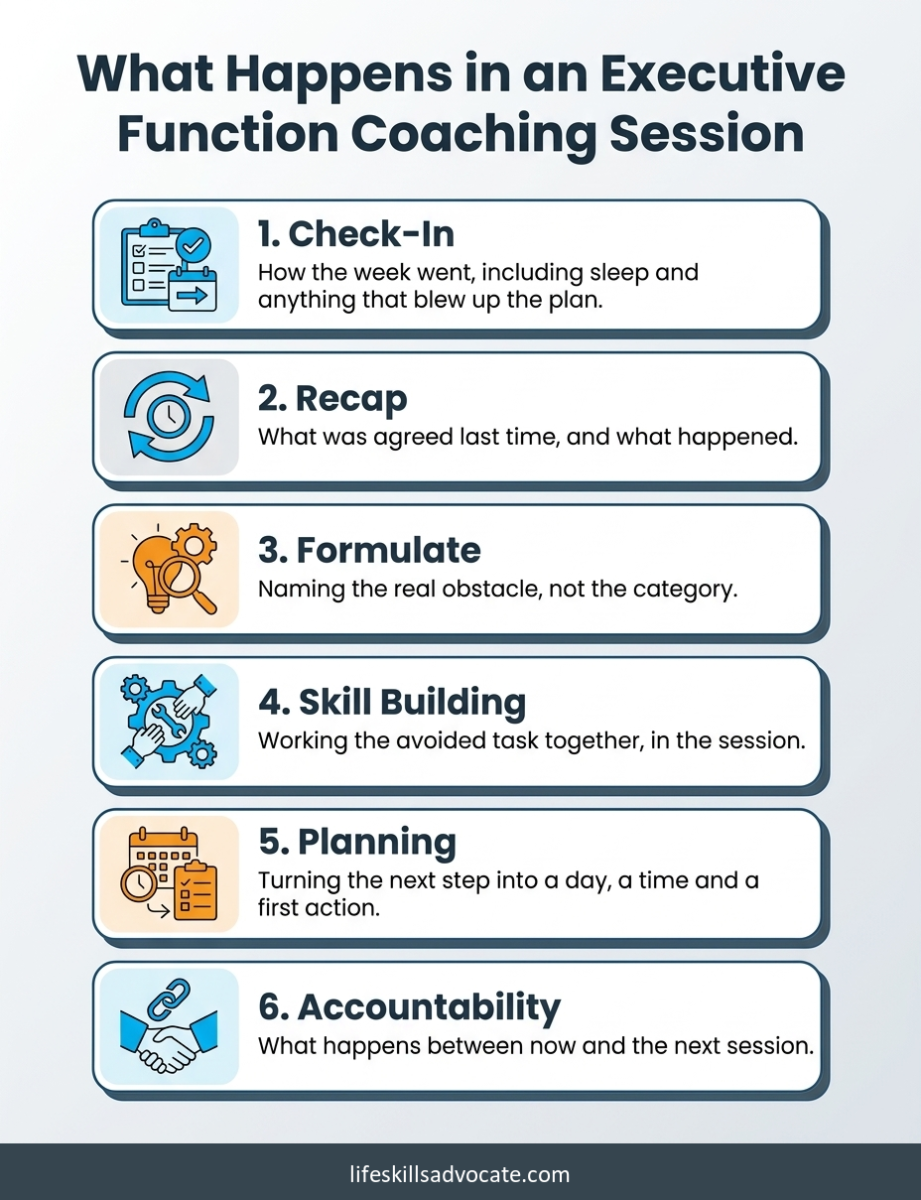
- A session is structured. Six parts: check-in, recap, formulate, skill building, planning, accountability.
- If you are a parent paying for a teen, your teen is the client, and the arrangement is worth agreeing out loud before the first session.
- Life Skills Advocate charges $220 per 50-minute session, and most people work in a three to six month stretch rather than indefinitely.
- Coaching is the wrong tool for several things, and those are named below.
This is educational, not a clinical evaluation. If you are working through ADHD or executive function difficulties with a professional, treat this as a supplement to that conversation.
What Executive Function Coaching Is, Briefly
Executive function coaching is skills and systems work. A coach helps you build the outside structure that makes a task possible: what the first step is, when it happens, what it looks like on a calendar, and what happens when the plan meets a Tuesday that goes sideways.
It is not therapy, not tutoring, and not a medical service. Life Skills Advocate sorts this work into 11 executive function skills, the set our resources use rather than a list every researcher agrees on. Most coaching touches two or three of them at a time.
Who Executive Function Coaching Suits, Including Parents Paying for a Teen
Executive function coaching suits a wider range of people than the marketing suggests, and a narrower range of situations. The person matters less than the moment.
If You Are Looking for Yourself
You do not need a diagnosis, a referral, or any documentation to start. Coaching works from the difficulty you can already see in your week, so “I keep missing deadlines I care about” is enough of a starting point.
If what is in the way right now is a crisis, a safety concern, or untreated trauma, a licensed clinician is the right first call, and coaching can follow.
Beyond that, the better predictor is not motivation or severity. It is whether you have any room in the week to try something between sessions. Two people with the same difficulty get different results when one of them has forty free minutes on a Wednesday and the other does not.
If You Are a Parent Paying for a Teen or Young Adult
This is the arrangement almost nobody spells out, so here is how it works at my practice and at most others.
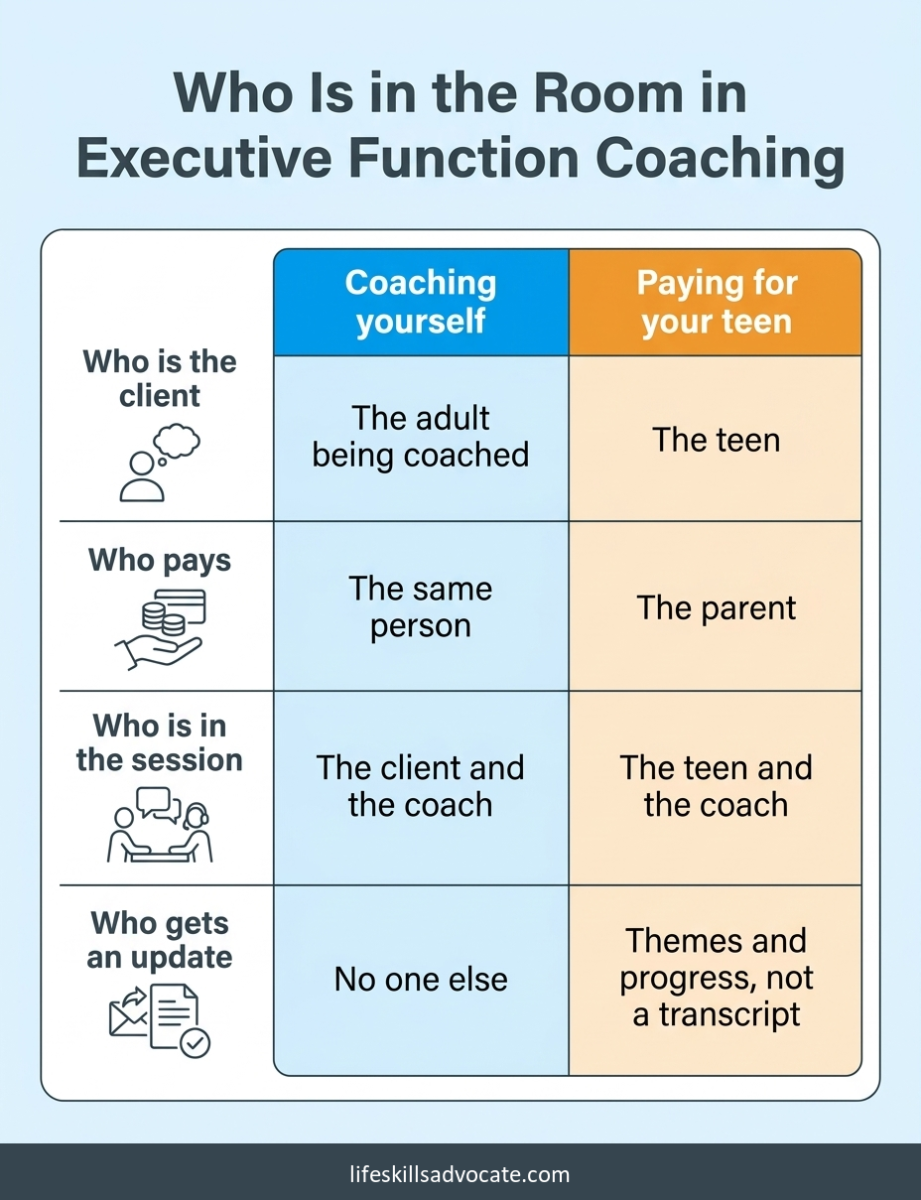
Your teen is the client. You are the payer. Those are two different roles, and coaching goes better when both have been said out loud before the first session.
What that looks like: the sessions belong to your teen, and a parent is not usually in the room, though the first ten minutes of an intake often include everyone. Between sessions you get themes and progress rather than a transcript, meaning what is being worked on, what got done, and where the friction sits.
What your teen says about you stays in the session, and I tell them so in the first meeting. A 16-year-old who thinks the hour is a report card will manage the hour instead of using it.
If your teen does not want coaching, say that when you book. It changes what the first month is for.
An ambivalent teen and an eager one can both end up somewhere good. What differs is that the ambivalent one needs the early sessions to be about something they picked, even if it is a driving test or a group chat they have been avoiding, rather than the chemistry grade you picked. Coaching cannot supply the wanting. It can make the first step small enough that the wanting matters less.
What Changes at Different Life Stages
The six parts of a session below are the same whoever is in the chair. What changes is the material: a high schooler is working on assignments and a backpack, a twenty-four-year-old is working on rent and a commute, and an adult at forty is often working around a job that will not move.
- Executive function coaching for high school students tends to sit alongside school, so an IEP or 504 and a teacher’s expectations are usually in the room even when nobody from school is.
- In college, the problem is usually the shape of a semester: long gaps with no checkpoints, then everything due at once. That is what executive function coaching for college students is built around.
- Launching is its own kind of work, so executive function coaching for young adults is rarely only academic. First jobs, appointments, and moving out land in the same month.
- Later on the constraint is usually other people. Executive function coaching for adults has to fit around a job and around anyone who depends on you, so the plan has to work in a week you do not control.
Where Coaching Is the Wrong Tool
Every method has a shape, and the shape rules some situations out. Executive function coaching runs on a schedule, works between sessions, and measures progress in months. Those three facts are what make the list below, and none of them are about the person asking.
- It cannot be the thing you call in an emergency. Sessions are booked in advance, so crisis support has to come from somewhere with on-demand coverage.
- When safety is the immediate concern, including aggression toward self or others, that needs a clinician and often a team, not a coaching hour.
- Mental health difficulty and substance use are not disqualifiers, but coaching sits alongside professional care rather than standing in for it. If that care is not in place yet, put it in place first.
- The timeline is months. A single session can produce one useful system; it will not resolve a pattern that took years to build.
- The method depends on trying things between sessions. If this season genuinely has no room for that, the timing is wrong even when the fit is right.
- It is not supervision or respite care. A coach is not in the house and cannot make anything happen while you are at work.
- It depends on regular contact. If the schedule cannot hold a consistent slot for a few months, the money does not do much work.
Inside an Executive Function Coaching Session
The question underneath “is executive function coaching worth it” is usually a narrower one: what am I buying for that hour. No page I read while researching this article answers it, which is strange for an industry charging by the session, so here is the shape of mine.
- Check-in. Five minutes on how the week went, including sleep, illness, and anything that blew up the plan. This is not small talk; it decides what is realistic for the next forty minutes.
- Recap. What did we agree to last time, and what happened. Counting what did get done matters here, because most people arrive with a tally of only the misses.
- Formulate. Naming the actual obstacle. “I did not do the expense report” and “I could not find the receipts” are different problems with different fixes.
- Skill building. Working the thing itself, in the session.
- Planning. Turning the next step into something with a day, a time, and a first physical action.
- Accountability. Agreeing what happens between now and next session, and what the check-in looks like.
The fourth part is where the difference between coaches shows up, so it is worth being specific.
Skill building is the part people picture as advice, and it usually is not. If the thing you have not done is a twenty-minute email to your landlord, that block is often the two of us opening the email, setting a timer for eight minutes, and writing the first sentence while I stay on the call and say nothing.
Other weeks it is stacking the new step onto a routine that already runs on its own, or working out why one specific task keeps getting skipped when its neighbors do not.
The reason is mechanical. If starting was the hard part, a better system for finishing solves the wrong problem, and being told to try harder does not touch it. That is the complaint people voice most often about coaching that did not work for them, and it is a fair one.
The planning block usually produces something written down. Ours often looks like the free SMART goal setting worksheet, which is the same tool we hand clients in a first month.
If that hour sounds like the thing that has been missing, executive function coaching for adults is where the discovery call lives.
How to Choose an Executive Function Coach
How do you tell a good coach from a confident one? Mostly by what they say when you ask something specific.
If you are still deciding which kind of coach to look for, our guide on choosing an executive function coach vs an ADHD coach (and where a generic life coach fits) sorts that out first.
There is no state license for this work. The certifications that exist are voluntary, they vary in rigor, and a coach can hold none of them and still be excellent, or hold several and still be wrong for you. That puts the weight on the conversation rather than the credential wall. (If you are reading this because you want to become a coach rather than hire one, the certification programs worth comparing are covered separately.)
Interview more than one person. Then ask these eight questions on the inquiry call:
- Do you have experience with people whose executive function difficulties look like mine?
- What is your specific training in this area?
- What is your track record with clients who wanted to accomplish something similar to what I want?
- How would you describe your coaching style? Hands-on and directive, or collaborative and client-led?
- What is your policy for rescheduling or cancelling a session, and what happens if I miss one?
- What tools do you use to track progress and outcomes?
- What is your availability, do you meet online or in person, and how often?
- What are your fees and payment policies?
Two of those separate coaches more than the rest.
On question one, a strong answer is specific and bounded: the population they work with most, and the kind of difficulty they refer out. An answer that claims every age and every difficulty, with no limit named anywhere, is telling you something.
On question four, there is no right style, only a matching problem. What you want is a coach who can describe their style concretely enough that you can picture disagreeing with them. “Collaborative” on its own is a word, not an answer.
Notice how the call feels, too. You are going to tell this person about the things you have been avoiding over and over, month after month, so whether you can picture admitting a bad week to them is real information rather than a soft consideration. Coaches who are good at the work are usually easy to be unimpressive in front of.
What Executive Function Coaching Costs
Executive function coaching is nearly always private pay. Life Skills Advocate charges $220 per 50-minute session, and most engagements run three to six months rather than open-ended, which is the number that matters more than the hourly rate. Prices are approximate and can change, so check the current figure on our session pricing page before you budget.
Rates across the field vary widely by experience and format, and a fuller breakdown of what executive function coaching costs in practice is worth reading before you compare quotes.
Insurance rarely covers coaching directly. An FSA, an HSA, an employer benefit, or a grant can lower what you pay, and our guide to financial aid for coaching walks through each route.
Ask one more thing on the inquiry call: are messages between sessions included, or billed separately? Coaches split about evenly, and it is the line item people are most often surprised by.
Where the Evidence Stands
The research base for non-medication support in ADHD is genuinely mixed, and anyone quoting you a success rate is going beyond what the published evidence can carry. That is a reason to judge a coach on their process rather than their outcome claims, not a reason to skip coaching.
| Finding | What it means | Source |
|---|---|---|
| A 2023 meta-review of 231 systematic reviews concluded that evidence for the efficacy of non-medication approaches in ADHD is mixed, and named it an open research gap. | Nobody selling executive function coaching can promise you a proven outcome. Ask how progress will be measured instead. | Chaulagain et al., European Psychiatry (2023) |
| ADHD affects roughly 2.5% of the general adult population and frequently co-occurs with mood and anxiety difficulties. | Adult executive function difficulty is common, and a coach should be able to say plainly when something belongs with a clinician instead. | Katzman et al., BMC Psychiatry (2017) |
| A 2022 UK expert consensus found university students with ADHD face poor educational outcomes and long waits for specialist support. | For a student, the delay in getting formal support is often the reason a family looks at private coaching at all. | Sedgwick-Muller et al., BMC Psychiatry (2022) |
| In 103 people scanned repeatedly between ages 5 and 32, several white matter pathways kept maturing past adolescence into the twenties. | A 19-year-old who “should have figured this out by now” is still inside the developmental window, which is worth knowing before writing off a young adult. | Lebel and Beaulieu, Journal of Neuroscience (2011) |
Frequently Asked Questions About Executive Function Coaching
Do I need a diagnosis to work with an executive function coach?
No. Coaching is not a medical service, so there is no diagnosis, referral, or paperwork requirement to start. If you are in crisis or dealing with untreated trauma, see a clinician first.
How long does executive function coaching take to work?
Most people notice something small within the first month, and twelve weeks is the mark we give for a change that holds. That is an expectation rather than a promise, and the range around it is wide enough that it is worth watching for your own early signs that coaching is working rather than trusting the average.
The useful early signal is not whether you feel better. It is whether the between-session steps are getting done more often than they were, and whether the two of you are working on a named problem rather than a general wish to be more organized.
If neither has shifted by session five or six, say so directly. Sometimes that conversation repairs the fit, and sometimes it tells you this is the wrong coach or the wrong season, which is worth learning at session six rather than session twenty.
Can coaching help a teen who does not want it?
Sometimes, and less than a parent would hope in the first two months.
A teen who is not interested will usually cooperate with the logistics and withhold the part that makes coaching work, which is telling the truth about what got skipped. The workaround is not persuasion. It is starting on something the teen chose, however unrelated it looks to the grades that prompted the call.
If your teen is actively opposed rather than lukewarm, spend the first month’s fee on one conversation with them instead, which our walkthrough on talking to a teen who is not bought in covers step by step.
Is executive function coaching covered by insurance?
Rarely. Insurers generally treat coaching as a non-clinical service, so it usually falls outside plan coverage, and that is worth confirming before you count on reimbursement.
The routes that do work more often are pre-tax and employer accounts. An FSA or HSA will sometimes reimburse coaching, and many coaches will provide an invoice or superbill for you to submit, though approval depends on your plan administrator rather than the coach. Some employers fund this kind of support through an employee assistance program or a wellness benefit, which is worth asking HR about before you assume it is out of reach.
Grants and sliding-scale spots exist too. Our guide to financial aid options for coaching covers each route in more detail, including which ones need documentation.
What is the difference between an executive function coach and a therapist?
A therapist is licensed and works on mental health. A coach is not licensed and works on skills, systems, and what happens between Tuesday and Thursday. Plenty of people see both, and good coaches refer out when what surfaces belongs in a therapy room. If you are weighing the two, coaching, therapy, or a combination goes deeper on the distinction.
Next Steps
The decision usually comes down to one question you can answer today, before spending anything.
- Name the friction. Write down the single thing that has gone undone longest. Not a category like “organization,” but the actual item. That sentence is what a good inquiry call starts from.
- Check the week for room. Look at the next month and find whether there is a recurring hour, plus a little space between sessions. If there is not, the timing conversation is the useful one.
- Book two calls, not one. Take the eight questions above to both, and notice which conversation you would rather have again.
- If it is a fit, start. Discovery calls for executive function coaching are free, and no diagnosis or referral is needed to book one.
Further Reading
- A systematic meta-review of systematic reviews on ADHD – Chaulagain et al., European Psychiatry
- Adult ADHD and co-occurring conditions: clinical implications of a dimensional approach – Katzman et al., BMC Psychiatry
- University students with ADHD: a consensus statement from the UK Adult ADHD Network – Sedgwick-Muller et al., BMC Psychiatry
- Longitudinal development of human brain wiring continues from childhood into adulthood – Lebel and Beaulieu, Journal of Neuroscience
- What Is Executive Functioning? – Life Skills Advocate
- What Coaching Costs, Provider by Provider – Life Skills Advocate
- Coaching vs Therapy: Which One Do I Need? – Life Skills Advocate
- Best Executive Functioning Coach Certification Programs – Life Skills Advocate
- Financial Aid for Coaching – Life Skills Advocate
- Coaching Session Pricing – Life Skills Advocate
- How to Talk to Your Teen About Coaching Who Isn’t Bought In – Life Skills Advocate
- Measuring Progress: Signs That Executive Function Coaching Is Working – Life Skills Advocate
- Executive Function Coaching for Adults – Life Skills Advocate
- Executive Function Coaching for Young Adults – Life Skills Advocate
- Executive Function Coaching for College Students – Life Skills Advocate
- Executive Function Coaching for High School Students – Life Skills Advocate
- Book a Discovery Call – Life Skills Advocate
- Free SMART Goal Setting Worksheet – Life Skills Advocate