
Most executive function coaching in the United States runs somewhere between about $115 and $265 for an hour of one-on-one time. That is the real range. The frustrating part is how hard it is to find, because plenty of coaches will not put a number on their website at all.
If you are an adult with ADHD paying for this yourself, or a parent covering it for a teen or young adult, the gap between “I just want to know the price” and “please book a call to learn more” gets old fast. You are trying to make a normal budgeting decision, and the market makes it feel like buying a car.
So here is the transparent version. Every provider below is shown on the same footing, cost per hour of actual one-on-one time, including our own rate, so pricing models that normally do not line up can finally be compared side by side. And because price is the thing that stops most people, we spend real time on how to pay less.
What EF Coaching Costs, and the TL;DR
Sorting out what executive function coaching will cost you is harder than it should be, partly because half the providers hide the number. This guide answers:
- What does executive function coaching cost per hour once you compare providers on the same terms?
- Why do so many coaches make you book a call before they will name a price?
- Can you use an FSA, HSA, or your employer’s benefits to bring the cost down, and how?
- Is it worth it, and how do you tell a genuinely skilled coach from an expensive letdown?
- How does the cost stack up against therapy, tutoring, or a one-time evaluation?
This article is for information, not financial or medical advice. Coaching prices change often, so confirm the current number with any provider before you commit.
What Executive Function Coaching Costs Per Hour
The reason executive function coaching cost is so hard to pin down is that every provider prices it differently. Some quote a session (of varying length), some a month, some a full year, and some only “starting at” a figure that few people actually pay. To compare them at all, you have to convert everything to one unit: cost per 60 minutes of one-on-one coaching. Where a provider only lists a monthly rate, the table below assumes about four sessions a month.
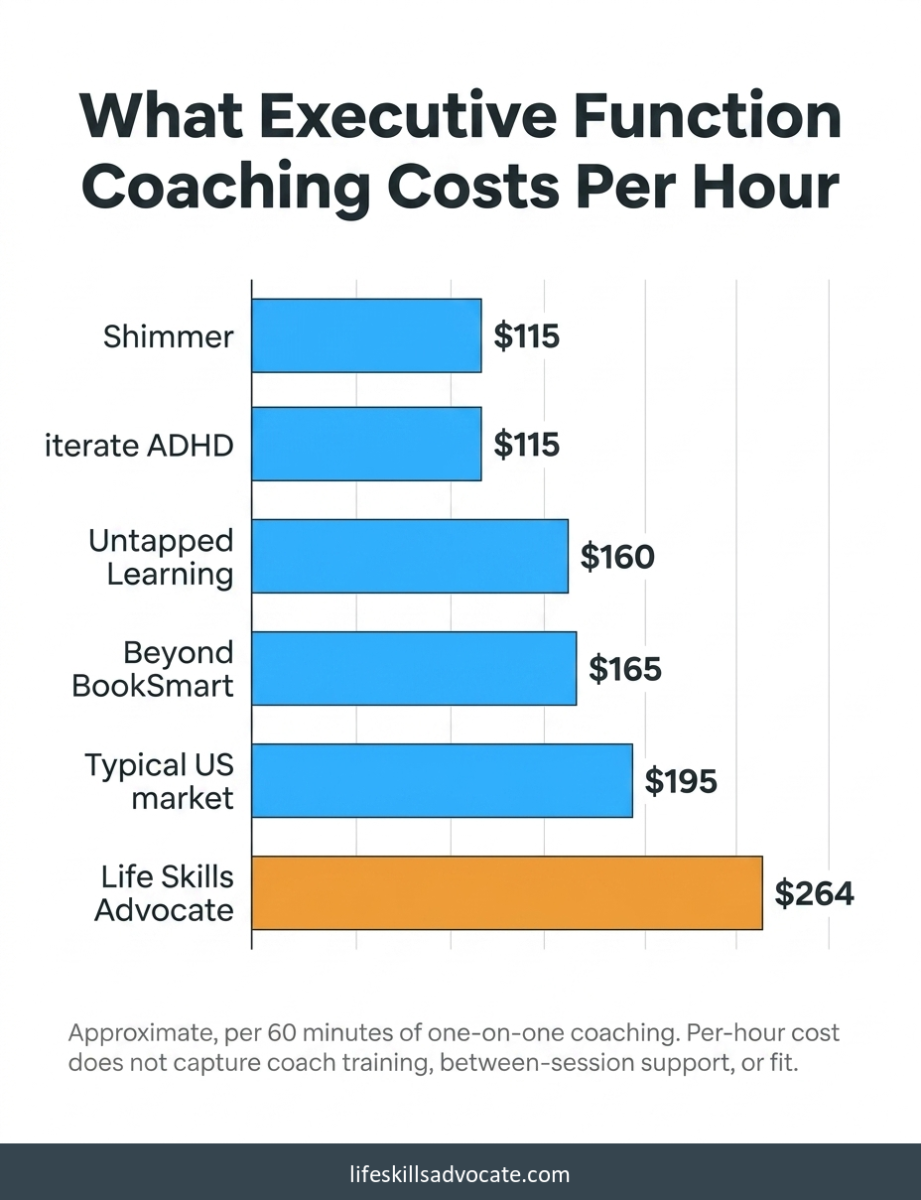
| Provider | Public price | Cost per hour of 1:1 | What you get |
|---|---|---|---|
| Shimmer | $230/mo (weekly 30-min) | ~$115/hr | App-based, lighter-touch weekly 1:1 |
| iterate ADHD | $115 / 60-min | ~$115/hr | Solo coach, no packages, email between sessions |
| Untapped Learning | $583–$717/mo (1 hr/wk) | ~$145–$180/hr | Full-service, same coach, parent updates |
| Beyond BookSmart | from $124 / 45-min | ~$165/hr and up | Pay-as-you-go or prepaid; adults routed to a sister brand |
| Life Skills Advocate | $220 / 50-min | ~$264/hr | Specialized EF, weekly accountability, neurodivergent coaches; teens through adults (14+) |
| Typical US market (Science Works, 2026) | $170–$225/session | ~$170–$225/hr | Aggregate across many providers |
| New Frontiers, Kaizen, Edge, Parallel, EF Specialists | Not published | Not shown | Price shared only after a call |
Prices are approximate and as of July 2026; they change often, so confirm the current number on each provider’s page before you decide.
A per-hour figure is one lens, and it is a useful one, but it flattens real differences. It cannot see a coach’s credentials, whether there is any support between sessions, or whether the coach genuinely understands how a neurodivergent brain works. Read the “what you get” column next to the number, not just the number.
Where does that put us? At the premium end. Our roughly $264 an hour sits inside what Science Works Health calls the specialized executive function tier ($200 to $350 and up for a coach with an advanced degree), and it is above the general market average. We would rather you know that up front than have you find out later.
The two cheapest options on the list are also structurally different. Shimmer is app-based and lighter touch; iterate ADHD is a solo coach working internationally. Neither is a direct swap for full-service one-on-one coaching in the US.
Age fit matters too. Beyond BookSmart routes adults to a separate sister brand, and our own coaching works with neurodivergent teens and adults, roughly 14 and up, so check that a provider actually serves your age group before you compare on price.
Cheaper per hour is not the same as more help per dollar. That is the whole point of the section below.
What Changes the Price of Executive Function Coaching
The cost of executive function coaching is not one fixed number handed down from above. Four things move it, and most of them are dials you can turn to build a plan that fits your budget rather than reasons a coach charges more.
Session length. A 30-minute check-in costs less than a full 60-minute session. Shorter sessions more often can keep momentum without the full price of a long one.
Frequency. Weekly is the common starting cadence because executive function skills are built through repetition, but every-other-week costs half as much per month and works for some people once routines are in place.
How you pay. Pay-as-you-go costs more per session but lets you stop anytime. Prepaid packages usually carry a discount but ask for money up front. Neither is better; they trade flexibility for savings.
Who the coach is. A general life coach sits at the low end (roughly $75 to $150 a session, per Science Works). A certified ADHD coach runs higher, and a specialized executive function coach with an advanced degree sits at the top. You are paying for training and fit, and for some people the specialist is worth it while for others a lighter option is plenty.
If money is tight, you have more control here than the sticker prices suggest. A shorter session, every other week, paid one at a time, is a completely different monthly number than a weekly hour on a prepaid package. If you want the bigger picture of what the work involves before you price it, our guide to executive function coaching walks through what actually happens in sessions.
How Long Do People Work With an Executive Function Coach?
Cost per hour is only half the math. The other half is how many hours, spread across how long. Here is what that looks like across our own clients.
Most people meet with a coach about once a week. A typical engagement runs somewhere around three to six months, which usually works out to between ten and twenty-five sessions. Plenty of people sit on either side of that:
- A few weeks to a couple of months for one specific bottleneck: a single system to set up, one deadline to get through, one habit to get going.
- Three to six months for the common case: building a handful of executive function habits until they hold up on their own.
- Six months to a year or more for bigger stretches, like a move to college or a first job, or when the thing someone came in for turns out to sit on top of a deeper skill.
That last one is worth slowing down on, because it is the part most people do not see coming.
Often the goal someone starts with is not where the real work ends up. Someone books coaching to catch up on late schoolwork, and a few weeks in we find the thing in the way is learning how to ask for accommodations and how to navigate that process. The schoolwork still gets handled.
There is just a skill sitting underneath it that is worth building, and that underneath skill is usually where the change that sticks comes from. When that happens, what looked like a two-month engagement becomes five or six, and that is usually the good version of events.
You have some say over the length:
- Cadence. Weekly keeps momentum up and tends to get there in fewer total months. Every other week lowers the monthly cost but usually adds time.
- Scope. One clear, contained goal wraps up faster than a whole season-of-life transition with several moving parts.
- A plan to taper. A good coach is working toward you not needing them. As your systems start holding on their own, sessions get less frequent and then stop.
For your budget, that means taking the per-hour range above, multiplying by how often you meet, and spreading it across the months you expect to go. A focused three-month run at a weekly cadence is a very different total from an open-ended year, and both are normal. The next section covers the levers that bring either number down.
How to Pay Less for Executive Function Coaching
Here is the part almost no other pricing page will tell you, and it is the piece readers ask about most. Health insurance rarely covers coaching directly, because coaching is not a medical service. That is the ceiling. But there are several real ways people lower what executive function coaching actually costs them, and most of them go unused simply because nobody explains them.
Use FSA or HSA dollars
If you have a Flexible Spending Account or Health Savings Account, you are already setting aside pre-tax money for health-related expenses. In many cases that money can go toward coaching, which effectively discounts it by whatever your tax rate is. The path usually looks like this: your own doctor writes a Letter of Medical Necessity explaining that coaching supports a diagnosed condition, you pay the coach, and you submit the invoice to your FSA or HSA administrator for reimbursement.
Two caveats. First, this is your doctor’s call, not the coach’s. The medical-necessity determination comes from your medical provider, because a coaching practice like ours does not diagnose, treat, or bill insurance. We are private-pay.
Second, plans differ, so confirm with your administrator before you count on it. When it works, it is one of the biggest levers available.
Check your employer’s benefits
Two workplace benefits often cover this and rarely get connected to coaching. An Employee Assistance Program (EAP) sometimes reimburses a set number of coaching or counseling sessions per year. Separately, many jobs offer professional-development or learning funds that can apply when coaching supports work performance, which for a lot of adults with ADHD it directly does. It takes one email to your HR or benefits contact to find out.
Ask about grants and lower-cost formats
Nearly every private-pay provider will point you to your own FSA or HSA dollars, but that is your money, not aid. Genuine financial aid, actual grant money that lowers the bill, is rare in this field, a few scholarship-based nonprofits aside.
LSA is one of the few private coaching providers with a real path to it: we help qualifying Washington State adults access a Canopy Neurodiversity Foundation grant through our financial aid options, which can cover part of the cost. It is worth asking any provider whether something similar exists in your area.
Beyond grants, you can lower the number by choosing a lower-cost format: group coaching (often $100 to $250 a month), an ADHD coaching app, or fewer and shorter sessions. Sliding-scale pricing exists at some practices but is not universal, so ask rather than assume.
One low-stakes way to test fit before spending anything: many practices, ours included, offer a free discovery meeting. It will not lower the eventual price, but it does let you find out whether a coach is right for you before any money changes hands.
Is Executive Function Coaching Worth the Cost?
The most useful thing we can tell you about whether executive function coaching is worth the cost is this: it depends far more on the coach than on the price. The people who describe coaching as life-changing almost always describe a specific coach who got them. The people who describe it as a waste almost always describe a coach who told them to “just try harder,” which is the least helpful thing anyone can say to a brain that struggles with task initiation.
Weigh it against the ADHD tax
Executive dysfunction has a running cost most people never add up: late fees, the thing you already own but bought again because you could not find it, the deadline that cost you a bonus, the deposit lost to a missed cancellation, the course dropped and paid for twice. We call it the ADHD tax, and it recurs every month.
Coaching is not a magic eraser, but building the underlying skills tends to shrink that recurring bill over time. For a one-time comparison, a full neuropsychological evaluation runs $2,000 to $4,000, and several months of coaching often lands in similar territory while continuing to pay off after it ends.
The returns you can’t put a number on
Some of what coaching gives back does not convert to dollars, and we are not going to pretend otherwise: confidence, independence, less shame about how your brain works, relationships that stop taking the hit for the disorganization. Naming those plainly is more truthful than inventing a return-on-investment figure for them.
If you want a way to weigh it, skip the spreadsheet and ask yourself one question: what would it be worth to you to reliably start the thing you have been avoiding, or to stop losing a specific amount of money and time every month? That answer is personal, and it is the one that matters.
What You Get With a Life Skills Advocate Coach
Since the coach is the variable that decides whether coaching is worth it, here is what you get with a Life Skills Advocate coach, and why each piece changes what your money buys.
Lived experience. Our coaches are neurodivergent themselves, and we match you with one who shares your kind of experience. You skip the part where you explain or defend how your brain works, so trust arrives in the first session instead of months in, and trust is what makes you willing to try the hard thing. Parents of a resistant teen tell us the fastest way to get their kid to open up is knowing the coach gets it.
Support built around your nervous system. Strategies only work when you are regulated enough to reach them, so our coaching is built around that, not a list of tips. A good plan collapses the moment overwhelm hits, so if a coach only shows up for the scheduled hour, one hard day becomes a lost week. Ours keep an open line between sessions, so a rough patch does not undo your progress, and your family is not left doing the reminding.
Respect for how demand avoidance works. A lot of neurodivergent people, especially those with a strong drive for autonomy, shut down the second something feels like an external demand or a “do it because I said so.” A coach who answers that by checking up on you and pushing harder triggers the shutdown, so you end up paying to resist your own coach. We work with your motivation instead of monitoring you, no surveillance and no nagging, so the accountability holds instead of backfiring.
The whole picture, not just school or work. Executive function does not stay in one lane. It shows up in sleep, in whether you ate today, in hygiene on the low days, in burnout, in how you talk to the people you live with. Fix the calendar while you are running on no sleep and it just falls apart again, so we look at the whole picture, which is what makes the change hold.
Coaching shaped around your life, not a package. The work happens in real life, not just as a conversation about strategy: we build your actual weekly schedule or start the task you have been putting off, together, so the skill sticks to your real week. Session length is flexible, even short and frequent if that suits your brain, and billing does not lock you into a subscription or package, so you pay for what helps.
If you want the fuller version of how we work and who your coach would be, you can explore the Life Skills Advocate difference.
One young adult we worked with had left college twice before they came to us, stuck in the same loop of falling behind and shutting down. Over several months of weekly sessions, they built routines that held, learned to catch the exact moment a task stalled, and eventually moved into their own place and kept it running.
We share that not as a promise. Results vary, and the fit between coach and client is what makes the difference. But it is the pattern we see when the match is right, and the free discovery call is there so you can test that fit before you spend anything.
Coaching Cost vs Therapy, Tutoring, and a One-Time Evaluation
People rarely weigh coaching in a vacuum. Adults tend to compare it to therapy; parents tend to compare it to tutoring. On price, therapy and coaching are usually in the same neighborhood, which is why ADDitude describes coaching costs as comparable to therapy. They solve different problems, though: therapy tends to work on mental health and the past, while coaching builds forward-looking skills and systems.
Tutoring is usually cheaper per hour, but it is subject-specific and teaches the material, not the executive function skills (starting, planning, following through) that decide whether the material ever gets done. A one-time neuropsychological evaluation is a different kind of spend entirely, $2,000 to $4,000 up front, useful for a diagnosis but not a substitute for ongoing support. If you are genuinely unsure which one you need, our post on coaching versus therapy versus tutoring walks through the decision.
Why So Many Coaches Hide Their Prices
Part of what makes executive function coaching cost so hard to compare is simple: most brand-name providers do not publish a per-session number. Some genuinely price by package and want to scope your needs first, which is a fair reason. It still leaves you unable to compare, and that is the part worth fixing. You do not have to accept “book a call to learn more” as the only answer.
There is something a little backwards about it, too. Chasing a price you cannot see, booking calls, waiting on quotes, and holding a handful of half-answers in your head to compare later is exactly the kind of open-ended, multi-step task that executive function challenges make hard. The friction lands heaviest on the very people shopping for help with those challenges. You should not have to be good at the thing you are hiring a coach for just to find out what it costs, which is all the more reason to make a provider give you a straight number.
Four questions get you a real total on any discovery call:
- What is the per-session or per-hour rate?
- How many sessions do you recommend to start, and can I pay per session or is it a package?
- What is included between sessions?
- Do you provide documentation I can submit for FSA or HSA reimbursement?
If a provider will not answer the first one, that tells you something too. For a transparent counter-example, our executive function coaching pricing is published in plain numbers, and you can also compare structured programs in our roundup of the best EF training programs for adults.
What Life Skills Advocate Charges, and What’s Included
Since we asked everyone else to be transparent about executive function coaching cost, here is ours. We coach neurodivergent teens and adults, roughly 14 and up, from high school and college students to working adults, and coaching is $220 per 50-minute session. We usually suggest starting with about 12 weekly sessions, not because it is a locked package but because that is roughly how long it takes for new routines to hold. We are private-pay and do not bill insurance, but we support FSA and HSA reimbursement, EAP, and the Canopy grant for qualifying Washington adults, so the effective cost is often lower than the sticker.
To be clear about what coaching is and is not: it is skill-building and forward-looking, not mental health treatment, and it does not replace therapy or medication when those are needed. If it sounds like a fit, our executive function coaching starts with a free discovery meeting, whether you are an adult paying for yourself or a parent setting it up for a teen or young adult, so you can meet a coach before deciding.
The Numbers Worth Quoting
| Finding | What it means for you | Source |
|---|---|---|
| Certified executive function coaches typically charge $150 to $350 per session (2025–2026). | That is one session, not a package; specialized EF coaches sit at the top of the range. | TherapyCostGuide (2025–2026) |
| Typical US executive function coaching runs $170 to $225 per session, or $475 to $675 per month (2026). | The middle of the market for one-on-one coaching. | Science Works Health (2026) |
| A one-time neuropsychological evaluation costs $2,000 to $4,000. | A useful cost-of-alternative anchor when you weigh ongoing coaching. | TherapyCostGuide (2025–2026) |
| ADHD coaching sessions typically run $75 to $250 per hour, and fewer than 5% of coaches accept insurance. | Budget for coaching the way you would budget for ongoing therapy, and expect to pay out of pocket. | ADDitude |
| Insurance rarely covers coaching directly, but FSA and HSA funds often can. | You may be able to use pre-tax dollars, sometimes with a letter of medical necessity from your own doctor. | FSA eligibility |
Frequently Asked Questions
Why do so many executive function coaches not list their prices?
Usually because they price by package and want to scope your needs on a call first. That can be reasonable, but it makes comparison shopping hard. Ask directly for a per-session or per-hour rate, and treat a refusal as a data point.
How much does executive function coaching cost per hour?
Roughly $115 to $265 per hour of one-on-one time in the US, depending on the coach’s training and the service model. Specialized EF coaches sit at the top of that range.
How long will I work with an executive function coach?
Most people meet weekly and work with a coach for about three to six months, which tends to land somewhere between ten and twenty-five sessions. Some wrap up in a few weeks when they came in for one specific thing. Others go a year or more through a bigger transition, or when the first goal turns out to sit on top of a deeper skill worth building. How often you meet and how much you take on at once both change the length.
Can I use my FSA or HSA to pay for executive function coaching?
Often, yes. FSA and HSA funds are your own pre-tax dollars set aside for health expenses, and many people apply them to coaching. The common path is a Letter of Medical Necessity from your own doctor, then you pay the coach and submit the invoice to your plan administrator for reimbursement. Because coaching is not a medical service, the practice itself does not bill insurance or make the medical-necessity call; your doctor does. Plans vary, so confirm with your administrator before you rely on it.
Our financial aid page walks through the FSA and HSA steps, plus EAP and grant options, in one place.
Is executive function coaching worth the cost?
It depends almost entirely on the coach, not the price tag. A skilled coach who understands neurodivergence, works with your motivation instead of nagging you, and looks at your whole life (not just school or work) is what makes it worth it. A generic coach handing out tips you could have found online is not.
The clearest way to judge it for yourself is to weigh the cost against the ADHD tax you are already paying every month, then use a free discovery call to test whether a specific coach is the right fit. Cheapest is rarely the best value here, and the most expensive option is not automatically the best either.
How is executive function coaching different in cost from therapy or tutoring?
Coaching and therapy are usually priced similarly, though they do different jobs. Tutoring is often cheaper per hour but teaches a subject rather than the executive function skills that decide whether work gets done at all. A one-time evaluation is a larger upfront cost ($2,000 to $4,000) and serves a different purpose entirely.
Next Steps
- Run your own number. Pick a realistic session length and frequency, multiply it out for a month, and you will have an executive function coaching cost figure more grounded than any “starting at” price.
- Ask your benefits contact two questions: can I use FSA or HSA funds for coaching, and does our EAP or development budget cover it? One email can change the math.
- Take the free executive functioning assessment to see which areas are costing you the most, so any coaching you pursue is aimed at the right target.
- Book a free discovery meeting with a coach before you commit to anything, so you are paying for a fit you have already tested.
Further Reading
- Executive Function Coaching Cost – Science Works Health
- Executive Function Coaching Cost Guide – TherapyCostGuide
- What Is an ADHD Coach and How Much Does One Cost? – ADDitude
- FSA Eligibility for Learning Disability Treatment – FSA Store
- Understanding the ADHD Tax – Life Skills Advocate
- Coaching vs Therapy vs Tutoring – Life Skills Advocate
- The Ultimate Guide to Executive Function Coaching – Life Skills Advocate
- Best Executive Function Training Programs for Adults – Life Skills Advocate
- Executive Function Coaching Pricing – Life Skills Advocate
- Financial Aid for Executive Function Coaching – Life Skills Advocate
- Executive Function Coaching – Life Skills Advocate
- Discover the Life Skills Advocate Difference – Life Skills Advocate
- Free Executive Functioning Assessment – Life Skills Advocate