
The question “is ADHD a disability” has a short legal answer and a much longer personal one.
The short answer is yes.
Under the Americans with Disabilities Act, Section 504, and IDEA, ADHD qualifies for legal protections and accommodations.
If you clicked through anyway, it might be because a simple “yes” did not cover what you actually need to know.
What does this mean at your job? What protections does your kid get at school? Can you qualify for benefits? And why does ADHD qualify in the first place, when the people around you, and sometimes you yourself, are not sure it “counts”? The word “disability” lands differently depending on the day and who is saying it. This article is about everything that comes after the short answer.
TL;DR
The legal answer to “is ADHD a disability” is yes, but what that means depends on where you are and what you need.
- The ADA, Section 504, and IDEA recognize ADHD when it substantially limits major life activities.
- At work, employers with 15 or more staff must provide reasonable accommodations, but you have to disclose to get them.
- In school, students can get 504 plans or IEPs. In college, the process shifts to being student-initiated.
- Disability benefits (SSDI/SSI) are possible but the bar is high.
- Executive function challenges are the reason ADHD qualifies. Whether you personally use the “disabled” label is a separate, valid question. Our guide to internalized ableism digs into what sits underneath that choice.
This is an overview of how ADHD connects to disability law and identity, not legal or medical advice. For anything specific to your situation, talk with a qualified professional.
The Short Answer: Yes, ADHD Is a Recognized Disability
ADHD is recognized as a disability under U.S. federal law. Three major statutes cover it: the Americans with Disabilities Act (ADA), Section 504 of the Rehabilitation Act of 1973, and the Individuals with Disabilities Education Act (IDEA).
In practical terms, “recognized” means you have legal protections. At work, you can request accommodations. At school, your child can receive a 504 plan or an IEP. In both settings, it is illegal to discriminate against someone because of their ADHD.
Roughly 6% of U.S. adults and roughly 11% of children have ADHD, making it one of the most common neurodevelopmental conditions in the country. It is not rare, it is not new, and the law is not ambiguous about it. The more useful question is what those protections look like when you actually try to use them.
What Does “Disability” Actually Mean Under the ADA?
Whether ADHD is a disability under the ADA depends on one phrase. The ADA does not list specific conditions by name. Instead, it defines disability as any physical or mental condition that “substantially limits one or more major life activities.” For ADHD, those activities include concentrating, thinking, reading, learning, and communicating.
The complicating part is that word “substantially.” It does not mean total inability. It means the condition creates a real gap between what you can do and what a person without ADHD can do in the same situation.
The “Substantially Limits” Standard
Major life activities under the ADA go beyond the obvious: working, sleeping, reading, concentrating, thinking, communicating, and learning. The law also covers “major bodily functions,” including neurological function. ADHD affects multiple items on that list at once, which is why the question of is ADHD a disability has a clear legal answer.
The standard does not require you to prove you cannot function at all. It requires showing that the condition makes things harder than they would be for someone without it. If you spend three times the mental energy to follow a conversation in a meeting, that counts. If you are putting enormous internal effort into things that look effortless from the outside, that gap between internal cost and external appearance is exactly what the law is trying to account for. (Working memory load, by the way, is the thing that makes “just pay attention” such spectacularly useless advice.)
How the 2008 Amendments Changed Things
Before 2008, qualifying as disabled under the ADA was harder than it should have been. Courts frequently ruled that people with ADHD were “not disabled enough,” especially if they had developed compensating habits. The ADA Amendments Act of 2008 changed the standard. It broadened what counts as a disability and made clear that conditions like ADHD inherently affect major life activities, even when the person has found ways to cope.
The EEOC regulations that followed broadly construe “substantially limits” and list ADHD as an impairment that affects neurological function. The question shifted from “prove how limited you are” to “does this condition affect how your brain handles everyday tasks?” For most people with ADHD, that answer is straightforward.
How ADHD Disability Protections Work at Your Job
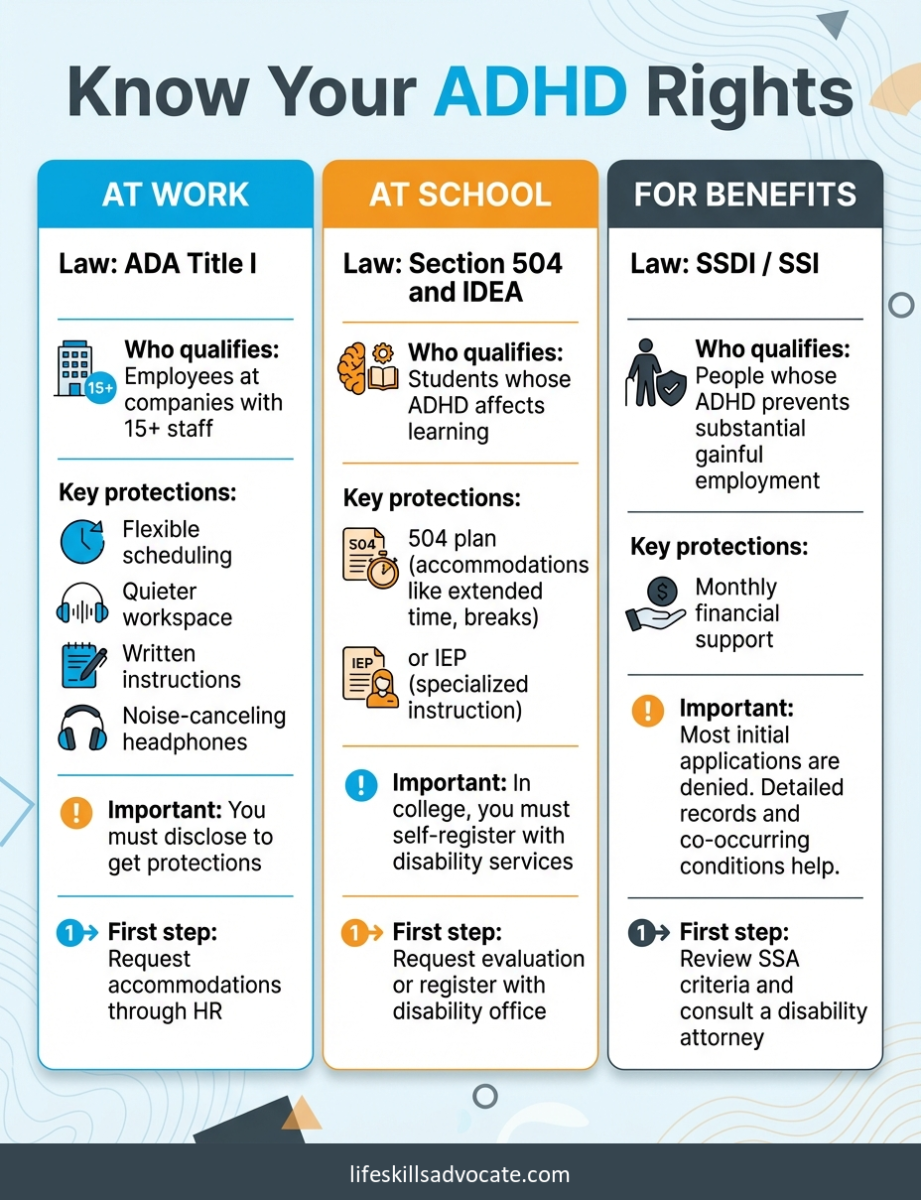
This comes up constantly: someone learns ADHD is a disability under federal law, realizes it makes work harder than it should be, but has no idea what to do with that information. ADA Title I requires employers with 15 or more employees to provide reasonable accommodations. That is not optional and not a favor.
Reasonable Accommodations You Can Request
The word “reasonable” does real work here. It means the change cannot create “undue hardship” for the employer, but that bar is higher than most people think. Common ADHD accommodations at work include flexible scheduling, a quieter workspace, written instructions, regular check-ins, and permission to use noise-canceling headphones or task management apps.
These are not special treatment.
They are adjustments that close the gap between what the job requires and how your brain processes those requirements.
The Job Accommodation Network (JAN), funded by the Department of Labor, maintains a detailed list of ADHD-specific accommodations. It is one of the best starting points if you are trying to figure out what to ask for. If the challenges you face are tied to executive function, like keeping track of deadlines or switching between tasks, our list of work accommodations for neurodivergent employees covers those specifically.
The Disclosure Decision
Here is the part nobody likes: you have to disclose your ADHD to get ADA protections. Without disclosure, your employer has no obligation to accommodate you. Disclosure does not mean handing over your full history. A note from a healthcare provider confirming ADHD and suggesting specific accommodations is typically enough.
What employers can ask is limited. They can request documentation. They cannot ask for your complete records, and they cannot use your disclosure as a reason to change your role, reduce your hours, or treat you differently.
Retaliation for requesting accommodations is illegal.
Disclosure still feels like a gamble, even when the law is clear. There is a gap between what the statute says and what happens in some workplaces. Pretending that gap does not exist would be dishonest. But the protections are real, and most people find the process less adversarial than they feared.
ADHD as a Disability in School: 504 Plans, IEPs, and College
What happens when ADHD is a recognized disability under federal law but your kid’s school says they “don’t qualify for services”? That response is more common than it should be, and it is often wrong.
Two federal laws protect students with ADHD. Section 504 of the Rehabilitation Act provides accommodations through a 504 plan for any student whose condition affects a major life activity. IDEA goes further, providing special education services through an IEP for students who need more intensive support. Under IDEA, ADHD falls under the “Other Health Impairment” category. CHADD’s Section 504 guide is a solid starting point for parents trying to understand which path fits.
The practical difference between a 504 plan and an IEP matters. A 504 plan provides accommodations like extended time, preferential seating, and breaks, but not specialized instruction. An IEP includes both accommodations and individualized teaching goals. If you want a deeper look at how these compare, our breakdown of IEP and 504 plan differences covers the full picture.
College changes everything.
The process shifts from school-initiated to student-initiated. No one is going to call you in for a meeting. If you had an IEP in high school, it does not transfer. ADHD is still a disability in college, but you need to register with the disability services office yourself, provide documentation, and request accommodations directly. That shift catches a lot of students off guard. Our guide to going to college with a disability walks through those first steps.
Can You Get Disability Benefits for ADHD?
ADHD is a disability under the ADA, but qualifying for disability benefits is a separate question with a less satisfying answer. You can apply for Social Security Disability Insurance (SSDI) or Supplemental Security Income (SSI). Whether you will qualify is a different matter.
The Social Security Administration requires evidence that ADHD prevents you from maintaining “substantial gainful employment.” That is a high bar. ADHD alone, without extensive documentation of how it limits your ability to work, is often not enough. Co-occurring conditions and detailed records from providers strengthen a claim, but the process is slow, and most initial applications for any condition are denied.
This is not meant to discourage you from applying if your ADHD genuinely prevents you from working. It is meant to set a clear expectation about what the process involves. The SSA’s disability criteria are publicly available, and a disability attorney or advocate who specializes in this area can tell you whether your documentation is strong enough to move forward.
This section is an overview, not legal guidance. The benefits process is complex enough that it deserves specialized advice for your specific situation.
Why ADHD Qualifies: The Executive Function Connection
Most articles asking “is ADHD a disability” stop at the legal answer. They confirm it qualifies under the ADA and leave it there. But knowing that ADHD is a recognized disability does not explain why it qualifies, and that “why” matters more than most guides acknowledge.
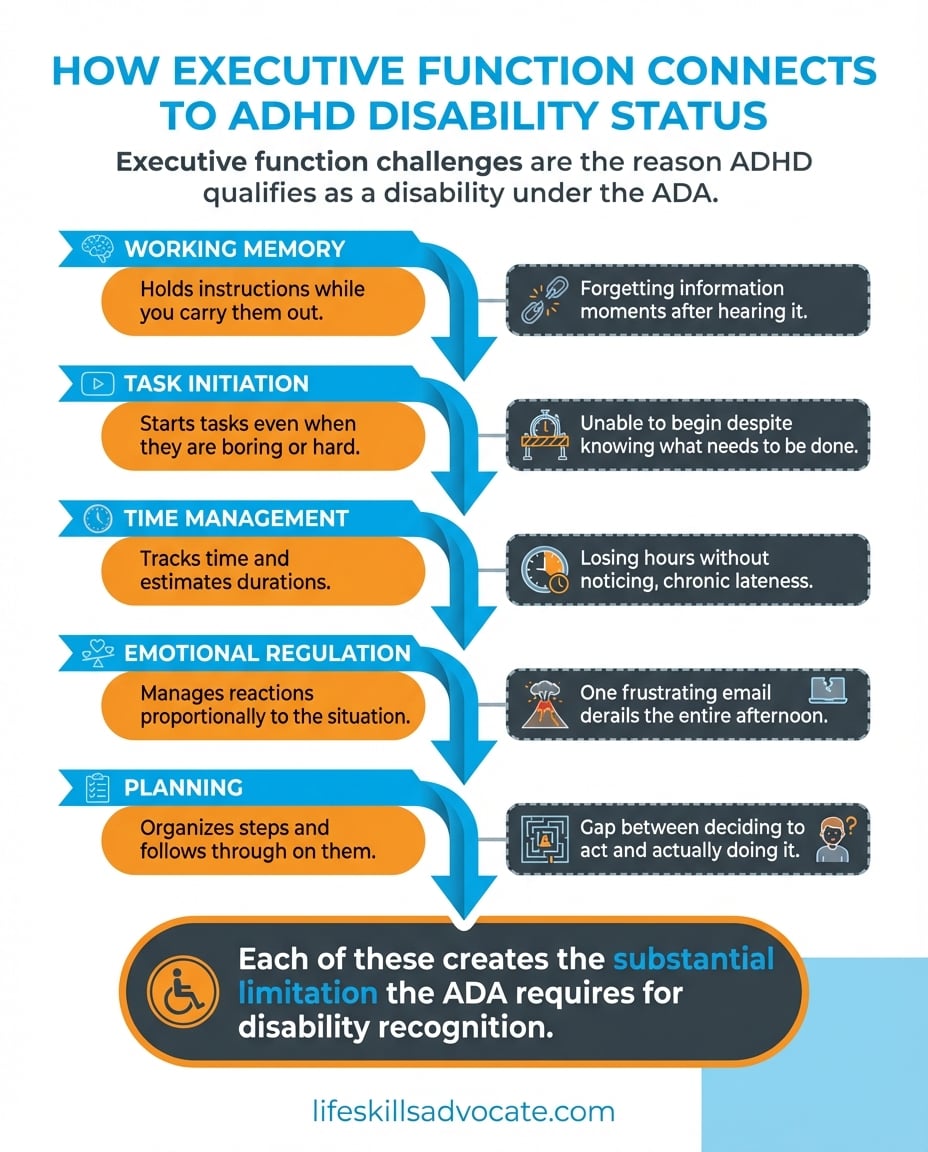
The answer is executive function. Executive function is the set of mental processes that handle working memory, task initiation, time awareness, emotional regulation, and planning. These are not nice-to-have skills. They are what allow you to start tasks, stay on them, manage your time, regulate your reactions, and follow through on plans. When these processes do not work the way the environment expects, the result is exactly the kind of “substantial limitation” the ADA describes.
Research by Silverstein and Faraone (2018) found that executive function deficits are strongly predictive of ADHD-related functional impairment.
It is not attention alone. It is the downstream effect on every system that depends on attention: memory, planning, time awareness, self-regulation. This is the functional reason ADHD is considered a disability, not just a label applied from the outside.
In concrete terms: working memory lets you hold instructions while carrying them out. Task initiation lets you start things even when they are boring. Time awareness keeps you from losing three hours without noticing. Emotional regulation keeps one frustrating email from derailing your afternoon. When these are unreliable, the effort to do ordinary things is extraordinary, and invisible from the outside.
This is the piece that explains why someone with ADHD can understand a meeting perfectly and forget half of it before reaching their desk. It is why “just use a planner” does not solve the problem. The problem is not planners. It is what happens between deciding to use one and actually opening it. If you want to understand how this gap develops over time, our article on ADHD executive age covers the research behind it.
| ADHD Disability Fact | Details | Source |
|---|---|---|
| ADA recognition | ADHD is a recognized disability under the ADA when it substantially limits major life activities like concentrating, learning, or working. | ADA.gov (1990, amended 2008) |
| School protections | Students with ADHD can receive 504 plans for accommodations or IEPs for specialized instruction under the "Other Health Impairment" category. | CHADD; Section 504; IDEA |
| Workplace protections | Employers with 15 or more staff must provide reasonable accommodations for employees with ADHD under ADA Title I. | JAN (askjan.org); ADA Title I |
| SSDI/SSI eligibility | ADHD can qualify for disability benefits if documented impairment prevents substantial gainful employment. | SSA.gov |
| Not a learning disability | ADHD is a neurodevelopmental condition, not a learning disability, though 30-50% of people with ADHD also have a co-occurring LD. | LDA America |
| U.S. prevalence | Approximately 6% of U.S. adults and 11.4% of children (2022 NSCH data) have ADHD. | APA; CDC (2022) |
Is ADHD a Disability, a Difference, or Both?
Whether ADHD is a disability, a difference, or both is the question that shows up in every online ADHD community, and nobody agrees on the answer. Some people find the word “disability” validating because it names something real and gives them access to protections they need. Others feel it reduces them to their hardest moments. Both reactions make complete sense.
The neurodiversity framework describes ADHD as a natural neurological variation, not a deficiency. Harvard Health’s overview of neurodiversity puts it plainly: neurological differences are part of normal human variation. The social model of disability takes this further. Disability arises not from the person but from the mismatch between the person and their environment. In a world designed for neurotypical brains, ADHD creates friction. In a differently designed world, much of that friction disappears.
Neither of these frameworks erases the real challenges. Executive function gaps do not stop being hard just because you have a theory that explains them. But they do change what it means to ask “is ADHD a disability.” It becomes a description of a situation, not a verdict about a person.
Here is what I think is worth sitting with: the same person can use the disability label to get accommodations at work and not think of themselves as “disabled” at home. Both can be true at the same time. The word is a tool, and you get to decide when to pick it up. What the unseen cost of executive dysfunction makes clear is that however you frame it, the internal cost is real.
Frequently Asked Questions
Is ADHD a disability or a learning disability?
ADHD is a disability under the ADA, but it is not a learning disability. They are separate categories. That said, research indicates that 30-50% of people with ADHD also have a co-occurring learning disability, so the two show up together often enough that the confusion is understandable.
Can you get Social Security disability benefits for ADHD?
You can apply, but the bar is high. The SSA requires evidence that ADHD prevents you from holding a job. ADHD alone is often not enough without clear proof of how it limits your ability to work. Co-occurring conditions and detailed records help. Most initial applications are denied, so expect appeals. A disability attorney who handles ADHD claims can make a real difference in how your case is framed.
Is ADHD always a disability under the ADA?
Not always. The ADA uses an individual standard: ADHD must “substantially limit” one or more major life activities for that specific person. Someone whose ADHD makes it hard to concentrate, manage time, or stay organized at work would likely qualify. Someone with a milder impact on daily tasks might not meet the legal threshold. This is genuinely case-by-case, which is why the process includes documentation and a conversation with your employer or school. Courts have been more willing to recognize ADHD as a disability since the 2008 amendments broadened the definition, but there is no automatic pass. Your documentation, the severity of your challenges, and how ADHD affects your daily life all factor in. The accommodation process also varies by employer and state, which adds another layer. There is no blanket answer, and anyone who tells you otherwise is oversimplifying.
Is ADHD a disability in countries outside the U.S.?
Yes, though the details vary by country. In the UK, ADHD can qualify under the Equality Act 2010 if it has a long-term impact on daily activities. Canada’s Human Rights Act provides federal-level protections. Australia’s Disability Discrimination Act covers ADHD as well. EU protections vary by member state. The underlying principle is similar internationally: if ADHD substantially affects daily functioning, most developed countries provide some form of legal recognition. This article covers U.S. law specifically.
Do I have to tell my employer I have ADHD to get workplace accommodations?
Yes. ADA protections require that your employer knows you need accommodations. You do not need to share your full history. A letter from a provider confirming ADHD and recommending specific adjustments is typically sufficient. Your employer can request documentation but cannot access your complete records or retaliate for the request.
Next Steps
So, is ADHD a disability? Yes. But knowing that and actually using the information are two different things. The gap between “I have rights” and “I know how to use them” is where most people stall.
- Check whether your workplace or school has a formal accommodations process. Most do. You do not need a lawyer to start it. Look for a disability services office (at school) or an HR accommodations form (at work).
- Protections differ by context. The legal framework is different at work, at school, and for benefits. Our breakdown of IEP and 504 plan differences covers school. The Job Accommodation Network covers work.
- Take the free executive functioning assessment to find out which EF areas create the most friction for you. That information is directly useful when requesting accommodations, and if you want structured support building those skills, executive function coaching with Life Skills Advocate can help translate the results into a plan.
- If the full process feels overwhelming, start with one thing. Name the single biggest barrier at work or school. That is your accommodation request. One specific ask is easier to make and easier to act on than a general “I need help.”
Further Reading
- Americans with Disabilities Act (ADA) – ADA.gov
- What Is ADHD? – American Psychiatric Association
- Enforcement Guidance on Disability-Related Inquiries – U.S. Equal Employment Opportunity Commission
- ADHD Accommodation Ideas – Job Accommodation Network (JAN)
- Section 504 and ADHD – CHADD
- Disability Benefits for Children with ADHD – Social Security Administration
- Executive Function and ADHD – Silverstein and Faraone (2018), PubMed
- What Is Neurodiversity? – Harvard Health
- ADHD and Learning Disabilities – Learning Disabilities Association of America
- Section 504 FAQ – U.S. Department of Education
- Individuals with Disabilities Education Act (IDEA) – U.S. Department of Education
- ADA Law and Regulations – ADA.gov
- ADHD Data and Statistics – CDC
- 20 Essential Work Accommodations for Neurodivergent Employees – Life Skills Advocate
- IEP vs. 504 Plan: What’s the Difference? – Life Skills Advocate
- Going to College with a Disability: Your First Steps – Life Skills Advocate
- ADHD Executive Age: What the 30% Rule Really Means – Life Skills Advocate
- Understanding the ADHD Tax – Life Skills Advocate
- Free Executive Functioning Assessment – Life Skills Advocate
- Executive Function Coaching – Life Skills Advocate