
A two-minute conversation goes sideways at ten in the morning, and at quarter to eleven you are still looking at the same sentence in the same document.
Nothing else happened. The work is the work it was an hour ago. Something in your body changed during that conversation and has not changed back, and if you are a neurodivergent adult you have probably already met the words for it: fight, flight, freeze, fawn.
Knowing the four names turns out to be the easy part.
The harder question, the one that decides what you do in the next five minutes, is which of the four you are in right now. Your body is doing four different jobs across those four states, and the move that helps one of them is close to the reverse of the move that helps another. Being told to breathe is decent advice for one and close to useless for the rest.
TL;DR
Fight, flight, freeze, fawn are more useful as a decision than as a set of definitions, so here is what each one changes about your next move:
- The fastest way to tell which one you are in is what your body is doing, not what you are feeling.
- Four states, four different first moves. Standard grounding advice is built for one of them.
- Freeze and fawn look almost identical to executive dysfunction from the outside, and three practical questions separate them.
- Task initiation and working memory drop during any of the four, and stress research documented the mechanism decades ago.
- Sources disagree about whether there are four, five, six, or seven of these, and “fawn” is the newest of them.
This is educational, not an evaluation. If you are working through trauma with a professional, treat this as something to bring to that conversation rather than something to replace it.
Fight, Flight, Freeze, Fawn: What Each State Describes
Fight, flight, freeze, fawn name what your body picked under pressure, not what kind of person you are.
The picking happens before you know it is happening. Your amygdala flags something as a threat. The hypothalamus passes the message on, and your adrenal glands release adrenaline and noradrenaline.
Bruce McEwen and colleagues have mapped how stress changes the amygdala, hippocampus and prefrontal cortex. The timing is the part to hold onto. The chemistry is already moving while you are still working out what was said.
Fight is your body getting ready to confront. Heat, tension across the shoulders, a shorter fuse, words sharper than the ones you meant to use.
Flight is your body getting ready to leave. Restlessness, task-switching, a sudden and specific urge to reorganize a drawer instead of answering the message.
Freeze is what happens when neither confronting nor leaving looked survivable, so the brakes came on instead. Heavy limbs, a blank screen behind your eyes, a body that will not take instruction.
The fourth, fawn, is your body trying to make you less of a target by making you more agreeable. Nodding, smoothing, saying yes to a deadline you already know is impossible.
Most people do have a default. That is different from having a type. The same person can go into fight with a sibling and freeze with a manager in the same week, because the state depends on what the body reads as available in that room, not on temperament.
How to Tell Which Stress Response You Are In
Fight, flight, freeze, fawn are straightforward to tell apart on paper. Telling which one you are in right now is harder, because the feeling arrives well before the label does, and the label is the thing you are trying to find.
Start With the Body, Not the Feeling
Emotions are slow to name and easy to misread. Body signals are faster and more specific.
A tight jaw and heat across the chest point somewhere different from heavy limbs and a blank head, even though both get described as “stressed.”
So the table below is keyed on what you would notice rather than on the four names. Read down the first column, find the row that sounds like the last ten minutes, and take the move in the last column.
| What you notice | Likely state | What your body is doing | First move |
|---|---|---|---|
| Tight jaw, heat across the chest, replies getting shorter | Fight | Getting ready to confront | Move the energy before you speak |
| Cannot sit still, cleaning instead of working, eleven open tabs | Flight | Getting ready to leave | Give the exit a time limit |
| Heavy, blank, stuck to the chair | Freeze | Neither option looked survivable, so the brakes came on | One small physical action |
| Agreeing before you have decided, watching their face for a reaction | Fawn | Trying to make you less of a target | Use a sentence you wrote earlier |
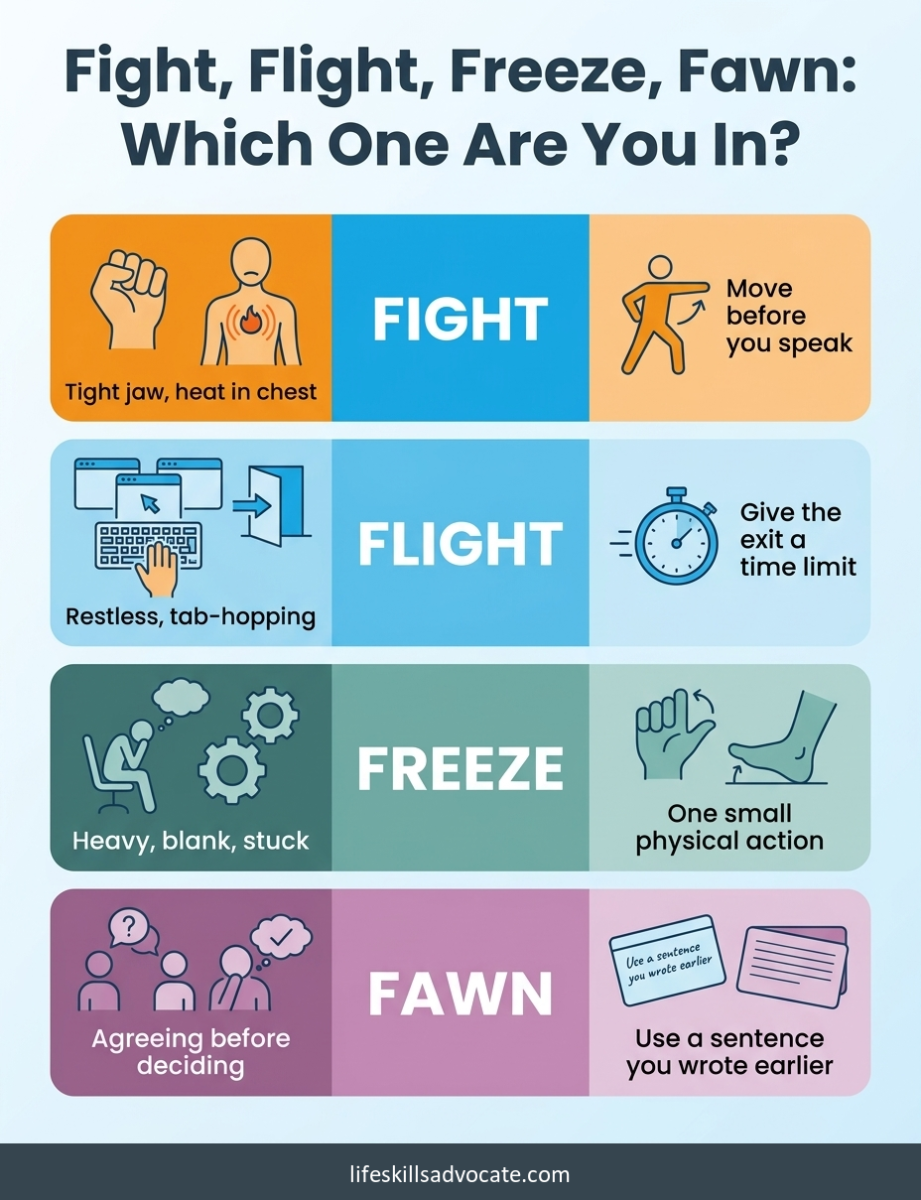
Reading your own body signals is a skill, and like most skills it gets easier with repetition. If that first column reads like a foreign language, the free How My Body Pays Attention Exercise is a short script for practicing exactly this, noticing what your body is doing before you try to name what you feel.
When Two of Them Feel True at Once
Two rows often feel true at the same time. That is common, and it usually means one of two things.
Sometimes the states are stacked, where an activated state got nowhere and settled into a stuck one, so you feel both the leftover heat and the inability to move. Sometimes it is switching, which is what a long meeting produces when you argue, give up, and start agreeing, in that order.
When two rows are live, work with the lower-energy one first.
Heat underneath a stuck body is still a stuck body, and you cannot discharge activation you cannot reach. Get one small movement back and the rest usually becomes readable.
The First Move for Each Stress Response
Fight, flight, freeze, fawn are four different preparations, and a first move works by giving the preparation somewhere to go. Which is why one piece of advice cannot cover all four: what your body is getting ready to do is different in each.
Fight: Move Before You Speak
Fight has already handed you the energy to confront. The energy is not the problem. The timing is, because the words that arrive at peak activation are rarely the ones you would pick ninety seconds later.
Put the activation somewhere physical first. Stand up, walk to the end of the hallway and back, or press your palms hard against the desk for ten seconds.
Then reply.
If you cannot leave the room, type the reply you want to send into a blank document and do not send it. The point is that the energy goes somewhere before it goes into a sentence.
Flight: Give the Exit a Time Limit
Flight makes leaving feel urgent, which is why it so often arrives disguised as productivity: a reorganized inbox, a suddenly clean kitchen, a browser you can no longer read the tabs in.
Fighting the urge to leave tends to lose. Bounding it works better.
Set a timer for eight minutes, leave properly, and come back when it goes off. A bounded exit satisfies most of what the state is asking for and costs you eight minutes instead of the afternoon.
Freeze: One Small Physical Action
Freeze is where the usual advice fits worst, because a system that has already braked does not need more stillness.
Start smaller than feels worth doing. Uncross your legs, stand up, or fill a glass of water.
The size of the action is not the point. Re-establishing that your body still takes instruction is the point, and everything else gets easier on the other side of that.
Once you are moving, a slow scan through the body is a reasonable next step, and the free Body Scan Mindfulness Activity is a two-page script for it. It works better after the first movement than before it.
When the stuck state runs for hours rather than minutes and brings a flatness that outlasts whatever set it off, you are probably looking at what a full shutdown state looks like, which is a deeper version of the same braking and needs a slower approach than anything in this section.
Fawn: Use a Sentence You Wrote Earlier
Fawn is the hardest of the four to interrupt live, for a specific reason: the state takes away the exact skill you would need, which is composing a considered sentence while someone waits.
So write the sentence earlier. Keep three of them in a note on your phone.
“Let me check my week and come back to you Thursday.” “I want to say yes, and I need to look at my calendar first.” “I don’t have an answer for you yet.”
Reading a sentence is a much lower demand than composing one, and having three ready turns a fawn moment from a negotiation into a recital. The pattern underneath it, and how it differs from ordinary agreeableness, gets fuller treatment in how the fawn response shows up day to day.
A first move is not a plan.
It buys back a few minutes of function, and it does not touch the reason the pattern is there, which for some people has roots that a note on a phone is not going to reach.
What Fight, Flight, Freeze, Fawn Cost Your Executive Function
People rarely go looking for this vocabulary because they want a definition. They go looking at two in the afternoon because they cannot work, and they want to know what fight, flight, freeze, fawn has to do with it.
Why the Thinking Part Drops Out First
The prefrontal cortex sits behind your forehead and handles the slow, deliberate work: holding a plan, weighing options, starting something you do not feel like starting.
It is also the region most sensitive to stress. Amy Arnsten’s review of stress signalling in the prefrontal cortex reports that even mild, brief, uncontrollable stress can cause a rapid loss of prefrontal cognitive abilities.
Read that again with the adjectives in view. Mild. Brief. The stress does not have to be large or long to take the planning equipment offline.
A stress state and an executive function drop are the same event described at two levels, the physiology and what it feels like at your desk.
The Skills That Go Offline
Research on executive function usually sorts it into three parts: inhibitory control, working memory, and cognitive flexibility. Life Skills Advocate sorts it into eleven skills. That is a finer-grained set built for coaching, not a competing claim about how the brain divides things up. Neither list is the definitive one, and other frameworks split them differently again.
Mapped onto the four states, the losses tend to look like this.
Fight takes emotional control and impulse control first, which is why the reply you send at peak activation is the one you rewrite later. Flight takes attentional control, so five things get started and the one that mattered is not among them.
Freeze takes task initiation and decision-making. That is the version most people recognize: you can see the task, you know how to do it, and you cannot begin.
Fawn takes self-monitoring, so your read on the other person stays sharp while your read on your own preference goes missing until about four hours later.
That mapping is our read from coaching practice, not a research finding, so hold it loosely.
What the research does support is the direction of travel. Adele Diamond and Daphne Ling’s review of what improves executive function treats it as established that stress impairs these skills, and argues from there that the approaches most likely to work will address emotional, social and physical needs rather than only drilling the skills. They present that second part as a prediction, not a settled result.
Either way, it makes steadying the body a route into executive function rather than a detour around it.
If the harder part is the executive function itself rather than the state that knocked it out, our longer piece on executive dysfunction works through the skills one at a time.
The everyday version of all this is reading the same email four times and retaining almost nothing. Your eyes work. The words are in English. Working memory is not holding them long enough to assemble a meaning.
When It Is Executive Dysfunction, Not a Stress Response
Three questions separate a stress response from ordinary executive dysfunction, and all three are about pattern rather than intensity.
How fast did it arrive? A stress response usually has an edge you can find: a message, a tone, a meeting that turned. Executive dysfunction is more often the background condition of a Tuesday, there before the trigger and still there afterwards.
The body signal test. Heat, a tight chest, heavy limbs, a pulse you can feel in your neck. Executive dysfunction tends to be flatter, more of an absence than a sensation.
The most useful of the three: take the demand away and see what happens. Cancel the meeting and a stress response generally drains within the hour. Cancel the meeting and executive dysfunction sits exactly where it was, because the task was never the threat.
These are practical separators, not an instrument, and they blur in the place they matter most, which is when both are true at once. For a lot of neurodivergent adults that is the ordinary condition rather than the exception. If the real question underneath is whether the pattern is ADHD, trauma, or both, how ADHD and trauma differ day to day works through that properly.
Why the Number of Stress Responses Keeps Changing
Ask four sources how many stress responses there are and you can get four, five, six, or seven. The disagreement is real, and it is less mysterious than it looks.
Fight, flight and freeze are the long-standing physiological set, described in stress research for decades. Fawn came later and from somewhere different. The psychotherapist Pete Walker named it as a fourth F in his 2013 book Complex PTSD: From Surviving to Thriving, describing it as responding to threat by becoming more appealing to the threat, and you can read his own account of the four F’s on his site.
That history is worth knowing for calibration rather than for skepticism. Fawn is a practitioner’s framework roughly a decade old, built from years of therapy practice. It does not carry the research base behind the first three.
It also describes something people recognize on sight. Both of those are true at once.
The rest of the counting is mostly naming. Some sources add “flop” for the collapse past freeze, or “faint.” Several UK services use “friend” for the same state Walker calls fawn. Lists of six or seven usually split one of the four rather than adding new territory.
The tidy sequence, where each state hands off to the next as a threat gets closer, is a description rather than a proven progression. A 2023 trauma-film study by Sarah Beutler and Ilona Croy found that the predicted downregulation did not follow the hyperarousal at all. Read that as directional only: 47 healthy female participants watching a film is a long way from real threat.
The routes into fawning also vary more than the usual explanation suggests. Fawn is most often explained through an abusive home, which is one real route. Years of ordinary correction, of being told you are too much or too loud or too slow, can build the same reflex, and plenty of late-identified neurodivergent adults arrive at appeasement that way rather than through anything they would name as abuse.
What the Research Says About Stress and Executive Function
| Finding | What it means | Source |
|---|---|---|
| Even mild, brief, uncontrollable stress can cause a rapid loss of prefrontal cognitive abilities | The planning-and-starting equipment goes offline during fight, flight, freeze, fawn, on a timescale of minutes rather than days | Arnsten, Nature Reviews Neuroscience (2009) |
| Stress impairs executive function; the review predicts that the most successful approaches will address emotional, social and physical needs, not only train the skills | The impairment is established. Treating the body first is a well-argued prediction rather than a settled result, so read it as a steer rather than proof | Diamond and Ling, Developmental Cognitive Neuroscience (2016) |
| “Fawn” was named by psychotherapist Pete Walker as a fourth F in 2013 | The fourth response is a practitioner’s framework roughly a decade old, not a long-established research category like the first three | Walker, Complex PTSD: From Surviving to Thriving (2013) |
| In a trauma-film study, hyperarousal was not followed by the downregulation the staged model predicts | The tidy sequence is a useful description, not a proven progression. Directional only: 47 healthy female participants | Beutler and Croy, European Journal of Psychotraumatology (2023) |
Frequently Asked Questions
Can You Be in More Than One of the Fight, Flight, Freeze, Fawn States at Once?
Yes, and it happens often enough that a single-answer version of this question would be misleading. Two states running at once is ordinary rather than unusual, and it tends to take one of two shapes: stacking and switching.
Stacking is an activated state that got nowhere and settled into a stuck one, so heat and heaviness sit together. You are furious and you cannot move, which is a confusing combination to be in and a far more common one than a four-box model makes it sound.
Switching happens across a longer episode, and the clearest example is a meeting. You push back, then you stop pushing back, then you find yourself agreeing with things you do not agree with, all inside forty minutes.
When two are live, take the move for the lower-energy one first. Getting one small movement back comes before anything else.
The rule has one gap. Fight and fawn can run together, and neither of them is the low-energy one: you are agreeing out loud while the heat sits underneath it.
There the order is set by what you can do with someone watching. Use the pre-written sentence first, because reading one is possible mid-conversation and walking off to discharge the fight energy is not. Deal with the heat after you have bought yourself the pause.
Is Fawning a PTSD Response?
Fawning shows up in trauma frameworks, including Pete Walker’s, and in accounts of complex PTSD. The reverse does not follow. Seeing yourself in a description of fawning does not establish that you have PTSD, and no article can tell you either way.
Appeasement is a common response to steady pressure of many kinds. If the question matters to you, it belongs with a professional who can look at your history.
What Is the Difference Between Fawning and Masking?
Fawning is a threat response aimed at a specific person in a specific moment. Masking is a longer-running performance aimed at a room, a workplace, or the world. They overlap constantly, and the fawn response piece takes the distinction apart properly.
Are the Four F’s of ADHD the Same as Fight, Flight, Freeze, Fawn?
Sometimes. It depends which version you ran into, because “four F’s of ADHD” is not one established framework and three different things get published under the name.
Some ADHD sites use it as a memory aid for everyday ADHD challenges: forgetfulness, fidgeting, frustration, and failure to finish. That set is about daily functioning and has nothing to do with threat.
Others use it for the four states on this page, applied to an ADHD nervous system. A third version comes from ADHD coaches writing for CHADD, who keep fight, flight and freeze and add fib as the fourth, meaning the quick untrue answer that arrives when a question lands as a threat.
The overlap people are reaching for is real, though. ADHD and autism both come with more frequent stress responses and more sensitivity to correction, plus the executive function drop described above. So fight, flight, freeze, fawn is worth knowing for a neurodivergent reader, and the recognition table works the same way whether or not trauma is part of your history.
The vocabulary on this page is borrowed from trauma work rather than native to ADHD.
How Long Does a Stress Response Last?
The acute part is short. Adrenaline and noradrenaline clear over minutes, and the sharp edge of a fight or flight state usually goes with them.
The aftermath is where a straight answer runs out. Some people are functional twenty minutes later. Others lose the rest of the day, and freeze states in particular seem to have a long tail nobody has pinned to a number.
Several things appear to move it: how much sleep you got, how recently the last one happened, whether the situation is resolved or still hanging over you, and how much the rest of the day is going to ask of you.
Research has not produced one figure, and any article offering a specific duration is rounding off something that varies a great deal between people and between episodes. If you are trying to plan around it, the more useful measure is your own pattern over a few weeks rather than a number from a study. Even that will move, because the same person recovers differently in a week with some slack in it than in a week without any.
Next Steps
Recognizing fight, flight, freeze, fawn is the part that needs setting up in advance, because you will be trying to do it at the exact moment you are least able to think. Everything below is designed to be done while you are fine.
- Write the three fawn sentences tonight and put them in a note on your phone. Ten minutes now, and it is the single highest-return item on this list.
- Screenshot the recognition table so it is available on the days you cannot hold four options in your head at once.
- Track which row you land on for a week. Most people find they have one dominant state and one that shows up only with particular people, which changes what is worth preparing for.
- For the longer game, the in-the-moment move matters less than the baseline, and there are ways to regulate your nervous system over time so that fewer situations tip you into one of these states at all.
If this is frequent enough to be shaping your weeks, two different kinds of support address two different halves of it. Therapy works on the material underneath a trauma response, which is not what coaching does. Executive function coaching works on the other half: rebuilding task initiation, planning and follow-through after the state passes, and putting routines in place that make the states less frequent. They are not interchangeable, and plenty of people use both.
Further Reading
- Stress Signalling Pathways That Impair Prefrontal Cortex Structure and Function – Amy Arnsten, Nature Reviews Neuroscience
- Conclusions About Interventions, Programs, and Approaches for Improving Executive Functions – Adele Diamond and Daphne Ling, Developmental Cognitive Neuroscience
- Stress Effects on Neuronal Structure: Hippocampus, Amygdala, and Prefrontal Cortex – Bruce McEwen, Carla Nasca and Jason Gray, Neuropsychopharmacology
- Psychophysiological Reactions During the Trauma-Film Paradigm – Sarah Beutler and Ilona Croy, European Journal of Psychotraumatology
- The 4Fs: A Trauma Typology in Complex PTSD – Pete Walker
- Complex PTSD: From Surviving to Thriving – Pete Walker
- 7 Signs You’re in Dorsal Vagal Shutdown (Not Just ADHD Burnout) – Life Skills Advocate
- 9 Signs You’re Fawning (Not Just People-Pleasing) – Life Skills Advocate
- 9 Clear Signs of Executive Dysfunction and Practical Ways to Work With It – Life Skills Advocate
- ADHD or Trauma: Daily-Life Differences Most Articles Miss – Life Skills Advocate
- How to Regulate Your Nervous System When Calm Won’t Come – Life Skills Advocate
- How My Body Pays Attention Exercise – Life Skills Advocate
- Body Scan Mindfulness Activity – Life Skills Advocate
- Executive Function Coaching for Adults – Life Skills Advocate