
The conversation ended at noon. Around nine that night, rinsing a pan, it lands: that comment hurt. Or nothing lands at all, just a tight chest, a jaw that won’t let go, and a sense that something is off without any clue what.
There is a word for that gap between feeling something and knowing what it is: alexithymia. It means having a hard time identifying and describing your own emotions, and it is especially common in autistic adults, with early signs that it runs higher in ADHD adults too. A lot of people only meet the word after years of being told they seem fine, flat, or hard to read.
Knowing the word helps. Knowing what to do at 9 p.m. with the tight chest helps more.
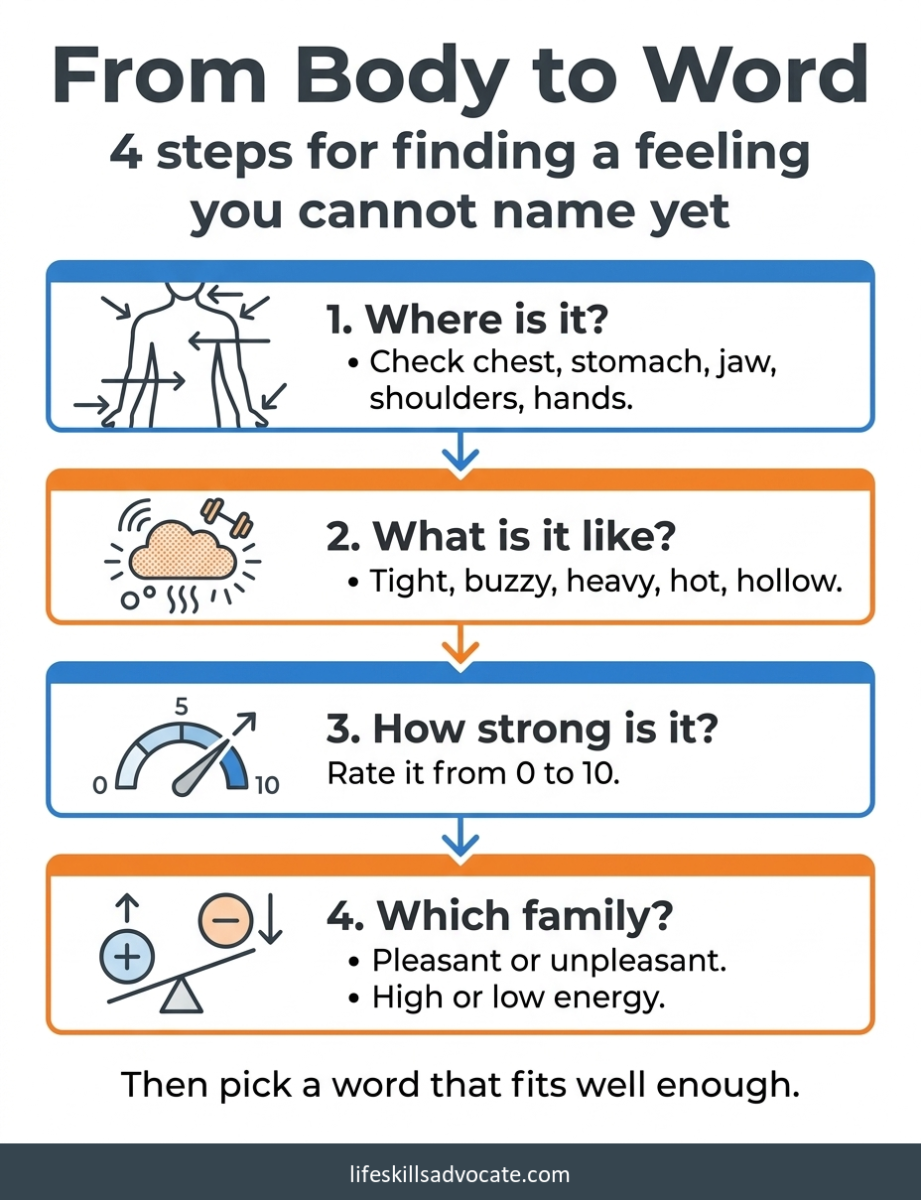
For many people, the body is an easier door than the feeling. Where does it sit? What is it like? How strong is it? The word tends to come last, and that order works.
TL;DR
Alexithymia makes feelings hard to spot and name, so the nine ways below start in the body and work toward a word in a minute or two:
- Start in the body: find where the feeling sits, describe the sensation, and rate how strong it is (ways 1-3).
- Narrow it down by sorting it into a feeling family, ruling out hunger, thirst and tiredness, and checking what just happened (ways 4-6).
- Check in on a timer instead of waiting to notice, and name feelings late on purpose (ways 7-8).
- Keep a “not sure yet” line ready for when someone asks (way 9).
This is educational, not an evaluation or a mental health assessment. If hard-to-read feelings are weighing on you, a professional who knows neurodivergence is a good person to bring this to.
What Alexithymia Means (and What It Doesn’t)
Alexithymia is a trait, not something a person either has or doesn’t. It works more like a dial than a switch: research describes how far along a range someone scores.
The Greek-born researcher Peter Sifneos coined the word in 1972. According to a history of the alexithymia concept in Frontiers in Psychiatry, it is built from Greek roots and literally means “lack of words for emotion.” The same review describes it as a personality trait that sits outside the official guidelines used to identify conditions.
Researchers usually group three things under the name: trouble identifying your feelings, trouble describing them to other people, and a thinking style that points outward, toward events, facts and tasks, more than inward. Most studies measure it with a 20-item research questionnaire called the Toronto Alexithymia Scale (TAS-20), which was built for research rather than self-checking.
The feelings still happen.
Picture plans getting cancelled at the last minute. You know you “should” feel disappointed, and when you look for the disappointment, there’s a blank, or just a restless urge to clean the kitchen.
The emotion is there. The label is what’s missing. (You may also see alexithymia called “emotional blindness,” a phrase plenty of people with the trait dislike for exactly that reason.)
Researchers Geoffrey Bird and Richard Cook have gone further. In a 2013 review in Translational Psychiatry, they proposed that some of the emotion and empathy differences long blamed on autism may track alexithymia instead. Other studies have pushed back on that idea, so treat it as a live debate rather than a settled finding.
Why Alexithymia Shows Up So Often in Autistic and ADHD Adults
If the description above sounded familiar, the next question is usually why it keeps turning up next to autism and ADHD. The answer is different for each, and the evidence is much stronger for one than the other.
About Half of Autistic People, in Pooled Studies
A 2019 meta-analysis by Kinnaird, Stewart and Tchanturia pooled studies comparing autistic and non-autistic groups. Across the nine studies that used a cut-off score, about half of autistic participants (49.93%, ranging from 33% to 63% by study) scored in the alexithymia range, compared with about 5% of the comparison groups. The authors’ own summary: common in autistic people, but not universal.
One wrinkle: these studies rely on self-report questionnaires, which ask people to reflect on their own emotions, the very thing the trait makes harder. The numbers are a useful estimate, not a precise count.
A 2020 study by Oakley and colleagues found the rate higher in autistic women (47%) than autistic men (21%) in its sample. It also found that difficulty identifying feelings was tied to anxiety, and in the people followed for one to two years, it predicted later anxiety too.
ADHD, AuDHD and the Late-Identified
The ADHD research is thinner. A 2010 study of 73 adults with ADHD found 22% scored high on the TAS-20, though the group’s average was not much above community samples. The part that stood out was “difficulty identifying feelings.” There isn’t yet a pooled analysis of ADHD studies big enough to give a reliable rate, so smaller studies are all there is for now.
AuDHD adults, who are both autistic and ADHD, have barely been studied as their own group. What shows up in community threads, again and again, is late-identified adults describing years of not being able to explain to anyone, professionals included, what was going on inside them. Many found the word only after a crisis led to an autism or ADHD identification as adults.
When the Body Signals Get Blurry
Interoception is the sense of what’s happening inside your body: heartbeat, hunger, temperature, a full bladder. In a 2016 study by Brewer, Cook and Bird, people with alexithymia struggled to recognize their own emotions and also tended to confuse them with body states like hunger, tiredness and arousal.
How strong that link is remains debated, and later research has found it varies a lot from group to group. Still, it matches what a lot of people describe: a signal arrives, and the brain can tell something is happening without being able to say whether it’s anxiety, hunger or a headache coming on.
Body awareness comes up again and again in LSA coaching conversations. Many people also find signals get even harder to read during neurodivergent burnout, when there’s less energy left for noticing anything.
How Alexithymia Adds to Executive Function Load
Alexithymia rarely shows up as a feelings problem first. It tends to show up as a getting-things-done problem, which is why it’s easy to miss.
LSA’s resources organize executive function into 11 skills (other frameworks split them differently). Four of them carry extra weight when feelings are hard to name:
- Emotional control. It’s hard to manage something you can’t see. Emotional control as an executive function skill assumes you know what you’re working with, and that first step is the one that goes missing.
- Task initiation, because unnamed dread about a task reads, from the inside, as “I just don’t want to.” From the outside it gets read as laziness. In ADHD forums, people ask how to tell the difference between not wanting to do something and an emotion they can’t recognize, and that question is the whole problem in one line.
- Problem-solving. “Go with your gut” assumes you can read your gut. Planning and decisions slow down when the signal that would break a tie is muffled.
- Self-monitoring means noticing how you’re doing while you’re doing it. When the inside signal is faint, the first notice often comes at the point of overload.
One limit to be clear about: no study we found measures the trait’s effect on executive function directly. This section applies LSA’s framework to the trait, based on patterns that come up in coaching. It is a way of thinking about the load, not a research finding.
It does explain why the ways below lean on structure (timers, lists, set questions) instead of waiting for a feeling to announce itself. If you want the bigger picture of how emotional regulation and executive functioning connect, that piece goes deeper.
9 Ways to Find Words for What You’re Feeling
With alexithymia, the body is usually an easier starting point than the feeling itself. Ways 1 through 4 run in order and take about two minutes together. Ways 5 through 9 help with the times that routine doesn’t land.
1. Start With Where It Sits in Your Body
You’ve just hung up from a phone call and something feels off. Before you try to name it, find it.
Scan from your feet up: feet, stomach, chest, shoulders, jaw, hands. Where is there tension, heat, heaviness, or a buzz? One location is enough. “Somewhere in my chest” counts.
Locating comes first because it’s a yes-or-no question your body can answer, while “what am I feeling?” is an open question that tends to stall. If scanning on your own feels too loose, a free body scan script walks you from feet to head with set cues, so you’re following steps instead of inventing them.
2. Describe the Sensation Before Naming the Feeling
Once you know where it is, describe what it’s like in physical words: tight, buzzy, heavy, hot, hollow, shaky, fizzy, sinking.
This step skips the hardest part. Describing a sensation doesn’t require deciding what it means. “My chest is tight and my hands are buzzy” is a complete, true sentence, even if “anxious” or “excited” isn’t available yet.
Once you have a sensation, the table below gives you a starting guess. Read each row as a lead to check. The last column lists ordinary body causes worth ruling out before deciding it’s an emotion.
| What you notice in your body | Feelings it can point to | Check first |
|---|---|---|
| Tight chest, shallow breathing | Worried, pressured, excited | Did I have caffeine? Am I about to do something new? |
| Heavy arms and legs, everything slow | Sad, discouraged, drained | Did I sleep? Have I eaten? |
| Hot face, clenched jaw | Annoyed, embarrassed, ashamed | Is the room hot? Did someone just say something? |
| Buzzy, restless, can’t sit still | Excited, anxious, impatient | Am I waiting on something? Is it loud or bright in here? |
| Hollow or sinking stomach | Dread, disappointment, lonely | Am I hungry? Did plans just change? |
| Lump in the throat, stinging eyes | Sad, hurt, moved | Am I tired? Did something remind me of someone? |
| Loose shoulders, slow easy breathing | Content, relieved, safe | Did something just finish or get sorted out? |
These pairings are common, not fixed. Your own body may have its own patterns, and over time you’ll know them better than any table.
3. Rate How Strong It Is Before Deciding What It Is
Someone asks if you’re okay. You can’t say what’s going on, but you could say “it’s about a six.”
For a lot of people, intensity is easier to read than identity. Use 0 to 10, or small, medium and big. Both work.
The number is useful on its own. A 2 can wait until later. A 7 that was a 4 an hour ago is a signal to stop and do something, even before you know what the something is. Writing the number down a few times a day also shows patterns the feeling itself might not, like the way Sunday evenings keep landing at a 6.
4. Sort It Into a Family Before Picking a Word
Good or bad? Wired or flat? People in community threads often say they can tell whether it’s good or bad, just not what it is. That’s a real starting point.
Two questions narrow things fast: is it pleasant or unpleasant, and is it high energy or low energy?
That gives four families: pleasant and wired (excited, eager), pleasant and low (content, relieved), unpleasant and wired (anxious, angry), unpleasant and low (sad, drained). Pick the family first, then try two or three words inside it until one fits well enough.
Finer words are worth working toward. A review by Kashdan, Barrett and McKnight found that people who tell their emotions apart in more detail tend to cope better under stress, though the research shows a link rather than proof that one causes the other.
Two tools help here. The neurodivergent feelings wheel guide shows how to work a wheel from the center out, and the printable Feel Wheel is free. It’s listed for parents and educators, and it works just as well taped above your own desk. If you’d rather use your phone, How We Feel is a free app from a nonprofit, developed with Yale’s Center for Emotional Intelligence, built to help people find the right word for what they feel.
5. Rule Out the Body Basics First
It’s 4 p.m., everything is irritating, and the irritation has no clear source. Then you remember lunch never happened.
Because body states and emotions can blur together, checking the basics is a real step, not a dodge. Run the short list:
- Hungry?
- Thirsty?
- Tired, or short on sleep?
- Too hot, too cold, or needing the bathroom?
- Too much coffee, or too much noise, light or people?
If eating, drinking water or stepping out of a loud room changes the feeling, you’ve learned something. If the feeling stays after the snack, it’s more likely emotional, and you’ve narrowed it down. People who regularly miss these signals often do better with outside cues, the same way drinking enough water with ADHD gets easier with a bottle in sight and a reminder on the phone.
6. Read the Context Clues
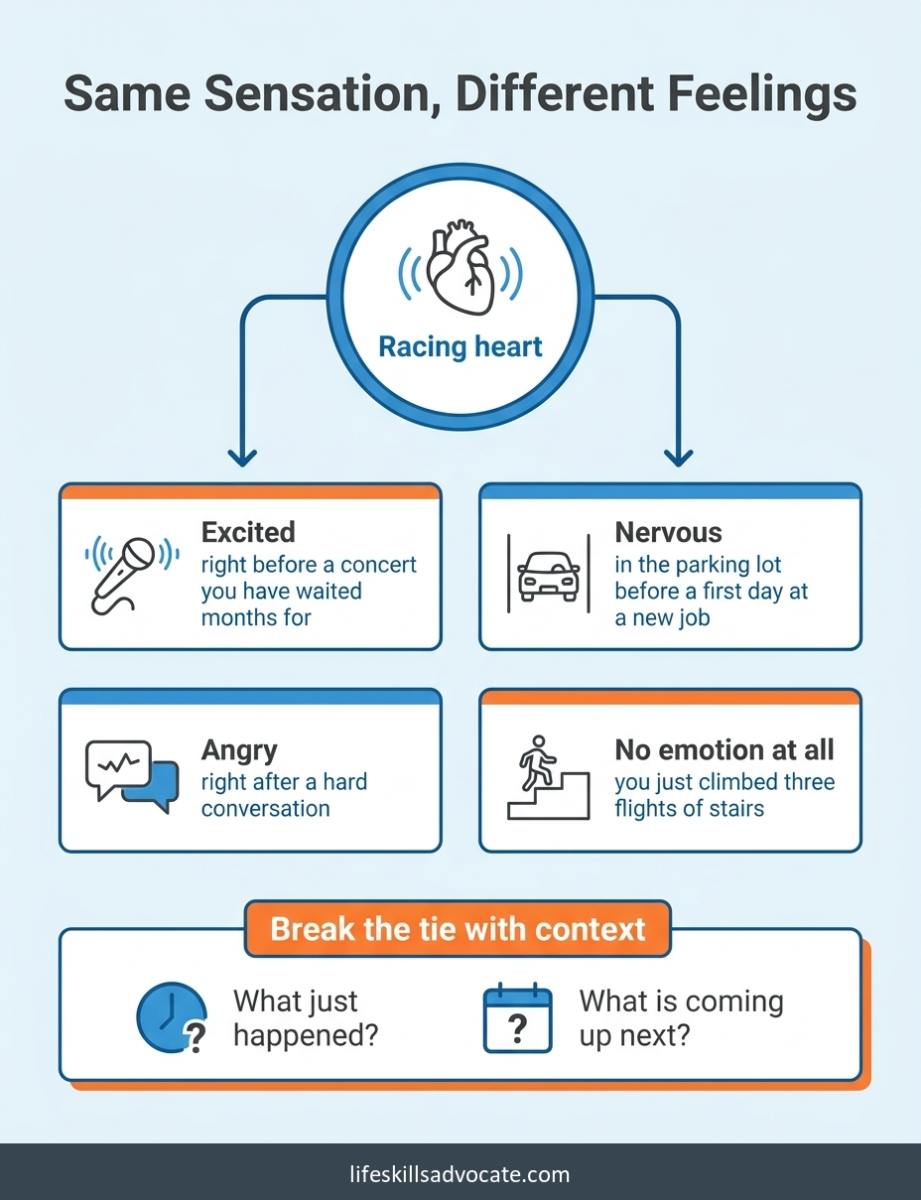
Your heart is pounding in the parking lot before the first day at a new job. Excited or terrified?
The body can produce nearly the same response for both, and plenty of people with the trait say excitement and panic feel identical from the inside. When the sensation can’t break the tie, the situation can. Ask three questions:
- What just happened?
- What’s coming up next?
- Who was there, or who is about to be?
A pounding heart after a hard conversation points one way. The same heartbeat before a concert you’ve waited months for points another. And sometimes it isn’t an emotion at all: three flights of stairs will do it too. Sometimes the answer is both, and “nervous and excited” is a perfectly good word for a first day.
7. Check In on a Schedule Instead of Waiting to Notice
For many autistic and ADHD adults, the first sign of stress is the point where everything is suddenly too loud and too much. Waiting to notice depends on the exact signal that’s faint.
So don’t wait. Set three phone or watch reminders, say 10 a.m., 1 p.m. and 4 p.m., that ask two things: where is it, and how strong? It takes about 20 seconds. Timers and routines tend to work where body cues don’t, because the prompt comes from outside.
Over a few weeks, the check-ins build an early-warning ladder. Yours might look like this: shoulders creeping up, then snapping at small things, then sounds getting louder, then overload. Write your own three or four rungs down. Catching yourself on the second rung leaves time to step away, eat, or cut the input before an autistic meltdown or a shutdown takes over the rest of the day.
8. Name It Late, on Purpose
The comment landed at noon and the feeling arrived at 9 p.m. That delay is common, and it’s workable.
Build a short look-back into the end of the day, five minutes in a notes app or a journal:
- What happened today that my body reacted to?
- Where did I feel it, and how strong was it?
- What word fits now, looking back?
Finding the word late has real value. In four lab studies by Lieberman and colleagues, putting a label on an emotion tended to take some of the edge off how strongly people reported feeling it. Those studies had people label emotional pictures, not their own lives, and the same authors note that going over a feeling again and again can make it worse, so treat this as a lead, not a promise.
The bigger payoff is pattern-spotting. A word found at 10 p.m. tells you what that kind of afternoon tends to cost, so the next one is easier to catch while it’s happening.
9. Keep a “Not Sure Yet” Line Ready
Your partner asks how you feel about the news. A therapist asks, “Where do you feel that in your body?” A manager asks what you think of the new plan. And the true answer is that you don’t know yet.
Without a line ready, the pause often gets filled with “I’m fine” or gets read as not caring. Keep one sentence for each place it tends to come up.
To a partner or friend:
At work:
To a therapist or counselor:
Each line tells the other person the feeling is on its way and gives you the time to find it, without guessing at a word that turns out to be wrong.
Alexithymia Research at a Glance
| Finding | What it means | Source |
|---|---|---|
| Alexithymia was named in 1972; the word means “lack of words for emotion.” | It describes a personality trait on a range, not an official condition. | López-Muñoz and Pérez-Fernández (2020) |
| About half of autistic people scored in the alexithymia range across pooled studies (range 33-63%), versus about 5% of comparison groups. | Common in autism, not universal. | Kinnaird et al. (2019), meta-analysis |
| About 10% of the general population is estimated to have alexithymia (2013 review). | It shows up in neurotypical people too, at a much lower rate. | Bird and Cook (2013) |
| 22% of 73 adults with ADHD at one clinic scored high (2010). | A small study; it suggests higher rates in ADHD, with no pooled estimate yet. | Edel et al. (2010) |
| People with alexithymia also tended to confuse emotions with states like hunger or tiredness (2016). | Body signals and feelings can blur together; how strong this link is remains debated. | Brewer, Cook and Bird (2016) |
| In 8,785 Danish twin pairs, genes accounted for about 30-33% of the differences in alexithymia scores (2007). | Partly inherited; most of the rest is tied to individual experience. | Jørgensen et al. (2007) |
When It Helps to Bring Someone In
Who is the right person to talk to about this, if anyone? It depends on what’s weighing on you most.
If anxiety, low mood or past trauma are part of the picture, a therapist is the right fit, ideally one who knows autism and ADHD. Anxiety and depression travel with the trait often enough that it’s worth raising directly, and a good therapist can work with you on body-based approaches that don’t depend on having the right word up front.
If the bigger struggle is the day-to-day load (starting tasks, making decisions, catching overload before it hits), executive function coaching is built for that. A coach helps you set up the check-in schedule, the early-warning ladder and the scripts, and adjust them until they hold up in a real week. Coaching is skill-building, not mental health care, so it sits alongside therapy rather than replacing it.
And peer support counts. Hearing other late-identified adults describe the same 9 p.m. feelings can make the whole thing less confusing.
Frequently Asked Questions About Alexithymia
Does alexithymia mean you don’t feel emotions?
No. People with alexithymia have emotions like anyone else, and many feel things strongly. The difficulty is in spotting, identifying and describing them, which is why a feeling can show up in the body, or hours later, without a name attached. When you look for a feeling and find a blank, it’s usually the label that’s missing.
Is alexithymia genetic?
Partly. A study of 8,785 Danish twin pairs estimated that genes account for about 30-33% of the differences in scores. Roughly half was tied to experiences each twin had on their own.
Can alexithymia get better with practice?
The trait itself tends to be fairly stable, but the skill of noticing and naming feelings can grow. The check-ins, sensation words and feeling families above are practice in exactly that, and many people find the gap between a feeling and its name shrinks over months of repetition.
The research on training is early. A 2021 trial with 121 autistic adults tested six sessions of heartbeat-awareness training and found a small drop in anxiety. It measured anxiety, not alexithymia, the drop across the whole group was smaller than the researchers had hoped for, and about half the participants didn’t complete the later follow-up.
So whether practice changes the underlying trait, or mostly builds better workarounds around it, isn’t settled. For daily life, it depends on the person, and it may not matter much which one is happening if the workarounds hold.
Why do my feelings show up hours or days later?
Delayed feelings are one of the most common ways the trait shows up. In the moment, attention goes outward: following the conversation, getting through the meeting, holding the mask in place for hours at a time.
The body may react right away, but there’s no room to read the reaction until things go still, often at night or on a weekend. An end-of-day look-back (way 8) turns that delay into something you can use, because the late word still points back to what caused it, and the next time a similar day comes along, you’ll have a better guess about what it might bring up.
Is it alexithymia, or am I just not a “feelings person”?
There may be no clear line between the two. It’s a trait on a range, so some people sit a little along it and some a lot.
The more useful question is whether it gets in your way: missed signs of overload, people misreading you, decisions that stall. If it does, the ways above are worth trying, whatever you decide to call it. Naming the effect can stand in for a while, too: “this makes me want to leave” is useful to know even without a word for why.
Next Steps
The smallest useful version of everything above is one check-in today, done on a timer instead of waiting to notice.
- Set a single phone reminder for this afternoon that asks, “Where is it in my body, and how strong?” Answer it in a word or two.
- Print the body scan. The free Body Scan Mindfulness Activity gives you set cues for way 1.
- Want more words to work with? Start with the neurodivergent feelings wheel guide.
- See which skills are carrying the most load with the Free Executive Functioning Assessment, and if planning around this is the hard part, look at executive function coaching for adults.
Further Reading
- A History of the Alexithymia Concept and Its Explanatory Models – López-Muñoz and Pérez-Fernández, Frontiers in Psychiatry
- Mixed Emotions: The Contribution of Alexithymia to the Emotional Symptoms of Autism – Bird and Cook, Translational Psychiatry
- Investigating Alexithymia in Autism: A Systematic Review and Meta-Analysis – Kinnaird, Stewart and Tchanturia, European Psychiatry
- Alexithymia in Autism: Cross-Sectional and Longitudinal Associations – Oakley et al., Psychological Medicine
- Alexithymia, Emotion Processing and Social Anxiety in Adults with ADHD – Edel et al., European Journal of Medical Research
- Alexithymia: A General Deficit of Interoception – Brewer, Cook and Bird, Royal Society Open Science
- Unpacking Emotion Differentiation – Kashdan, Barrett and McKnight, Current Directions in Psychological Science
- Subjective Responses to Emotional Stimuli During Labeling, Reappraisal, and Distraction – Lieberman et al., Emotion
- Interoceptive Training to Target Anxiety in Autistic Adults (ADIE) – Quadt et al., EClinicalMedicine
- Genetic and Environmental Factors in Alexithymia: 8,785 Danish Twin Pairs – Jørgensen et al., Psychotherapy and Psychosomatics
- How We Feel – The How We Feel Project (free app)
- Neurodivergent Feelings Wheel – Life Skills Advocate
- Executive Functioning 101: The Basics of Emotional Control – Life Skills Advocate
- Emotional Regulation and Executive Functioning – Life Skills Advocate
- Neurodivergent Burnout: Signs and Recovery – Life Skills Advocate
- Understanding Autistic Meltdowns – Life Skills Advocate
- Dorsal Vagal Shutdown – Life Skills Advocate
- How to Drink More Water With ADHD – Life Skills Advocate
- Body Scan Mindfulness Activity (free) – Life Skills Advocate
- Feel Wheel Exercise (free) – Life Skills Advocate
- Free Executive Functioning Assessment – Life Skills Advocate
- Executive Function Coaching for Adults – Life Skills Advocate