
It is 4 p.m. and the water bottle you filled this morning is still full. You meant to drink it. You even slid it closer at one point, and somewhere between then and now the thought either never arrived or got shoved aside by something more interesting.
If you have ADHD, this loop is familiar. It runs on how your brain handles thirst signals and reward, not on how hard you are trying, so learning how to drink more water with ADHD is really about removing the specific things that trip you up.
Most advice hands over a flat list of hacks. This one sorts the fixes by the exact reason water keeps getting skipped, so you can pick the one that matches your barrier instead of trying all of them at once.
TL;DR
If you have been trying to figure out how to drink more water with ADHD, the reason it keeps failing is usually mechanical: the thirst memo never gets delivered. Here is the short version:
- Your ADHD brain skips water for real reasons: faint thirst signals, hyperfocus, no dopamine payoff, and medication that dries you out.
- Make water impossible to miss and take the steps out of drinking it, so a clear bottle with a built-in straw sits within arm’s reach.
- Let the vessel do the work, and anchor a sip to something you already do every day.
- Give your brain a reason to bother, and work with your senses instead of against them.
- Expect the trick to wear off, and swap it out instead of deciding you failed.
This is educational, not medical or diagnostic advice. If dehydration or ADHD is something you are working through with a professional, treat these as a supplement to that, not a replacement.
Why Your ADHD Brain Skips Water
For a lot of adults with ADHD, the thirst signal itself is unreliable, and the reasons stack up.
Start with interoception, the sense that tells you what is happening inside your body: hunger, a full bladder, thirst. According to a 2025 systematic review of interoceptive awareness in ADHD, these internal signals tend to register less clearly, so the “I’m thirsty” memo often arrives late, faintly, or not at all. You are not ignoring it so much as never fully receiving it.
Building that inner awareness is a slow skill, and an exercise like our how my body pays attention worksheet is one way to practice it.
Then there is time blindness and hyperfocus. Locked into something, you can lose whole hours without a single “get water” thought surfacing.
Plain water also offers no payoff, so a brain that runs on interest quietly files it under “later.” That is the same wiring behind a lot of executive dysfunction around boring tasks, and it is why “just remember” rarely works. Medication adds a last layer: stimulant medication can reduce the urge to drink and cause dry mouth, so you can be under-hydrated without feeling thirsty. That is worth naming plainly, not as a reason to change anything about your meds.
None of this means your body is broken.
It means your usual cue, thirst, is unreliable, so the fix is to stop depending on it.
7 Ways to Drink More Water When You Have ADHD
This is the core of it. Each fix below targets one specific reason water gets skipped, so you do not need all seven at once. Find the barrier that sounds like your day, start there, and add another only when the first one runs on its own.
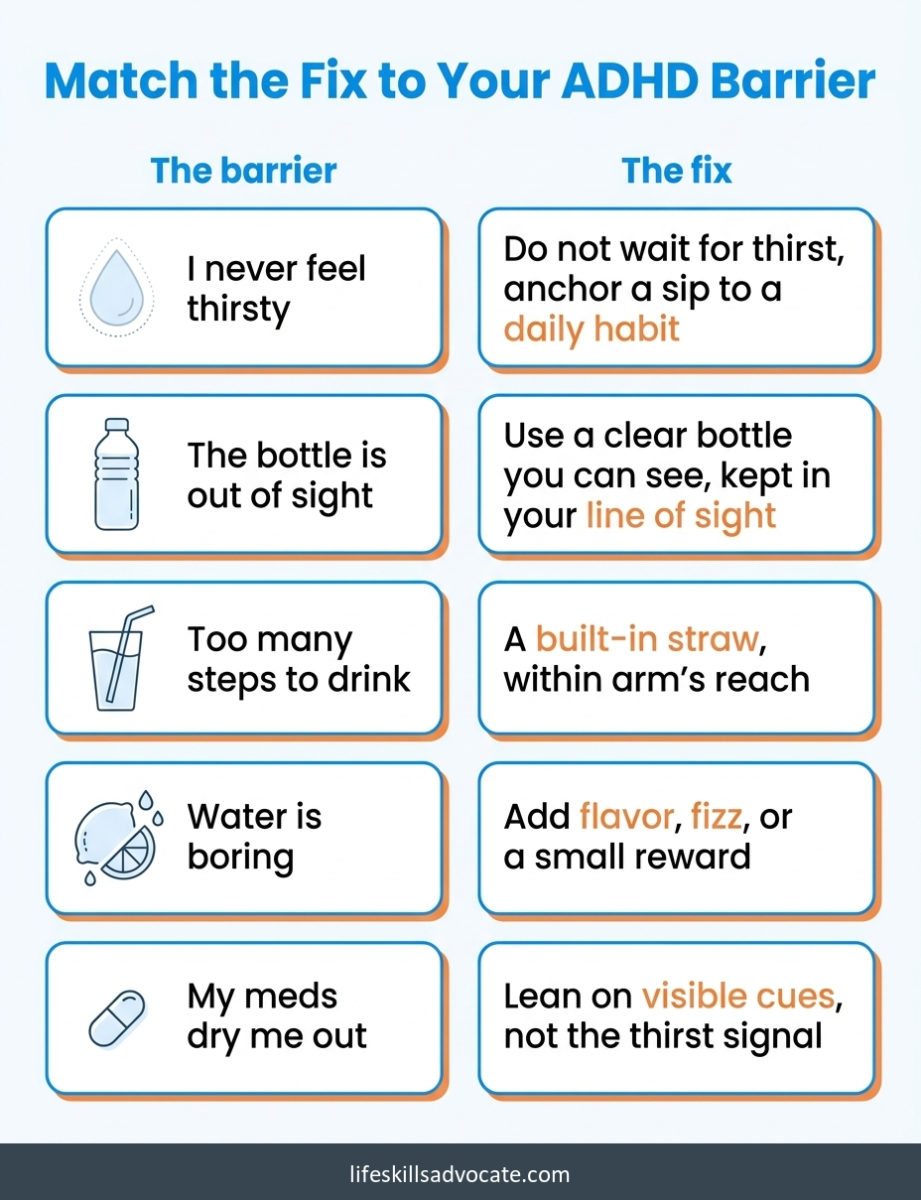
1. Make Water Impossible to Miss
Out of sight really does mean out of mind here.
If your working memory drops whatever it cannot currently see, a bottle in a cupboard or an opaque one on the counter might as well not exist.
Use a clear container you can see the level of, and park it directly in your line of sight. The visible level doubles as a progress bar your brain reads at a glance, so half gone by lunch is information an opaque bottle hides. Put it where your eyes already go, next to the keyboard, not off to the side.
2. Take the Steps Out of Drinking It
Every step between you and a sip is a place to quit. Unscrewing a lid, standing up, walking to the kitchen: any one of them can leave you sitting there mildly thirsty for two hours.
So strip the steps out. A built-in straw is the single biggest upgrade a lot of people report, because it turns drinking into one move: grab, sip, done. Keep the bottle filled and within arm’s reach so “get water” never becomes a project. This is task initiation in miniature, and the lower the effort to start, the more often you will.
3. Let the Bottle Do the Work
There is a running joke in ADHD circles that the whole solution is “the vessel,” and it is not wrong.
The right container does more work than any reminder.
A bottle with time markers can pace your day, but only if the times fit your actual schedule, not a generic 8-a.m.-to-8-p.m. printout. Some people drink far more from a big wide-mouth jar they refill once. Others find a jug intimidating and do better with a small glass they empty often. There is no single right vessel, only the one you will use.
One caveat on reminders: app notifications fail a lot of ADHD folks. They get swiped away, muted, or lost in the pile of other alerts. A visible, easy-to-reach bottle usually beats a phone buzz, because it works even on the days you have stopped noticing your phone.
Recommended tool
Hyeta 32 oz Water Bottle With Straw and Time Marker
It folds three of the fixes above into one object: a crystal-clear body so you can see the level at a glance, a built-in straw so drinking is one move, and printed time markers to pace the day.
Best for: Adults who skip water because the bottle is out of sight, too much effort, or hard to keep track of. The printed hours run 8 a.m. to 6 p.m., so treat them as a rough guide and re-space them to your real day.
4. Anchor a Sip to Something You Already Do
New habits rarely survive on their own. They stick better bolted onto something already automatic, which is the idea behind habit stacking.
Pick something you do without thinking and attach water to it. Fill the bottle before you open the laptop. Sip every time you make coffee or take medication. Keep a glass in the bathroom and drink while you are already there.
You are not adding a task to remember, you are hitching a ride on one that already runs. If you have a morning routine that works, park the first glass there.
5. Give Your Brain a Reason to Bother
Plain water is a hard sell for a brain that wants a payoff. Tasteless and unexciting, it loses to almost every other option in reach.
So make it worth something. A squeeze of lemon, a splash of sugar-free flavor, cold water over ice, or sparkling water can be the difference between a bottle you finish and one you forget (just watch added sugar for your teeth). Some people gamify it, racing to empty the bottle by a certain hour. If a small reward is what gets the water in, that still counts, and it is working with your dopamine instead of against it.
6. Work With Your Senses, Not Against Them
For some people the barrier is not forgetting at all. Water is genuinely unpleasant to drink, which is real, especially for autistic and AuDHD adults, and it deserves a better answer than “just get used to it.”
Sensory details decide a lot. Temperature can flip a hard no into an easy yes, and so can mouthfeel, still versus fizzy, and the container itself: some people cannot stand a metal bottle or a straw and only tolerate a plain glass. There is no correct setup, only the combination your senses accept. If sensory sensitivity is the main thing in your way, our guide to sensory regulation strategies goes deeper than we can here.
7. Plan for the Day It Stops Working
The trick working right now will probably stop, and that is worth planning for from the start. The novelty fades, the cute bottle becomes furniture, and one day the whole system has quietly died.
That is the novelty wearing off, the same thing an ADHD brain does with any new system.
When a system stops working, do not give up on water for a month, just change the variable that went stale: swap the bottle, switch the flavor, move the anchor. You are not starting over, you are rotating one piece. Treat boredom as a maintenance step, not a verdict.
How Much Water Is Enough With ADHD?
So how much water is actually enough? Less rigidly measured than the famous rule suggests. The “8 glasses a day” target is not a medical requirement, just a catchy number, and chasing it exactly can stress you out for nothing.
General guidance from the National Academy of Medicine, summarized by Harvard’s Nutrition Source, sets daily fluid intake at about 13 cups for men and 9 cups for women from all beverages, with more water coming from food. Soup, fruit, herbal tea, and sparkling water all count, and heat, exercise, and being sick push the number up.
A simpler check than counting cups: glance at your urine color. Pale usually means you are fine, consistently dark usually means drink more. The goal is steady enough hydration through the day, not a perfect number.
When Drinking Water Feels Bigger Than a Habit
For most people, water is a habit problem, and the tactics above are enough. Sometimes it is bigger than that, and the stakes are worth naming.
Real dehydration is not minor.
It can leave you foggy, exhausted, and irritable, and some people end up seriously unwell from going too long without enough fluids. If you have a health condition that raises the stakes, or you keep landing in genuinely rough shape, that is a conversation for a doctor, not a blog post.
There is also a difference between needing information and needing support. If daily self-care tasks keep slipping no matter how many systems you try, that is an executive function pattern, and it is the kind of thing coaching helps with. Coaching is educational and skill-focused, not medical treatment or therapy, and for some people a second brain on the problem is what finally makes a habit hold.
ADHD and Hydration: What the Research Says
| Finding | What it means for ADHD hydration | Source |
|---|---|---|
| ADHD is linked to reduced interoceptive awareness. | Your thirst signal can register late or faintly, so “I’m not thirsty” is not proof you are hydrated. | Systematic review (2025) |
| Daily fluid guidance is about 13 cups for men and 9 cups for women from beverages, with more water from food. | The rigid 8-glasses rule is a myth. Aim for a range and let urine color guide you. | Harvard Nutrition Source |
| Even mild dehydration is associated with reduced attention, working memory, and mood. | Low fluid can look like a worse ADHD day, so the two get confused. | Water, hydration and health review (2010) |
ADHD and Water: Frequently Asked Questions
Why is it so hard to drink more water when you have ADHD?
Usually it comes down to how the ADHD brain handles internal signals and reward. Thirst is an interoceptive cue, and those cues tend to be fainter in ADHD, so the prompt to drink arrives weakly if at all. Add hyperfocus that swallows hours and medication that dries your mouth, and forgetting looks more like the default than a lapse.
Does ADHD medication make dehydration worse?
It can. Stimulant medication often reduces the urge to drink and causes dry mouth, so you can be under-hydrated without feeling thirsty. That is not a reason to change your medication, just a reason to lean on visible cues instead of waiting to feel thirsty.
How much water should someone with ADHD drink?
There is no single right number. General guidance lands around 13 cups a day for men and 9 for women, counting all beverages plus water from food, not eight glasses of plain water. Heat, exercise, and illness raise it.
A quicker gut check is urine color: pale is usually fine, consistently dark usually means more. The exact figure matters less than steady intake across the day, and the right amount shifts with your body, your medication, and the season, so treat any number as a starting point.
Do coffee, tea, and sparkling water count toward hydration?
Yes. Herbal tea, sparkling water, and flavored water all count toward your daily fluids, and so do water-rich foods like fruit and soup. Coffee counts too, despite its reputation, though it is not the best thing to lean on.
What if every water reminder app stops working for me?
This is one of the most common ADHD hydration complaints, and it is not a sign you are doing it wrong. Reminder apps fail a lot of people: the notification gets swiped away on autopilot, blends into a wall of other alerts, or you stop opening the app once the novelty wears off. If your phone has stopped working as a water cue, the answer is usually to stop relying on it.
A visible, easy-to-reach bottle tends to beat a notification, because it does not need you to notice anything. That said, even the bottle will fade into the background eventually, and that is normal. When it does, the move is not to give up but to change one variable: a new bottle, a new spot, a new flavor. There is no permanent fix here, only a system you keep gently rotating.
Next Steps
The fastest way to make this real is to change one thing today, not seven. Pick the barrier that sounded most like your day and take the smallest possible action on it.
- Name your barrier. Decide which reason hits you hardest, no thirst signal, water invisible, too many steps, boredom, or medication, and try the one matching fix first.
- Swap one bottle for a clear one you can see the level in, and put it where your eyes already go. This one takes about five minutes.
- Anchor a single sip to something you already do daily, like making coffee or sitting down to work.
- Check where your executive function is stretched. If self-care tasks like this keep slipping across the board, our free executive functioning assessment shows you which skills to focus on, and executive function coaching for adults is there if you want a hand building systems that hold.
Start with one. A habit you keep beats a perfect plan you abandon by Thursday.
Further Reading
- Interoceptive awareness in ADHD: a systematic review (2025) – PMC
- Water: how much do you need – Harvard Nutrition Source
- Water, hydration and health – Nutrition Reviews
- How My Body Pays Attention exercise – Life Skills Advocate
- Time blindness and ADHD – Life Skills Advocate
- Signs of executive dysfunction – Life Skills Advocate
- Habit stacking for consistent routines – Life Skills Advocate
- Morning routines for people with ADHD – Life Skills Advocate
- Building a dopamine menu – Life Skills Advocate
- Sensory regulation for neurodivergent adults – Life Skills Advocate
- Free Executive Functioning Assessment – Life Skills Advocate
- Executive function coaching for adults – Life Skills Advocate