
There is a book on the nightstand with the receipt still tucked in it, somewhere around page thirty-one.
Maybe a therapist recommended it. Maybe a coworker did, or a video that felt like it had been made about you specifically. You bought it that same night. It arrived, you got through the introduction and most of chapter one, and then a Tuesday happened, and then a month did.
Buying an ADHD book and reading an ADHD book turn out to be two separate projects, and only one of them takes an evening. The twelve ADHD books below are all worth an adult’s time. What decides whether any of them helps you is what happens on page thirty-one.
The stack on the nightstand is a task initiation problem wearing a book jacket, and task initiation is workable.
TL;DR
Twelve ADHD books worth an adult’s time, sorted by what you need one for, plus the part that decides whether you finish it.
- Four foundational picks for the whole picture, including the one nearly every other reading list also names
- Three that hand you tactics instead of explanation, for readers who already know what ADHD is
- Two that are the easiest to get through, which is not the same thing as being the shortest
- Two narrower picks, one for a marriage and one for executive function skills specifically
- One written by an ADHD coach rather than a psychologist, out in September 2026, plus a section on how to finish the ADHD book you buy, which is where most of them stall
This is educational, not medical or diagnostic advice. Books can carry a lot. They are not a stand-in for working with a professional if that is what you need.
How We Chose These ADHD Books
A list of thirty ADHD books is not a shortlist. It is a second decision, handed back to the person who came looking for a first one.
So we read the five ADHD book lists ranking on page one for this search in August 2026 and counted the titles across them. Seven books appear on three or more of the five. Exactly one appears on four, and it is Driven to Distraction. The agreement a reader assumes is out there is thinner than it looks, which means the grouping matters more than the count.
Four things decided what made the cut:
- Format. A book you cannot get in the form you will really use is not a recommendation. Every pick carries whether it exists in print, on Kindle, and as an audiobook.
- Pages. A 160-page book and a 480-page book are not the same ask. The count is in the table so you can choose by the size of the commitment, not the size of the reputation.
- Published. Some of these are classics and some are current, and those are two different claims. Every pick carries its year and its edition.
- Best for. Every pick had to suit a specific situation. “Good book” is not much help when you are standing in a bookstore at nine at night.
Every one of these ADHD books is written for adults reading about themselves. If you want a book about your child’s ADHD, this is not that list. Mixing the two is what makes a thirty-title list so hard to use.
Adults are also usually working with an executive function profile that runs behind their age peers, which is what the 30% rule and executive age describes. A book written for the parent of a nine-year-old does not speak to that.
If you are autistic or AuDHD and the reading you want is about autism rather than ADHD, our autism book roundup is the better door. Two books that show up on several of these lists are missing from ours because they are not ADHD books, however good they are on their own terms.
We have not read every ADHD book in print. This is twelve we can stand behind.
Compare All 12 ADHD Books at a Glance
Two facts decide whether an ADHD book gets finished more often than the writing does. How long it is, and whether it exists in a form that fits how you read. Both are in the table.
Every book below is written for adults, so that column would have said the same thing twelve times and has been left out.
| Book | Format | Pages | Published | Best for |
|---|---|---|---|---|
| Driven to Distraction | Print, Kindle | 400 | 1994, revised 2011 | The reader who wants the whole picture before anything else |
| ADHD 2.0 | Print, Kindle, audio | 208 | 2022 paperback | Someone who read the classic years ago and wants the update |
| Scattered Minds | Print, Kindle, audio | 368 | US edition, 2023 | Readers asking where this came from |
| You Mean I’m Not Lazy, Stupid or Crazy?! | Print, Kindle, audio | 480 | Revised edition, 2006 | Anyone who has never seen their own life described in a book |
| Taking Charge of Adult ADHD | Print, Kindle, audio | 294 | Second edition, 2021 | Readers who trust a claim more when the research is shown |
| Order from Chaos | Print, Kindle, audio | 218 | 2019 | People who have bounced off every organizing system so far |
| Thriving with Adult ADHD | Kindle, audio, paperback | 162 | 2018 | Readers who want exercises rather than another explanation |
| How to Keep House While Drowning | Print, Kindle, audio | 160 | 2022 | Whoever is looking at the kitchen right now |
| How to ADHD | Print, Kindle, audio | 464 | 2024 | A first ADHD book, especially after a late identification |
| The ADHD Effect on Marriage | Print, Kindle, audio | 233 | 2010 | Couples who keep having the same argument |
| The Smart but Scattered Guide to Success | Print, Kindle, audio | 294 | 2016 | Someone who wants to know which executive function skills are their weak ones |
| Overcoming the Wall of Awful | Hardcover, ebook, audio | 304 | September 2026 | The person who cannot start and cannot say why |
Published shows the edition we link to, and Format is what that listing offered as of August 2026.
The 12 Best ADHD Books for Adults
These ADHD books are grouped by the job they do rather than ranked, because the right first one depends entirely on what you walked in wanting.
The four foundational picks come first.
1. Driven to Distraction by Edward Hallowell and John Ratey (1994, Revised 2011)
Driven to Distraction is the book most other lists start with, and the only title we found on four of the five pages ranking for this search. It builds its picture of ADHD out of case stories rather than frameworks, which is why people who read it tend to remember specific people from it years later. It is also thirty years old and reads like it in places, and the revised edition we link to has no audiobook.
At 400 pages, most people end up dipping into it rather than reading it through. That is a fine outcome, and worth deciding on deliberately rather than discovering at page ninety.
Best for: The reader who wants the whole picture before anything else, and does not mind a long book.
2. ADHD 2.0 by Edward Hallowell and John Ratey (2022 Paperback)
ADHD 2.0 is the same two authors coming back with what changed. The material readers tend to single out is the account of what happens when the brain gets stuck in its default mode network, the rumination gear, instead of the task-focused one.
It overlaps the first book more than the cover suggests, so buy one of the two rather than both. At 208 pages it is less than half the length, which is the real argument for starting here.
Best for: Someone who read the classic years ago and wants the update, not the reread.
3. Scattered Minds by Gabor Maté (US Edition, 2023)
Scattered Minds asks where ADHD traits come from, and answers with early environment and attachment alongside biology rather than genetics alone. That is a bigger claim about origins than the other books here make, and Maté argues it as a case rather than reporting it as settled. Read it as one strong point of view that a lot of readers find enormously validating, particularly readers whose childhood was hard.
Best for: Readers asking where this came from, who want a view with a real argument in it and know it is one view.
4. You Mean I’m Not Lazy, Stupid or Crazy?! by Kate Kelly and Peggy Ramundo (Revised 2006)
You Mean I’m Not Lazy, Stupid or Crazy?! is the recognition book. It appears on three of the five lists we read, and it pairs the “oh, that is me” chapters with practical material on organization and working memory rather than stopping at validation. The title alone does a lot of work for people who have carried the other three words around since school.
The catch is the size. It is the longest book here at 480 pages, and the 2006 revision means some of what surrounds ADHD has moved since.
Best for: Anyone who has never once seen their own life described accurately in a book.
The next three are for readers who already know what ADHD is and want something to do about it.
5. Taking Charge of Adult ADHD by Russell Barkley (Second Edition, 2021)
Taking Charge of Adult ADHD is the evidence-first pick, written by a researcher who has spent decades on adult ADHD. Its central reframe is that ADHD is a performance problem, not a knowledge problem. You generally know exactly what you are supposed to do. The gap opens at the point of doing it, which is why the book argues for putting reminders, timers and structure outside your head where you can see them.
It is denser than anything else on this list. That density is the point, and it is also why some readers stall.
Best for: Readers who trust a recommendation more when the research behind it is on the page.
6. Order from Chaos by Jaclyn Paul (2019)
Order from Chaos is one adult’s organizing system, built by someone writing openly about her own ADHD rather than about a tidy brain she happens to study. It is short, it is specific, and it does not assume you can simply keep a system going once you have set it up, which is the assumption that sinks most organizing books for this audience.
It is one person’s approach rather than a research summary, so treat it as a working model to adapt rather than a program to follow.
Best for: People who have bounced off every organizing system built for someone who is naturally tidy.
7. Thriving with Adult ADHD by Phil Boissiere (2018)
Thriving with Adult ADHD skips the explanation almost entirely and hands you assessments and exercises for the executive function skills underneath the day: focus, organization, handling stress. At 162 pages it is closer to a workbook than a book, which is exactly why it works for people who have already read two explanations and want a page they can write on.
One practical note. The paperback comes and goes through marketplace sellers rather than Amazon itself, so what you see there will not match what we saw. The Kindle and audio editions are the reliable routes.
Best for: Readers who want exercises rather than another explanation of what ADHD is.
The next two are the easiest to get through, which is a different quality from being short. Length is a real barrier for a lot of readers and pretending otherwise does not help.
8. How to Keep House While Drowning by KC Davis (2022)
How to Keep House While Drowning is 160 pages, the shortest book here, and it treats cleaning as a set of care tasks rather than a verdict on the person doing them. It is not strictly an ADHD book, and we are including it anyway because the counter it aims at, the pile of undone home tasks and everything that gets attached to it, lands squarely on this audience.
The chapters are short enough to read one while the kettle boils.
Best for: Whoever is looking at the kitchen right now and cannot make themselves start.
9. How to ADHD by Jessica McCabe (2024)
How to ADHD comes from the creator of the YouTube channel of the same name, and it is the most readable entry point here despite being 464 pages. The layout is the reason: chapter summaries, clear structure, and material from researchers woven through McCabe’s own account of living with ADHD. Coming back after two weeks away does not mean rereading forty pages to find your place, which is a design decision almost no other book on this list made.
Best for: A first ADHD book, especially for someone identified as an adult.
The last three are narrower on purpose: one relationship, one executive function skills profile, and one that is brand new.
10. The ADHD Effect on Marriage by Melissa Orlov (2010)
The ADHD Effect on Marriage names the specific patterns that build up between partners when one of them has ADHD: the nagging cycle, the sudden anger, the forgotten thing that reads as not caring. It comes with worksheets, and it is one of the few books here that will be useful to the non-ADHD partner too, which matters because ADHD in a marriage tends to be a two-person pattern.
It is from 2010, and it is framed tightly around marriage, so an unmarried couple will be doing some translating.
Best for: Couples who keep having the same argument and cannot work out why it keeps coming back.
11. The Smart but Scattered Guide to Success by Peg Dawson and Richard Guare (2016)
The Smart but Scattered Guide to Success gets you a profile of your own executive function skills first, then work on the two or three that are genuinely weak. Check the cover before you buy, because the better-known Smart but Scattered is the parenting book, and this one is the adults edition.
Dawson and Guare divide executive function into twelve skills. Our own resources use eleven. The count in any book is that book’s framing rather than a settled fact.
Best for: Someone who suspects two specific skills are the problem and wants to find out which.
12. Overcoming the Wall of Awful by Brendan Mahan (September 2026)
Overcoming the Wall of Awful is written by an ADHD coach rather than a clinician or a researcher, and it appears on none of the five lists we read, because it did not come out until September 1, 2026.
Mahan named the Wall of Awful, the pile of accumulated emotional weight that stands between a person and a task they have failed at before. This is the first book-length treatment of the model.
The publisher’s listing shows a hardcover, an ebook and an unabridged audiobook, with a foreword by Jessica McCabe.
Being brand new cuts both ways. Nobody has a long track record with it yet, including us.
Best for: The person who cannot start the thing and cannot explain why, which is a different problem from not knowing how.
If You Only Read One ADHD Book, Start Here
Start with How to ADHD.
It is current, it is written by someone describing her own ADHD from the inside, and its structure is built for a reader who puts books down. Chapter summaries mean the cost of coming back after a gap is close to zero, and it exists as an audiobook if print is the barrier. For most adults picking up their first ADHD book, that combination beats a better-known title you will not finish.
Two situations change which ADHD book comes first.
If what you want is the foundational picture rather than tactics, start with Driven to Distraction and go in knowing it is thirty years old. If you want something usable by Thursday, start with Thriving with Adult ADHD, or with How to Keep House While Drowning if the state of the house is the actual emergency.
How to Finish the ADHD Book You Just Bought
The ADHD book arrives. You read eleven pages that night with real intent, and then it sits on the nightstand for four months while you walk past it twice a day.
This is the part that decides whether any ADHD book on the list above was worth buying, and it is not a reading problem.
Why the Book on Your Nightstand Is a Task, Not a Read
An unread book is an open task, and open tasks collect weight. Every walk past it adds a small deposit of “I still have not,” and after enough deposits the book is no longer a book, it is a reminder of a promise you did not keep.
That accumulation is what Brendan Mahan named the wall of awful. It is why the ADHD book that has sat longest is the hardest one to open, regardless of how much you want to read it.
Underneath the emotional weight is a plainer mechanic. Starting is its own skill, separate from wanting to and separate from knowing how, which is why when your brain will not let you start can happen with a book you genuinely chose.
There is also a reading-specific piece. In a study of 90 college students, the group high in ADHD-inattention traits reported more mind wandering during a reading task, and their comprehension of the text suffered for it. That was a non-clinical sample rather than an identified one, so read it as a real effect measured in people who look like this audience, not a rule about what you can do.
Shrink the Unit to One Chapter
The unit is not “the book.” The unit is one chapter, in one sitting, and the book is done when you stop getting anything out of it.
Skipping is allowed. So is reading chapter nine first because the title is the thing you are dealing with this month. Most of the books above are reference material rather than an argument that builds, and treating them as sequential is a rule nobody imposed on you.
If a chapter is still too big, the unit is ten minutes. Ten minutes of a book is not a compromise, it is how task initiation works when the starting cost is the expensive part.
Estimate Before You Commit, Not After
A 400-page book with no number attached to it is an unbounded commitment, and unbounded commitments are exactly what time blindness makes impossible to weigh. That is half the reason the page count sits in the table above.
Before you start, work out what a chapter costs you. Read one, time it, and multiply. Twenty-two minutes a chapter across fourteen chapters is five hours, which is two weeks of fifteen-minute evenings, and now the book is a thing with edges. Our estimate how long it will really take worksheet exists for exactly this comparison, because the gap between the guess and the stopwatch is usually the useful part.
The Reward Has to Come Before the Insight
Waiting for the book itself to be rewarding is a losing bet on a Tuesday in February. Research on mind wandering finds that higher interest and motivation in a task track with less of it, which is worth knowing in both directions: an interesting book holds you, and a book you feel you should read does not.
So attach something to the finish line that arrives sooner than the insight does. A specific show after chapter four. Coffee out on Saturday when you hit halfway. Our plan a reward for finishing the chapter worksheet walks through picking one that is small enough that you will deliver it, which matters more than picking a good one.
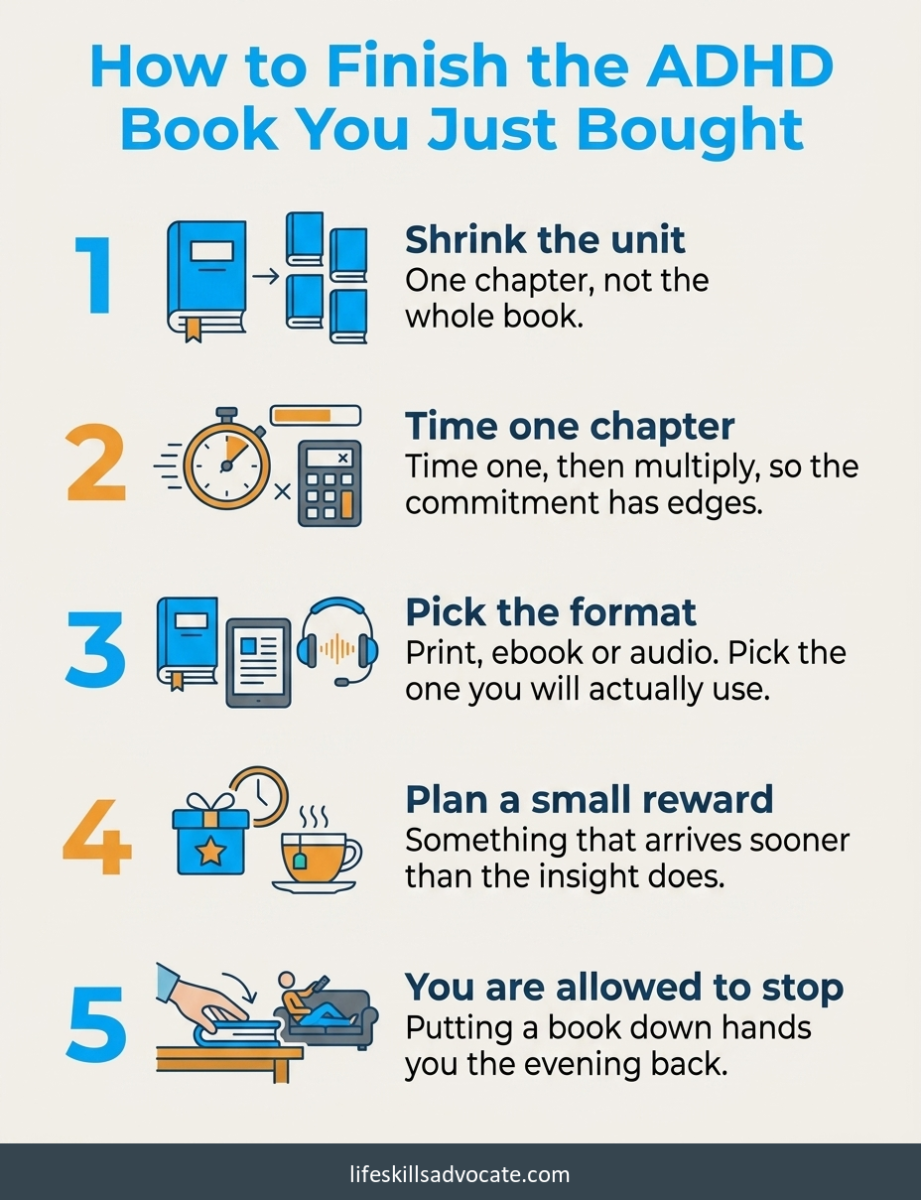
None of this makes a dense book short. And some books genuinely are not worth finishing: putting one down at page forty is a decision, and it hands you the evening back for a different book. What we cannot do is tell you which of yours is which.
When Reading Is the Barrier: Formats That Count
Listening to an ADHD book is reading it. Eleven of the twelve ADHD books above exist as audiobooks, and for a lot of adults that single fact is the difference between a finished book and a shelf ornament.
Audio has its own failure mode, which is worth naming rather than discovering. You can finish an entire audiobook while driving and retain almost none of it, because the part of you that was tracking the road was the part that would have been tracking the argument. If that happens, the answer is a shorter session and something for your hands, not a return to print.
Format works the other direction too. A workbook you can open at any section beats a book with a thesis when your attention is the scarce thing. Short chapters are a real accessibility feature, not a sign of a lightweight book.
The two shortest ADHD books above are both under 165 pages, and both were chosen partly for that.
The other thing to work with rather than against is what your attention shows up for. An interest-based nervous system is not going to be argued into a book it finds dull, so the book you are curious about will get further than the book you are supposed to have read.
What the Research Says About ADHD and Reading
Four findings sit underneath the way these ADHD books are grouped and ordered, plus one piece of attribution that keeps getting handed to the wrong person.
| Finding | What it means | Source |
|---|---|---|
| Among 90 college students, those high in ADHD-inattention traits reported more mind wandering during a reading task, and their text comprehension suffered | Losing the thread mid-page is a measured effect, not a verdict on the book or the reader | Jonkman et al., PLoS ONE (2017) |
| Mind wandering is universal and represents up to about 50% of daily thinking time | The question is never whether your mind wanders, only how much of it is spontaneous | Bozhilova et al., Neuroscience and Biobehavioral Reviews (2018) |
| Higher task-related interest and motivation are both associated with less mind wandering | A book you want to read holds better than one you feel you should read, which is why the ADHD books here are grouped by need rather than ranked | Bozhilova et al. (2018) |
| Dawson and Guare’s adult executive skills book maps twelve executive skills; other frameworks divide them differently | There is no settled count, so treat any book’s list of executive function skills as that book’s framing | Dawson and Guare, Guilford Press (2016) |
| The Wall of Awful, the emotional barrier that builds in front of a task, was named by ADHD coach Brendan Mahan, whose book on it came out in September 2026 | The unread book is usually an emotional barrier rather than an information gap | Brendan Mahan (2026) |
Frequently Asked Questions
What is the best ADHD book for adults?
For most adults reading about themselves for the first time, How to ADHD by Jessica McCabe is the one to start with, because it is current, written from the inside, and structured so that putting it down does not cost you your place.
It depends on which of two things you came for. If you want to understand ADHD, start there or with Driven to Distraction. If you already understand it and want something to do this week, start with Thriving with Adult ADHD.
What if I buy the ADHD book and never read it?
This is the most common outcome, and it is worth planning for rather than promising yourself it will be different this time.
The practical version: buy one book, not three. Decide before it arrives when you will read the first chapter, and put that fifteen minutes somewhere it already fits, next to something you reliably do. Read one chapter, time it, and use that number to decide if you are in for the whole thing or if this is a dip-into book.
The part we cannot resolve for you is which books deserve the effort. Some of the twelve above are references that were never meant to be read cover to cover, and some will not be worth your evenings. There is no way to tell from the outside, though forty pages in is usually enough.
What we would not do is let one unfinished book become evidence about you. The evidence it gives is about the book, the format, and the week you tried to read it in.
Do audiobooks count as reading?
Yes. Eleven of the twelve books here have an audio edition, and a book you finish in the car is worth more than a book you own in hardcover.
Are the classic ADHD books still worth reading?
Some are, with a caveat about which edition you pick up. Driven to Distraction is from 1994 and the edition on sale is the 2011 revision, so it is the strongest picture of ADHD across a whole life and it is also thirty years old. You Mean I’m Not Lazy, Stupid or Crazy?! was revised in 2006 and still does the recognition job better than anything newer.
If you want the current science rather than the classic account, ADHD 2.0 and Taking Charge of Adult ADHD are both from the last five years and both say so on the cover. The rule of thumb we would use is to read a classic for the picture of a whole life and something recent for the mechanics, rather than expecting either one to do both jobs.
Which ADHD books are written by people who have ADHD?
Two clearly are. Jessica McCabe writes How to ADHD from her own ADHD, and Jaclyn Paul wrote Order from Chaos out of her experience as a wife and mother with ADHD. Brendan Mahan writes as an ADHD coach, a different vantage point again. For the rest we could not confirm it from a primary source, so we will not guess.
Next Steps
With ADHD books the failure point is almost never the choosing. It is the fortnight after the book arrives, so the steps that matter are the small ones with a time attached.
- Pick the shortest book on this list and read only chapter one tonight. Both of the short picks are under 165 pages, and chapter one of either takes about the length of a sitcom.
- Time that chapter and multiply it out before you commit to the rest. The Time Estimation Worksheet is free and takes about two minutes.
- If you would rather have a workbook than a book, we make two: the Real-Life Executive Functioning Workbook by Chris Hanson and Amy Sippl, and The Neurodivergent-Friendly Cookbook by Chris Hanson and Amy Sippl, BCBA, for the specific problem of feeding yourself on a bad executive function day. They are ours, so weigh that accordingly.
- Find out which executive function skills are the weak ones before you buy anything else, using the free executive functioning assessment. It is a faster answer than a 300-page book.
- If reading about it has stopped being the bottleneck, that is usually the point where executive function coaching starts to make sense. Coaching is educational and skills-focused, working on what you do on a Tuesday rather than on mental health, which is therapy’s job and a genuinely different thing.
Further Reading
- Mind Wandering During Attention Performance – Jonkman, Markus, Franklin and van Dalfsen, PLoS ONE (2017)
- Mind Wandering Perspective on Attention-Deficit/Hyperactivity Disorder – Bozhilova, Michelini, Kuntsi and Asherson (2018)
- Overcoming the Wall of Awful – Brendan Mahan
- Overcoming the Wall of Awful title page – Hachette Book Group
- The Smart but Scattered Guide to Success – Guilford Press
- Why Does the Wall of Awful Make Easy ADHD Tasks Feel Impossible? – Life Skills Advocate
- Task Paralysis: Ways to Start When Your Brain Will Not Cooperate – Life Skills Advocate
- ADHD Executive Age: What the 30% Rule Really Means – Life Skills Advocate
- ADHD in Marriage: A Guide for the Identified Partner – Life Skills Advocate
- 30 Best Autism Books for Adults, Parents, and Educators – Life Skills Advocate
- Interest-Based Nervous System: What an EF Coach Sees – Life Skills Advocate
- Executive Functioning Skills 101: The Basics of Task Initiation – Life Skills Advocate
- Time Estimation Worksheet – Life Skills Advocate
- Rewarding Success Worksheet – Life Skills Advocate
- Real-Life Executive Functioning Workbook – Chris Hanson and Amy Sippl
- The Neurodivergent-Friendly Cookbook – Chris Hanson and Amy Sippl
- Free Executive Functioning Assessment – Life Skills Advocate
- Executive Function Coaching for Adults – Life Skills Advocate