
If you have ADHD, your morning may already involve a small arsenal: six alarms set three minutes apart, one across the room, one under the pillow, and a phone you somehow silenced in your sleep with no memory of doing it. And still, some mornings, none of them work.
When a normal alarm keeps failing an ADHD brain, the answer is rarely a louder one. The right ADHD alarm clock is usually a different type, matched to the specific reason you cannot wake up. That is how the best alarm clocks for ADHD get chosen: by problem first, product second. Loud is only one of at least five separate reasons, and guessing wrong is how people end up with a drawer full of clocks that did nothing.
TL;DR: How to Pick an ADHD Alarm Clock
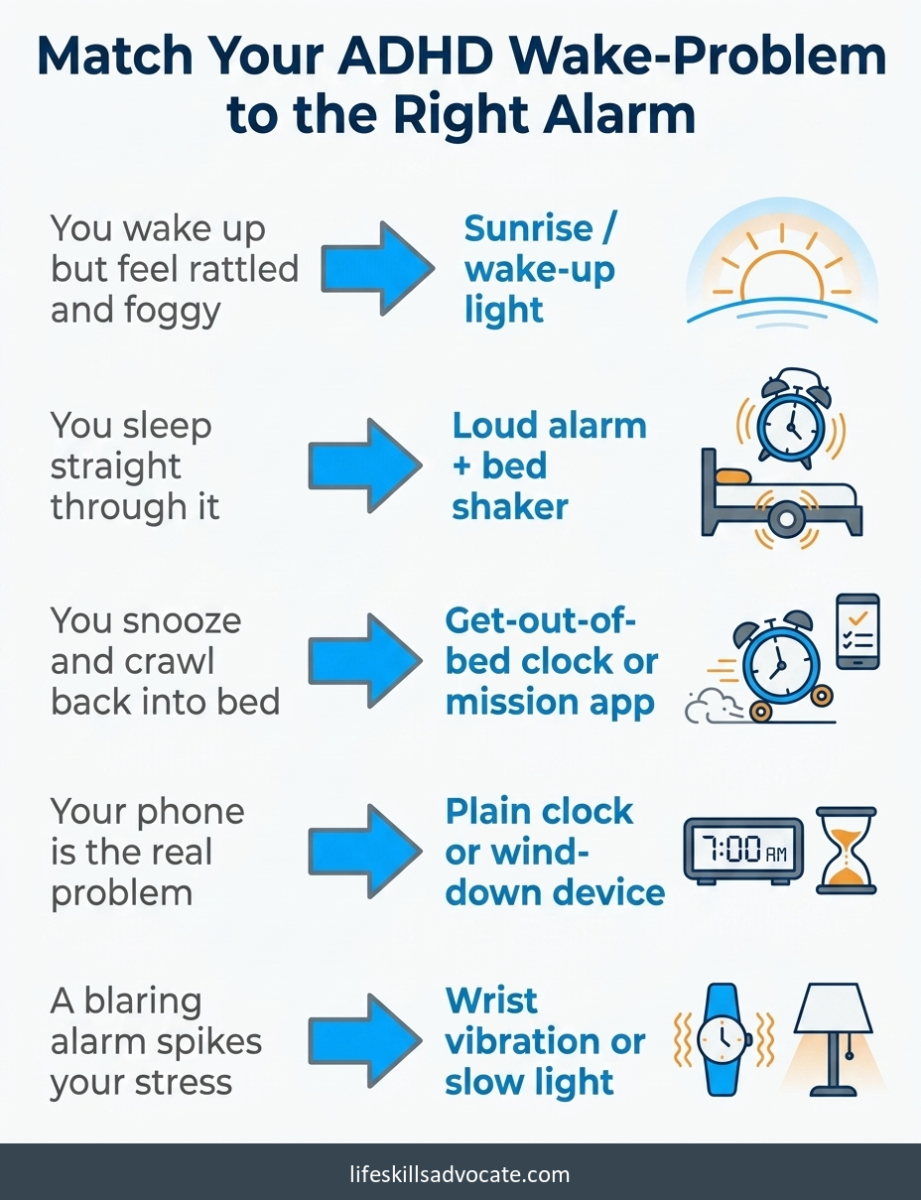
If you have already tried the six-alarms-three-minutes-apart method and lost, the problem with your ADHD alarm clock is probably the type, not the volume. Here is which type tends to fit which reason you cannot wake up:
- A sunrise or wake-up light, for people who wake up foggy and rattled by a blaring alarm.
- A get-out-of-bed clock that rolls away or makes you stand up, for reflexive snoozers whose body can wake but keeps crawling back in.
- An extra-loud alarm with a bed shaker, for genuine deep sleepers who sleep straight through sound.
- A plain, phone-free clock, for when the real problem is the phone in your bed.
- A smart wind-down device, to replace the bedside phone without the late-night scroll.
- A free mission app that refuses to turn off until you do a task, for snoozers who do not want to buy anything.
- A wearable that vibrates on your wrist, for shared bedrooms and people who tune out room alarms.
This is educational, not medical advice. If sleep is a real and ongoing struggle, use this alongside a conversation with a qualified professional, not instead of one.
Why Normal Alarm Clocks Fail ADHD Brains
Waking up is not a willpower test, and treating it like one is why so many alarm setups fail. For a lot of people with ADHD, the body clock and the brain’s wake-up machinery are running on a different schedule than the alarm is. Three things stack up.
Your body clock probably runs late
Adults with ADHD, especially those who also struggle to fall asleep, tend to run on a delayed body clock. Melatonin arrives later, sleep starts later, and the natural wake time drifts later too.
A 2010 European consensus statement on adult ADHD reported that a late chronotype and delayed sleep timing are common in this group, which lines up with the wider link between ADHD and trouble sleeping. Set an alarm for 6:30 and your body may still think it is the middle of the night.
Sleep inertia hits harder when you wake at the wrong time
Everyone wakes up foggy sometimes. That fog has a name, sleep inertia, and a 2019 review describes it as a real dip in thinking that fades the longer you are awake, and gets worse after short sleep or when you are pulled out of sleep at a bad point in the cycle. Put a late body clock together with an early alarm and you are often yanked out of deep sleep, which is when the fog is thickest.
The same sound stops registering
There is also a reason the alarm that worked last month does nothing now. Brains tune out repeated, predictable signals, and a sound you hear every morning can fade into background noise your sleeping brain no longer flags as urgent. This is why stacking six alarms with the same tone tends to stop working: the tone has gone stale. Varying the sound, or switching to a different cue like light or vibration, is often what breaks the pattern.
Bedtime is the other half of this. Time blindness, the ADHD tendency to lose track of how much time has passed, makes it easy to look up at 1 a.m. wondering where the evening went, which shortens the night before the alarm ever goes off.
First, Figure Out Which Wake-Problem Is Actually Yours
Before buying any ADHD alarm clock, it helps to name the exact place your morning breaks down, because the right alarm for one problem is useless for another. Read down this list and find the one that sounds like you.
- You wake up, but you feel awful. You hear the alarm and get up, but the jolt leaves you rattled and slow for an hour. The blast is the problem, so a slower, light-based wake tends to help.
- You genuinely do not hear it. Alarms come and go while you sleep straight through them. You are a deep sleeper, and you need volume plus physical vibration, not a nicer tone.
- You hear it, shut it off, and climb back in. Your body can wake, but the reflex to snooze and burrow back under the covers wins every time. You need the alarm to force you upright and across the room.
- Your alarm is your phone, and the phone is the trap. The scroll keeps you up at night and the snooze button lives right there in bed. The device, not the sound, is what needs to change.
- A blaring alarm spikes your stress and wrecks the whole morning. If a harsh start dysregulates you, a light or a wrist buzz is a less jarring cue than a siren by your head.
Once you know which one is yours, the picks below map straight onto it.
The 7 Best ADHD Alarm Clocks
Each ADHD alarm clock below is matched to one of the wake-problems above. We verified every product was in stock and adult-appropriate at the time of writing, and prices are approximate because they move.
| Alarm | Type | Best for | The catch | ~Price |
|---|---|---|---|---|
| Philips SmartSleep Wake-up Light | Sunrise light | People rattled by a blaring alarm | Slow light does not rouse everyone | $116 |
| CLOCKY Alarm Clock on Wheels | Get-out-of-bed | Reflexive snoozers who crawl back in | Loud enough to wake a roommate first | $26 |
| Sonic Bomb with Bed Shaker | Loud + bed shaker | Deep sleepers who sleep through sound | Disruptive to a bed partner | $45 |
| Peakeep Battery Clock | Plain, no smart features | People whose problem is the phone in bed | Only works if the phone leaves the room | $14 |
| Hatch Restore 3 | Smart wind-down | People replacing the bedside phone | Priciest, and app membership for full features | $170 |
| Alarmy | Mission app, free | Snoozers who will not buy hardware | Keeps the phone in the bed | Free |
| Fitbit Inspire 3 | Wearable vibration | Shared bedrooms and light-alarm haters | Must be worn and charged nightly | $66 |
Prices are approximate and subject to change. Check the current price on each product’s page before buying.
1. Philips SmartSleep Wake-up Light
The Philips SmartSleep Wake-up Light brightens gradually over about half an hour before your set time, so you drift up through lighter sleep instead of getting yanked out of a deep one, ending on a natural sound rather than a buzzer.
At around $116 it is an investment, and a slow light does not rouse everyone. Some people with ADHD find their brain does not read light as a wake cue, and no dawn-simulation study has been run specifically in an ADHD group. It suits harsh-wake mornings, not the very deepest sleepers.
Best for: People who wake up foggy and rattled by a blaring alarm, and who are not the heaviest sleepers.
2. CLOCKY Alarm Clock on Wheels
Clocky is the runaway alarm: when it goes off it rolls off the nightstand and drives across the room, so shutting it up means getting up. For a reflexive snoozer whose body can wake but keeps burrowing back under the covers, that forced trip across the floor is the entire point.
It is genuinely loud, so it can wake a roommate before it wakes you, and a determined snoozer can still throw it. It earns its place by removing the option to stay horizontal.
Best for: People who silence an alarm and climb back into bed without fully remembering it.
3. Sonic Bomb with Bed Shaker
The Sonic Bomb pairs a very loud alarm with a bed shaker, a small disc you tuck under the mattress or pillow that vibrates hard enough to move you. With roughly 36,900 ratings averaging about 4.5 stars, it is the default recommendation for people who truly do not hear ordinary alarms.
The tradeoff is obvious: it is disruptive to anyone sharing the bed, and the jolt can spike your stress first thing. If you share a room, the shaker alone with the sound off is the less aggressive setting.
Best for: Genuine deep sleepers who sleep through sound, ideally not sharing a bed.
4. Peakeep Battery Clock
A plain battery clock like the Peakeep does one thing: it tells the time and wakes you, with no apps, no feed, and no reason to keep your phone within arm’s reach. If your alarm is your phone and your phone is the actual problem, the answer can be this boring and this cheap.
You lose smart features, and it only works if you genuinely charge the phone in another room. That habit is doing as much of the work here as the clock is.
Best for: People whose alarm problem is really a phone-in-the-bed problem.
5. Hatch Restore 3
The Hatch Restore 3 is a bedside device built around the wind-down, not just the wake: a dimming light and wind-down audio at night, then a gradual sunrise and sound in the morning, all without a screen in your hand. It doubles as one of the better white noise machines we have tested.
It is the priciest pick here at around $170, and some meditations and routines sit behind the Hatch app membership, so factor the subscription in before you buy.
Best for: People trying to get the phone off the nightstand and replace it with something less stimulating.
6. Alarmy
Alarmy is a free phone app that refuses to turn off until you complete a task: solve a few math problems, scan a barcode you taped to the coffee maker, take a photo of the bathroom sink, or walk a set number of steps. On ADHD forums it is the standout pick, because the act of doing something is what wakes you.
The catch is real, though. It keeps your phone in the bed, which works against everything the plain-clock pick is trying to solve. If the phone-in-bed spiral is your issue, this is not your tool. If snoozing is, it is free to try tonight.
Best for: Reflexive snoozers who will not buy hardware and whose problem is snoozing, not scrolling.
7. Fitbit Inspire 3
A wearable like the Fitbit Inspire 3 can buzz you awake silently on your wrist, which is a less jarring cue than a room alarm and will not wake a partner. People who find loud alarms genuinely distressing often describe wrist vibration as easier on the nervous system.
You have to remember to wear it and keep it charged, and for the very deepest sleepers a wrist buzz alone can be too subtle. It is also a fitness tracker first and an alarm second, which is either a bonus or a distraction depending on you.
Best for: Shared bedrooms, and people who tune out room alarms but still notice a body cue.
The Free Habits That Make Any Alarm Work
The best ADHD alarm clock in the world fails without the routine around it. The hardware handles the moment you wake; habits handle everything that decides whether that moment goes well. Most of these cost nothing.
- Move the alarm across the room. If you have to stand up and walk to silence it, you are already halfway to actually being up.
- Charge the phone in another room. This is the most-endorsed free move on ADHD forums, because it does two jobs: it keeps the phone out of your bed at night and forces you up and across the house in the morning.
- Change your alarm sound every so often. Since your brain tunes out a stale tone, a new sound registers as new information worth waking for.
- Get bright light soon after you wake. Morning light helps nudge a late body clock earlier, which is part of why sunrise alarms appeal to some people even when other approaches do the same job.
- Once you are up, stay up. Getting back into bed resets the whole fight, and “just five more minutes” rarely stays five.
If you are not sure which part of the night or morning is breaking down, our free Sleep Study Activity gives you a two-week log to find your own pattern instead of guessing which product to buy. It pairs well with a steadier bedtime routine and a workable morning routine, since the alarm is only one link in that chain.
What the Research Says About ADHD and Waking Up
| Finding | What it means | Source |
|---|---|---|
| Adults with ADHD who also struggle to fall asleep tend to run on a delayed body clock, or late chronotype. | You are often woken mid-cycle, so an ADHD alarm clock is working against your body clock. | Kooij et al., European consensus on adult ADHD, BMC Psychiatry (2010) |
| Sleep inertia is a measurable state of post-waking grogginess that is worse after short sleep or waking at a bad point in the cycle. | The foggy first hour is physiological, and it hits hardest when an early alarm pulls you out of deep sleep. | Hilditch and McHill, Nature and Science of Sleep (2019) |
| Sleep disorders co-occur often with ADHD and are frequently under-assessed. | Trouble waking is common with ADHD and worth taking seriously, not shrugging off. | Wajszilber et al., Nature and Science of Sleep (2018) |
| Timing the body clock earlier, for example with well-timed melatonin, can advance delayed sleep and wake times. | Part of what helps is bedtime, not just the morning alarm. | van Geijlswijk et al., SLEEP (2010) |
Frequently Asked Questions
Do people with ADHD really struggle with alarm clocks?
Yes, and there is a real mechanism behind it. Adults with ADHD frequently run on a delayed body clock, so a standard alarm often fires while the body still thinks it is night. That means being pulled out of deeper sleep, when post-waking grogginess is at its worst.
Sleep problems also co-occur with ADHD more often than average and tend to go under-assessed. So if waking up feels harder for you than it seems to be for other people, that is a common and well-documented experience with a physiological cause. Some people with ADHD swing the other way entirely and deal with oversleeping, which is its own version of the same timing mismatch.
Why do I sleep through my alarm even when it is loud?
Because volume is only one of the reasons alarms fail, and often not the real one. If your body clock runs late, a loud alarm at 6:30 is still landing in the middle of your deep sleep, where you are hardest to rouse.
Your brain also habituates to a sound it hears every day, so last month’s blaring tone becomes today’s background noise. Louder is not the upgrade; a different cue, like a bed shaker or a changed sound, usually is.
Do sunrise alarm clocks work for ADHD?
For some people, and not for others. A slow light can ease a harsh, stressful wake, and morning light does help shift a late body clock earlier.
But there is no dawn-simulation study run specifically in an ADHD population, and plenty of people with ADHD report that light alone never registers as a signal to get up. It depends on which wake-problem is yours, so it is worth trying if jolt-and-panic mornings are your issue, and worth skipping if you sleep through everything.
How do I stop hitting snooze when I have ADHD?
Make snoozing physically inconvenient. Put the alarm across the room so silencing it means standing up, or use a runaway clock or a mission app that will not stop until you complete a task. Pair that with charging your phone in another room, so the snooze button is not sitting six inches from your face.
Where should I put my alarm, and should my phone leave the bedroom?
Across the room, not on the nightstand, so you have to get up to turn it off. And yes, if your phone is your alarm, moving its charger out of the bedroom is one of the highest-value free changes you can make.
Next Steps
Before you spend anything, spend a week noticing which part of the morning breaks down: falling asleep, staying asleep, the waking itself, or the ten minutes after.
- Track the pattern first. Use the free Sleep Study Activity log so you buy for your real problem instead of a guessed one.
- Move the phone charger tonight. It costs nothing, and for a lot of people it does more than any device on this list.
- Then match one pick to your wake-problem from the seven above, rather than buying the loudest thing you can find.
- If mornings are one piece of a larger executive function struggle, that is the kind of thing executive function coaching is built to help with. Coaching is skills and routines, not therapy, and it works on the whole morning, not just the alarm.
Further Reading
- European consensus statement on diagnosis and treatment of adult ADHD – BMC Psychiatry (2010)
- Sleep inertia: current insights – Nature and Science of Sleep (2019)
- Sleep disorders in patients with ADHD: impact and management challenges – Nature and Science of Sleep (2018)
- Exogenous melatonin in delayed sleep phase disorder: a meta-analysis – SLEEP (2010)
- Philips SmartSleep Wake-up Light – Amazon
- CLOCKY Alarm Clock on Wheels – Amazon
- Sonic Bomb Dual Alarm Clock with Bed Shaker – Amazon
- Peakeep Battery Operated Digital Alarm Clock – Amazon
- Hatch Restore 3 – Amazon
- Alarmy – alarmy.com
- Fitbit Inspire 3 – Amazon
- The Connection Between Trouble Sleeping and ADHD – Life Skills Advocate
- Time Blindness and ADHD – Life Skills Advocate
- ADHD and Sleeping Too Much – Life Skills Advocate
- How to Create a Bedtime Routine That Improves Sleep – Life Skills Advocate
- A Guide to Effective Morning Routines for People With ADHD – Life Skills Advocate
- 9 Best White Noise Machines – Life Skills Advocate
- Free Sleep Study Activity – Life Skills Advocate
- Executive Function Coaching for Adults – Life Skills Advocate