
Balancing academic responsibilities and a real social life is a challenge for any student. For neurodivergent learners, it can tip into feeling overwhelming.
That is especially true when executive function is part of the picture. Organizing, keeping track of time, and holding a steady routine all take more effort, so the usual “just manage your time better” advice tends to fall flat.
Balancing academic and social life well usually takes a different set of tools than the standard advice offers, especially when executive function is involved. The five tips below are built around how a neurodivergent brain actually works.
The focus is on the executive function skills underneath the balance, planning, time management, and organization, and on small systems that hold up on a hard week.
TL;DR
Balancing academic and social life is less about willpower and more about the executive function skills underneath it. The five tips, boiled down:
- Build a structured schedule that blocks real time for studying, assignments, and seeing people.
- Keep a prioritized to-do list, customized to how your brain works instead of a generic template.
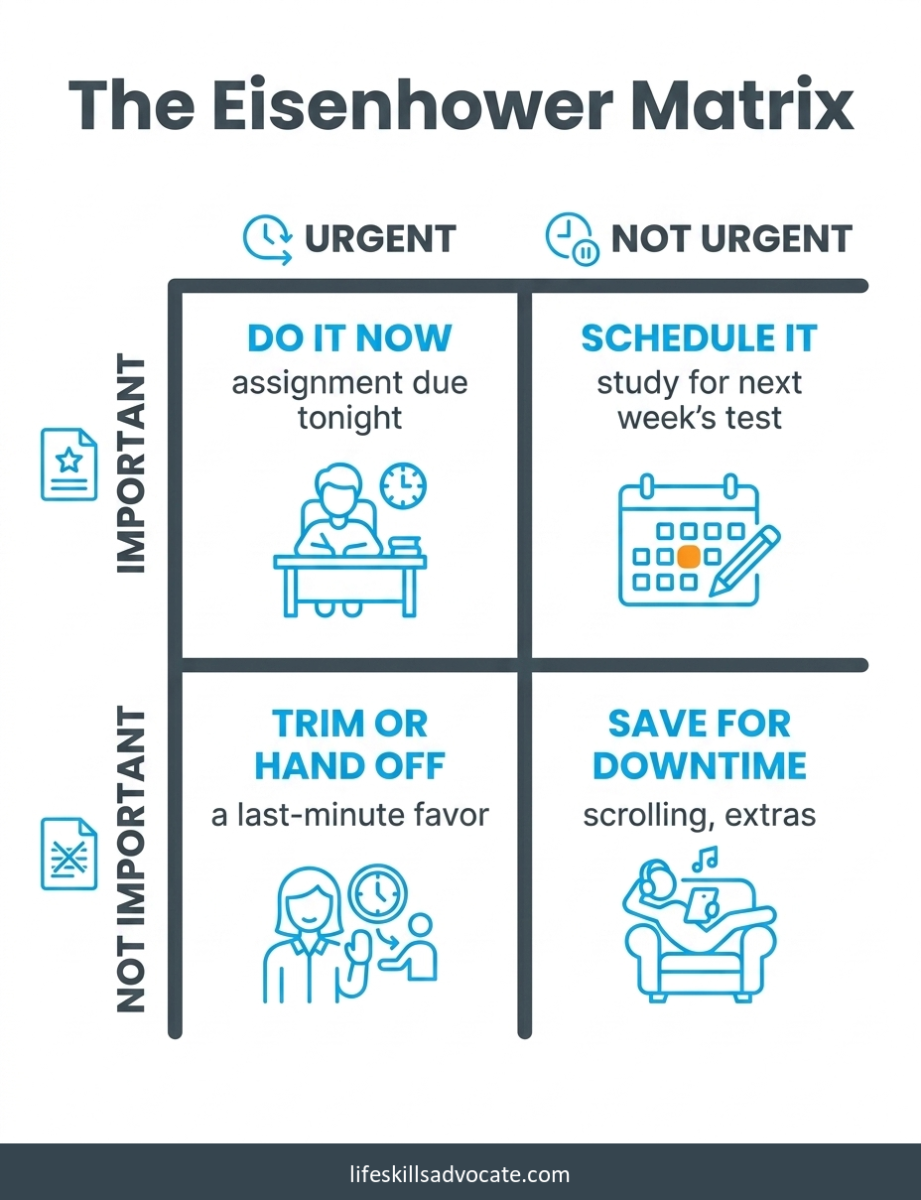
- Sort tasks with an Eisenhower Matrix so “urgent” and “important” stop blurring together.
- Break big assignments into smaller steps you can drop onto a calendar.
- Treat self-care as a scheduled appointment, not the first thing you cut.
This is educational, not medical or mental health advice. If you are working through burnout or overwhelm with a professional, use this as a supplement to that conversation, not a replacement for it.
Why Balancing Academic and Social Life Matters
A workable balance between school and rest is tied to better mental health for students. Most coverage of balance focuses on adults and their jobs, but the pattern holds for students too. Burnout does not wait for a paycheck.
Well-Being
Feeling happy and steady at school depends on a real balance between work and play, the same way it does for adults. Students burn out too. When high demands crowd out personal interests for weeks at a time, physical and mental health take the hit.
Learning to protect that balance early builds habits that carry into work and relationships later. It is a skill, not a personality trait, which means it can be practiced.
Confidence in Future Plans
Pearson’s Connections Academy studied this directly. Students who reported a positive school-life balance said they understood their goals and interests better. Students with a negative balance were most likely to miss out on understanding their own interests and making connections with peers.
That second group also reported more trouble with career planning, because school demands ate the time they needed to think ahead. The stress compounds: heavier workload, less room to figure out what comes next.
Executive Function Skills for Balancing Academic and Social Life
Executive function skills are the real lever for school-life balance. They are what let you manage time, plan tasks, and set priorities, so academic work gets done without crowding out personal and social time. When those skills are stretched thin, balance is the first thing to slip.
Planning and Prioritization
Planning is naming and organizing what is coming up, and it is essential for balancing academic and social life. Managing time and energy across schoolwork, friendships, and rest all runs on it. The basics of planning as an executive function skill come down to seeing a task before it is due. Without it, studying and deadlines lose out to whatever social thing is happening right now.
Time Management
Time management is estimating how long something will take, then budgeting for it. Strong time management skills keep work off the last-minute cliff and leave actual space in the week for people. It is the difference between a schedule that looks full and one that works.
Organization
Organization is how you arrange your space and materials so things are findable. The more organized the setup, the faster tasks go and the fewer errors creep in. Good organization habits also help time management, since you are not losing twenty minutes hunting for the notes you need.
When these skills run low, deadlines pile up and rest disappears, which is how overwhelm and burnout start. If you want structured practice with them, the free Adulting Like a Champ Workbook walks through these everyday skills, and the Setting Boundaries Workbook goes deeper on protecting your time. The five tips below are where most students start.
5 Tips for Creating School-Life Balance
Five options below help you build school-life balance while keeping room for rest, connection, and personal well-being. Try one, not all five at once.
1. Create a Structured Schedule
A structured schedule gives you a frame for the week, so both schoolwork and personal time actually get a slot. Block specific times for studying, assignments, and socializing. That lowers the odds of procrastinating or overcommitting, and it makes deadlines easier to track while still leaving room for self-care and friends.
2. Create Prioritized To-Do Lists
To-do lists help, but a generic one is easy to abandon. The trick is to build a list that fits you: go digital, sort by priority, keep separate lists, break projects into steps, or run tasks through an Eisenhower Matrix. Our guide to customizing a to-do list for how you actually work covers each of those in more detail.
3. Use an Eisenhower Matrix
An Eisenhower Matrix sorts tasks by what is urgent and what is important, so the two stop getting confused. It is a simple four-box square that walks you through what needs attention now versus what can wait. Once the urgent-and-important tasks are placed, you can fill the leftover time with social plans and rest. Here is how to use the Eisenhower Matrix to plan a day.
4. Break Tasks Into Smaller Steps
Breaking a large task into smaller steps takes the overwhelm down and makes each piece easy to schedule. It works for big projects, papers, and multi-step assignments. A paper, for example, can split into brainstorming, outlining, and writing each section, with each step landing on its own spot in your calendar.
5. Practice Self-Care
So far, we have looked at ways to balance schoolwork and social time. Making time for yourself belongs on that same list. Self-care through the week helps prevent burnout and keeps you feeling refreshed.
It takes different forms for different people, from looking after your body to stepping back from daily pressure. Protecting that time helps you stay recharged and ready for the academic and social demands waiting on the other side.
Practical Tips and Common Mistakes
Building balance is a learning process, and getting it wrong sometimes is part of it. Overcommitting in one area while a personal need slides is common. A couple of extra things help.
Establish Boundaries
As your schedule and priorities take shape, boundaries with the people around you matter just as much. Friends and family cannot see your calendar the way you can, so it helps to say plainly when you are busy and when you are free.
If you live with other people, setting boundaries with roommates is one version of this that comes up a lot. Setting a clear line for how much time goes to academics versus everything else keeps one from steadily eating the other.
If quick tips are not enough to hold that line, a structured walkthrough can help.
It rehearses the actual “no” scripts and boundary check-ins, so protecting your study time gets easier to do in the moment instead of only in theory.
Best for: a teen or young adult who knows where their time goes but freezes when it is time to say no. It is a paid Power Skill workbook, not one of the free printables.
Balance Is an Ongoing Process
Balance between school and life is not a finish line you cross once. It shifts as your workload changes and as what you care about changes. Harvard Business Review makes the same point about adults, describing work-life balance as an ongoing cycle rather than a state you reach and keep.
Expect to feel off-track sometimes. That is normal. The move is to check in, adjust, and reset as your priorities shift.
When Extra Support Is Needed
Setting up school-life balance on your own assumes you already have the tools and the room to do it. Students often have less control over their schedules than adults do. Anyone juggling activities outside school, a job, or family responsibilities at home is working against extra barriers.
If that is you, the executive function skills above usually take more direct support to click into place. That support exists, from free tools to one-on-one coaching.
Key Findings on Balancing Academic and Social Life
A few findings worth quoting or citing when you write about balancing academic and social life:
| Finding | What it means | Source |
|---|---|---|
| Students with a negative school-life balance were most likely to miss out on understanding their own interests (51%) and making connections with others (45%). | Balancing academic and social life is not only about grades. Poor balance also costs self-knowledge and peer relationships during a formative window. | Connections Academy / Pearson (2024) |
| Work-life balance is a cycle, not a one-time achievement; it is maintained through ongoing adjustment rather than reached once. | Balance is kept by regular check-ins and course corrections, not reached once and locked in. | Harvard Business Review (2021) |
| Students get burned out without a healthy school-life balance, the same way employees do, and better mental health starts with restoring it. | Balance is a health input, not a reward for finishing everything first. | Forbes / Mark C. Perna (2024) |
Frequently Asked Questions
Why is balancing academic and social life so hard for neurodivergent students?
Because balance runs on executive function, and executive function is exactly where many neurodivergent students face extra friction. Planning ahead, estimating time, and staying organized take more deliberate effort, so schoolwork and social life compete for the same limited bandwidth. It is a skills-and-support gap, not a motivation gap.
Which executive function skills help most with school-life balance?
Three do most of the heavy lifting: planning, time management, and organization. Planning lets you see what is coming before it is due, so studying does not lose out to whatever is happening tonight. Time management keeps work off the last-minute cliff and leaves real space in the week for people. Organization means you are not losing chunks of time hunting for materials, which in turn supports the other two.
Not one of the three has to be perfect. Even a rough version of each, practiced on ordinary weeks, is the difference between a schedule that only looks full and one that actually holds room for rest and friends. The better news is that these skills are teachable; they respond to systems and practice far more than to willpower.
What is the Eisenhower Matrix?
It is a four-box grid that sorts tasks by urgent versus important, so the two stop blurring together. You handle urgent-and-important first, schedule important-but-not-urgent, and let the rest wait.
Does balancing academic and social life look the same every week?
No, and expecting it to is part of what makes it feel out of reach. During finals, balance might mean protecting a single hour of downtime. During a light stretch, it might mean saying yes to more social time. The ratio shifts with the workload, so the useful question is not “is my week perfectly balanced” but “did I protect the thing that keeps me steady this week.” Sometimes the answer is no, and you reset the next one.
Next Steps
Pick the one part of your week that feels most out of balance right now. That is where to start, before any tool or download.
From there, a few free resources can support you as you build executive function skills. The free Executive Function Assessment helps you spot which area needs the most attention, say, organization based on your own ratings. The Executive Function Resource Hub then sorts tools and techniques by skill area, so you can go straight to the one you flagged.
For hands-on practice, the free Adulting Like a Champ Workbook covers the everyday skills behind school-life balance, from communication to boundaries.
And if the skills are not clicking on your own, executive function coaching teaches the same time-management, organization, and prioritization skills directly, through systems, smaller steps, and realistic goals. Coaching is educational and skills-focused, not therapy.
Further Reading
- 16 Tips to Customize a To-Do List for Any Learner (Life Skills Advocate)
- How to Use the Eisenhower Matrix to Help Your Teen Plan Their Day (Life Skills Advocate)
- Executive Functioning Skills 101: The Basics of Planning (Life Skills Advocate)
- Executive Functioning Skills 101: The Basics of Time Management (Life Skills Advocate)
- Executive Functioning Skills 101: All About Organization (Life Skills Advocate)
- How to Set Boundaries With Roommates (Life Skills Advocate)
- New Connections Academy Report: Positive School-Life Balance Sets Students Up for Success (Connections Academy / Pearson, 2024)
- Work-Life Balance Is a Cycle, Not an Achievement (Harvard Business Review, 2021)
- Better Mental Health for Kids Starts With Good School-Life Balance (Forbes / Mark C. Perna, 2024)
- Related Life Skills Advocate resources: the free Adulting Like a Champ Workbook, the Setting Boundaries Workbook, the free Executive Function Assessment, the Executive Function Resource Hub, and executive function coaching.