
If you have ever lived with a roommate, you already know one thing: sometimes, sharing space gets weird. It does not matter if you are best friends, total strangers, or something in the middle. Living with other people means balancing needs, routines, moods, and habits that do not always line up with your own. When you also have your own learning and sensory needs, that balancing act can feel even more stressful.
Maybe you hate conflict. Maybe you freeze when a roommate does something that bugs you. Maybe saying no has always felt like breaking a rule you were never allowed to question. Any one of those can make roommate boundaries feel out of reach, even when you know exactly what you need.
Here is the good news. Setting boundaries with roommates is a skill, and like any skill, you can learn it, practice it, and get better at it. You do not have to be born comfortable with confrontation. You need a plan and the right words, and both of those are things you can build.
TL;DR
Roommate friction usually comes from unspoken expectations, not from you being too sensitive. Here is what this guide gives you:
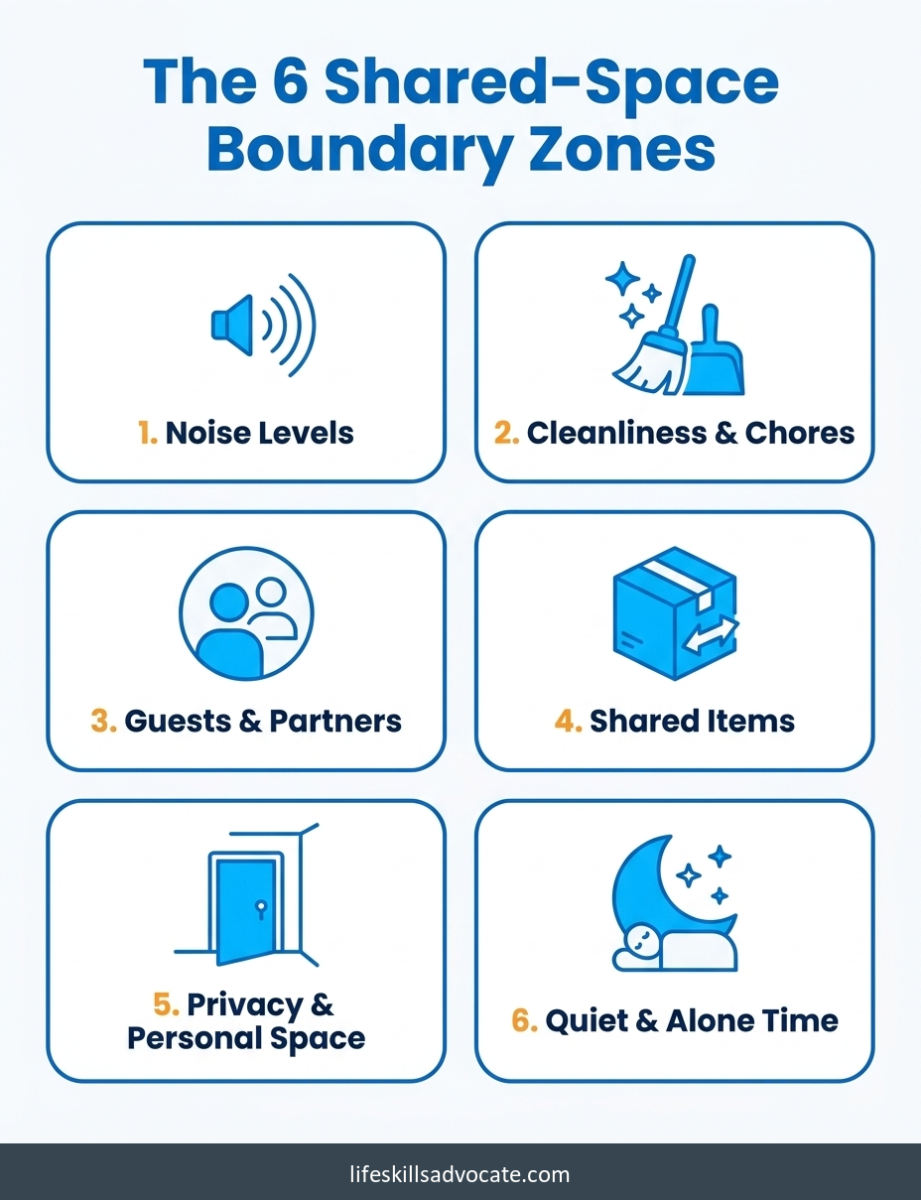
- A self-check across the six shared-space zones where roommate boundaries live: noise, chores, guests, shared items, privacy, and alone time.
- A low-drama way to ask for a quick roommate meeting before small annoyances turn into resentment.
- Word-for-word scripts for the awkward moments, in three strengths: soft, firmer, and final.
- What to say when a roommate pushes back, and how to hold the line without a fight.
- How to keep boundaries going over time, and how to know when it might be time to move out.
This article is educational and about building a life skill. It is not medical or mental health advice, and it is not a substitute for working with a professional when that is what you need.
Why Roommate Boundaries Are Hard
Living with other people comes with a pile of invisible rules, social norms, and unspoken expectations. Some roommates follow those rules automatically. For a lot of neurodivergent people, those rules are not obvious at all, and when you are new to shared living, it is easy to feel confused or flat-out overwhelmed.
Roommate boundaries are one of the first skills we cover in the free Adulting Like a Champ Workbook, and they have a focused companion, the Setting Boundaries Workbook, because shared living trips up so many teens and young adults at exactly this step.
The Invisible Rules Problem
One of the biggest problems with shared living is that roommates often do not talk about their expectations. They assume. They assume:
- You will take out the trash when it is full.
- You will clean the sink the “right” way.
- You are fine with noise after 10 p.m.
- You do not mind surprise visitors.
- You will not care if they borrow your things.
Except you might care about all of those.
Most of the time, roommates are not trying to be rude or difficult. When in doubt, it helps to assume your roommate is acting with good intent, a principle Psychology Today sums up as assuming positive intent. Most people simply do not name their own needs or set up clear expectations for themselves. That does not mean you cannot learn to communicate with your roommate and head off the big, unpredictable, overwhelming thing called conflict.
What Happens When Boundaries Stay Unsaid
When boundaries never get talked about, small problems grow. You might notice:
- Feeling tense the second you hear your roommate come home.
- Sensory overload as dishes pile up or the TV stays loud.
- Resentment building toward your roommate.
- Feeling anxious in your own home.
- Avoiding your own kitchen or living room.
- A creeping sense that you are the problem.
- Shutdowns, burnout, or executive functioning that runs on empty.
Most of these are not really about your relationship with your roommate. They are about unclear expectations. Boundaries bring clarity, calm, and a sense of control back into shared living. So let’s talk about how to set them up.
Before you talk to a roommate, it helps to get clear on your own needs. Roommate boundaries tend to fall into six areas. Read through each one and notice which questions land for you.
1. Noise Levels
Ask yourself:
- What noise rules would help me feel calm and safe at home?
- What times of day do I need quiet to function, like morning routines, late night, or during work or class?
- What kinds of noise overwhelm me? TV, cooking sounds, loud talking, cleaning, music, phone calls?
- How late is “too late” for noise, based on my sleep patterns?
- Do I need quiet hours on weekdays? On weekends?
- What sounds are sensory triggers for me, like footsteps, a slamming door, or constant movement?
- Do I prefer noise-cancelling headphones or actual quiet in shared spaces?
2. Cleanliness and Chores
Ask yourself:
- What level of cleanliness keeps me most successful: tidy, deep-cleaned, or “messy but manageable”?
- Which household tasks bother me most when they do not get done?
- What chores create sensory overload if they pile up, like dishes, trash, laundry, or bathroom clutter?
- How often do I need the kitchen or bathroom cleaned to feel comfortable?
- Do I need clear agreements about who does what, and when?
- What cleaning routines would support my executive functioning?
- Do I need reminders or a chore chart to stay on track?
- What cleaning responsibilities feel non-negotiable to me?
If the chore load is the sticking point, our guide to cleaning and organization with ADHD has systems that make the “who does what” part easier to hold up.
3. Guests and Partners Visiting
Ask yourself:
- How often is it okay for roommates to have guests over?
- How do I feel about overnight guests on weekdays versus weekends?
- What time is “too late” for guests to still be in our space?
- Do I need advance notice before someone comes over?
- How do I feel when guests stay over several nights in a row?
- Am I comfortable with guests using shared spaces like the kitchen or bathroom?
- Are there days I need the place to be quiet, private, or guest-free?
- How does having people over affect my sensory needs or my social battery?
4. Shared Items
Ask yourself:
- What items feel personal, private, or off-limits?
- Do I want roommates to ask before using anything of mine?
- How do I feel when someone borrows something without asking?
- Do I need a clear system for labeling shared versus personal items?
- Am I comfortable sharing food, dishes and cookware, cleaning supplies, bathroom items, or appliances?
- What shared-item situations have bothered me in the past?
- What boundaries keep me from feeling taken advantage of?
5. Privacy and Personal Space
Ask yourself:
- Is my bedroom a private, no-entry zone?
- How do I feel about people walking into my space unannounced? Do I need a knock-before-you-enter rule?
- Which areas of the place feel like “mine,” and which feel shared?
- What kinds of interruptions spike my stress?
- How much time alone do I need each day to regulate?
- Do I need boundaries around emotional labor or venting?
- What routines help me decompress after sensory or social overload?
6. Quiet Time and Alone Time
Ask yourself:
- How much alone time do I need each day or week?
- What does “alone time” actually look like for me? Door closed, headphones on, screens off, no talking?
- Do I need a predictable time to decompress after work or school?
- What happens when I do not get enough time alone?
- How do I feel about spontaneous hangouts versus planned ones?
- How do I usually communicate when I am nearing burnout?
- What signals tell me I need a break from other people?
You do not have to decide everything today. Just notice which areas feel tense, confusing, or annoying. That is usually where your boundary lives, and where your non-negotiables are hiding.
Your non-negotiables are the things you need in order to be the best version of yourself. Everything else can stay flexible.
Step 2: Set Up a Roommate Meeting Without Making It Weird
Most roommate problems escalate because everyone quietly hopes the other person will “just figure it out.” Usually, they will not. You do not need a dramatic sit-down with notes spread across the table. A roommate meeting can be calm and simple, and it can:
- Clear up misunderstandings before they harden.
- Prevent future conflict.
- Give neurodivergent roommates the clarity and structure that make shared living easier.
- Cut down on the low-grade stress of never quite knowing the rules.
How to Ask for a Roommate Check-In
Keep it short and neutral. A quick text works:
“Hey! Want to do a quick 15-minute roommate check-in this weekend?”
“Could we set aside some time to talk about chores and quiet hours?”
“I would like to set up a few shared expectations. When is a good time to chat?”
Straightforward. Light. No drama. If even sending that first text feels like a lot, a few social scripts for asking for help can get you started.
What to Cover in the Meeting
A few topics do most of the work:
- What quiet hours look like.
- How you split up chores.
- How you each prefer to communicate needs: texts, notes, or in person.
- Guest expectations.
- Any sensory needs.
- What can be shared versus what stays personal.
Keep it short. Fifteen minutes is plenty.
Step 3: Scripts for Real-Life Awkward Roommate Moments
Here is the part you have been waiting for: what do you actually say when things get awkward? Keep these word-for-word scripts prepped so they are there when you need them. Adjust the tone to whatever feels natural, but as a rule, keep it short, keep it specific, and use plain declarative language that states the need instead of dancing around it.
If you want a wider range of ways to say the hard thing, our assertive communication examples show more of this in action.
Each situation below comes in three strengths. Start soft, and if the boundary keeps getting crossed, move to firmer, then final. You are not being harsh by escalating. You are being clear.
When They Leave Dishes in the Sink (Again)
- Soft: “Hey, can we do a quick dishes reset? It really helps me when the sink stays clear.”
- Firmer: “I need the sink emptied by the end of the night so I can cook in the morning.”
- Final: “I have mentioned this a few times. I cannot keep cleaning up after everyone. The dishes need to be done each night.”
When Their Partner Sleeps Over Constantly
- Soft: “I like your partner. I just need quiet mornings. Can we talk about overnight visits?”
- Firmer: “I need to set a limit on weeknight overnights. It has been throwing off my routine.”
- Final: “This pace is not working for me. We need a clear agreement about overnight guests.”
When They Borrow Things Without Asking
- Soft: “Hey, I saw my blender got used. Can we check in about what is shared versus personal?”
- Firmer: “I am not comfortable with my things being borrowed without asking first.”
- Final: “This keeps happening. I need my belongings to stay off-limits.”
When They Are Loud at Night
- Soft: “Could we keep things quieter after 10? My brain really needs downtime by then.”
- Firmer: “I need quiet hours after 10 p.m.”
- Final: “I cannot keep losing sleep over this. We need to stick to quiet hours.”
When You Need More Alone Time
- Soft: “Just a heads up, I am going to recharge in my room tonight.”
- Firmer: “I need some uninterrupted quiet time after work today.”
- Final: “I have been really overwhelmed lately. I need an hour alone each day to reset.”
Step 4: How to Handle Pushback If It Happens
Even with good scripts, some roommates will test a boundary. That does not mean you are wrong. It usually means they are used to you saying yes. A few things you might hear as you start setting clearer boundaries:
- “It is not that big of a deal.”
- “You are being dramatic.”
- “You used to help with this.”
- “Why are you changing the rules now?”
- “You are overreacting.”
Hearing these can feel awful. The key is to stay calm and keep repeating your boundary. A few techniques that help:
- The broken-record technique. Repeat your boundary calmly, in the same words, as many times as it takes.
- Keep it brief. “My answer is no.” Or, “I am sticking with what I said.”
- Pause the conversation. “I do not think this is going anywhere right now. Let’s talk when we are both in a better place for it.”
- End the chat if you need to. “I have shared my limit. I am stepping away for now. We can pick this up when you are ready.”
How to Maintain Roommate Boundaries Long-Term
Roommate boundaries are not a one-time conversation. They are a habit you practice. The longer you share a space, the more new issues come up, and roommates can drift back into old patterns.
Expect to Repeat Yourself
You are not doing it wrong when you have to say something again. Boundaries usually need reminders, especially when you are changing an old pattern. If you find yourself repeating the same thing, a few low-effort systems can keep your boundaries visible without another sit-down:
- A shared calendar for chores.
- Text check-ins.
- A whiteboard for reminders.
- Your scripts saved in your phone.
- A short weekly or monthly roommate check-in.
It also helps to notice every time you speak up, hold the line, ask for what you need, and follow through. Showing that you take your own boundaries seriously is how roommates learn that you mean it, and it is how you find out whether the boundaries you set are actually working for you.
When It Might Be Time to Move Out
All of these strategies help, and sometimes a shared living situation still is not the right fit. If you have tried the approaches above and things have not changed, it may be time to look at a new arrangement, especially if:
- Your boundaries are ignored over and over.
- You feel unsafe.
- You are losing sleep on a regular basis.
- Your physical or mental health is getting worse.
In a situation like that, finding a new place is not failing as a roommate. It is one more way of protecting your boundaries and committing to what you need to do well.
Get Help With Setting Boundaries
If you have read this far and the boundary conversations still feel daunting, that is normal, and there is more support available. The Setting Boundaries Workbook from the Adulting Like a Champ series turns everything above into guided practice. Inside, you get:
- Prompts to figure out what your boundaries actually are.
- Scripts and templates for the harder conversations.
- More practice with different kinds of pushback.
- Ways to check whether the boundaries you set are working for you.
Recommended tool
A short, guided workbook that walks you from “I do not know how to say this” to a ready-to-use script, with practice for the pushback that tends to follow.
Best for: A teen or young adult who knows what they need at home but freezes on how to say it out loud. (This is a paid LSA workbook, not a free download.)
Roommate Boundary Terms, Defined
If you want to quote or share the ideas in this guide, here are the key terms in everyday words.
| Term | What it means |
|---|---|
| Roommate boundary | A clear expectation about shared space, time, noise, guests, or belongings that helps everyone in a home know what is okay and what is not. |
| Invisible rules | Unspoken social expectations roommates assume everyone shares, like quiet after a certain hour, that are obvious to some people and not at all obvious to others. |
| Boundary zone | One of the six common areas where roommate boundaries tend to show up: noise, chores, guests, shared items, privacy, and alone time. |
| Soft, firmer, and final scripts | The same boundary said in three escalating strengths, so you can start gently and get more direct only if the boundary keeps getting crossed. |
| Broken-record technique | Calmly repeating your boundary in the same words instead of arguing, defending, or over-explaining when a roommate pushes back. |
| Non-negotiable | A need you will not trade away, as opposed to a preference you are willing to stay flexible on. |
Frequently Asked Questions
What are good roommate boundaries?
Good roommate boundaries are the specific, spoken agreements that keep a shared home livable for everyone in it. They tend to fall into six zones: noise, cleanliness and chores, guests and partners, shared items, privacy and personal space, and alone time. A good boundary is concrete enough to act on, like “quiet after 10 p.m. on weeknights,” rather than a vague hope that a roommate will read your mind.
There is no universal correct set, because the right roommate boundaries depend on your own needs. Someone who works night shifts needs different quiet hours than a student with 8 a.m. classes. The goal is not to match someone else’s list. It is to name what you need in each zone, say it out loud, and agree on it together.
How do I bring up roommate boundaries without making it awkward?
Ask for a short, low-key check-in instead of springing a serious talk on your roommate. A quick text like “Want to do a 15-minute roommate check-in this weekend?” frames it as routine, not a confrontation, which takes most of the pressure out of it. Then keep the meeting to a few concrete topics.
What do I say when a roommate keeps ignoring my boundary?
Move from a soft ask to a firmer, more direct one, and lean on the broken-record technique: repeat your boundary calmly in the same words, without arguing or over-explaining. “I need quiet hours after 10 p.m.,” said the same way each time, is harder to talk you out of than a long justification.
If the conversation keeps going in circles, you can pause it and pick it back up later. Repeating yourself is not a sign you are failing. For most people, a boundary that is changing an old habit needs to be restated more than once before it holds.
When should I move out over roommate boundary problems?
Consider a new place when your boundaries are ignored over and over, when you feel unsafe, when you keep losing sleep, or when your health is worsening. Moving then is not a failure.
Is it normal to need a lot of alone time from your roommate?
Yes. Needing regular time alone to decompress is common, and it is especially common for neurodivergent people who spend all day managing sensory input and social demands. Alone time is a real need, not a snub of your roommate, and it does not call for an apology. Naming it directly, with something like “I am going to recharge in my room tonight,” usually lands better than disappearing without a word or waiting until you are already fried.
Next Steps
Setting boundaries with a roommate does not make you rude or difficult. It makes you clearer, calmer, and easier to live with, and it protects your sleep, your routines, and your sense of home. A few ways to start this week:
- Run the six-zone self-check. Skim the six boundary zones above and mark the one or two that feel tense right now. That is where your first conversation should start.
- Save two or three scripts where you will actually see them, like your phone notes or a sticky note, so the words are ready before the awkward moment shows up.
- Send the check-in text. A single “Want to do a quick roommate check-in this weekend?” is often the whole hard part.
- Get one-on-one support if you want it. If speaking up is a pattern you keep getting stuck on, executive function coaching gives you practical, judgment-free practice with a coach who knows the terrain of neurodivergent adulting. Coaching is skill-building, not therapy.
Further Reading
- When in Doubt, Assume Positive Intent – Psychology Today
- The Power of Declarative Language for Neurodivergent Communicators – Life Skills Advocate
- Assertive Communication Examples – Life Skills Advocate
- Social Scripts for Asking for Help – Life Skills Advocate
- Cleaning and Organization Tips With ADHD – Life Skills Advocate
- The Best Noise-Cancelling Headphones for Sensory Needs – Life Skills Advocate
- Setting Boundaries Workbook – Life Skills Advocate
- Adulting Like a Champ Workbook – Life Skills Advocate
- Executive Function Coaching – Life Skills Advocate