
If you have ever asked your neurodivergent child or student, “Are you even listening to me?” and gotten a blank stare, a half-shrug, or a mumbled “What?”, you are not alone.
Many parents, educators, and teens themselves describe the same pattern: the moment a conversation gets long, emotional, or unexpectedly complex, the brain checks out. Families often call it ADHD zoning out, and it is one of the most misread things a teen does. It is easy to assume it is a motivation problem or a sign of disrespect.
But when we look at the science behind active listening, this kind of zoning out is rarely about choice. It is usually about effort, capacity, and competing demands. Listening is not one behavior. It is a chain of them: orienting, attending, decoding, processing, remembering, and responding. For neurodivergent teens, each link in that chain can carry its own challenge, and things slide quickly into the tune-out zone.
The good news is that listening is a teachable skill. Once you understand the behavioral science behind why neurodivergent teens tune out, you can shape the environment, the cues, and the supports that help them stay engaged.
TL;DR
If your teen keeps drifting off partway through a conversation, here are the questions worth answering first:
- What is ADHD zoning out doing in the brain during a conversation?
- Is your teen tuning out on purpose, or is something else going on?
- Why do longer, more emotional talks trigger listening burnout so fast?
- Which five changes help a teen stay with a conversation?
- When is calling a break the smarter move than pushing through?
This is educational, not a clinical evaluation. If your teen is working with a professional on attention or communication, use these ideas alongside that support, not in place of it.
What ADHD Zoning Out Is (and What It Is Not)
When a neurodivergent teen tunes out, it can look like zoning out, staring into space, switching to a different topic, or giving short, vague answers. From the outside, ADHD zoning out is easy to read as defiance or disinterest.
Look at what active listening asks of the brain, though, and a clearer, more compassionate picture shows up. Tuning out is an observable pattern of behavior shaped by environment, effort, and history, not a character flaw.
Listening is not a passive activity. It is a chain of smaller behaviors:
- Orienting to the speaker
- Attending to what they hear and see
- Decoding the language
- Holding the information in working memory
- Generating a relevant response
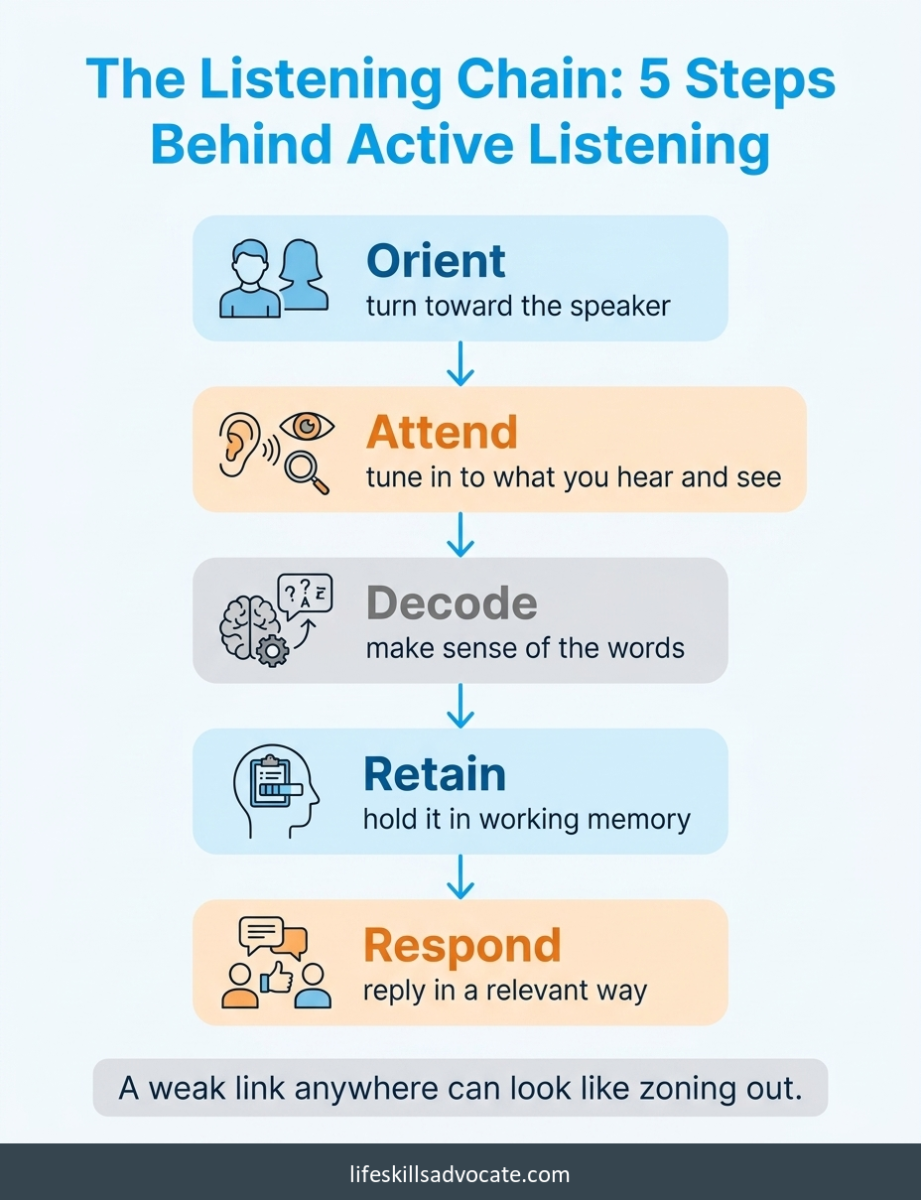
Sit with that for a second. Every time your teen joins a conversation, this chain runs in milliseconds, and it repeats hundreds of times a day when they are socially engaged.
For a lot of neurodivergent teens, each of those steps takes more effort. One 2019 study in the Journal of Speech, Language, and Hearing Research found that adults with ADHD spent measurably more cognitive effort to follow speech than their peers, even when they understood the words just as well. Tuning out is often a replacement behavior, a way to escape a situation that has become overwhelming, confusing, or low-reward.
In behavioral terms, tuning out tends to show up when:
- The listening task becomes too hard (high response effort)
- The environment is too loud or busy (competing stimuli overpower the speaker)
- The conversation lacks clear cues or predictability (weak signals about what to attend to)
- Past listening attempts were corrected, criticized, or dismissed (an aversive history)
- The teen is unsure how long they are expected to attend
Understanding these competing variables matters. It shifts the question from “Why won’t they listen?” to “What is interfering with listening right now?” That reframe sits at the heart of the common myths about motivation, where won’t-listen gets mistaken for won’t-try.
And that shift opens the door to changing the environment, clarifying expectations, and teaching listening as a concrete skill, rather than treating it as a moral failing or a personality flaw.
Your teen’s tuning out is not a character issue. It is a signal. When we read that signal correctly, we can meet it with supports that match how their brain and behavior work.
Why Conversation Burnout Happens
Conversation burnout and listening fatigue are real for neurodivergent teens, and they are a big source of ADHD zoning out. It is the moment the brain hits its limit: answers get shorter, attention slips, frustration climbs, or the teen quietly shuts down.
Conversation burnout happens when the demands of an interaction outrun the cognitive, sensory, or emotional resources a teen has available. The conversation is asking for more than the brain can comfortably give. A few features make some conversations far more likely to end in tune-out.
Duration. Long or unstructured conversations often have no clear endpoint, no predictable shape, and no sense of what “done” looks like. In behavioral terms, the effort of staying engaged rises while the payoff for doing so drops. That imbalance nudges the listener toward escape or shorter and shorter replies.
Emotional content and ambiguity. Conversations that carry disappointment, conflict, or mixed signals raise the stakes. It takes more work to listen when there is a tricky tone, an underlying message, or a stack of nonverbal cues to interpret.
History matters here too. A teen who has been corrected (“That’s not what I meant”), misunderstood, or pressured in past conversations carries that in, and it makes similar talks harder to stay with. When a talk reliably spikes emotion, it also pulls resources away from listening, which is where emotional regulation and ADHD overlap with tuning out.
Fatigue. Whatever the history, tune-out happens more when a teen is physically and mentally spent. It is hard to attend when you are tired or carrying sensory and cognitive load from school, transitions, masking, or multitasking. When your teen is already depleted, even a simple conversation can tip into burnout fast.
Naming conversation burnout for what it is changes how we respond to it. Instead of pushing a teen to “just listen better,” we can adjust the length, the structure, and the emotional load of the conversation. We can offer breaks, add written or visual support, and teach listening in short, doable bursts.
As conversations become more predictable and success becomes reachable, burnout eases and engagement grows. It is the same recovery pattern that shows up across neurodivergent burnout and recovery.
5 Ways to Help Before Your Teen Tunes Out
Now that the reasons behind tune-out are clearer, the goal shifts to preventing it in the first place. Supporting your teen’s listening starts before the conversation does. Each of these five changes lowers the effort, clarifies what to expect, or adds a reason to stay engaged, so listening gets easier before fatigue sets in.
If you want ready-made practice to pair with them, the free Adulting Like a Champ Workbook and the Active Listening Workbook both turn these ideas into step-by-step exercises for teens and young adults.
1. Modify the Environment Before You Start
Antecedent moves are the things you set up before listening begins. They are simple, and they can dramatically cut the odds of tune-out:
- Pick quieter, low-distraction spaces for important conversations
- Cut background noise you can control (TV, music, a room full of other talkers)
- Let your teen use sensory tools: fidgets, headphones, movement breaks
- Offer written or visual support alongside the spoken words
- Sit side-by-side instead of face-to-face if direct eye contact is stressful
The point of these changes is to lower the competing stimuli that pull attention away and reduce the effort of listening when other things are demanding your teen’s focus. A calmer room is part of what makes a home a genuinely sensory-friendly environment for the harder talks.
2. Use Clear, Predictable Listening Cues
During the conversation, clear and predictable cues help your teen know exactly what the listening task involves, which makes success far more likely.
- Say how long it will take: “Can I have your attention for two minutes?”
- Tell them what to listen for: “We are going to sort out the plan for today.”
- Give a quick summary up front
- Use a consistent signal that important information is coming: “Can I share something important with you?”
Over time, these small scripted lines become reliable cues that important information is on the way and that closer attention is worth it.
3. Give the Conversation a Reason That Matters
Conversations go more smoothly when they connect to something your teen cares about. It helps to understand their “why” and work it into your message.
- Explain why the conversation matters
- Start with a shared interest
- Offer a choice: “Do you want the short version or the long version first?”
- Keep a reward in mind, close to the conversation: “After we talk for two minutes, you can head back to your game.”
For a teen with a long history of conversations that went badly, this is how listening gets paired with more positive, successful experiences. It does not turn around overnight, but with repeated practice it can change how conversations feel.
4. Break Talks Into Shorter Listening Intervals
For a teen who is just building the skill, or one with a long history of tune-out, you can lower the effort of intense listening by breaking it into predictable steps.
- Share one or two sentences of information at a time
- Give chances to respond or ask questions in between
- Pause often to check in: “What did you hear so far?”
- Build up the length gradually, the way you would shape any new skill
5. Allow Breaks and Watch for Burnout
Every one of us loses the thread sometimes, and when the speaker misses those cues, a conversation can fall apart fast. Meeting that moment with a calm response instead of frustration keeps a short lapse from turning into full listening burnout.
- Normalize the pause: “Do you want a break before we keep going?”
- Stay flexible on timing, especially right after school or a stressful event
- Offer another way in for a heated conversation: texting, typing, writing, or drawing can reach the same outcome without the tune-out
Active Listening Is a Teachable Skill
The hopeful flip side of ADHD zoning out is that active listening behaves less like a fixed personality trait and more like a skill teens build over time, the same way they build time management, organization, or emotional regulation. Neurodivergent learners often do best when it is broken into small, concrete steps with clear expectations and low-pressure practice. With the right structure, they can build listening skills that carry over to school, work, friendships, and independence.
If you want a place to start together, the free Adulting Like a Champ Workbook is a 38-page guide to the everyday skills teens and young adults are building, listening among them. For focused practice on this one skill, the Active Listening Workbook goes deeper with:
- Simple, step-by-step listening exercises
- Low-pressure role plays and reflection tools
- Support for attention, working memory, and self-regulation
- Real-world scenarios (roommates, teachers, parents, bosses)
- Clear scripts for reflective listening and harder conversations
For a teen-facing place to start, the free How My Body Pays Attention exercise helps your teen notice their own attention and catch it starting to drift, which is the first step in heading off a tune-out before it takes over.
Recommended tool
It breaks active listening into small, concrete exercises, low-pressure role plays, and reflection tools, with support for attention, working memory, and self-regulation built in.
Best for: a teen or young adult who does better when a skill is broken into doable steps than when they are simply told to pay attention. (It is a $15 workbook, separate from the free one above.)
Final Thoughts
Neurodivergent teens do not tune out because they are careless or disrespectful. They tune out because listening is a demanding chain of behaviors, and when the environment is overwhelming, the task is unclear, or the emotional load is high, the brain protects itself by conserving energy.
Once you understand the behavioral science behind listening fatigue and conversation burnout, the whole dynamic changes. You shift from frustration to empathy, from correction to coaching, from “Why won’t you listen?” to “How can we make listening feel doable for you?”
Active listening is a skill built over time, not a switch that flips. And at school, the same skill shows up in an IEP as listening comprehension IEP goals. With small steps, clear supports, and the right tools, neurodivergent learners can strengthen the skills that help them connect and communicate.
Key Terms Behind ADHD Zoning Out
If you want a few lines about ADHD zoning out to share with a teacher, co-parent, or IEP team, here is the short version of the ideas above.
| Term | What it means |
|---|---|
| Listening chain | The five linked behaviors listening actually requires: orienting, attending, decoding, holding information in working memory, and responding. A weak link anywhere can stall the whole thing. |
| Response effort | How much mental work a task takes. When the effort of listening climbs higher than the payoff, the brain looks for an exit, which is what ADHD zoning out often looks like. |
| Competing stimuli | Background sights and sounds that pull attention away from the speaker. Lowering them, with a quieter room or less clutter, makes listening easier. |
| Conversation burnout | The point where a talk asks for more cognitive, sensory, or emotional resources than a teen has left, so attention drops, replies shrink, or they shut down. |
| Antecedent support | Anything you set up before a conversation starts, like naming the topic, cutting noise, or saying how long it will take, to make listening more doable from the outset. |
Frequently Asked Questions
Is ADHD zoning out on purpose, or is my teen being disrespectful?
Almost never on purpose. When a teen zones out mid-conversation, it reads like defiance, but it is usually the brain stepping off a task that got too effortful, too loud, or too unclear. Treating it as disrespect tends to make the next conversation harder, because it adds an aversive history to a skill they are still building. The more useful question is not “why won’t they listen?” but “what is making listening hard right now?”
What does ADHD zoning out feel like from the inside?
From the inside, it usually is not blank. Most neurodivergent people describe zoning out as the mind heading somewhere else, a memory, a tangent, or a plan for how to respond, rather than a mental dead space. That is the gap that trips up so many supporters: the textbook picture of “zoning out” describes how it looks from the outside, not how it feels from within.
It also tends to resist effort. People often describe trying hard to follow a teacher or a conversation and losing the thread anyway, sometimes many times in a single hour.
So when your teen with ADHD zones out, they are usually not choosing to check out. Their attention got pulled elsewhere and they could not easily pull it back. Naming that out loud (“I lost you there, want me to rewind?”) tends to land better than “pay attention.”
Does ADHD make people space out more often?
Yes. Spacing out, or drifting off attention, is a common part of ADHD, and it can happen several times an hour when a task or conversation is not holding the brain. It is a wiring pattern, not a character flaw.
How can I help my teen listen without nagging?
Start before the conversation, not during it. Cut the background noise, say how long it will take and what to listen for, and keep it short enough to finish well. Nagging adds pressure and effort to a moment that is already effortful, which usually backfires.
What works will look different for every teen, though, so treat the ideas here as a starting set to test, not a fixed formula, and expect to adjust as you learn what helps yours. A quick heads-up like “two things, then you’re free” often does more than a reminder to focus, because it shrinks the task instead of piling pressure on top of it.
Next Steps
The biggest shift is not a technique, it is the reframe: your teen’s zoning out is a signal about the listening task, not a verdict on their character. Here is where to take that this week.
- Pick one recurring conversation and change one thing. Before the next version of a talk that usually goes sideways, cut the background noise or name how long it will take. One change is enough to start.
- Name the listening task out loud. “I need two minutes on the ride schedule” tells your teen exactly what to attend to, which lowers the effort of guessing.
- Practice the skill with a structured tool. Work through the free Adulting Like a Champ Workbook together, or use the Active Listening Workbook for step-by-step listening practice.
- Consider ongoing support if the pattern runs deep. For families who want a coach in their corner, executive function coaching works on skills like this one with the teen directly. Coaching is educational and skills-focused, not therapy.
Further Reading
- Listening Effort Among Adults With and Without ADHD – Journal of Speech, Language, and Hearing Research (2019)
- The Myths of Motivation – Life Skills Advocate
- Neurodivergent Burnout: Signs and Recovery – Life Skills Advocate
- Emotional Regulation and ADHD – Life Skills Advocate
- How to Create a Sensory-Friendly Environment at Home – Life Skills Advocate
- How My Body Pays Attention (free exercise) – Life Skills Advocate
- Listening Comprehension IEP Goals – Life Skills Advocate
- Adulting Like a Champ Workbook (free) – Life Skills Advocate
- Active Listening Workbook – Life Skills Advocate
- Executive Function Coaching – Life Skills Advocate